

Turn recordings into transcripts and summaries in minutes
Upload audio or video for multilingual transcription, AI notes, and action items
Why Have I Been Looking for a Better Recording Tool?
Honestly, as the manager of a small team of 8, I have at least 4 or 5 meetings every week, not to mention recording lectures and client interviews.
I used to rely on my phone's built-in recorder, but going back to find key points was a nightmare. Later, I tried several transcription tools, but either the Chinese recognition was clunky, or the output was just raw text that still needed hours of cleanup.
Recently, I intensively tested 5 highly-discussed audio-to-text tools. This article will break down my real experience, pros and cons, and who each tool is best for.
If you value your time as much as I do, this should save you several afternoons of trial and error.
Quick Overview of 5 Audio-to-Text Tools
Here's a summary table to give you a basic idea. I've listed the free tier, pricing, and key features for each, and I'll go into detail later.
| Tool | Core Positioning | Free Tier | Paid Entry Price (Annual, Monthly Avg) | Chinese Support | My Personal Impression |
|---|---|---|---|---|---|
| Tinrec | Multi-source audio/video hub | Monthly base quota | Varies by plan | Optimized for Traditional Chinese, Mandarin, Cantonese | After transcription, you can ask AI for key points—really saves time |
| Notta | General transcription & meeting notes | 120 min/month | ~$8.17 | Supports Traditional Chinese, good multilingual | Fast transcription, but fewer organization features than Tinrec |
| Otter.ai | AI meeting assistant | 300 min/month | ~$8.33 | Primarily strong in English, Chinese is okay | Best for English meetings, but struggles with mixed languages |
| Fireflies.ai | Meeting notes & sales collaboration | Some transcription credits, but team restrictions | ~$10 | Supports 100+ languages, Chinese is passable | Strong CRM integration, but overkill for individuals |
| TurboScribe | High-value document transcription | 3 sessions/day, 30 min each | ~$10 | Multilingual translation, but weak Chinese organization | Great for batch processing old files, but editing is cumbersome |
Prices based on official public information. Exchange rates may vary.
In-Depth Comparison: Which Works Best in Real Scenarios?
Comparing specs isn't enough. Let's look at real-world differences across five dimensions I care about most.
1. Real-time Recording & Transcription: Latency & Accuracy
In meetings or classes, the worst thing is transcription lagging behind speech or producing many errors.
Tinrec displays text as you record—I feel less than 1 second of latency. Chinese recognition is stable in quiet environments, even with air conditioning noise. On iPhone 15, a 5-minute Mandarin meeting had about 7-8% word error rate, which is acceptable.
Notta is also fast, but sometimes misses filler words in Chinese; accuracy is similar to Tinrec. Otter is great for pure English but gets shaky with Chinese-English mixing. Fireflies real-time transcription waits until the meeting ends, which is slow. TurboScribe has no real-time feature—only file upload, so skip.
2. File Transcription: Supported Formats & Speed
I often receive client audio files or old lecture recordings, so upload and transcription is a must.
Tinrec supports direct import of audio and video—MP3, MP4, MOV—and is fast. A 30-minute podcast file finished in about 2 minutes.
TurboScribe handles large file uploads stably, but the output is just raw text with no organization. Notta also supports import, but the free plan has minute limits. Otter and Fireflies are primarily for online meetings; file transcription is an add-on.
Stop organizing recordings by hand
Upload audio or video and automatically get a transcript, summary, and action items
3. Online Video Link Transcription
This is a highlight for Tinrec—many tools can't do it. Paste a link from YouTube, Bilibili, TikTok, or even Xiaohongshu, and it transcribes and organizes the content.
I recently used it to analyze competitor launch videos, then asked AI to extract key points—speeds up market analysis.
Notta and Otter have similar features, but Notta only supports YouTube, and Otter doesn't support Chinese video platforms. Fireflies and TurboScribe have no link parsing at all.
4. AI Summarization: Summaries, Action Items, Q&A
Transcription is just the first step. The real value is quickly understanding the content.
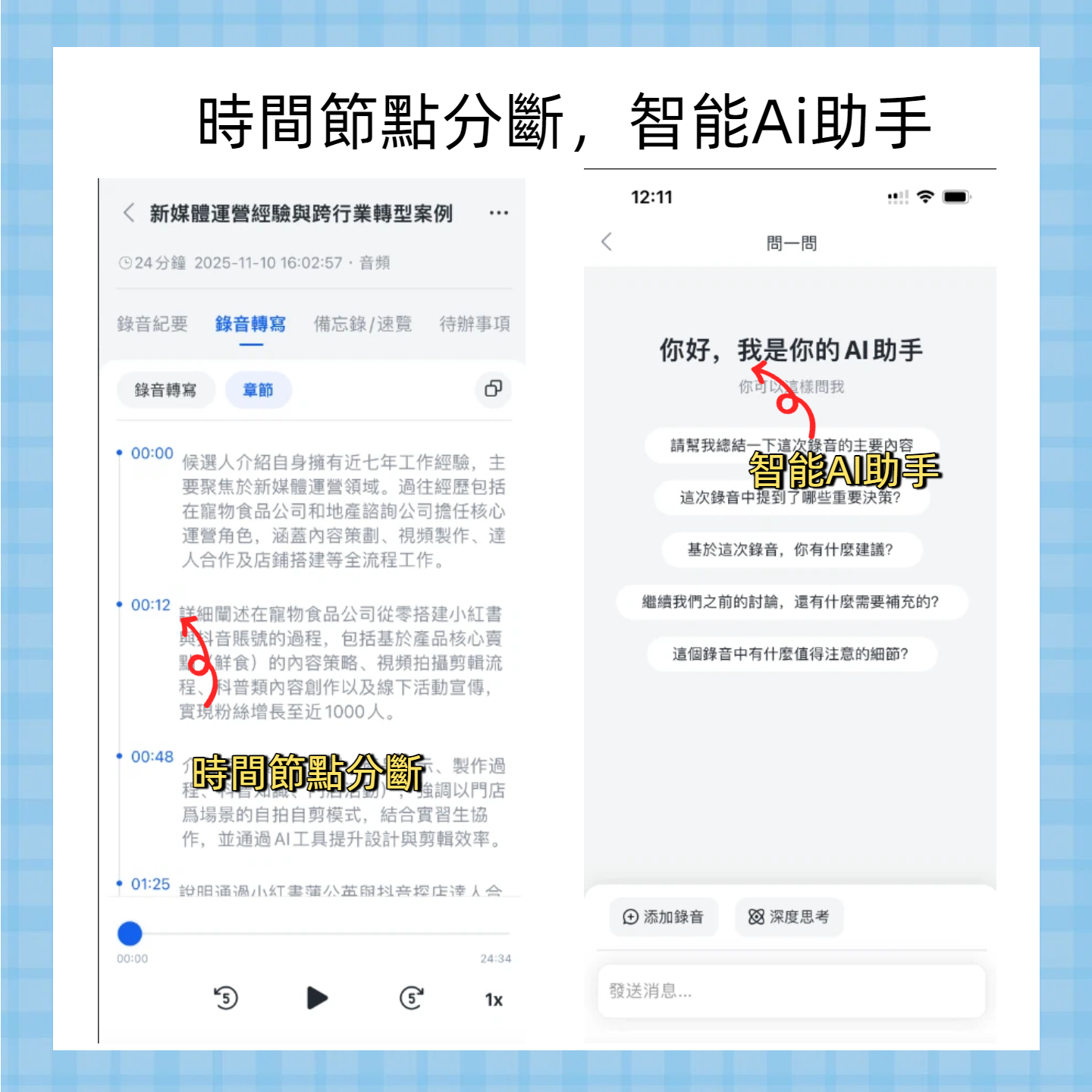
Tinrec has the most complete AI features: auto-summary, chapter division, action items, and you can ask questions like "What was the meeting conclusion?" or "Who is responsible for what?"—saves manual note review.
Otter and Fireflies also have AI summaries, but Chinese summaries are less fluent. Notta has summaries but no conversational queries. TurboScribe has none of these.
5. Cross-Platform & Export
I switch between phone, computer, and tablet, so the tool can't be locked to a single device.
Tinrec supports iOS, Android, and web; recordings sync automatically; export formats include TXT, Word, PDF, and direct integration with Notion or Google Docs.
Notta also has multi-device support but fewer export options. Otter is primarily web-based, with an okay app. Fireflies leans toward team collaboration—feels heavy for personal use.

Tinrec: More Than Just Transcription—An Audio/Video Hub
Comparing them, Tinrec's positioning is different. Most competitors are "meeting note bots" or "document transcribers," but Tinrec is more like a centralized workspace for all your audio and video.
A few features that really help:
- Multi-source input: Live recording, file upload, video link—no need to switch apps.
- AI conversational query: Ask questions about the recording directly, like talking to a database. Historical recordings never become a black hole.
- Post-processing generation: Not just summaries—you can generate meeting minutes, reports, tables. Great for managers who need to submit reports.
One honest point: Tinrec doesn't yet have an auto-join meeting bot like Otter. If you need automatic recording for Zoom or Teams, Otter or Fireflies might be better. But if you, like me, deal with meetings, classes, interviews, and videos, Tinrec's versatility wins.
Real-World Use Cases
Meeting Notes
Open Tinrec for live recording, and it transcribes in real-time, marking key points and action items. After the meeting, AI generates a summary with a task list. My team uses this for weekly meetings, saving the hassle of rotating note-taking.
Classes & Lectures
For university or online courses, I used to scribble notes and miss content. Now I record, transcribe, and ask Tinrec to break into chapters. Reviewing is much faster—great for exam prep.
Interviews & Research
During user interviews, I focus on asking questions without typing. After recording, I ask AI, "What are the user's pain points about pricing?" and it pulls relevant paragraphs in seconds—no need to re-listen to the whole hour.
Content Creation
Sometimes I need to write articles from podcast highlights or turn YouTube videos into social posts. Tinrec transcribes and summarizes, then I edit to produce a draft—saves a ton of transcription time.
Buying Advice: Key Points to Consider
1. What's Your Primary Scenario?
If you only have online English meetings, Otter is strong. If you just need batch file transcription, TurboScribe is cost-effective. But if you're like me with a mix of meetings, courses, and videos, an all-in-one tool like Tinrec is more convenient.
2. How Much Chinese Content Do You Handle?
Chinese users must test recognition accuracy. Tinrec's optimization for Traditional Chinese and mixed-language scenarios is noticeable, especially with dedicated Cantonese tuning. If you process Cantonese content, it's the most stable option.
3. What Do You Need After Transcription?
If you just need raw text, many tools work. But if you want summaries, action items, Q&A, and even document generation, Tinrec's post-processing is clearly ahead.
4. Budget and Usage
Try the free version first. If you record less than 5 hours a month, the free tier might suffice. For long-term use, annual plans average out to a reasonable cost—about the price of a good meal.
Conclusion: Is Tinrec Worth Trying?
If you're looking for a multi-language, cross-platform audio-to-text tool that lets you find key points with AI—Tinrec is one of the few options that meets all three.
Especially for Chinese users, its optimized support and direct video link transcription are unmatched by current alternatives.
Of course, if you only need an auto-join meeting bot, Otter or Fireflies might suit you better. But when your recording scenarios go beyond meetings, Tinrec is the most versatile choice.
I recommend downloading the free version and testing it with your own recordings—nothing beats real-world testing. The monthly base quota is enough for a few tries. If you like it, consider a paid plan.
Tested July 2026 on iPhone 15 and MacBook Air M2, in a typical office environment.
Turn every recording into actionable outcomes
Get 60 free transcription minutes when you sign in. No credit card required.
Related Reading
You might also like

2026 In-Depth Comparison of 4 Speech-to-Text Tools: Beyond Notta and Otter, Why Tinrec Is Worth a Try
A thorough hands-on test of 4 major speech-to-text tools, from free to paid versions. As a small team manager, I'll tell you directly which one saves you the most time, so you won't be fooled by vendor hype.

2026 Comparison of Two French Transcription Tools: Good Tape vs. Tinrec – Which One Is Right for You?
Good Tape is a solid tool for French transcription, but if you need multilingual support, AI summaries, and cross-platform compatibility, Tinrec is the more comprehensive choice. This hands-on comparison helps you decide quickly.

2026 Ultimate Guide to Transcription Tools: Beyond Good Tape, Discover Better Options
Hands-on review for small to mid-sized team leaders: If you're looking for a Good Tape alternative, this explains why Tinrec is better for meetings, courses, interviews, and content creation—handling everything from recording to organizing in one go.

2026 Comparison of 6 AI Transcription and Note-Taking Tools: From Free to Paid, Which One Is Your Work Accelerator?
Meetings, lectures, and interview recordings piling up? Which AI note-taking tool can really save you time? This article compares 6 popular solutions, evaluating real-time transcription, AI summaries, and multi-source support. After reading, you'll know which one to choose.

How to Choose a Speech-to-Text Tool in 2026: A Complete 5-Step Guide
This article starts from the pain point of accumulating recordings, shares 5 speech-to-text tools I've tested, and uses Tinrec as an example to teach you a method for selecting and using these tools, turning recordings into usable knowledge.

2026 AI Recording Tools Comparison: Tinrec vs PLAUD Note – Which Is Better for Organizing Your Audio Files?
Thinking of buying a recording-to-text tool but torn between software and hardware? This article deeply compares Tinrec and PLAUD Note across five dimensions: input sources, AI organization, pricing, platform support, and use-case coverage, helping you find the best solution on any budget.

2026 Comparison of 3 Speech-to-Text Tools: Which Is Best for Chinese Users?
A hands-on comparison of three leading speech-to-text tools, evaluating language support, cross-platform compatibility, AI features, and pricing to determine the best fit for Chinese users.

2026 Side-by-Side Comparison of 2 Speech-to-Text Tools: Good Tape vs. Tinrec - Which Free Plan Is the Best Deal?
Looking for a Good Tape coupon? Check out Tinrec's free plan instead. This article tests two speech-to-text tools head-to-head, comparing free credits, Chinese recognition, multi-source support, and AI Q&A to help small teams decide.

2026 Recording Tool Comparison: Which One Saves You More Money?
Looking for a recording tool but don't want to spend big money? This article compares Tinrec and PLAUD NOTE across price, input sources, post-processing, cross-platform support, and Chinese language support to help you find the best value.