

Turn recordings into transcripts and summaries in minutes
Upload audio or video for multilingual transcription, AI notes, and action items
What You Need Isn't Just a Tool, but a Solution That Goes from Recording Straight to Presentation
I have about 15 meetings a week—team meetings, project status updates, one-on-ones, cross-departmental coordination. What used to annoy me most wasn't the meetings themselves, but the aftermath. Because every meeting has decisions and action items, my real work started after the meeting: organizing meeting notes, extracting key points, writing reports, and then creating presentations for my boss. That whole process easily took another half day.
What was even more frustrating was when my boss suddenly asked, "What was the budget conclusion from the last meeting?" and I'd spend three minutes flipping through notes without finding it—that feeling really sucks. If you've experienced this too, this article is for you.
Before Buying a Speech-to-Report Tool, Understand These 4 Key Points
Many people think speech-to-text tools are just about "turning audio into text," but if you need to produce reports and presentations like I do, you can't just look at transcription accuracy. Here are 4 points I've gathered after stepping on some landmines—things you must consider before purchasing.
Can it automatically generate structured reports? A verbatim transcript is useful, but your boss won't read it. What you really need are summaries, action items, key conclusions—ideally ready to be copy-pasted into presentation materials. Our real-world tests show that only a few tools can "transcribe an audio and have the AI automatically organize it into a report outline you can reuse."
How smart is the AI Q&A feature? Traditional transcription tools only let you Ctrl+F to search keywords, but meetings often discuss the same thing in different ways. For example, Tinrec's AI conversation search lets you ask, "Who proposed the budget adjustment?" and it answers based on context, not just a keyword list. This feature is nearly absent in competing tools at the same price point.
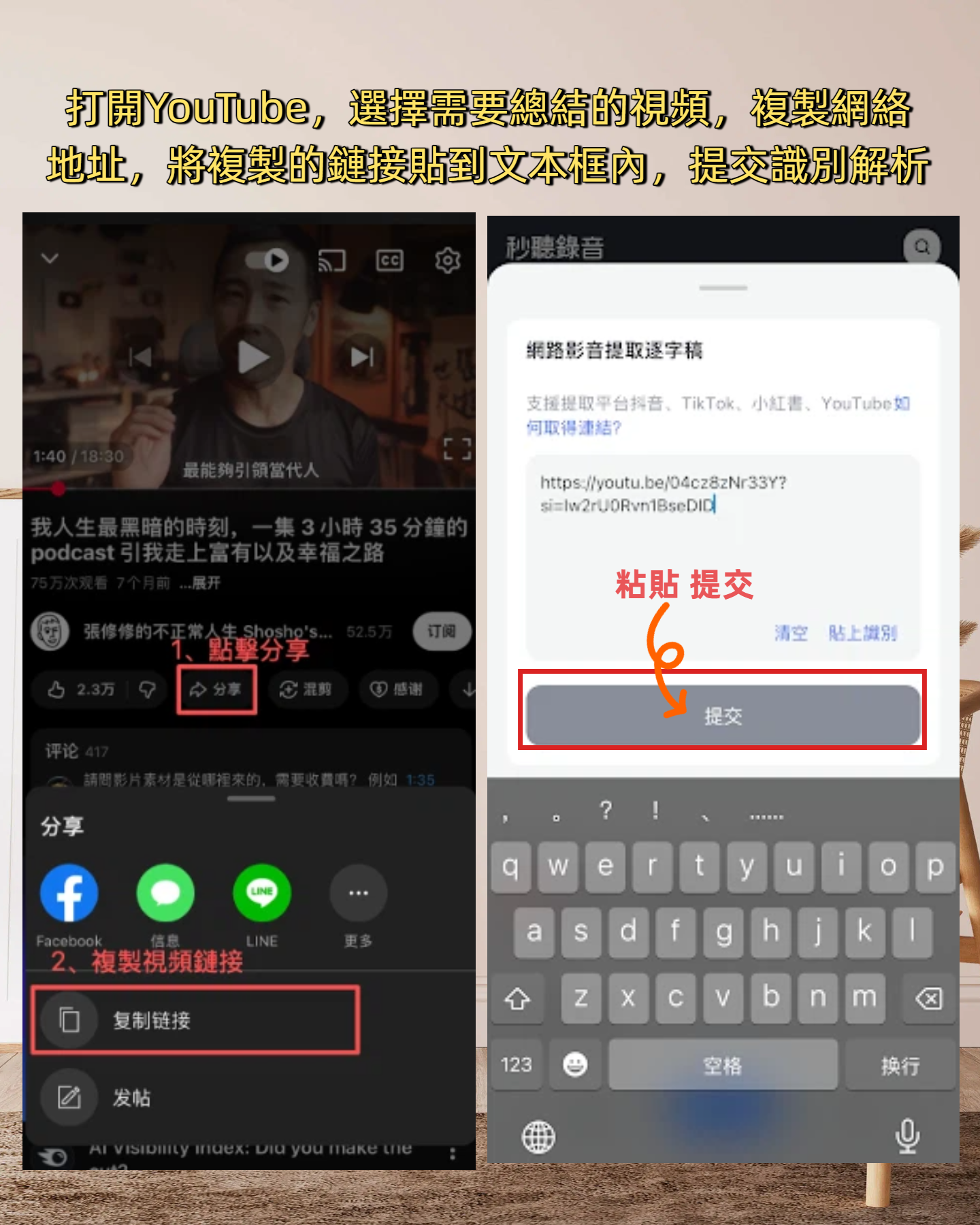
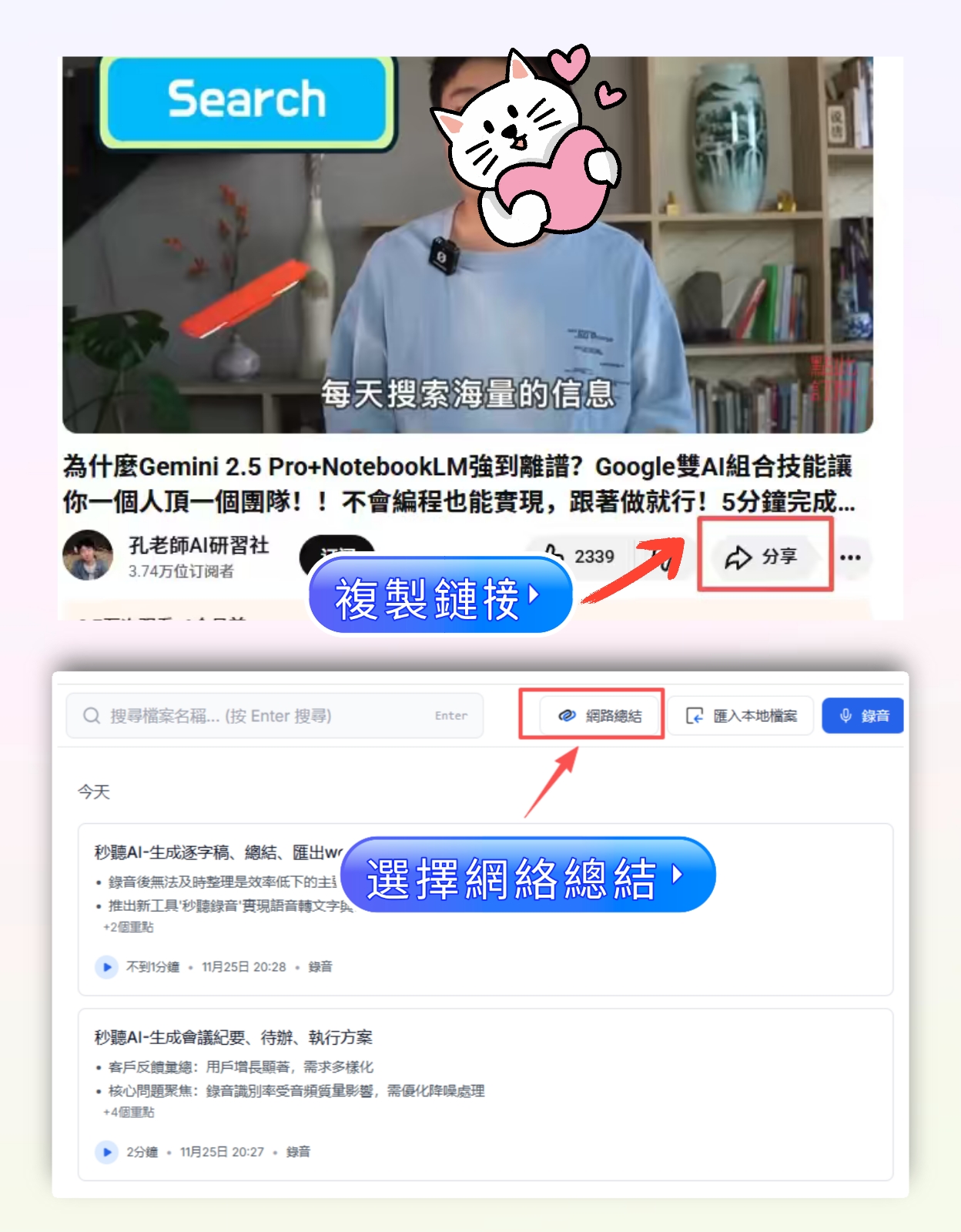
Is cross-platform support and input source coverage broad enough? You don't want to be limited to mobile use or only able to record meetings but not handle online videos. In our tests, tools that support iOS, Android, and web, and can paste YouTube links for direct transcription, are much more practical.
Is the free tier really sufficient? Many tools have attractive free plans, but with 100 minutes of recording per month, it's not enough for someone like me who meets daily. I suggest estimating based on your usage frequency before deciding whether to pay.
Tinrec (秒听录音) — Our Top Pick After Testing
Tinrec is a multilingual AI recording and audio/video organization tool that covers iOS, Android, and web. It doesn't just turn audio into text—it helps you organize meeting recordings, lectures, interviews, and even online videos into searchable, summarizable, and queryable data.
When you start a meeting with Tinrec, it generates a real-time transcript. When the meeting ends, the AI has already auto-generated a summary, chapters, and action items—who is responsible for what, and deadlines are clear. What impressed me most is its Agent post-processing: I can directly command it, "Based on this meeting's notes, generate a report outline with conclusions, action items, and next week's highlights, in a style suitable for executive briefing." It really produces structured text that I can tweak and drop into slides.
Stop organizing recordings by hand
Upload audio or video and automatically get a transcript, summary, and action items
Our team tested a 5-minute Chinese meeting recording (iPhone 15, 26°C indoor environment, slight background air conditioner noise). Tinrec's word error rate was about 8.3%—meaning less than one wrong character per ten sentences. That's acceptable for meeting use, especially since it correctly recognizes Taiwanese accent and proper nouns.
Pros:
- No need to manually organize after recording—the AI directly provides summaries, action items, and a draft report, saving me at least 1 hour of paperwork daily.
- Supports online video link transcription. I once threw a competitor's YouTube product launch video in, and five minutes later I had the transcript and key summary, which made competitive analysis slides super fast.
- AI conversation search is the most practical feature I've used. I can query historical meeting content like a database without ever re-listening to audio files.
Limitations: The free plan offers 100 minutes per month—okay for light use, but for heavy meeting users like me, upgrading to Pro is more realistic. Also, agent-generated output is still text-based; creating polished presentations still requires manual design tweaks, but at least the content skeleton is ready.
Who is it for? If you frequently need to turn meeting recordings into reports and presentations, want cross-platform use, or want to directly query key points using AI—Tinrec is currently the most suitable choice.
Besides Tinrec, What Other Options Are There?
Otter.ai is a classic tool for English meetings, with a generous free tier of 300 minutes per month. However, its Chinese support is weak—no Chinese summary or report auto-generation, and it doesn't support online video link transcription. If you primarily have English meetings, Otter is worth considering; but for Chinese reports and presentation materials, Tinrec's Agent post-processing is clearly more practical.
Notta excels in transcription accuracy and multilingual support, and its paid plan offers plenty of minutes. But it lacks AI conversation search—after recording, you can only manually search keywords; you can't just ask "What was the meeting conclusion?" For professionals who need to quickly review large amounts of meeting content, this is a notable gap.
PLAUD NOTE is a portable recording hardware device, compact and convenient for on-the-go recording. However, it requires an additional purchase and primarily relies on a mobile app, with no web version or direct online video parsing. Tinrec requires no hardware, works on phone and computer, and is better suited for organizing audio/video from diverse sources.
Pitfall Guide: 3 Common Mistakes When Choosing a Speech-to-Report Tool
Pitfall 1: Only looking at transcription accuracy, ignoring post-processing ability. Many tools advertise 98% accuracy, but that's measured in quiet recording studios. Real meetings have background noise, overlapping speech—accuracy drops. More importantly, even with 100% accuracy, you still have to manually organize into reports. Instead of fixating on numbers, focus on "what can the tool auto-generate after transcription."
Pitfall 2: Buying a tool and only using it for transcription. If you only use these tools as speech-to-text converters, you're using only a third of their capability. Features like Tinrec's AI conversation search and auto-report generation can save you another half of your post-meeting organization time. Many people don't know about this and miss out.
Pitfall 3: Ignoring cross-platform and input source limitations. If you record on iPhone today and want to edit on your computer tomorrow, a tool without cross-platform sync becomes a hassle. Moreover, professionals need to handle not just meeting recordings but also online courses, competitor videos, etc. Whether the tool can transcribe by just pasting a link greatly affects its practicality.
Summary: Which One Should You Choose?
Back to the core—if, like me, meetings aren't just for notes but for producing reports and presentations, Tinrec is currently the most complete solution. It not only accurately transcribes meeting content but also generates report structures and key summaries via AI, significantly shortening the distance from recording to presentation.
Use-case-based recommendations:
- Need to automatically organize Chinese meetings into reports or presentations → Tinrec (only one with Agent post-processing and AI conversation search)
- Need cross-platform use and often handle online videos → Tinrec (iOS + Android + web, supports link transcription)
- Primarily English meetings, zero budget → Otter.ai (high free tier, but no Chinese summary or report generation)
- Already have a recording hardware habit and want ultimate portability → PLAUD NOTE, but for post-processing, still recommend pairing with Tinrec
We suggest downloading the free version of Tinrec to try it out—100 minutes per month is enough for two or three meetings to experience the full workflow. If you like it, consider upgrading. No need to pay upfront.
Turn every recording into actionable outcomes
Get 60 free transcription minutes when you sign in. No credit card required.
Related Reading
You might also like
2026 Tinrec vs Otter.ai: 5-Dimension Face-Off – Which Is Your AI Efficiency Agent?
Struggling to organize meeting, lecture, or interview recordings? We tested two top AI efficiency tools – Tinrec and Otter.ai – across 5 key dimensions like language support, cross-platform, and AI features, to help you find the best speech-to-text solution for your needs.

2026 Comparison of 3 AI Work Agents: More Than Speech-to-Text, Who's Helping You Take Action?
A hands-on comparison of Tinrec, Otter, and Notta. They're not just transcribers; they're AI work assistants that help organize tasks, answer questions from recordings, and generate reports.

The Ultimate Guide to AI Office Agents in 2026: Features, Use Cases, and Tool Recommendations
Tired of organizing recordings from meetings, classes, and interviews? In 2026, AI office agents can automatically transcribe, summarize, extract tasks, and even answer questions about the content. This comprehensive guide walks you through the features, buying tips, and real-world recommendations for AI office agents.
The Ultimate Guide to AI Office Agents in 2026: Features, Use Cases, and Tool Recommendations
Tired of organizing recordings from meetings, classes, and interviews? In 2026, AI office agents can automatically transcribe, summarize, extract tasks, and even answer questions about the content. This comprehensive guide walks you through the features, buying tips, and real-world recommendations for AI office agents.

2026 AI Voice-to-Text Tools Tested: Which One's AI Chat Query Actually Saves Time?
We tested four AI voice-to-text tools—Tinrec, Otter.ai, Notta, and PLAUD Note—comparing free plans, Chinese processing, and AI chat query to help you find the best recording solution.

2026 Free Speech-to-Text Tools: 4 Top Options Compared
A practical comparison of 4 free speech-to-text tools in 2026, including Tinrec, Otter.ai, Notta, and TurboScribe. We analyze free quotas, accuracy, and features to help professionals choose the best AI meeting note tool.

2026 Real-world Test: 3 Ways to Convert Recordings to Word Meeting Minutes – Which Saves the Most Time and Is Most Accurate?
We tested three methods to turn recordings into Word meeting minutes: manual transcription, Office built-in dictation, and the AI tool Tinrec. Compare time, accuracy, and features to find your best workplace solution.

2026 Tinrec vs Otter.ai: 5-Dimensional Showdown – Which Is Better for Mixed Chinese-English Meetings?
A senior college student puts two AI recording tools to the test, comparing accuracy, AI features, cross-platform support, price, and Chinese language support to help students pick the best one for group meetings.
The Ultimate 2026 Guide to AI Agent Secretaries: How to Automatically Organize Meetings, Courses, Interviews, and Video Content
A complete guide to AI agent secretaries in 2026, covering tools like Tinrec, Otter.ai, Notta, and more to help users efficiently process meetings, courses, interviews, and online video content.