

Turn recordings into transcripts and summaries in minutes
Upload audio or video for multilingual transcription, AI notes, and action items
Last month I attended a two-day workshop with intensive lectures and group discussions. I kept recording throughout.
When I got home, staring at nearly ten hours of audio files on my phone, I had zero motivation to open them.

Because I knew that just listening through and taking notes would take several workdays.
I've tried feeding recordings to generic transcription tools before, only to get long, messy transcripts where I still had to hunt for the key points.
It wasn't until I started using Tinrec to organize these training recordings that I truly turned those audio files into material I could review and search.
But some might ask, what about AI recording hardware like Plaud Note? Isn't it more convenient?
So this time, I used my own training recordings to compare these two tools and see which one is better for people like me who want to actually make use of training content.
Tinrec vs Plaud Note: Quick Overview
Plaud Note is a lightweight AI recording hardware that emphasizes portability and long battery life. After recording, it transcribes and summarizes via the mobile app.
Tinrec, on the other hand, is a cross-platform AI recording and audio/video organization tool. It not only records in real time but also handles files and online videos, providing deeper AI understanding and export options.
| Item | Tinrec | Plaud Note |
|---|---|---|
| Category | AI recording and audio/video workstation | AI recording hardware |
| Platform | iOS, Android, Web | Hardware + mobile app |
| Input sources | Real-time recording, audio/video files, web links | Hardware recording |
| Core post-processing | AI summaries, chapters, tasks, Q&A, export | AI summaries, templates |
| Pricing model | Free tier + subscription | Hardware cost + subscription |
Next, I'll dive into a detailed comparison across five practical dimensions to see which one is the better choice for organizing training recordings.
Dimension 1: Diversity of Recording Sources
Training formats are no longer limited to physical classrooms.
Online courses, pre-recorded videos, YouTube tutorials, and even Zoom meeting recordings have all become learning materials.
Plaud Note's design logic is simple: it's a recording device; you must carry it with you and press the record button.
So it's powerless when faced with mp3 files already on your computer or online videos you want to organize.
(Screenshot: Tinrec's "web video link parsing" feature, where entering a YouTube URL directly shows the transcript and AI summary.)
Tinrec's approach is different.
It's not just a recording device; it's more like an audio/video hub.
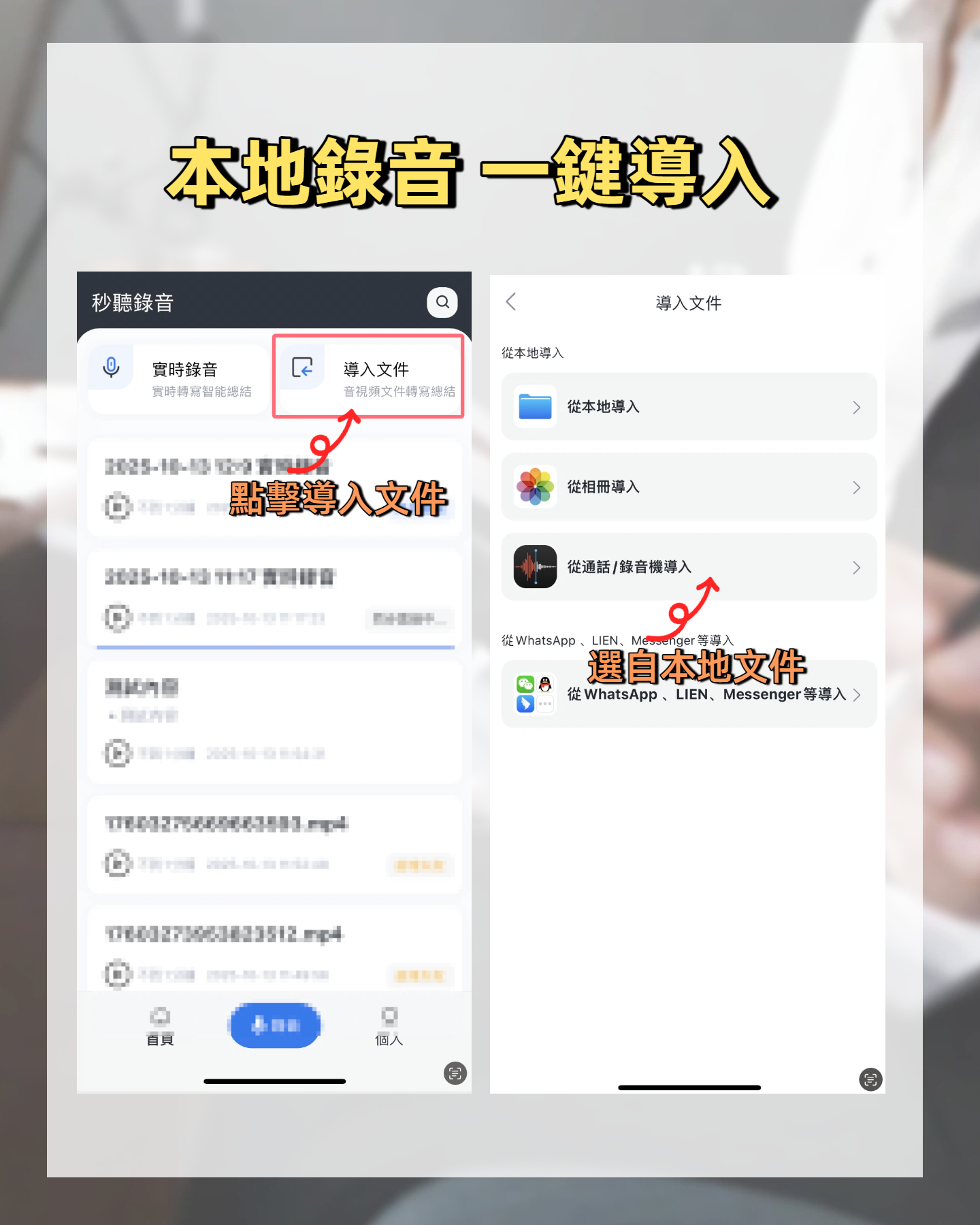
Besides real-time recording, I can directly upload previously saved audio or video files, and even paste public video links. It automatically fetches the content and transcribes it.
In other words, all training materials scattered in different places can be organized in one place.
→ Verdict: Tinrec clearly wins, better suited for modern blended learning needs.
Dimension 2: Chinese Transcription Accuracy
Training sessions often mix Chinese and English, contain technical jargon, and include the instructor's speaking habits.
In the same workshop, I recorded the same 15-minute lecture with both Plaud Note and Tinrec.
Plaud Note's Chinese recognition is decent in quiet environments, but as soon as the instructor mixes in English words or speeds up, the error rate noticeably increases.
(Screenshot: Tinrec's real-time transcription correctly labels terms like "Empathy Map" and "customer journey" in the transcript.)
Stop organizing recordings by hand
Upload audio or video and automatically get a transcript, summary, and action items
Tinrec is clearly tuned for Chinese content.
It not only correctly identifies English words that pop up but also captures common training terms (like "ORID Focused Discussion Method").
Of course, any transcription tool is affected by recording quality, but based on my training files this time, Tinrec's transcript is much more reliable, and the cost of subsequent editing is lower.
→ Verdict: Tinrec wins, offering higher transcription quality in Chinese environments.
Dimension 3: AI Organization and Post-Processing
Transcription is just the first step; the real value lies in turning long recordings into something usable.
Plaud Note's app automatically generates summaries and has some meeting templates, but basically it stops at "telling you what the recording is about."
But I need more than that.
After training, I need to know: what sections was this class divided into? What are the key points of each section? What action items did the instructor give?
(Screenshot: Tinrec's AI query feature, asking "What are the three key steps covered in this lesson?" and the AI directly answers with timestamps.)
Tinrec takes post-processing to a much higher level.
Besides summaries, it automatically segments chapters, extracts tasks, and lets me ask questions about the recording as if querying a knowledge base.
I can directly ask, "What are the three levels of time management the instructor mentioned in the second section?" It will find the answer from the recording.
Moreover, the organized results can be exported to Word, PDF, or synced to Notion, directly becoming my training report or review notes.
→ Verdict: Tinrec wins big, turning recordings into continuously usable knowledge assets.
Dimension 4: Cross-Platform Support and Convenience
Plaud Note's hardware is compact, but that also means it's an extra device.
When attending training, I already bring my phone, laptop, and charging cables. Adding a recording device to look after sometimes leads to forgetting to charge it or forgetting to bring it.
Tinrec lives directly in my existing devices.
It's available on phone, computer, and web, with data syncing. I can record a meeting on my phone and continue organizing on my computer.
(Screenshot: Tinrec cross-platform sync, showing the same recording list and processing status on both the mobile and web versions with the same account.)
In daily use, I'm already used to recording with my phone, so Tinrec starts with almost zero extra burden.
→ Verdict: Tinrec wins, better aligning with the multi-device workflow that knowledge workers are already used to.
Dimension 5: Price and Long-Term Investment
Plaud Note requires an upfront hardware cost (currently around US$179), plus a monthly subscription for more transcription hours.
For those who only occasionally want to transcribe training recordings, this upfront investment is a bit high.
Tinrec's entry barrier is much lower.
The free tier offers basic transcription credits, allowing you to try it out first.
If training is intensive during a period, a one-month Pro subscription can get you through. For long-term use, the annual fee is more affordable than maintaining hardware plus a subscription.
→ Verdict: Tinrec wins, with more reasonable costs for light to moderate training recording needs.
What Are Their Unique Advantages?
Tinrec's Unique Advantages
- Broadest source coverage: real-time recording, file uploads, web video links—three input types in one.
- From transcription to understanding: AI summaries, chapters, tasks, Q&A—making recordings more than just walls of text.
- Seamless cross-platform: phone, computer, web—edit across devices immediately after recording.
- Economic flexibility: no hardware needed, free tier available, affordable paid plans.
Plaud Note's Unique Advantages
- Long battery life for independent recording: ideal for long in-person classes without worrying about phone battery or notification interruptions.
- Intuitive hardware feel: one-button recording, friendly for those not used to mobile apps.
Conclusion: Which Should You Choose?
- If 90% of your training is sitting in a classroom listening and you want a dedicated recording device, Plaud Note is still worth considering.
- But if you're like me—your learning channels are no longer limited to in-person sessions; sometimes it's online classes, sometimes it's video links shared by colleagues, sometimes meeting recordings—you don't need another recording device. You need a workstation that can capture all audio/video materials and organize them into usable content.
- In terms of Chinese transcription quality, depth of AI post-processing, and cross-platform convenience, Tinrec clearly aligns better with the reality of modern knowledge workers.
Instead of spending money on hardware first, I recommend downloading Tinrec's free tier and testing it with a training recording you have on hand.
That's how I started—and then I realized that making recordings truly useful isn't that hard.
Test it step by step, and you can gradually build your own training recording knowledge base.
Turn every recording into actionable outcomes
Get 60 free transcription minutes when you sign in. No credit card required.
Related Reading
You might also like

2026 Free Lawyer Meeting Notes Plans: One Tool to See It All
A lawyer's work involves meetings, client discussions, and various recordings. This article introduces Tinrec, a free and easy-to-use AI recording and meeting notes tool that supports real-time transcription, AI summaries, and action item extraction, saving you hours of organizing time.

2026 Tinrec vs PLAUD Note: 5-Dimension Showdown – Can Software Beat Hardware?
2026 AI voice recorder comparison: Compare popular hardware PLAUD Note with software tool Tinrec across features, use cases, and cost. Find the best audio and video transcription solution for your needs.

Tinrec vs Notta 2026: A 5-Dimension Showdown for Writers' Voice Input
In-depth Tinrec vs Notta comparison for 2026, evaluating five dimensions: Chinese recognition, editing features, export formats, pricing, and AI Q&A, to help you find the best voice input tool for writers. Includes full usage guide and FAQs.

Best English Speech-to-Text App for International Students? 2026 Review of 3 Apps, Found the Perfect One for Class
Can't keep up with fast English in class? We tested multiple speech-to-text apps and show how Tinrec can easily convert lecture recordings, online courses, and group discussions into text notes. AI automatically organizes key points and to-dos, and you can ask questions anytime to review. Save time and study easier.

How to Convert Legal Recordings to Text in 2026: A 5-Step Guide
Essential for lawyers and legal professionals! This guide shows you how to use Tinrec to quickly transcribe legal recordings, meeting discussions, and interview content into transcripts, with automatic summaries and task extraction to save you hours of paperwork.

2026 Free Therapy Recording Solutions: One Tool at a Glance
How to make therapy recordings safe and efficient? This article covers one free solution—from real-time transcription, AI summaries, to task extraction—showing you step by step how to turn session recordings into searchable, actionable knowledge with Tinrec.

5 Subtitle Generation Tools for Content Creators Compared (2026): Free vs. AI Automation – Which Saves the Most Time?
Adding subtitles is the most time-consuming part of video creation for content creators. This comparison reviews 5 mainstream subtitle generation tools, including free editing software, online AI platforms, and professional transcription services, to help you choose the best solution for accuracy, multilingual support, and editing efficiency.

2026 Comparison of 4 Conference Call Transcription Tools: Which One Handles Cantonese Best?
Tired of spending hours after meetings transcribing recordings? We tested 4 transcription apps, and Tinrec's Cantonese transcription and AI features stood out, helping you save overtime.

2026 Free Audio-to-Text Solutions for Content Creators: 3 Methods at a Glance
Starting from practical methodologies, this article outlines three free speech-to-text solutions for content creators, using Tinrec as an example to demonstrate how to turn interviews and videos into searchable, summarizable, and exportable content assets, complete with copy-paste AI prompt templates.