

Turn recordings into transcripts and summaries in minutes
Upload audio or video for multilingual transcription, AI notes, and action items
A few days ago, a friend who runs a YouTube channel messaged me, sounding exhausted. "I spent the whole night transcribing the latest interview verbatim. My eyes are killing me."
I've heard this kind of complaint countless times in my productivity consulting work over the past few years.
But the problem has never been "no tools."
It's using the wrong approach.
There are plenty of free audio-to-text solutions out there, but the key is how to turn audio into truly useful content, not just text.
In 2026, I have a few go-to free strategies, from fully manual to AI-assisted. Here's a rundown for you.
Why Content Creators Need Smarter Audio-to-Text Tools
Content creators often find themselves recording interviews, jotting down notes, and then replaying the audio to transcribe it later.
But time is never on our side.
What you need isn't just a transcript; it's "content material" you can directly use to write articles, craft headlines, or create short videos.
In other words, an ideal audio-to-text tool must do three things:
- Convert speech into editable text
- Automatically extract key points, sections, and action items
- Let you ask questions about the audio content like a database
Only then can you turn interviews, courses, meetings, or even online videos into a creative accelerator.
2026 Free Audio-to-Text Solutions for Content Creators: 3 Methods at a Glance
I've tested various methods, from basic to advanced, and organized them into three entry-level free options.
Method 1: Fully Manual Free Workflow — Phone Recording + Manual Transcription
This is the most cost-effective starting point.
Open your phone's built-in voice recorder, place it next to you during the interview, and hit record.
After recording, put on your headphones, replay the audio, and type it out yourself.
Pros: Zero budget, immediate start.
Cons: Very time-consuming.
For a 30-minute interview, transcribing and proofreading can take a beginner 2-3 hours.
Plus, you can easily miss tonal shifts or spontaneous quotable lines.
If you're just starting out and your output is low, this method works in a pinch.
But in the long run, the time cost will eat up your creative energy.
Method 2: Online Transcription Services with Free Tiers
Some online speech-to-text platforms offer a fixed amount of free transcription minutes per month.
Upload your audio file, and they'll automatically generate a transcript.
This is much easier than manual transcription.
However, most free plans have significant limitations:
- Low monthly minutes; may only be enough for 1-2 episodes
- Limited functionality — usually just plain transcription with no post-processing
- Some require linking to a specific platform, reducing flexibility
If you only need occasional transcription and don't care about further organization, these services can serve as a lightweight aid.
But as a regular part of content production, you'll quickly hit a wall.
Method 3: Tinrec — Not Just Transcription, But Turning Audio/Video into Usable Content (Free Tier: 100 Minutes per Month)
This is the solution I recommend most often to my students.
Tinrec's free version offers 100 minutes of basic transcription per month.
The key is, it doesn't just give you a transcript.
It also auto-generates summaries, chapters, action items, and even lets you ask AI questions about the recording.
In short, Tinrec packages the entire workflow — record → transcribe → organize → export — into a reusable process.
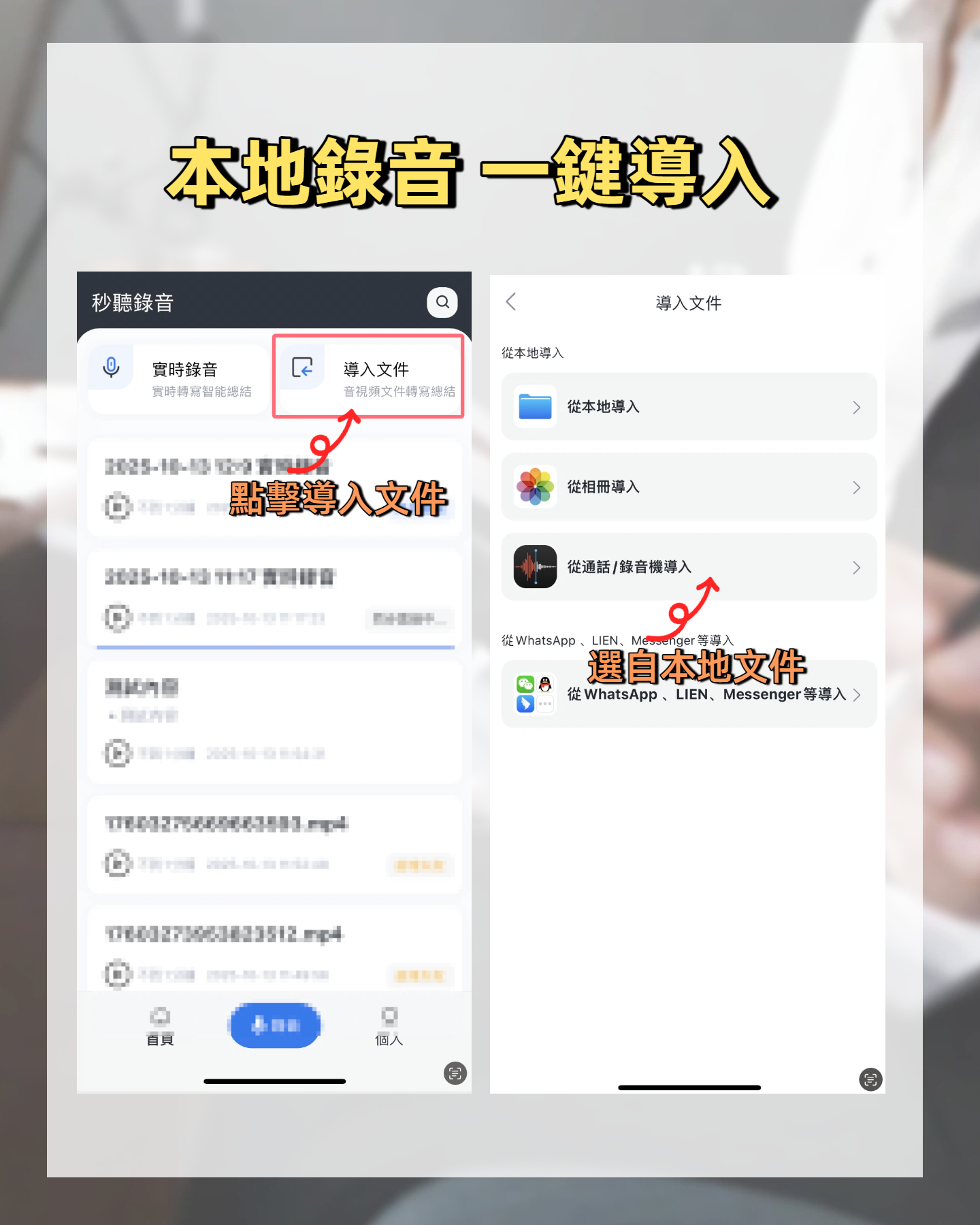
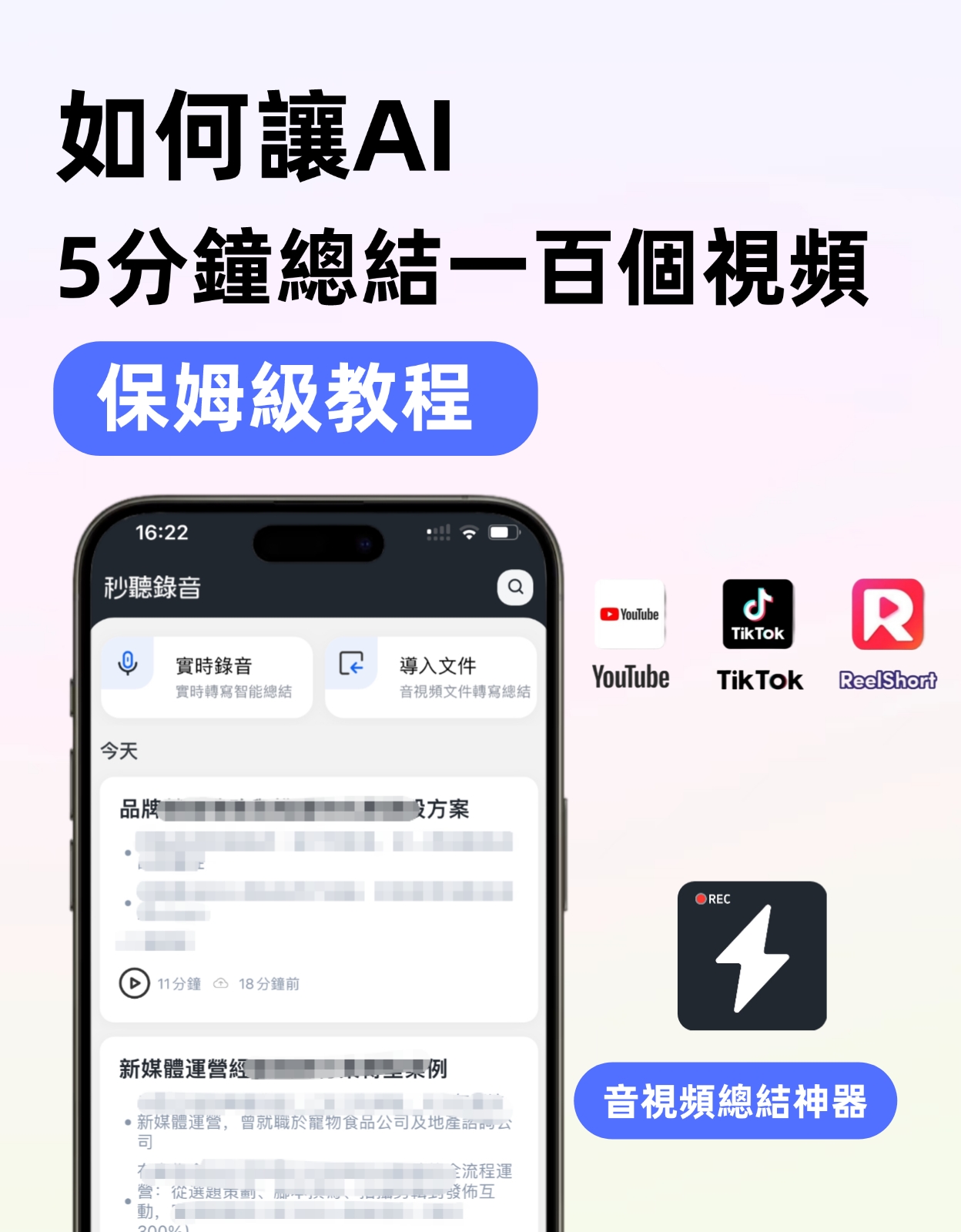
You can record live with your phone, import local audio files, or paste a link to an online video (YouTube, TikTok, etc.).
It's ideal for content creators who need to handle large volumes of interviews, courses, or idea recordings.
The free 100 minutes are enough to transcribe 3-4 podcast episodes or several short videos each month.
Stop organizing recordings by hand
Upload audio or video and automatically get a transcript, summary, and action items
(Screenshot: Tinrec main interface showing three input methods: live recording, import file, paste link)
How Tinrec Helps Creators Turn Audio/Video into Content
Let me walk through the entire workflow using my own example.
Step 1: Record or Import Material
Whether it's a live interview recorded on your phone, a saved MP3 file, or a YouTube video URL, you can throw it into Tinrec.
(Screenshot: Import audio file screen, arrow pointing to the "Import" button)
Step 2: Auto-Generate Transcript and Chapters
Shortly after uploading, you'll see a complete transcript.
Even better, it automatically splits the content into chapters and highlights key sections.
That saves you from manually segmenting.
(Screenshot: Transcript and chapter split view, arrow pointing to chapter titles)
Step 3: Use AI Q&A to Extract What You Need
This is my go-to feature.
You can directly ask Tinrec about the recording's content.
For example, I'd ask:
"Based on this interview, list the three most important time management tips shared by the guest, and include the corresponding excerpts from the original text."
Tinrec will understand the semantics and give you the answer, along with timestamps.
No more flipping through 30 pages of transcript manually.
(Screenshot: AI chat query interface showing question and answer results)
Step 4: Export in Your Preferred Format
The organized summary, action items, and chapters can be exported as Word, PDF, Markdown, or even synced to Notion.
Directly into your creative workflow.
(Screenshot: Multi-format export options)
My Real Test: Processing a 30-Minute Interview with Tinrec
Recently, I recorded an online seminar that was exactly 30 minutes long.
I used the free version of Tinrec to transcribe it. Here's how it went:
- Opened the Tinrec app on my phone, started live recording, and let it capture the audio.
- When the seminar ended, I stopped the recording, and the transcript was nearly ready in real time.
(Screenshot: Live recording in progress with text appearing simultaneously)
- I tapped the AI summary, and within 5 seconds, I got a 200-word summary of the entire seminar.
(Screenshot: AI summary content)
- Then I used AI Q&A and asked: "List the three recommended reading books mentioned and explain how they connect to the seminar theme."
Tinrec not only listed the books but also showed the logical relationship between each book and the talk content.
Doing this manually would have taken at least an extra hour.
- Finally, I selected the paragraphs I wanted to export, generated a Markdown file, and pasted it into my note-taking app.
(Screenshot: Selected paragraphs ready for export)
From recording to usable notes, the entire process took about 10 minutes.
That's what I always say: tools must be applied in the right workflow to make a difference.
3 Things to Keep in Mind When Choosing an Audio-to-Text Tool
1. It Should Understand Your Chinese, Not Just Any Chinese
Content creators often mix Chinese and English, use jargon, and have filler words.
A good tool maintains a high recognition rate in such real-world scenarios.
Tinrec is specifically tuned for Traditional Chinese. I tested it in mixed scenarios like lectures and interviews, and even with technical terms, the output remained readable.
(Screenshot: Recognition result showing mixed Chinese-English content)
2. What Can You Do After Transcription?
If a tool only gives you a transcript, it just speeds up your typing.
But the brainwork of organizing, extracting, and repurposing is the real challenge.
Tinrec's AI summaries, chapters, and Q&A offload that cognitive load as well.
That's why I recommend it over plain transcription tools.
3. Does It Seamlessly Fit Your Existing Workflow?
What apps do you usually use for writing?
Can you export directly to Google Docs, Notion, or copy-paste?
Tinrec offers multiple export formats and supports shareable links, making it easy to integrate into your note-taking and editing workflow.
(Screenshot: Export and share options)
Summary: My Recommendation
If you're a content creator who regularly needs to transcribe interviews, courses, or videos into text, here's my advice:
- If budget is tight: Start with phone recording + manual transcription to get familiar with content organization.
- If you want to save time and improve quality: Use Tinrec's free tier directly. 100 minutes can handle 3-4 short pieces. Experience the convenience of "transcription + AI organization."
- If your volume increases: Consider the paid plan to free up time for actual creation.
Quick start checklist:
- Download the Tinrec app or open the web version.
- Record your first interview or idea (just 3-5 minutes).
- Observe the transcription result and try the AI summary to see what highlights it captures.
- Use AI Q&A to practice asking: "What is the core point of this content?" "Are there any quotable lines that could be a headline?"
- Export the result to your preferred note-taking or writing software.
- Gradually build your own recording organization workflow.
Test it step by step, and you'll gradually master this method.
Turning audio and video into a steady stream of content is the true competitive edge for creators.
Turn every recording into actionable outcomes
Get 60 free transcription minutes when you sign in. No credit card required.
Related Reading
You might also like

2026 Free Lawyer Meeting Notes Plans: One Tool to See It All
A lawyer's work involves meetings, client discussions, and various recordings. This article introduces Tinrec, a free and easy-to-use AI recording and meeting notes tool that supports real-time transcription, AI summaries, and action item extraction, saving you hours of organizing time.

2026 Tinrec vs PLAUD Note: 5-Dimension Showdown – Can Software Beat Hardware?
2026 AI voice recorder comparison: Compare popular hardware PLAUD Note with software tool Tinrec across features, use cases, and cost. Find the best audio and video transcription solution for your needs.

Tinrec vs Notta 2026: A 5-Dimension Showdown for Writers' Voice Input
In-depth Tinrec vs Notta comparison for 2026, evaluating five dimensions: Chinese recognition, editing features, export formats, pricing, and AI Q&A, to help you find the best voice input tool for writers. Includes full usage guide and FAQs.

Best English Speech-to-Text App for International Students? 2026 Review of 3 Apps, Found the Perfect One for Class
Can't keep up with fast English in class? We tested multiple speech-to-text apps and show how Tinrec can easily convert lecture recordings, online courses, and group discussions into text notes. AI automatically organizes key points and to-dos, and you can ask questions anytime to review. Save time and study easier.

How to Convert Legal Recordings to Text in 2026: A 5-Step Guide
Essential for lawyers and legal professionals! This guide shows you how to use Tinrec to quickly transcribe legal recordings, meeting discussions, and interview content into transcripts, with automatic summaries and task extraction to save you hours of paperwork.

2026 Free Therapy Recording Solutions: One Tool at a Glance
How to make therapy recordings safe and efficient? This article covers one free solution—from real-time transcription, AI summaries, to task extraction—showing you step by step how to turn session recordings into searchable, actionable knowledge with Tinrec.

5 Subtitle Generation Tools for Content Creators Compared (2026): Free vs. AI Automation – Which Saves the Most Time?
Adding subtitles is the most time-consuming part of video creation for content creators. This comparison reviews 5 mainstream subtitle generation tools, including free editing software, online AI platforms, and professional transcription services, to help you choose the best solution for accuracy, multilingual support, and editing efficiency.

2026 Comparison of 4 Conference Call Transcription Tools: Which One Handles Cantonese Best?
Tired of spending hours after meetings transcribing recordings? We tested 4 transcription apps, and Tinrec's Cantonese transcription and AI features stood out, helping you save overtime.

2026 Training Recording to Text Tool Buyer's Guide: Tinrec vs Plaud Note Hands-On Comparison
Training recordings piling up and you don't know how to organize them? This article compares Tinrec and Plaud Note in five dimensions: source diversity, Chinese transcription accuracy, AI organization, cross-platform support, and price. Find out which tool can turn your training recordings into usable knowledge.