

Turn recordings into transcripts and summaries in minutes
Upload audio or video for multilingual transcription, AI notes, and action items
I have a colleague from Shanghai on my team. Every time we get into details during a meeting, the Shanghai dialect comes out—and previous transcription tools would just turn it into gibberish. To find a tool that could handle this situation, I tried several and ended up keeping Tinrec on my phone. But honestly, it doesn't perfectly solve the dialect problem either; it just makes it less painful.
In this article, I'll share my real-world experience and do a deep comparison between Tinrec and Otter.ai, to see which one is more practical for professionals who need to process Chinese content (including Shanghai dialect situations).
Tinrec vs Otter.ai | Quick Overview
Otter.ai is a typical AI meeting transcription tool, excelling in English meetings and team collaboration. Tinrec, on the other hand, is more like an "audio/video content organization hub"—it handles not only meetings but also courses, interviews, and online videos.
| Comparison Item | Tinrec | Otter.ai |
|---|---|---|
| Core Positioning | Multi-source audio/video content organization | English meeting transcription & collaboration |
| Free Tier Limit | Monthly basic transcription quota | 300 minutes per month |
| Cross-Platform | iOS, Android, Web | iOS, Android, Web |
| Input Sources | Live recording, audio/video files, web links, online meetings | Live recording, online meetings, file import |
| Output Results | Transcript, summary, chapters, action items, AI Q&A, export | Transcript, meeting summary, action items |
Below I break down the comparison across five dimensions, each based on my team's actual experience.
Dimension 1 | Input Source Diversity
Otter starts with meetings, so its recording, speaker identification, and meeting summaries are all designed around that scenario. Want to transcribe a YouTube video? Otter doesn't directly support it.
Tinrec is much more flexible: it can record live, or you can paste a link from YouTube, TikTok, or Xiaohongshu (Little Red Book) and convert it to text in one click. It can even upload audio and video files from your computer. For teams like ours that not only have meetings but also need to organize tons of online material, this makes a huge difference.
→ This dimension: Tinrec clearly wins with the most complete input sources.
Dimension 2 | Chinese Content Experience
Otter's transcription for English meetings is top-notch, but when it comes to Chinese, accuracy drops significantly—let alone mixed scenarios like Shanghai dialect, where English and Chinese are mixed with dialect words. Otter often produces fragmented sentences.
Tinrec, while not specifically optimized for Shanghai dialect, handles overall Chinese content more "down to earth." For regular meetings, Chinese transcription fluency, punctuation, and paragraphing are more natural. Plus, its follow-up AI summaries and Q&A let you directly ask questions about the content, so even if a few words are transcribed incorrectly, you can quickly grasp the key points without re-listening to the recording.
Stop organizing recordings by hand
Upload audio or video and automatically get a transcript, summary, and action items
→ This dimension: Tinrec is more suitable for Chinese users, with a clear advantage when combined with post-processing capabilities.
Dimension 3 | AI Summarization & Q&A
Otter's auto-summaries do save time, but they are limited to meeting scenarios and the quality for Chinese summaries is unstable. If you want to extract action items, split into chapters, or generate a mind map from a recording, Otter barely has these features.
With Tinrec, transcription is just the beginning: it automatically splits chapters, highlights key points, and extracts action items. You can also keep asking the AI—"In this recording, what three budget issues did the client raise?" "Were the decisions from the last meeting executed?" This turns every recording into a searchable knowledge base, not just a pile of moldy files.
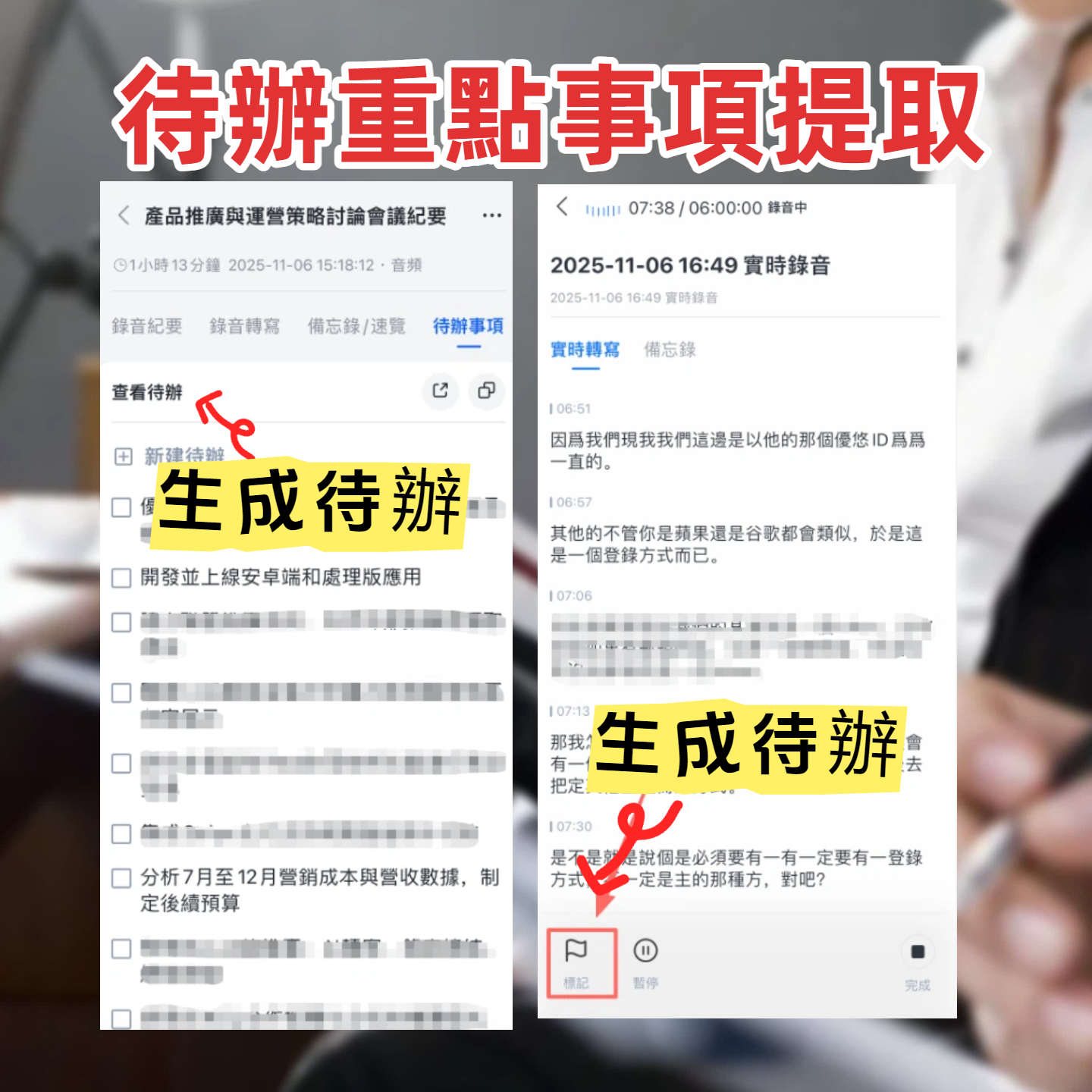
→ This dimension: Tinrec offers more complete AI post-processing features—it's not just a transcription tool.
Dimension 4 | Export & Workflow Integration
Otter can export to TXT, PDF, SRT, etc., and supports some collaboration tools, which is sufficient for English teams. But if you want to export to Markdown, mind maps, or sync to Notion or Google Docs, flexibility is limited.
Tinrec offers more export options, and crucially, it allows you to take the organized results into the tools you already use, without locking you into a closed platform. For mid-level managers who need to produce several meeting reports a week, this is more important than anything else.
→ This dimension: Tinrec has higher export flexibility, making it easier to integrate into existing workflows.
Dimension 5 | Pricing & Free Tier
Otter's free tier offers 300 minutes per month, which seems generous, but for meetings in Chinese (even with some Shanghai dialect), you won't use that much—because accuracy isn't good enough, so more minutes don't help. The Pro plan costs about NT$270 per month (yearly payment), which is a bit pricey for occasional users.
Tinrec's free tier gives you a trial quota covering live recording, online videos, and file transcription, so you can test how it works with your recording environment. If you have many meetings or need full AI features, the Pro monthly or yearly fee is roughly the cost of skipping two Starbucks drinks a week.
→ This dimension: Considering practicality and cost-effectiveness for Chinese scenarios, Tinrec is a better value.
What Are Each's Unique Strengths?
Tinrec's Unique Strengths
- Online video link transcription: Paste links from YouTube, Xiaohongshu, TikTok and it transcribes—something Otter simply cannot do.
- AI dialogue query: After transcription, keep asking for details and extracting key points, turning passive notes into active knowledge.
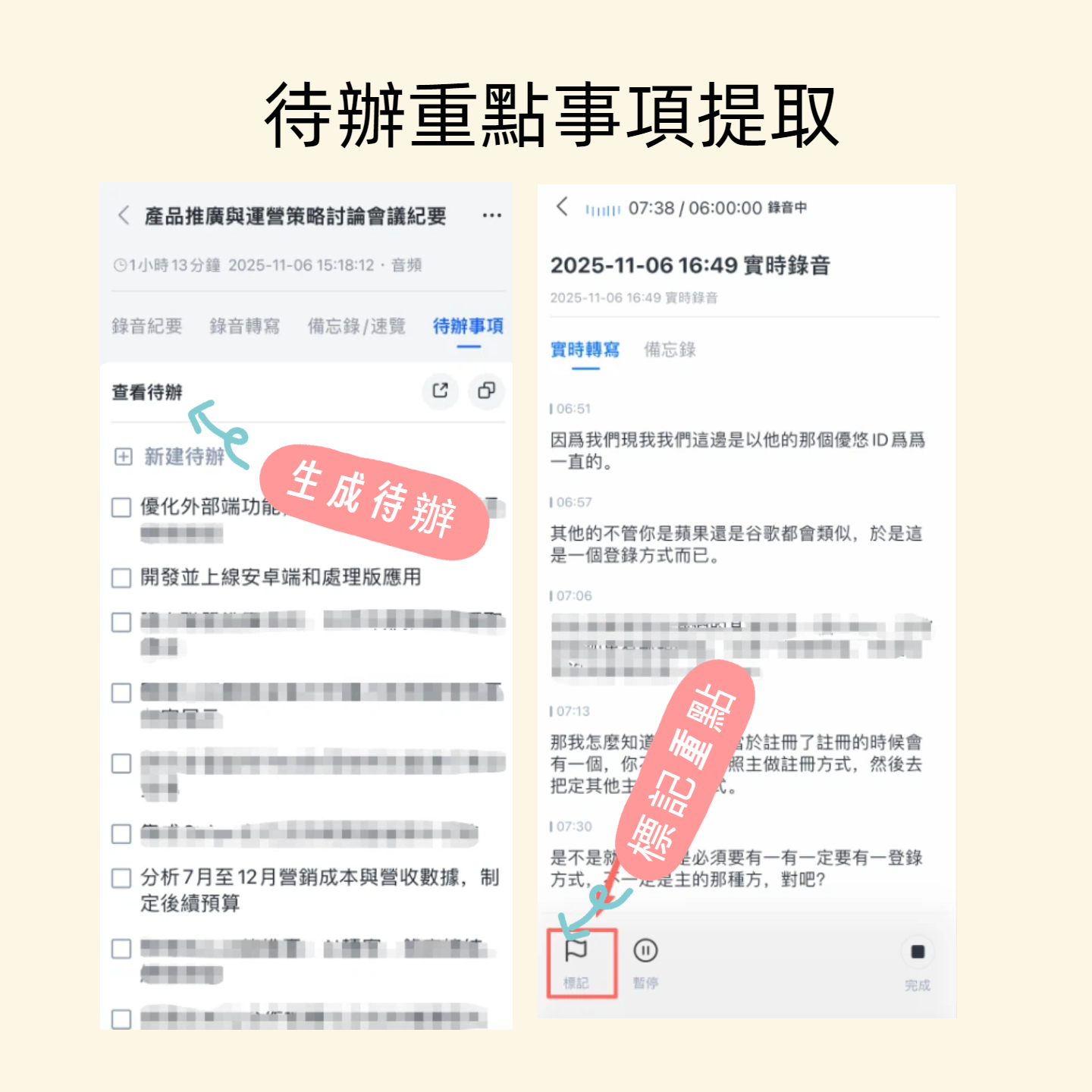
- Action item extraction: Meetings produce a to-do list directly, saving manual organization time.
- Cross-platform anytime: Sync across phone, computer, and web, so you can start processing audio/video content anywhere, anytime.
Otter.ai's Unique Strengths
- Automated English meetings: Automatically joins Zoom and Google Meet, with excellent speaker identification and English summaries—ideal for purely English teams.
- Team collaboration & permission management: Suitable for meeting collaboration in large organizations; Tinrec is weaker in this area.
Summary: Which Should You Choose?
• If you need to organize Chinese meetings, courses, interviews, or often deal with communication mixed with Shanghai dialect → Tinrec is more suitable. Its multi-source input and AI Q&A compensate for dialect recognition shortcomings.
• If your team is entirely English-speaking and heavily relies on meeting bots to automatically join online meetings → Otter.ai is still a strong option.
• If you think, "I have occasional meetings, but I more often organize online videos and podcast material" → Don't hesitate; Tinrec's online link transcription alone is worth it.
For me, as a mid-level manager with 15 meetings a week, the biggest change after using Tinrec isn't transcription accuracy—it's that I no longer spend an afternoon re-listening to recordings and writing meeting minutes by hand. I recommend downloading the free version of Tinrec and throwing your meeting or online video into it to see the results for yourself.
Turn every recording into actionable outcomes
Get 60 free transcription minutes when you sign in. No credit card required.
Related Reading
You might also like

2026 Hands-on Comparison of 3 Cantonese Subtitle Generators: This AI Recorder Saves the Most Time
Want to convert meeting recordings, YouTube videos, and interview recordings into Cantonese subtitles? We tested 3 tools to find the best one for Hong Kong workers. Tinrec not only transcribes accurately but also automatically generates to-do lists and AI Q&A, helping you finish work without overtime.

2026 Comparison of 3 Cantonese Meeting Recording Tools: Which AI Summary Really Saves Time?
We tested 3 Cantonese-compatible meeting recording tools on the market, comparing transcription accuracy, AI summary quality, and practicality to help you find the most time-saving solution. Whether for company meetings, client communication, or class recordings, this comparison helps you pick the right tool in one step.

2026 Real-World Test: 5 Cantonese Real-Time Translation Tools Compared—Which One Sounds Most Authentic?
Need to transcribe or translate Cantonese in real time during meetings, classes, or interviews? We tested 5 leading AI tools for live recording, online video translation, and AI-powered Q&A to find the best solution for Cantonese speakers.

2026 Comparison of 4 Cantonese Subtitle Generation Tools: Which Free Version Is Most Useful?
We compared several Cantonese subtitle generation apps, evaluating transcription accuracy, AI organizing features, and free plans to help you pick the best tool for daily use. How does Tinrec Instant Voice Memo perform?

Which Sichuan Dialect Speech-to-Text Tool is Best? 2026 Review of 3 Tools, This Free One is Most Practical
Sichuan dialect speakers often struggle with organizing recordings. This article reviews 3 tools and finds that Tinrec's free plan performs well for Sichuan dialect transcription, providing a complete guide and selection tips.

2026 Tinrec vs Plaud Note: Dialect Speech-to-Text Test – Which Is More Accurate for You?
2026 dialect speech-to-text tool comparison: real-world test of Tinrec vs Plaud Note on Cantonese recognition, cross-platform support, AI Q&A, and more, to help you choose the best AI solution for transcribing meetings, lectures, and interviews.

2026 Comparison of 5 Speech-to-Text Tools: Shanghai Dialect Recognition Solutions at a Glance
This article compares 5 Chinese-capable speech-to-text tools, including Tinrec, Notta, Otter.ai and others, and provides selection tips and practical techniques for Shanghai dialect recognition scenarios.

Top 5 Speech-to-Text Tools in 2026: Which One Excels at Recognizing the Northeastern Chinese Dialect?
Can you easily convert Northeastern Chinese dialect to text? This article compares several speech-to-text tools on the market for their performance in recognizing the Northeastern Chinese dialect, covering free and paid options, so you can quickly see which one suits you best.

Tutorial: Tinrec Hokkien Voice-to-Text in 2026 – Supports Hokkien Recognition and Auto-Generated Transcripts
Want to convert Hokkien recordings to text? Tinrec supports Hokkien recognition, letting you transcribe live recordings, uploaded audio files, or video links, and it can also auto-summarize and extract tasks. This complete guide shows you how to handle Hokkien transcription on your phone or computer.