
Turn recordings into transcripts and summaries in minutes
Upload audio or video for multilingual transcription, AI notes, and action items
2026 Real-World Test: Two Hokkien Speech-to-Text Apps Compared – Which AI Summary Really Saves Time?
I have about 15 meetings a week, at least 3 of which are conducted entirely in Taiwanese Hokkien. The most annoying part isn't the meeting itself—it's the aftermath: sorting out decisions and action items. I've tried handwritten notes and replaying recordings, but they're all too time-consuming. Then I started trying speech-to-text tools, switching from Otter.ai to Tinrec. This article puts them head-to-head, especially on Hokkien recognition, to see which one works better for busy professionals like me.
Otter.ai vs Tinrec: Quick Overview
Otter.ai is a popular AI meeting note-taker in the US, known for automatically joining online meetings like Zoom and Google Meet, transcribing English in real time, and labeling speakers. Tinrec is a more comprehensive AI recording and media processing tool that handles not only meetings but also lectures, interviews, and YouTube videos, with better support for Mandarin and Hokkien.
| Basic Info | Otter.ai | Tinrec |
|---|---|---|
| Price | Free: 300 min/month; Pro ~$8.33/mo (annual) | Free with basic monthly quota; Pro plans for heavy users |
| Platform | iOS, Android, Web | iOS, Android, Web |
| Key Difference | Strong English meeting bot | Excellent multi-source audio/video processing, great Hokkien/Mandarin recognition |
Below, I compare them across five dimensions that matter most in the workplace.
Dimension 1: Hokkien Recognition Accuracy
Otter.ai claims to support over 100 languages, but in practice, its strength is English. I tested it with a 5-minute Hokkien meeting recording (office environment, three people talking). Otter misrecognized most Hokkien as Mandarin, left some sections blank, and produced unusable text.
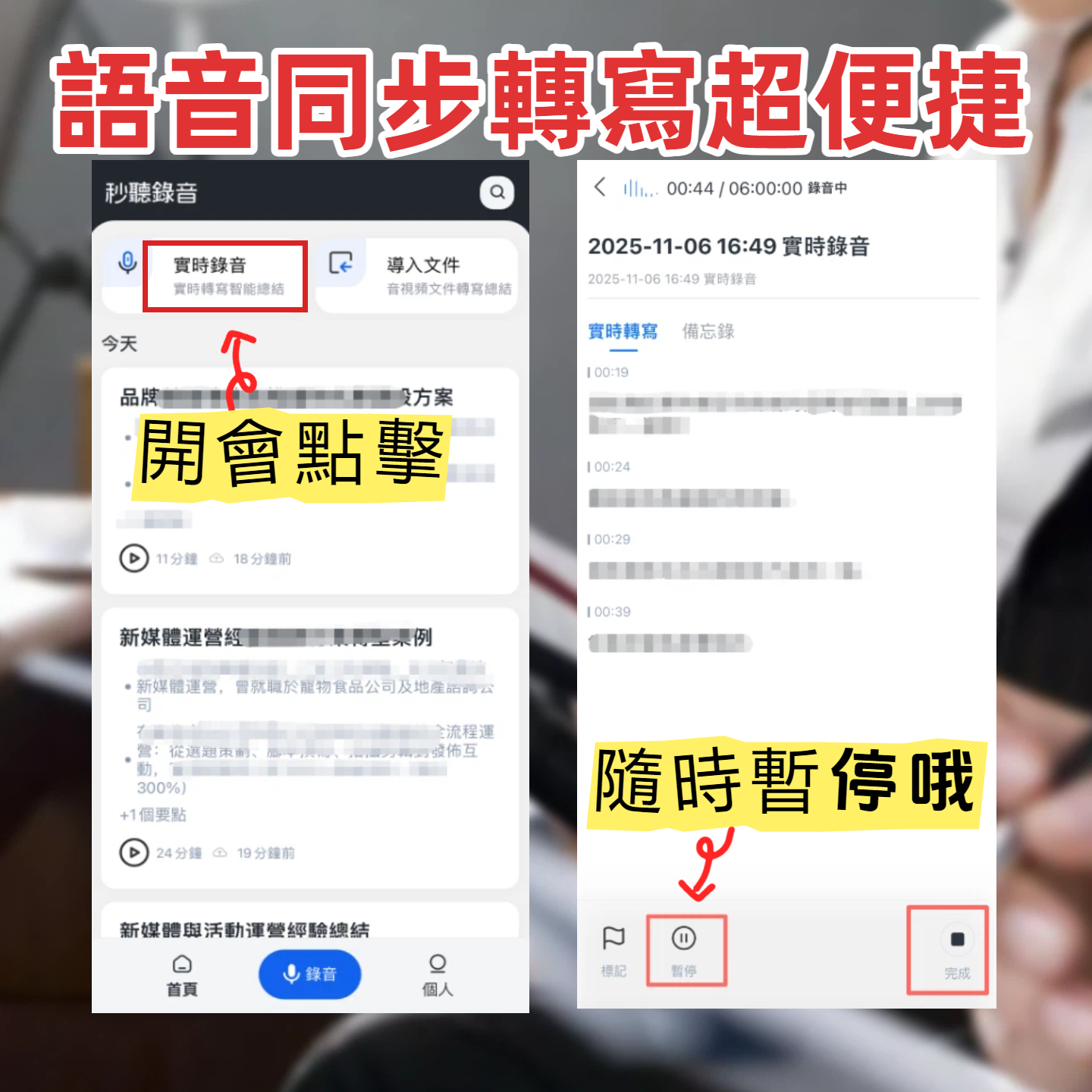
Tinrec performed significantly better. With the same recording, it not only achieved high Hokkien recognition but also correctly marked filler words and code-switching. Although it sometimes transcribed "歹勢" as "拍謝" (both are acceptable), the full transcript was coherent—I didn't have to spend hours correcting it.
→ Verdict: Tinrec clearly wins, especially for Hokkien-heavy workplaces.
Dimension 2: Input Source Diversity
Otter.ai mainly records via its mobile app or web interface, and you can upload audio files. However, it barely supports online videos. When I wanted to transcribe a Hokkien interview on YouTube, I had to download the video and convert it first—an extra step.
Stop organizing recordings by hand
Upload audio or video and automatically get a transcript, summary, and action items
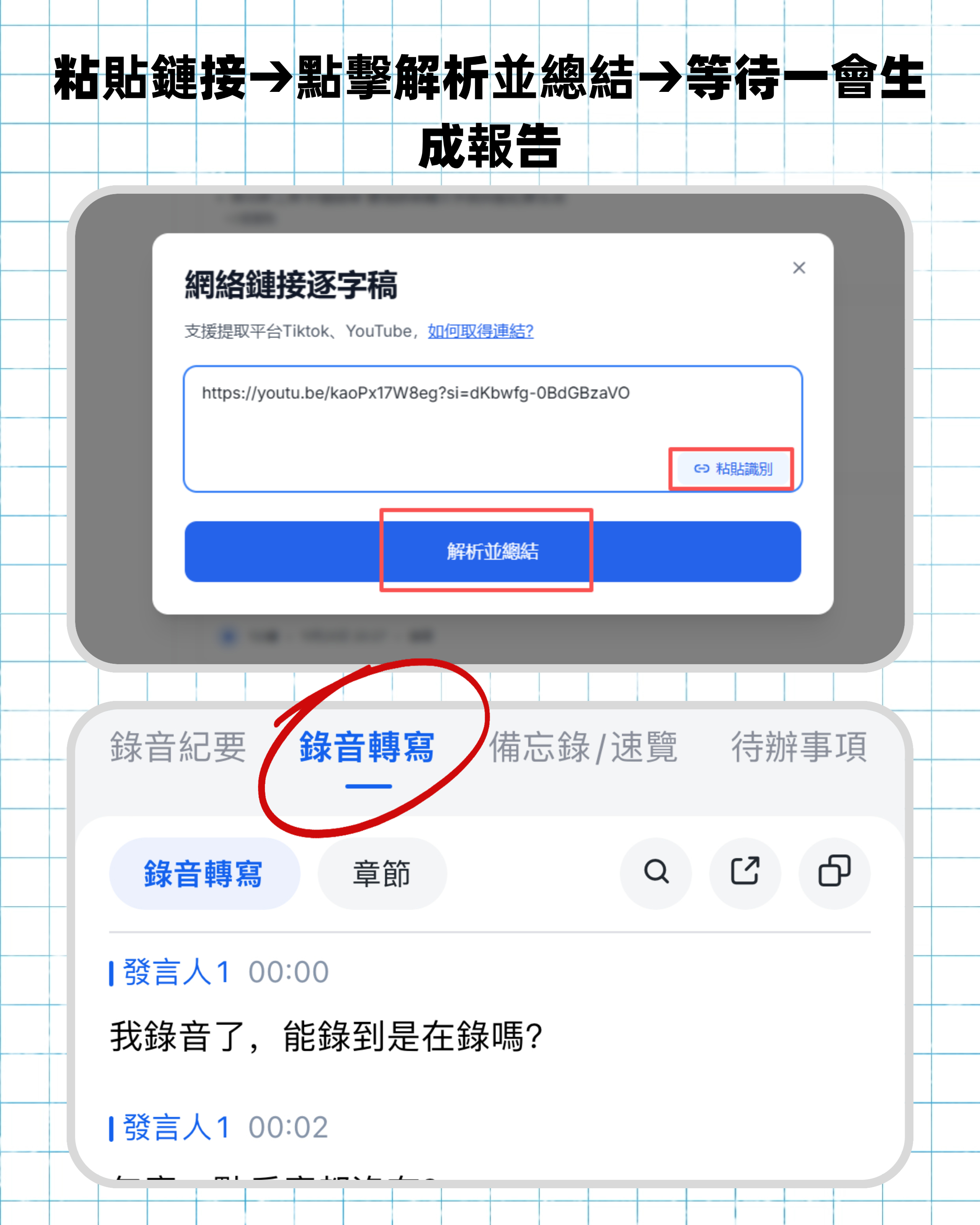
Tinrec is much more flexible. Besides live recording and uploading audio/video files, you can directly paste links from YouTube, Bilibili, or Xiaohongshu, and the system automatically extracts and transcribes the audio. This saves tons of time when you need to quickly capture external references or meeting recordings.
→ Verdict: Tinrec wins again with far richer input sources.
Dimension 3: AI Summary & Organization
Otter.ai auto-generates meeting summaries, keywords, and even segments by speaker. But these features are accurate only in English. When used with Hokkien meetings, summaries often miss key points and action items.
Tinrec offers AI summaries, chapter splits, action item extraction, and a feature I use a lot: AI chat with the transcript. You can ask, "What budget items were discussed?" or "What suggestions did Amin make?" and the system pulls answers directly from the recording. This is a lifesaver when reviewing past meetings or when your boss suddenly asks about a previous decision.
→ Verdict: Tinrec wins on depth of AI organization, especially for Mandarin/Hokkien scenarios.
Dimension 4: Export & Workflow Integration
Otter.ai exports mainly as text, PDF, or TXT, and syncs with Google Calendar or Slack. But if you paste the meeting notes into Notion or Google Docs, formatting often breaks and requires manual cleanup.
Tinrec offers more export options: Word, PDF, TXT, even subtitle files (SRT), and integrates directly with Notion, Google Docs, OneNote, and more. For teams that use Notion as a knowledge base, this is seamless.
→ Verdict: Tinrec better fits Taiwan workplace workflows for post-meeting integration.
Dimension 5: Pricing & Local Support
Otter.ai's free tier gives 300 minutes per month, enough for light users, but its Pro plan is priced for Western markets and focuses on English meeting collaboration. If you run into issues, support is only in English.
Tinrec offers flexible pricing: free tier, weekly pass, monthly, and annual plans—great for people like me with fluctuating meeting volumes. The product is designed for Traditional Chinese and Hokkien, and customer support is available in Chinese.
→ Verdict: Tinrec is more affordable and localized for Taiwanese users.
Unique Strengths
Tinrec
- Optimized Hokkien recognition: Not just "supports Chinese"—the model is tuned for dialects like Hokkien, delivering noticeably better accuracy.
- Direct web video transcription: Paste a YouTube link and it's done—few tools offer this.
- AI chat with transcript: Query the recording like a database; past meetings are no longer forgotten files.
- Full workflow integration: Exports to Notion, Google Docs, mind maps, etc., great for team collaboration.
Otter.ai
- Strong English meeting bot: If you only have English online meetings, Otter's auto-join, real-time transcription, and speaker labeling are mature.
- Team collaboration features: Channels, sharing, permissions—suitable for managing English meetings across global teams.
Conclusion: Which One Should You Choose?
- If your daily work involves Hokkien meetings, interviews, or frequent Chinese media processing → Tinrec is the better choice, from recognition to post-processing.
- If you only have pure English online meetings and rely heavily on auto-join meeting bots and team collaboration → Consider Otter.ai.
- If you're like me, juggling many mixed-language meetings each week and want to save post-meeting time → Start with Tinrec's free tier, test it with your own recordings, then decide on an upgrade.
Bottom line: For most Taiwanese professionals, Tinrec is more grounded and hits the pain point of Hokkien speech-to-text far better.
Turn every recording into actionable outcomes
Get 60 free transcription minutes when you sign in. No credit card required.
Related Reading
You might also like

2026 Free Cantonese Translation Solutions: 3 Tools at a Glance
A review of three free solutions supporting Cantonese translation, comparing Tinrec, Notta, and TurboScribe in terms of Cantonese recognition, translation features, and free quotas, helping you find the best tool for Chinese-speaking users.
2026 Comparative Review of 2 Taiwanese Speech-to-Text Apps: Which Is Better for Multi-Platform Audio/Video Management?
We tested two major speech-to-text tools, Tinrec and PLAUD Note, comparing them on Taiwanese content management, AI summaries, cross-platform support, and price, to help Hong Kong users find the most time-saving option.

2026 Tinrec Voice-to-Text Guide: Supports Cantonese & Auto-Generates Meeting Minutes
As a student, can't keep up with notes in class or understand Cantonese in group discussions? Tinrec is an AI voice-to-text tool that supports Cantonese and multiple languages, and can automatically summarize and create to-do lists, turning your lecture recordings into reviewable notes. This article covers 5 Cantonese voice-to-text solutions suitable for students, from free to paid, to help you choose the best tool for your needs.

Which Cantonese Meeting Transcription Tool is Best? 2026 Test of Multiple Tools: Free Version of This One is Most Practical
Tested multiple AI meeting transcription tools for Cantonese meetings, comparing transcription accuracy, AI summaries, action item extraction, and multi-platform support. After a thorough comparison, Seconds Audio (Tinrec) is recommended—the free version offers practical features suitable for everyday office workers and frequent meeting users.

2026 Real-World Comparison of 2 Southern Min Speech Recognition Tools: Which is Better for Daily Recording and Organization?
For users needing Southern Min speech recognition, support from mainstream tools is still limited. This article compares Tinrec and PLAUD Note across dimensions such as recognition capability, input sources, AI organization, cross-platform support, and pricing, helping you choose the most suitable transcription tool for your needs.

2026 Comparison of 5 Cantonese Translation Apps: Which Is the Most Accurate for Work?
Hong Kong office workers encounter Cantonese content daily in meetings, lectures, and videos. Looking for a reliable Cantonese translation app to help organize? We tested 5 popular tools, from AI voice transcription to real-time translation, to find the best solution for Hong Kong users, so you can stop working overtime on meeting minutes.

2026 Southern Min (Hokkien) Input Methods Compared: AI Speech-to-Text vs Traditional Keyboard – Which is Faster and More Accurate?
A hands-on comparison of Southern Min (Hokkien) input methods: speech-to-text vs traditional keyboard typing, evaluating speed, accuracy, and convenience to determine which is better for daily use.

Which Cantonese Real-Time Translation App is Best? 2026 Test of 2 Tools Reveals the Most Comprehensive One
Need Cantonese real-time translation for weekly meetings? We tested two tools — comparing accuracy, ease of use, extra features, and price — to find the best fit for professionals who need instant Cantonese translation.

How to Transcribe Hokkien Audio to Text in 2026? A Complete 5-Step Guide
Struggling to transcribe Hokkien meetings, interviews, or lectures? This article tests several tools and shows you how to use Tinrec to quickly convert Hokkien audio to text and organize it into searchable data.