

Turn recordings into transcripts and summaries in minutes
Upload audio or video for multilingual transcription, AI notes, and action items
2026 Complete Guide to Hokkien Speech to Text: Convert Hokkien Recordings to Text, Summaries & Transcripts with Tinrec
Have you ever had this problem: You attend a meeting conducted entirely in Hokkien and want to create meeting minutes, but you find that while speaking Hokkien is easy, typing it out is a challenge because you don't know how to romanize it? Or, you recorded an oral history from your grandparents and want to save it as a text file, but you're stuck spending hours transcribing word by word?
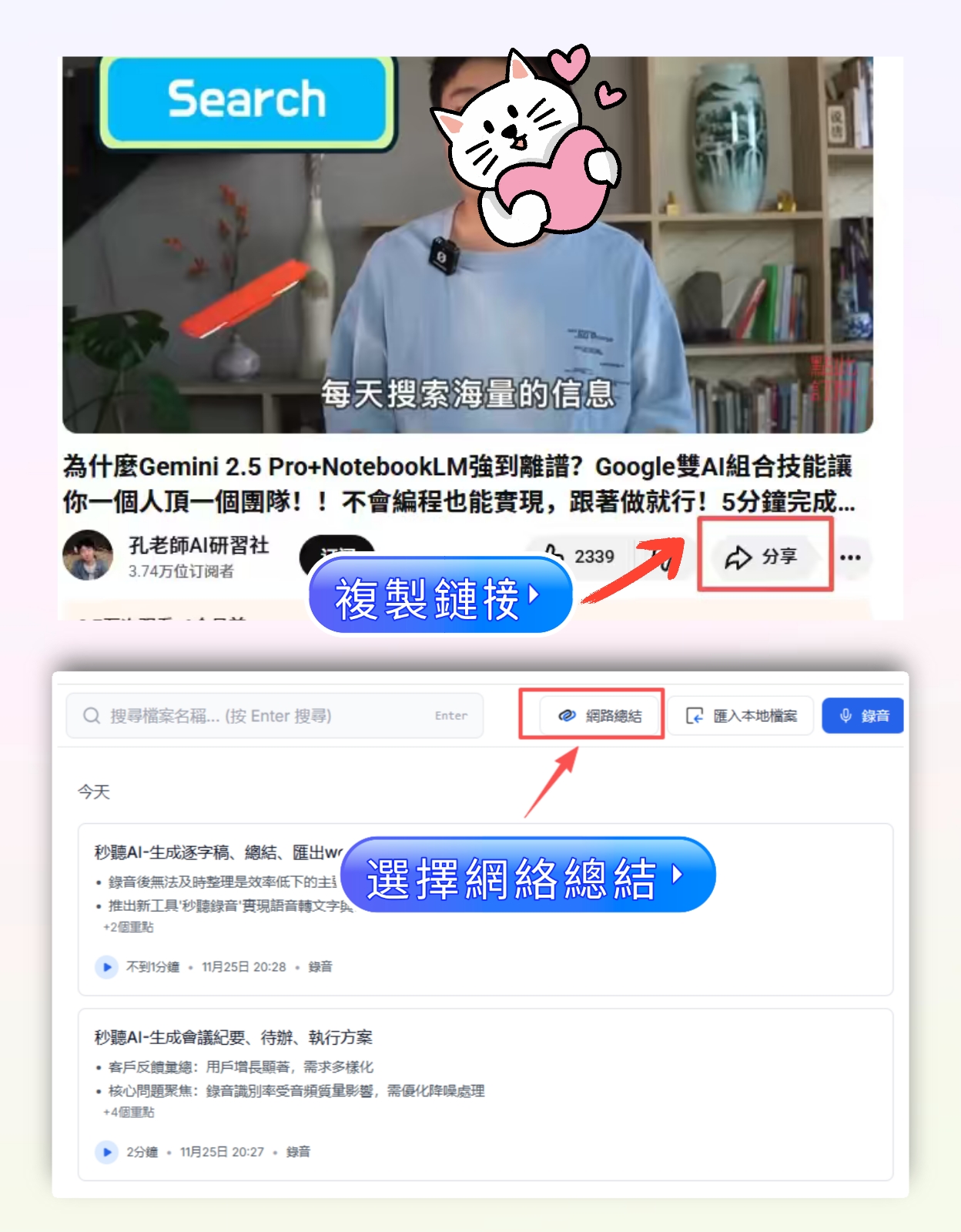
Now, with AI speech-to-text tools, these pain points can be significantly simplified. Take Tinrec as an example: it is an AI recording and audio/video organizing tool that supports multiple languages. It can transcribe Hokkien recordings into text in real time, and further organize them into summaries, chapters, and action items. Below, we'll guide you step by step on how to use such tools to turn your Hokkien audio into usable digital data.
What Can Hokkien Speech to Text Do for You?
Whether you are an office worker, student, researcher, or content creator, as long as your work or life involves processing Hokkien recordings, AI speech to text can help in the following scenarios:
Scenario 1: Meeting minutes without manual transcription
After a meeting conducted entirely in Hokkien, instead of relistening to two hours of audio and typing slowly, just upload the recording to Tinrec. It will automatically generate a transcript, and even highlight key points and action items, getting the summary done in 5 minutes.Scenario 2: Quick transcription for interview research
When conducting fieldwork or oral history interviews, Hokkien conversations often need to be recorded verbatim. Tinrec supports uploading audio files for direct transcription. After transcription, you can use the AI Q&A feature to search for keywords—for example, ask "Who mentioned 'temple fair'?" and instantly locate the relevant section.Scenario 3: Easier mother tongue learning
Want to learn Hokkien but lack materials? Record conversations with elders or listen to Hokkien podcasts, then use Tinrec to transcribe them into text. Syncing the audio with the text speeds up learning and improves accuracy much faster than just listening.Scenario 4: Repurposing video content
Many YouTube or TikTok Hokkien teaching and entertainment videos can be processed by pasting the link into Tinrec, which extracts the content and converts it to text, making it easy to create notes, subtitles, or social media posts.
What Are the Core Capabilities of Hokkien Speech to Text?
Choosing the right tool means Hokkien to text goes beyond just "dictation"—it can understand and apply the content. Tinrec offers the following key capabilities:
Real-Time Transcription: Output Text as You Record
Tinrec's real-time recording-to-text feature has a delay of less than 1 second. During meetings or classes, you can see text output immediately. Even if the entire session is in Hokkien, it displays smoothly, allowing you to verify accuracy on the spot.
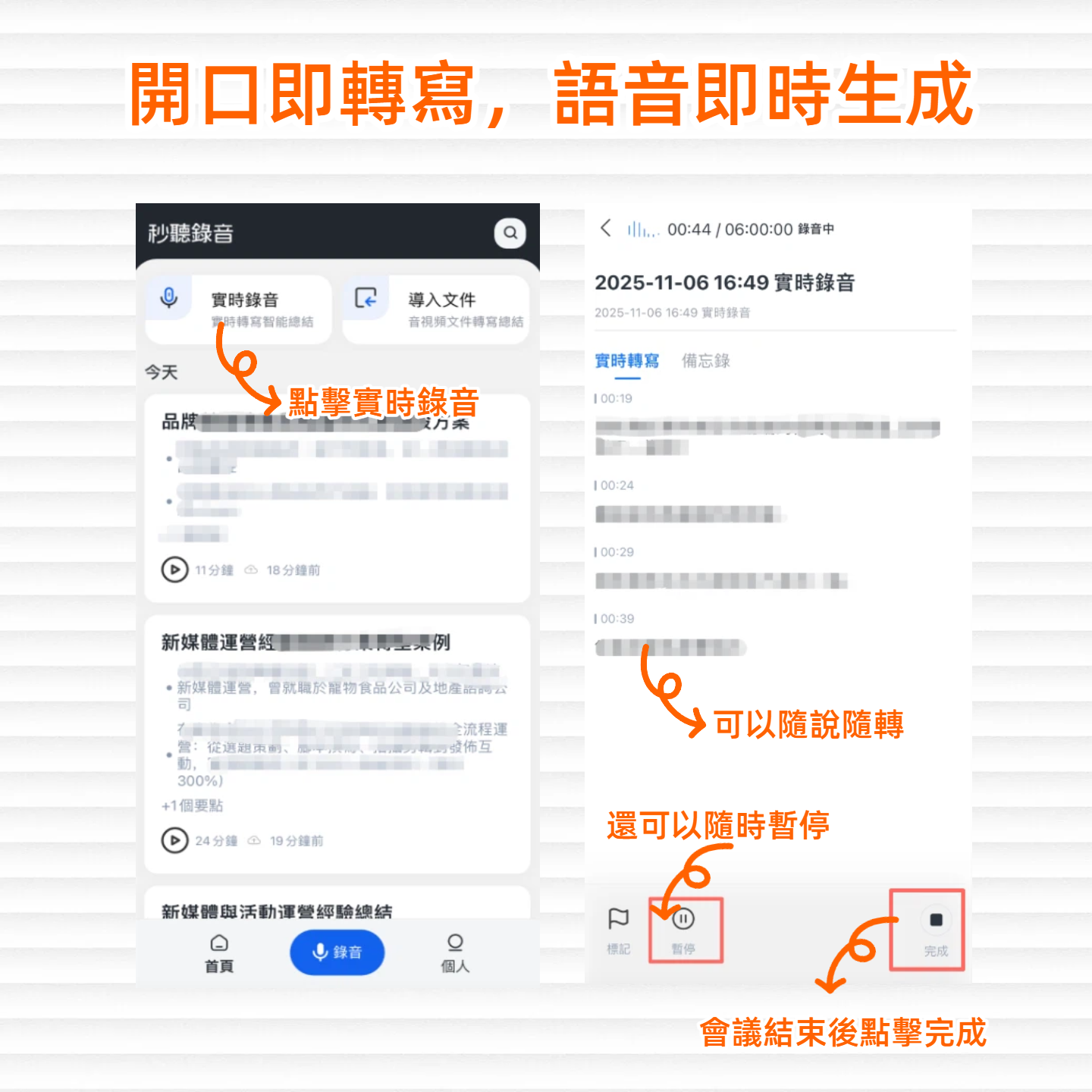
Multiple Input Sources: Process Videos and Files
Besides direct phone recording, Tinrec can import local audio or video files, and even support pasting online video links (e.g., YouTube, TikTok) for direct content parsing. This means you are not limited to recording scenarios; any Hokkien audio/video material can be converted to text.
AI Summaries and Chapters: Quickly Grasp Key Points
Transcription is just the first step. Tinrec automatically splits long recordings into chapters with summaries. For example, a one-hour Hokkien meeting recording will be organized into structures like "Discussion Topic: Spring Festival Event Planning" and "Conclusion: Budget Approved," so you don't have to listen from start to finish.
Stop organizing recordings by hand
Upload audio or video and automatically get a transcript, summary, and action items
Automatic Action Item Extraction
For instructions like "You need to submit the report the day after tomorrow" mentioned in a meeting, Tinrec can automatically extract action items, listing responsible persons and deadlines. This is especially useful for teams accustomed to holding meetings in Hokkien.
AI Q&A: Query Like a Database
After transcription, you can directly ask Tinrec questions using keywords in Chinese or Hokkien, such as "What did the customer think about the price?" It uses semantic understanding to pull out the relevant sections, saving you time searching through a haystack.
Real-World Use Cases
Use Case 1: Company Meetings Entirely in Hokkien
A small-to-medium enterprise that holds meetings in Hokkien used to rely on one colleague to slowly type up minutes. After adopting Tinrec, they just place a phone on the table to record, and get the transcript and summary immediately after the meeting. A senior employee noted: "Although some Hokkien slang still has errors, over 80% of the content is accurate, and with minor edits it's good enough."
Use Case 2: University Hokkien Classes
A student taking Hokkien literature classes records 2 hours of lecture each week. Previously, reviewing relied on notes. Now they upload the recording to Tinrec, let AI transcribe and auto-segment. Before exams, they use the Q&A feature to quickly find key authors mentioned by the professor.
Use Case 3: Podcast Transcripts
A podcaster regularly interviews guests from different generations entirely in Hokkien. They upload the audio to Tinrec for transcription, lightly polish it, and publish it as show notes. Listeners feedback that "having a searchable text version is super convenient," and it also boosts SEO.
Use Case 4: Organizing LINE Group Voice Messages
In family chat groups, elders often use voice messages to give instructions. Accumulated hundreds of these are hard to search through. Tinrec can import these voice messages via "Import Audio" and convert them to text, then use keyword search to never miss mom's reminders again.
4 Points to Consider When Choosing a Hokkien Speech-to-Text Tool
1. Recognition Accuracy
Hokkien has significant tonal and dialectal variation, so no tool is perfect. Don't just rely on official specs; test with your own recordings. For instance, Tinrec performs steadily in mixed Chinese-English and everyday conversations, though it still has room for improvement with obscure slang. Overall, it's sufficient for daily needs.
2. Input Source Diversity
If you need to process not only phone recordings but also video files on your computer or YouTube links, a tool that accepts multiple input sources is important. Tinrec covers a wide range of common audio/video formats and platforms.
3. Post-Processing Capabilities
Transcription is just the first step. Real value lies in summarizing, highlighting key points, and extracting action items. Beyond basic transcription, Tinrec generates structured meeting summaries, action lists, and even lets you ask questions to find information—essentially an AI assistant included.
4. Pricing and Free Plans
For average users, whether the free tier offers enough minutes is a key consideration. Tinrec's free plan provides a certain number of transcription minutes per month, suitable for light users to try out. If you have high-volume needs weekly, the Pro monthly or annual subscription is reasonably priced, so you don't need to pay a large upfront fee.
Frequently Asked Questions
Q: Does Tinrec support Hokkien? How is the recognition accuracy?
A: Tinrec supports 14 languages, including Mandarin Chinese and multiple dialects. In practice, its recognition of Hokkien is decent. However, due to large tonal variation, accuracy improves with clear audio and mainstream accents; heavy slang or strong accents may require manual correction. We recommend testing with a sample of your own recording using the free version.
Q: How long can I transcribe Hokkien audio with the free plan?
A: Currently, the Tinrec free plan provides a basic monthly transcription allowance, enough for a few meetings or classes. For heavy use, consider the weekly card or Pro plan. Exact figures please refer to the official pricing page.
Q: Can I upload an existing Hokkien MP3 file?
A: Yes, Tinrec supports importing audio and video files, including common formats like MP3, WAV, and MP4. Open the app or web version, select "Import Audio/Video," and upload files from your computer or phone for transcription.
Q: Can I export the transcribed text?
A: Yes. Tinrec offers multiple export formats, including TXT, Word, and PDF. You can also share a link directly. If you prefer organizing in tools like Notion or Google Docs, you can integrate via third-party export functions.
Q: After transcribing Hokkien to text, can it be translated into Chinese?
A: Tinrec focuses on speech-to-text and content organization. If you need to translate the Hokkien transcript into Mandarin, you can export the text first and then use other translation tools. However, due to grammatical differences between Hokkien and Mandarin, the translation may require manual polishing.
Conclusion
Hokkien speech-to-text is no longer a distant technology. With the right tool, you can save significant time on manual transcription and organization. Tinrec, as a multifunctional AI recording and audio/video organization platform, not only supports real-time recording, file import, and online video parsing but also provides summaries, action items, and Q&A features. Even the free version lets you try it out. If you have Hokkien recordings that need processing, download Tinrec now and turn your audio into searchable, usable text assets.
Turn every recording into actionable outcomes
Get 60 free transcription minutes when you sign in. No credit card required.
Related Reading
You might also like

2026 Best 5 Real-Time Translation AI Tools Compared: Which Can Handle Transcription and Live Translation Simultaneously?
This article reviews 5 AI tools with real-time translation capabilities, from speech-to-text to multilingual comparison, analyzing free plans and paid features to help you find the best choice for meetings, courses, video content, and more.

2026 Tinrec vs Otter.ai: 5-Dimensional Comparison – Which Is Better for Online Meeting Notes?
Based on hands-on experience as a mid-level manager, this article compares Tinrec and Otter.ai across five dimensions: Chinese meeting transcription, input source diversity, post-transcription organization, free plans, and cross-platform convenience. It helps you find the best tool for online meeting notes and everyday audio/video content processing.

2026 Comparison of 4 Real-Time Translation Tools: Which One Do Free Users Recommend Most?
How to choose the best real-time translation software in 2026? We tested and compared 4 tools, from voice translation and meeting conversations to video subtitles, fully analyzing features and use cases. Want to know which free version is the most capable? This article helps you find the best real-time translation solution.

2026 Comparison of 3 Meeting Recording Tools: Never Miss Key Points Even if Google Meet Has No Sound
How to fix Google Meet audio issues? This article tests 3 meeting recording tools, from audio/video transcription, AI summaries to cross-platform use, giving you the most reliable backup solution.
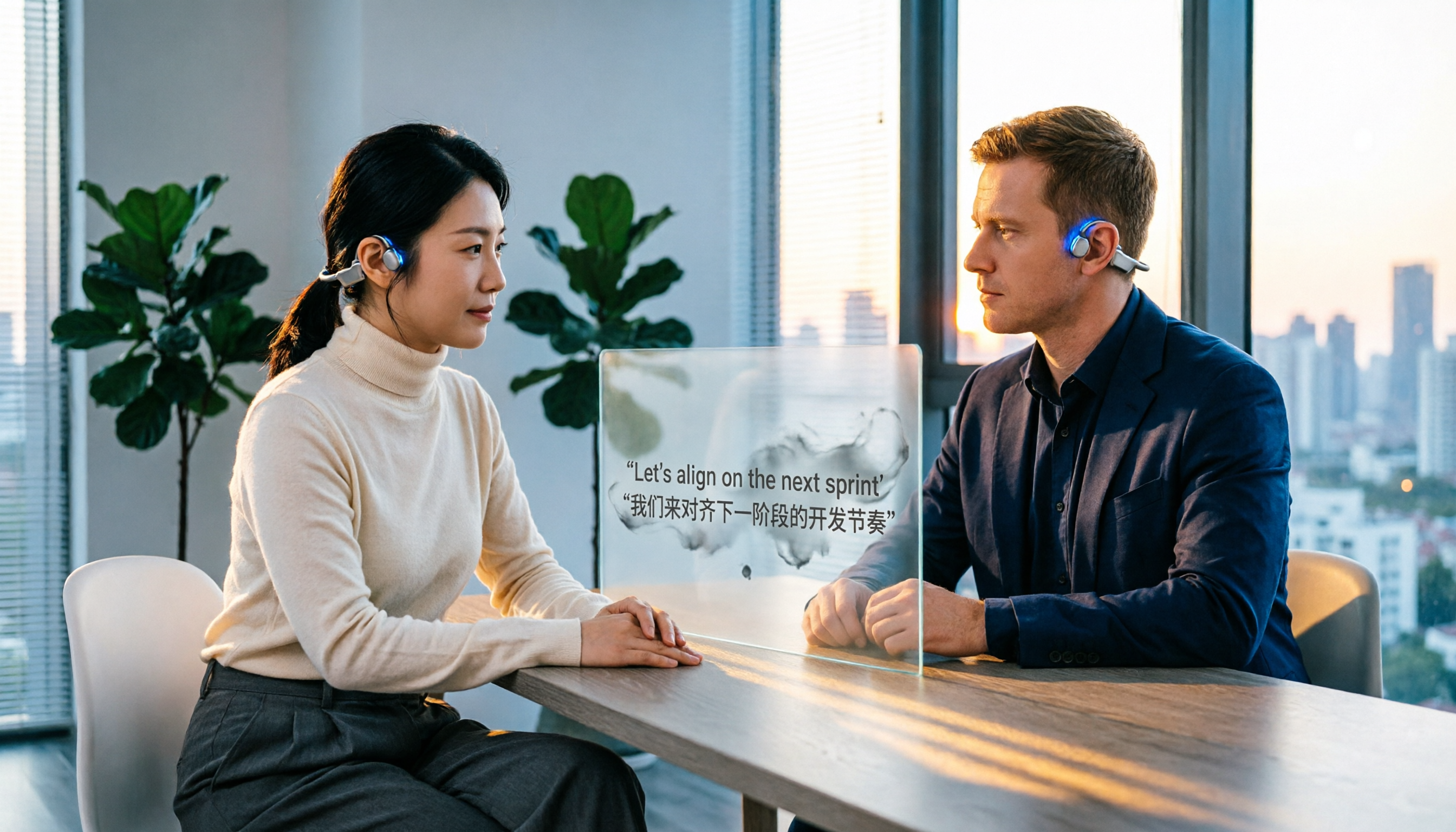
2026 Comparison of 3 Simultaneous Interpretation Software: Which Free Plan is Most Worth It?
We tested three popular simultaneous interpretation tools on the market, analyzing real-time translation accuracy, supported languages, free plan limits, and actual user experience. This article focuses on Tinrec as a key example to help you choose the best real-time voice translation software for meetings, classes, and interviews.
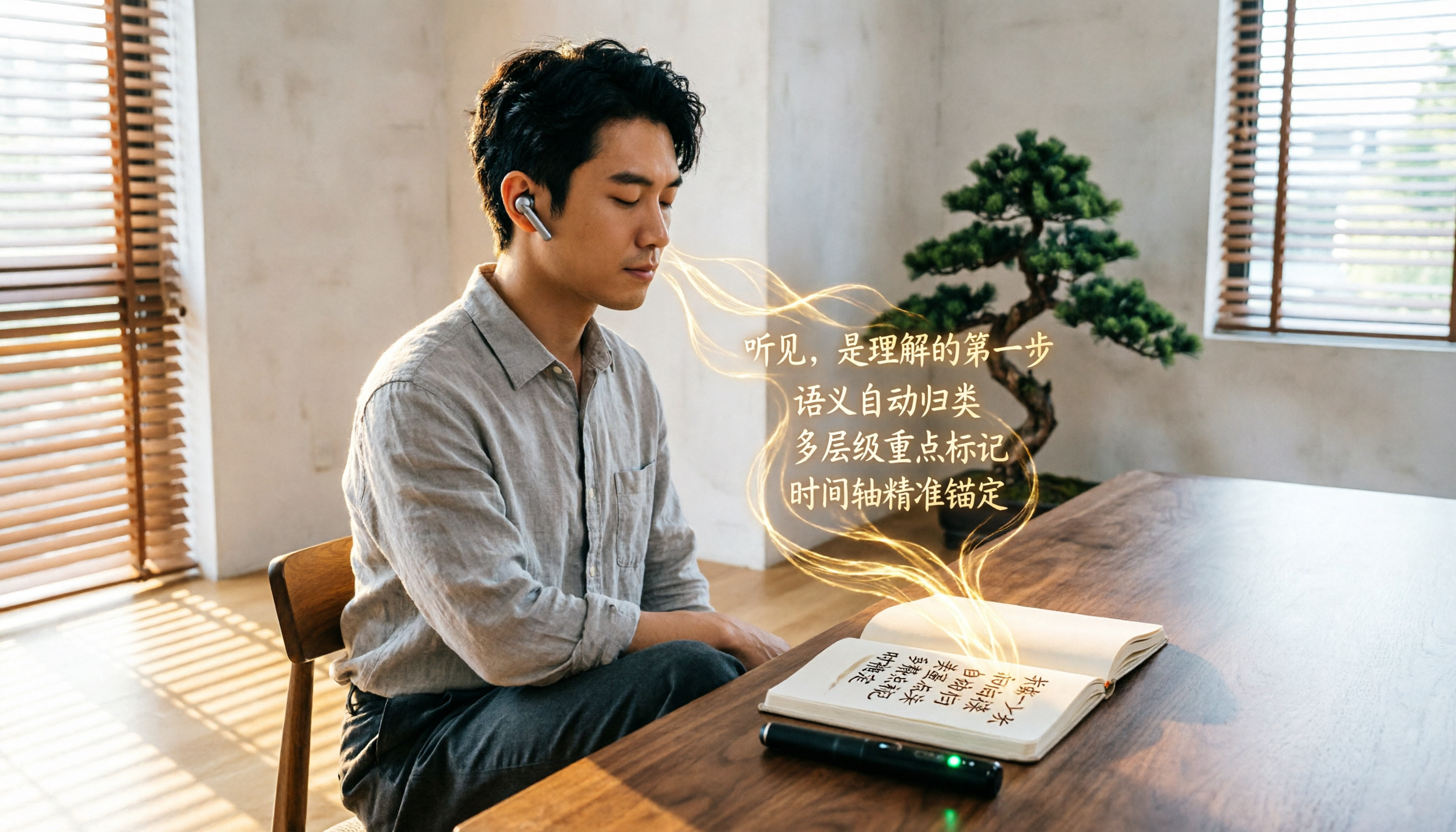
Tinrec vs Notta 2026: A 5-Dimension Showdown – Which Is Better for Chinese Content Organization?
Choosing a speech-to-text tool? This article compares Tinrec and Notta across five aspects including transcription accuracy, AI post-processing, and multi-source input to help you find the best solution for organizing Chinese content.

2026 5 Real-Time Translation Apps Compared: Are Free Plans Good Enough?
Looking for a great real-time translation app? This article compares 5 popular tools in real-time translation, AI summarization, free quotas, and Chinese recognition to help you choose.

2026 Comparison of 3 Meeting Note Tools in Real Tests: Which AI Minutes Really Save You Time?
How to take meeting notes quickly and accurately? This article tests 3 tools, showing you how to use AI to automatically generate summaries and to-dos, from recording to organizing in one go. Using Tinrec as an example, we demonstrate the full meeting note process and summarize 4 key purchase points to help you find the best solution.

2026 Speech-to-Text Tool Buying Guide: 3 Tools Tested and Recommendations
A student's real-world test of speech-to-text tools, comparing online and offline solutions, sharing genuine experiences in class and meeting scenarios to help you choose the best learning tool.