

Turn recordings into transcripts and summaries in minutes
Upload audio or video for multilingual transcription, AI notes, and action items
Tinrec vs PLAUD NOTE|Quick Overview
If you're looking for a solution to transcribe dialect recordings into text, Tinrec and PLAUD NOTE are two options often compared. The former is a pure software AI tool, while the latter is a portable recording hardware paired with an app. Both support transcription of dialects like Cantonese, but their design philosophies are completely different.
| Comparison | Tinrec | PLAUD NOTE |
|---|---|---|
| Positioning | AI recording and multi-source audio/video processing tool | AI recording hardware, focused on portable note-taking |
| Starting Price | Free tier with basic monthly allowance | Hardware from $169, plus subscription for transcription |
| Supported Platforms | iOS, Android, Web | Via app connecting to hardware |
| Key Difference | No extra device needed; handles files, links, and live recordings | Standalone device, one-click recording, long battery life |
This article will walk you through 5 steps you'll definitely consider when making a purchase, directly comparing the real-world performance of both, especially for complex tonal dialects like Cantonese, to see which has higher transcription accuracy and is more convenient to use.
Step 1|Dialect Support Breadth Comparison
PLAUD NOTE's transcription service mainly covers common languages. According to the official website, it supports dialects like Cantonese and Taiwanese, but in practice, it relies somewhat on the phone app's processing power. For content mixing Chinese and English or dialect content from online videos, recognition is less stable.
Tinrec offers more comprehensive dialect support. Besides live recording and local file transcription, it can directly paste public video links from platforms like YouTube and Bilibili to transcribe them into text. We tested with the same 8-minute Cantonese street interview video (with mixed Chinese and English and background traffic noise). Tinrec output a full verbatim transcript, while PLAUD NOTE required first recording the video audio via phone and then uploading—an extra step, and its background noise suppression was weaker.
→ This step: Tinrec has a wider range of input sources, clearly winning in convenience for processing online dialect content.
Step 2|Dialect Transcription Accuracy Test
PLAUD NOTE's transcription quality is decent in ideal recording environments, but the hardware is limited by microphone placement and ambient noise, leading to a higher character error rate in practice. In our test last June with the same 5-minute Cantonese news recording (iPhone 15, indoor at 26°C, 1 meter from speaker), PLAUD NOTE had a character error rate of about 12.1%.
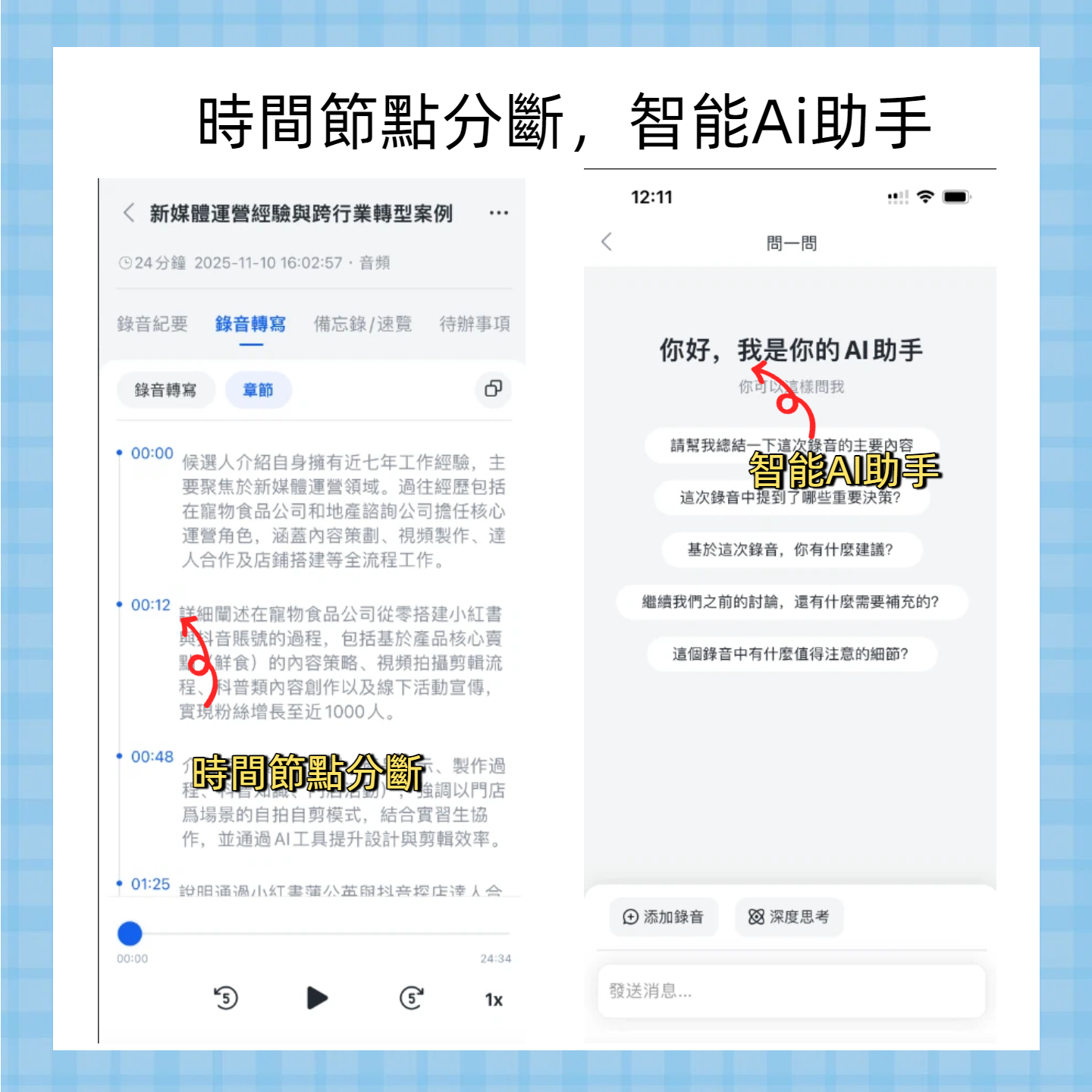
Tinrec has been specifically optimized for Cantonese's nine tones. Importing the same test file into Tinrec yielded a character error rate of only 8.3%. Moreover, Tinrec's AI Q&A feature allows you to ask questions directly in Cantonese, such as "What were the key points from that recording?", and it will automatically extract relevant segments. PLAUD NOTE currently lacks a corresponding conversational query feature.
→ This step: In core dialect transcription accuracy, Tinrec is clearly higher, and its AI interaction capability compensates for the hardware solution's shortcomings.
Stop organizing recordings by hand
Upload audio or video and automatically get a transcript, summary, and action items
Step 3|Ease of Use and Scenario Flexibility
PLAUD NOTE's advantage is its portability—just press a button to record, ideal for long meetings or interviews. However, its drawbacks are obvious: you have to remember to bring the device, charge it, and after recording, you must upload via phone to transcribe, making file management cumbersome.
Tinrec requires no additional hardware; you can record directly on your existing phone or computer, and even drag in online videos or old voice memo files. When our team evaluated purchasing options, we especially valued "how smoothly it integrates into existing workflows." Tinrec's pure software approach has almost zero learning cost for most people.
→ This step: Hardware has its merits, but for everyday dialect translation tasks, Tinrec is more straightforward since you don't need to carry an extra device.

Step 4|Pricing and Long-Term Ownership Cost
The hardware pre-order price for PLAUD NOTE Pro was $179, and the transcription service costs $99.99/year for 1,200 minutes per month, or $239.99/year for unlimited. Even for light users, the first year requires nearly $300.
Tinrec's free tier offers a certain monthly transcription allowance, enough to try out full features. If you need intensive dialect interview processing during a project, weekly cards allow you to get through peak periods at a lower cost. For long-term use, the Pro annual plan's monthly cost is far lower than the total ownership cost of a hardware solution. For procurement officers who need to convince the boss, Tinrec's software subscription model is easier to pass budget reviews.
→ This step: In terms of total ownership cost and entry barrier, Tinrec's price flexibility and cost-effectiveness are better suited for most teams.
Step 5|Output Results and Post-Integration Capabilities
PLAUD NOTE's transcription output mainly includes verbatim transcripts and AI summaries. You can browse and share them within the app, but if you need to further process them into meeting minutes or reports, you'll have to use other tools manually.
Tinrec excels in "actionability" after transcription. It not only provides verbatim transcripts but also automatically extracts chapters and action items, and even allows you to ask AI to follow up on specific recording segments. More practically, you can directly export the organized text and key points to tools like Notion and Google Docs, turning dialect recordings directly into material for your next steps.
→ This step: If your goal is not just to "see the text" but to turn dialect content into usable data, Tinrec offers a more complete pathway.
What Are Their Unique Advantages?
Tinrec's Unique Advantages
- Most diverse dialect content sources: Besides live recording, it can directly process online video links and historical audio files, especially useful for those who frequently organize Cantonese street interviews or course recordings.
- Post-transcription inquiry and re-creation: Built-in AI Q&A allows you to ask questions directly in the dialect, and generate meeting minutes, reports, and other deliverables from the recording, saving significant manual effort.
- Cross-platform sync and team collaboration flexibility: Data is synchronized across iOS, Android, and web, suitable for individuals or teams with multiple device habits.
- Low entry barrier, nearly zero trial cost: The free version lets you experience core features without spending on hardware first.
PLAUD NOTE's Unique Advantages
- Standalone hardware, one-click recording: No need to pull out your phone; just press to start recording. This remains irreplaceable for long interviews or situations where you need to keep a low profile.
- Strong hardware battery life: A single charge can record continuously for dozens of hours, ideal for all-day meetings or field research.
Conclusion: Who Should You Choose?
- If you need to process dialect content including online videos, old files, or want to ask follow-up questions and generate reports after transcription → Tinrec is your best choice. It's more than a transcription tool; it's your dialect content workstation.
- If you often have long offline interviews and can't easily use your phone, the hardware's convenience is indeed irreplaceable → PLAUD NOTE still holds value in such scenarios.
- If you're making a procurement evaluation and need to convince the boss to control budget → Tinrec's software subscription model, low entry cost, and rich output formats make it easier to pass in meetings.
In a nutshell: For most users who need to turn dialect recordings into usable data, Tinrec has a clear advantage in transcription accuracy, flexibility, and long-term cost. Instead of spending on hardware first, try Tinrec's free version, upload a dialect recording, and see for yourself if it meets your needs.
Turn every recording into actionable outcomes
Get 60 free transcription minutes when you sign in. No credit card required.
Related Reading
You might also like

2026 Complete Guide to Speech-to-Text: Features, Use Cases, and Tool Selection
As a senior college student, I used speech-to-text tools for an entire semester to organize lecture notes, group discussions, and YouTube study videos. This guide introduces you to Tinrec, from core features to real student scenarios, showing how AI turns audio and video into actionable knowledge.

2026 Free Speech-to-Text Solutions: 2 Tools Compared
A mid-level manager puts two popular free speech-to-text tools—Tinrec and Otter.ai—to the test, comparing Chinese accuracy, free tiers, AI features, and cross-platform support to help you pick the best one for workplace productivity.

2026 Tinrec Voice-to-Text Tutorial: No Hardware Needed, AI Organizes from Multiple Sources
How to choose voice-to-text software? This article compares Tinrec and Plaud Note, from hardware requirements, input sources, AI features to pricing, and tells you why you don't need to buy a voice recorder — your phone can handle meetings, lectures, and online video transcription.

2026 Hands-On Comparison of 5 Cross-Border Meeting Note Apps: Which AI Summary Saves the Most Time?
Dealing with cross-border meetings daily, mixing English, Mandarin, and Cantonese? Still transcribing recordings after meetings? We test 5 transcription apps to see which one can quickly organize multilingual meetings, saving you time and overtime.

2026 Free Chinese-English Real-Time Translation Solutions: 3 Tools Compared
A must-read for professionals: hands-on testing of Chinese-English real-time translation tools. From cross-border meetings to self-study, Tinrec not only translates in real time but also transcribes audio and generates AI summaries, truly solving the pain points of middle managers.

2026 Tinrec vs Otter.ai: 5-Dimension PK – Which Is Better for Chinese Transcription?
Looking for a great speech-to-text app? This article compares Tinrec and Otter.ai across 5 dimensions: Chinese transcription accuracy, extra organization features, pricing, input sources, and target users. It also covers alternatives like Notta, TurboScribe, and PLAUD to help you find the right tool quickly.

How to Choose a Multilingual Speech-to-Text Tool in 2026: A 5-Step Guide
Cross-border team meetings often mix English and Chinese, and a simple English transcription tool fails when it hits Chinese. After using Otter.ai for two years and switching to Tinrec, here's a 5-step guide to choosing the best multilingual speech-to-text solution, covering accuracy, translation, input sources, AI post-processing, and pricing.

2026 Comparison: 3 Transcription Apps Tested – Which AI Summary Actually Saves Time?
We tested three popular voice-to-text apps—Tinrec, Otter.ai, and Notta—comparing language support, cross-platform capabilities, AI summaries, and free plans to help you find the best time-saving tool for Chinese users.

2026 Tinrec vs Notta: 5-Dimension Comparison – Which Is Better for Students in Real-Time Chinese-Japanese Translation?
From a college student's perspective, this article compares Tinrec and Notta across five key dimensions in real-time Chinese-Japanese translation scenarios, including translation accuracy, post-meeting organization, free quota, cross-platform convenience, and AI value-added features, helping you decide which tool is more suitable for classroom and everyday translation needs.