
Turn recordings into transcripts and summaries in minutes
Upload audio or video for multilingual transcription, AI notes, and action items
After a project meeting, are you still spending hours replaying audio recordings just to produce a messy transcript no one wants to read? This is a common pain point for project managers and administrative staff: recording is easy, organizing is hard, and turning it into action is even harder. Especially in cross-departmental project discussions, missing one action item can cause delays.
This article reviews and recommends the mainstream AI meeting note tools on the market in 2026. We evaluate them from four dimensions: Chinese recognition accuracy, real-time capability, action item extraction, and value for money, to help you find the most suitable digital assistant. If you just need simple text files, free tools may be enough; but if you value quickly extracting decisions and to-dos from recordings, advanced tools with AI understanding are a better choice.
Quick guide conclusion:
- Simple file-to-text, light usage: Recommend MyEdit (free credits, intuitive interface).
- Prioritizing online meeting (Teams/Meet) integration: Recommend tl;dv or Notta.
- Valuing post-recording search and action item management: Recommend Tinrec (with AI chat query and full workflow).
Why Project Discussions Need AI-Generated Minutes
Traditional voice recorders or phone recordings have a major problem: extremely low information density. A 60-minute project meeting recording may only contain 5 minutes of key decisions. Without AI tools, manually transcribing a 1-hour audio file typically takes 3 to 4 hours to proofread.
Next-generation AI meeting note tools go beyond "speech to text". Their core value includes:
- Automatic speaker identification: Clearly know who said what.
- Smart summarization: Filter out fluff, keep decisions and conclusions.
- Action item extraction: Directly tell you who should do what by when.
Comparison of 4 Selected AI Meeting Note Tools in 2026
Based on market popularity and feature completeness, we selected the following 4 tools for comparison:
1. MyEdit: A Lightweight Choice Developed in Taiwan
MyEdit is an online tool developed by a Taiwanese team. Its biggest advantage is a user-friendly interface that supports both mobile and desktop. It is primarily positioned as an "audio editor", with speech-to-text as one of its features.
- Pros: Supports Traditional Chinese interface, daily free login credits, intuitive operation, high recognition accuracy.
- Cons: Mainly for uploading files, lacks real-time recording and post-meeting project management features (e.g., AI chat retrieval).
2. Notta: All-Round Meeting Note Assistant
Notta is quite popular both domestically and internationally, supporting 58 languages. Its strength lies in integrating with Zoom, Google Meet, and Microsoft Teams, allowing bots to join online meetings for recording.
- Pros: Multi-platform support (Web/App), speaker differentiation, real-time recording.
- Cons: The free plan has many limitations (3 minutes per session), and the interface currently focuses on Simplified Chinese, which may be slightly inconvenient for Traditional Chinese users.
3. tl;dv: Dedicated Plugin for Online Meetings
tl;dv stands for "Too Long; Didn't Read", emphasizing solving the problem of not having time to watch videos. It is deeply integrated with online meeting software and can generate meeting notes with timestamps.
- Pros: Generous recording limits for Google Meet/Zoom on the free plan, suitable for pure online meeting teams.
- Cons: Does not support Chinese interface, and uploading local recordings (e.g., in-person meeting recordings) has strict limits.
4. Tinrec (Sec Ting Recording): Complete Workflow from Recording to Action
Tinrec is a tool that emphasizes "understanding and action". It not only provides recording-to-text but also focuses on "usage efficiency" after recording. Through its AI chat feature, users can query recording content with questions (e.g., "What was the budget mentioned in this discussion?"), saving time searching through transcripts.
- Pros: AI chat query feature, automatic generation of structured meeting minutes and to-do lists, supports multiple audio/video format imports.
- Cons: The free plan has a monthly limit of 100 minutes.
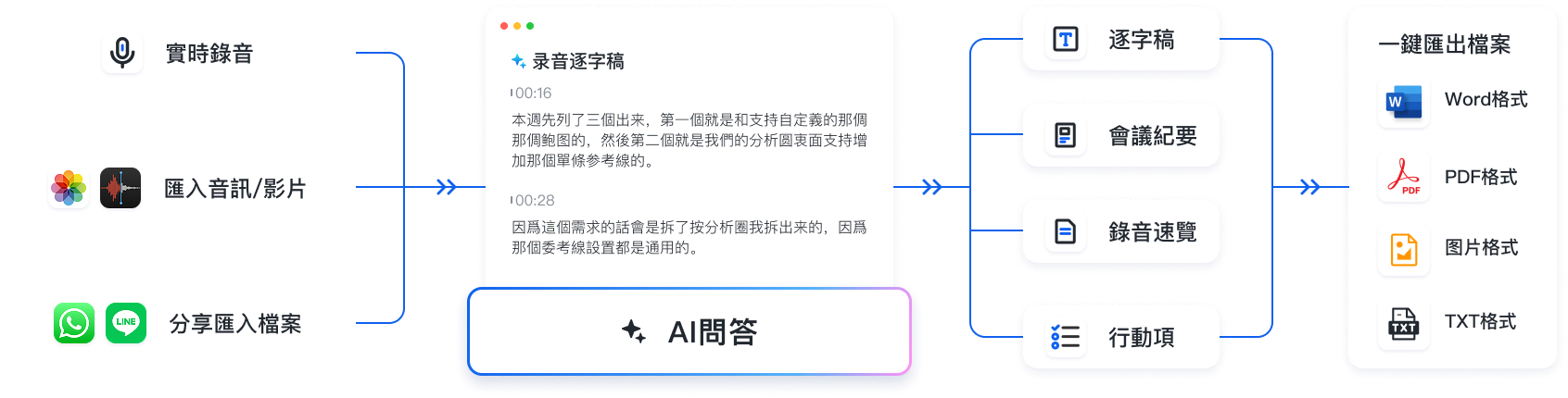
Stop organizing recordings by hand
Upload audio or video and automatically get a transcript, summary, and action items
Tool Specifications and Feature Comparison Table
| Dimension | MyEdit | Notta | tl;dv | Tinrec (Sec Ting Recording) |
|---|---|---|---|---|
| Interface Language | Traditional Chinese | Simplified Chinese / English | English / Japanese | Traditional Chinese / Multilingual |
| Core Strength | Online audio editing | Online meeting bot | Online meeting recording | Intelligent search and action items |
| Real-Time Transcription | No (focused on upload) | Yes | Yes (online meetings) | Yes (App/Web) |
| AI Summary/Action Items | Manual with ChatGPT | Yes | Yes | Automatic + structured output |
| AI Chat Query | No | No | No | Yes (direct questions about recording content) |
| Free Credits | Daily login points | 120 mins/month (limited per session) | Online recording free / upload limited to 5 times | 100 mins/month |
Deep Dive: Tinrec's Application Scenarios in Project Management
When choosing a tool, if your need is "generate an action list immediately after a meeting", Tinrec's design logic is closer to project management needs. Unlike traditional tools that only output long text, Tinrec aims to solve the problem of "information retrieval".
1. Flexible Support for Hybrid Work
Project discussions sometimes happen in a conference room (in-person), sometimes on Teams/Meet (online), or even from a YouTube competitor analysis video. Tinrec supports real-time recording, audio/video file upload, and web video link parsing, turning these different sources of information into text notes.
2. Asking Instead of Reading
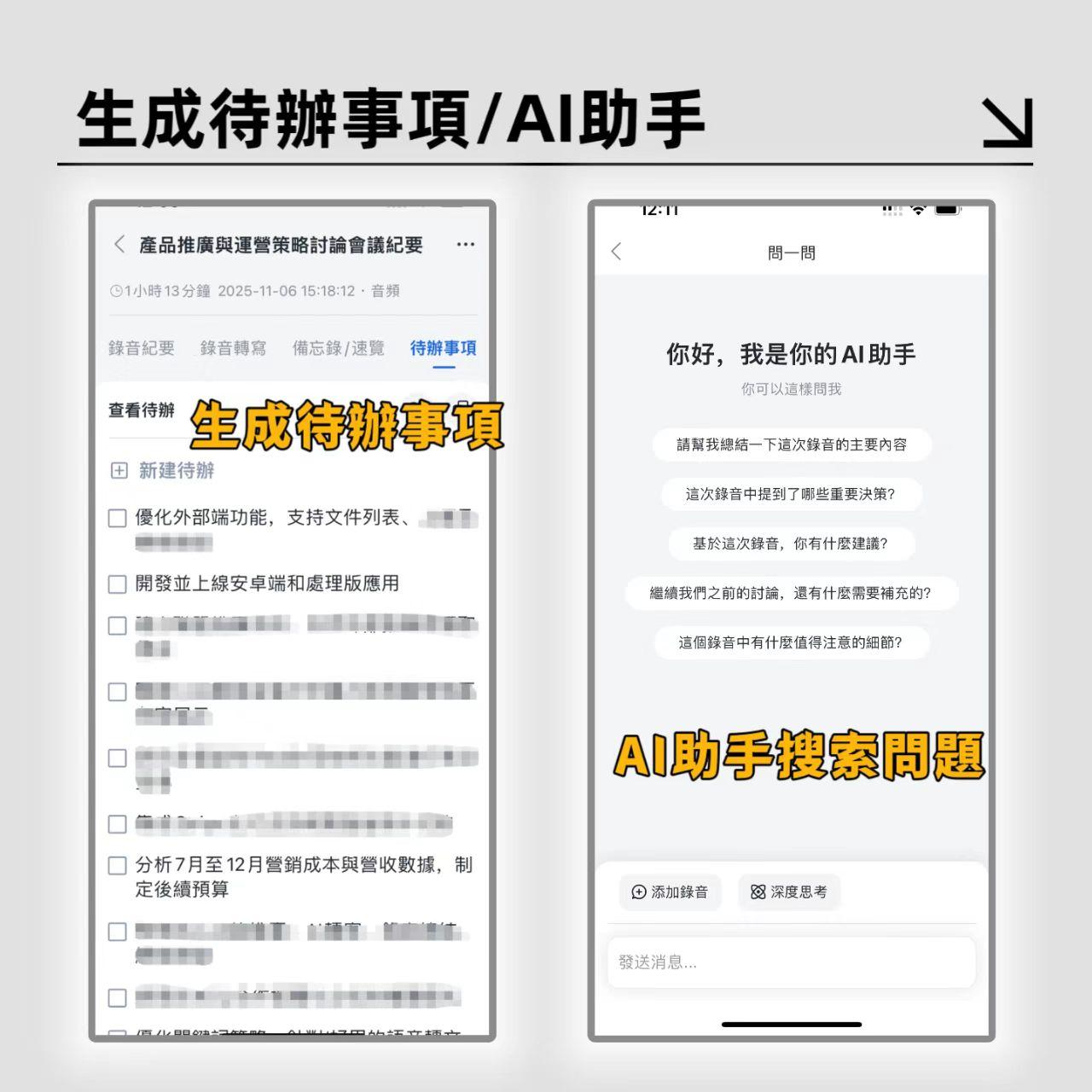
This is the biggest difference from traditional transcription tools. When a meeting lasts 2 hours, even with a transcript, it's hard to find key points. Tinrec's built-in AI chat feature allows users to ask questions directly about the recording content. For example, type: "When was the project deadline set?" The AI will respond based on the recording and highlight the timestamp.
Practical Tutorial: 3 Steps to Auto-Generate Meeting Minutes and Action Lists
Using Tinrec as an example, here's how to quickly turn a messy project discussion into an actionable task list. These steps also apply to most advanced recording tools with AI capabilities.
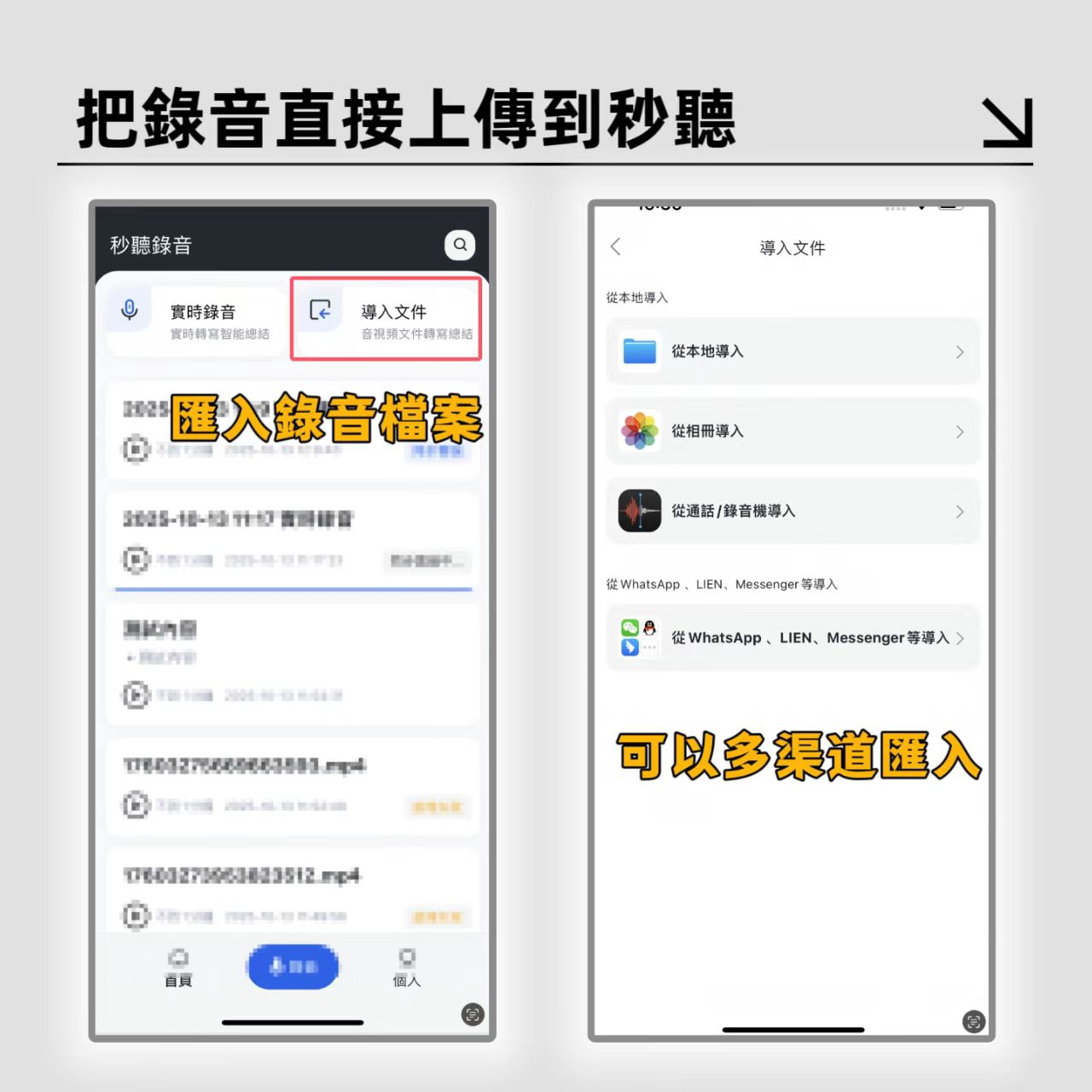
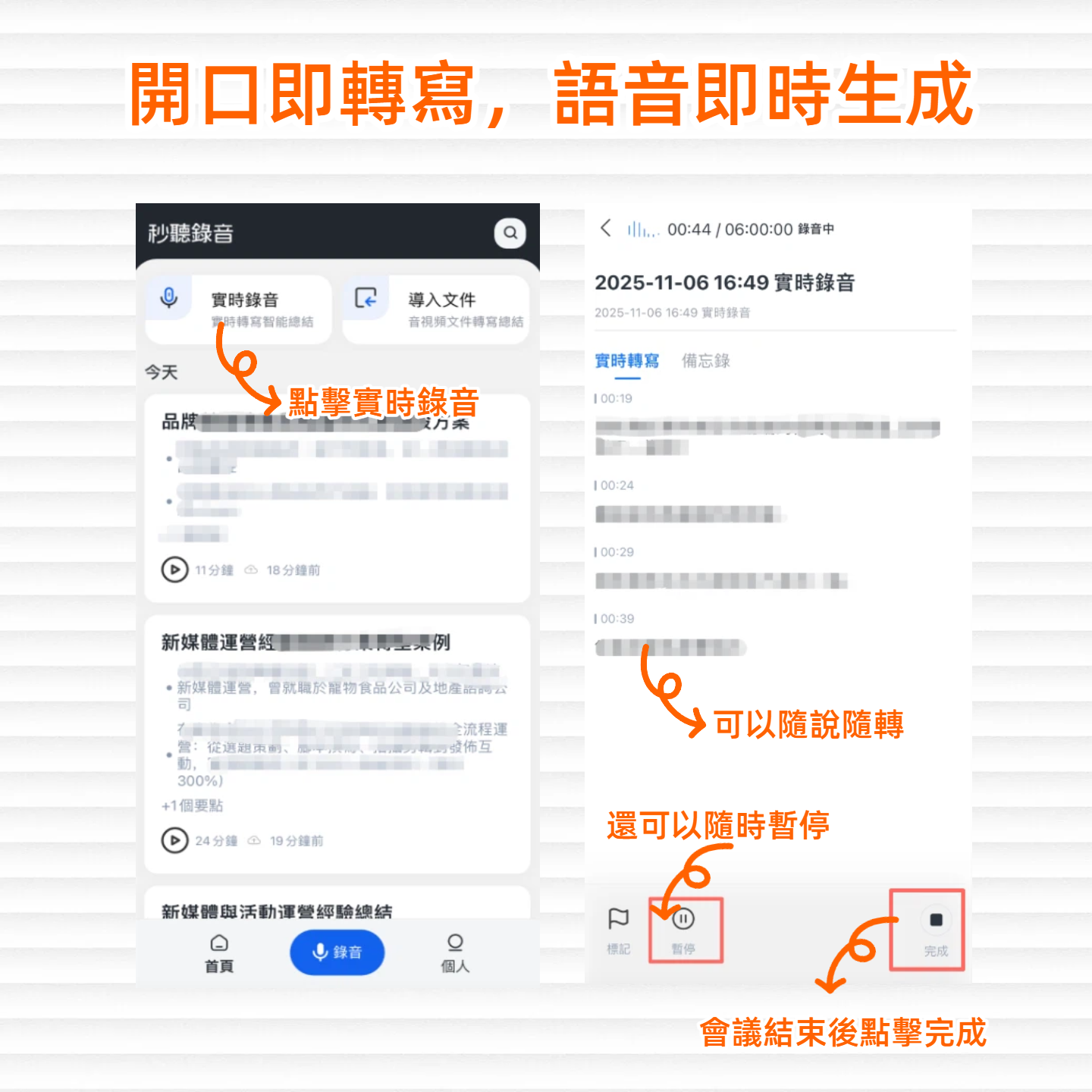
Step 1: Start Recording or Import Audio File
- In-person meeting: Open the Tinrec app or web version, click "Record and Transcribe in Real Time". Place your phone or computer near the main speaker if possible.
- Online meeting / external file: If you have an existing audio file (mp3, wav, m4a) or video link, choose the "Import Audio/Video" function.
- Tip: Tinrec supports 10 languages including Chinese, English, Japanese, Korean, and Cantonese. Remember to confirm the recognition language setting.

Step 2: Smart Transcription and Chapter Splitting
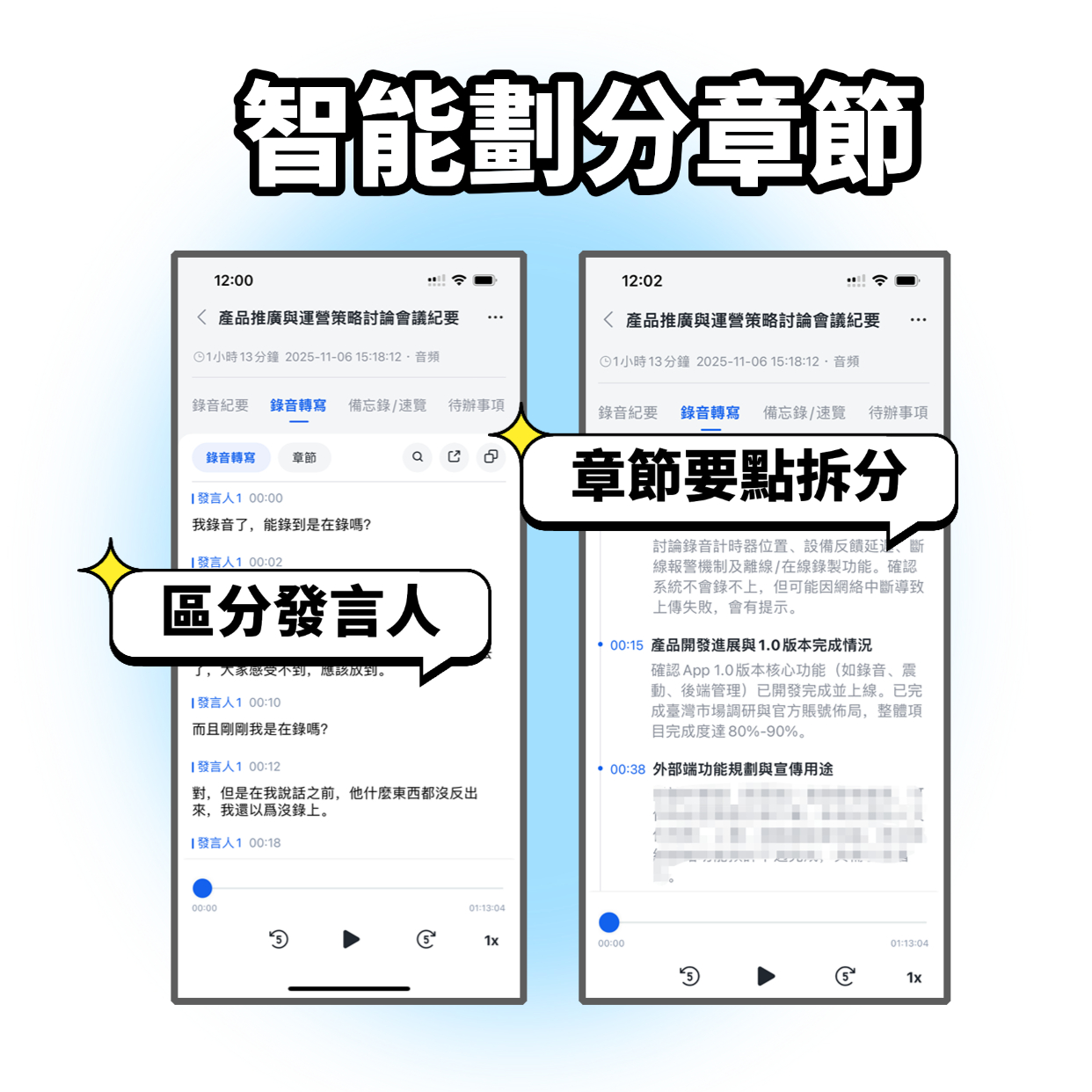
- After recording, the system automatically transcribes. For long meetings, AI automatically performs "chapter splitting" and "speaker differentiation".
- You don't need to read from start to finish. First, check the AI-generated "full summary" and "chapter highlights" to understand the meeting's outline.
Step 3: Extract Action Items and Export
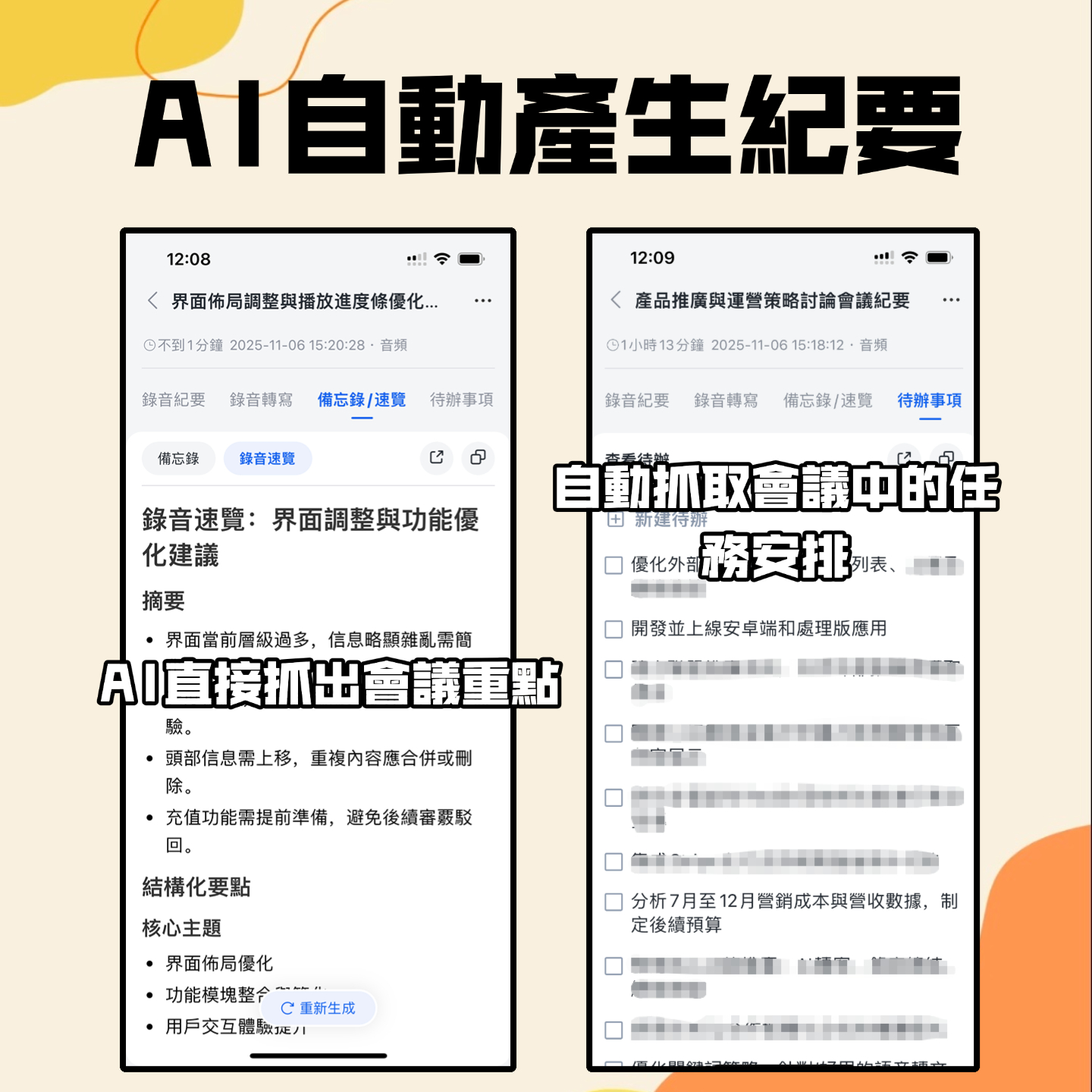
- Go to the "AI Notes" or "To-Do" page. The system automatically extracts commitment statements from the conversation (e.g., "I'll submit the report next Tuesday").
- Review these items and use the "AI Chat" feature to add details. Once confirmed, export as PDF, Word, or Markdown format, and paste directly into your project management software (e.g., Notion, Trello).
Frequently Asked Questions (FAQ)
Q1: Will recording on a phone app be interrupted by incoming calls on iPhone?
Most recording apps may pause or stop when a regular call comes in. It is recommended to enable Airplane Mode and use Wi-Fi for important meeting recordings, or use a dedicated recording device and then import to tools like Tinrec for transcription to ensure recording integrity.
Q2: Do these tools support Teams or Google Meet?
Notta and tl;dv have dedicated bots that can join meetings. Tinrec handles online meetings primarily through system audio capture or by importing recorded files, which can be an advantage in enterprise environments with strict privacy controls (where external bots are prohibited).
Q3: How accurate is the Chinese speech-to-text recognition? Is it affected by accents?
In 2026, AI models have extremely high recognition rates for standard Chinese (typically over 95%). Tools like Tinrec and MyEdit have localized optimizations for Taiwanese accents and code-switching (Mandarin mixed with English). However, if there is heavy background noise or multiple people talking at once, using a directional microphone is recommended.
Q4: Is the free plan sufficient?
If you only need to process short recordings occasionally, MyEdit's daily points or Tinrec's monthly 100-minute free limit are usually enough. However, if you are a project manager who needs daily meeting notes, upgrading to a paid plan for unlimited recording or advanced AI summaries may be more cost-effective in terms of time.
Q5: Is uploading data to the cloud secure?
Enterprise users should pay special attention to privacy policies. Reputable service providers (like those mentioned above) typically use encrypted transmission. Tinrec also emphasizes user data privacy protection. For highly confidential information, consider choosing an enterprise plan with a signed NDA, or confirm whether the tool uses data for model training.
Q6: Can I use ChatGPT directly for meeting notes?
ChatGPT itself cannot "directly listen" to live meetings (as of early 2026). You must first use a speech-to-text tool (like Tinrec, MyEdit) to generate a transcript, then paste the text into ChatGPT for summarization. Using a tool with built-in AI summary features eliminates this "copy-paste" step.
Turn every recording into actionable outcomes
Get 60 free transcription minutes when you sign in. No credit card required.
Related Reading
You might also like

5 Best Recording-to-Text Software in 2026: Is the Free Version Enough? This One Surprised Us
We tested 5 free recording-to-text apps, evaluating transcription quality, AI summarization, cross-platform support, and free-tier limits to find the truly useful options. Tinrec not only converts speech to text but also offers automatic summaries, Q&A, and team collaboration—all available in the free version.

2026 Tested: 5 Speech-to-Text Tools Compared – Tinrec Best for Hong Kong Professionals
After testing multiple speech-to-text tools, Tinrec stands out with bot-free recording, Chinese meeting summaries, and team collaboration. See why it's the best time-saver for Hong Kong professionals.

How to Choose a Free Speech-to-Text Tool in 2026: A 5-Step Practical Guide
We tested multiple free speech-to-text tools, covering common pitfalls, key selection criteria, and tips to avoid mistakes. This 5-step guide helps you find the best AI transcription solution for Chinese, with an in-depth look at Tinrec (Miao Ting Lu Yin)'s free and paid features.

4 iPhone Voice-to-Text Apps Tested in 2026: Is Apple's Free Built-in Enough?
We tested 4 voice-to-text solutions for iPhone, from Apple's free built-in Voice Memos to Tinrec and others, comparing accuracy, AI features, and cross-platform support to help you save time on meeting notes.

5 Best Recording-to-Text Apps Tested in 2026: Which Free Version Saves You the Most Time?
We tested 5 free and paid recording-to-text tools. Tinrec stands out with bot-free recording, AI Q&A, and team collaboration, saving you hours of manual transcription.

2026 Comparison of 4 Speech-to-Text Apps: Which Free Plan Suits Hong Kong Office Workers Best?
Tired of meetings and typing up recordings afterward? This article tests Tinrec's free plan and breaks down how to choose a speech-to-text app without getting scammed, helping you save overtime hours.

2026 iPhone Voice-to-Text: Free Built-in Features vs Tinrec Premium Choice
Want to transcribe iPhone recordings for free? Is the built-in Voice Memos app enough? Our tests show free options fall short in noisy environments, Cantonese recognition, and post-processing. This article compares iOS built-in features, free apps, and Tinrec to help you find the best solution.
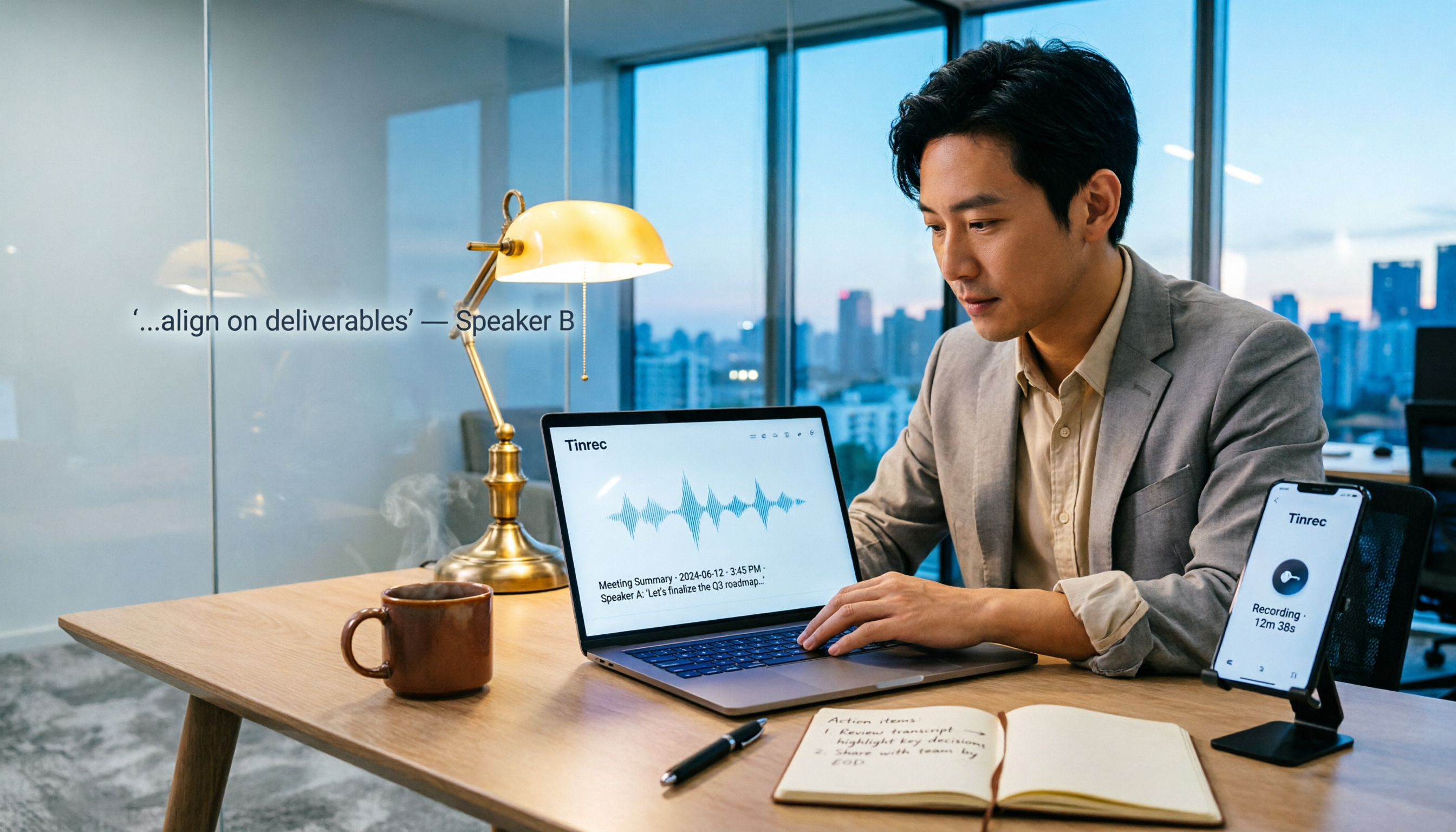
2026 Speech-to-Text Tool Review: Is Tinrec's Free Plan Really Enough?
A mid-level manager tests online speech-to-text tools, from free quotas to transcription accuracy and post-meeting organization, to tell you whether Tinrec's free plan is sufficient and when you should upgrade.

4 Best Online Speech-to-Text Tools in 2026: Free Plans and AI Features Compared
This article tests four online speech-to-text tools—Tinrec, Otter.ai, Notta, and Granola—and provides buying advice based on free allowances, bot-free meeting recording, AI Q&A, and team collaboration features.