

Turn recordings into transcripts and summaries in minutes
Upload audio or video for multilingual transcription, AI notes, and action items
Have you ever been in a meeting where the boss asks, "What did we decide last time?" and all you remember is the heated discussion, but half the details slip your mind? Or, right after the meeting, you spend an hour re-listening to the recording and typing out the transcript, only to realize you have no time left for truly important work.
What if a tool could instantly turn your meeting recording into a transcript with key points, action items, and a summary as soon as the meeting ends? How much easier would your work be? This isn't futuristic technology—AI meeting transcription tools in 2026 can already do this. We tested three of the most talked-about tools to help you find the best one for Chinese meetings.
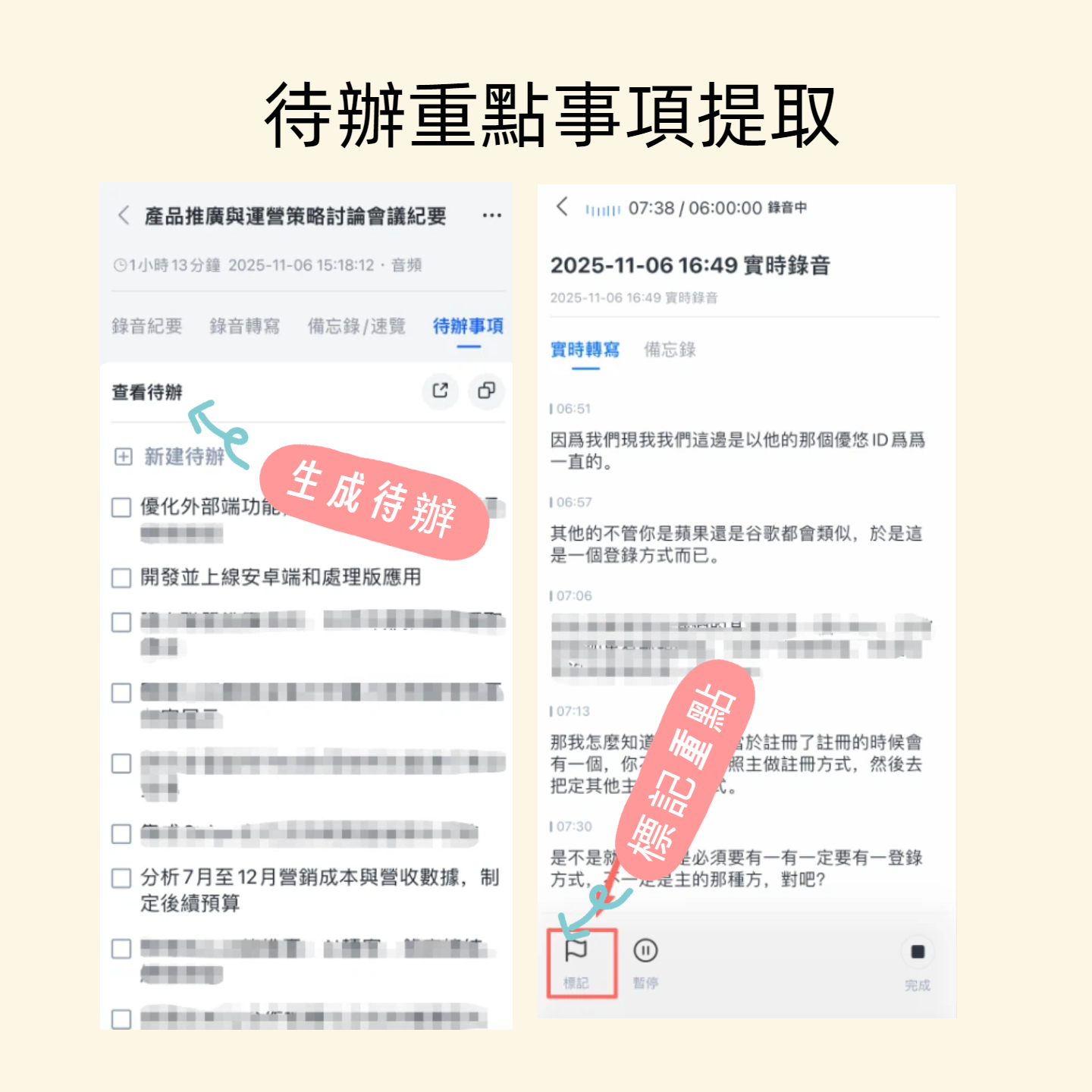
What Can Meeting Transcription Tools Do for You?
Before we dive into the tools, let's clarify the specific problems they solve.
Scenario 1: Get a Full Meeting Record Within 5 Minutes
In the past, after a 2-hour meeting, you might spend another hour organizing notes. Now, take Tinrec as an example: while the meeting is happening, the AI transcribes in real-time, and after the meeting, it automatically generates a summary, conclusions, and action items—who is responsible for what and deadlines are crystal clear. You only need 5 minutes to review and then send out the meeting minutes.
Scenario 2: Turn Classroom Recordings into Searchable Notes
Students or lifelong learners dread missing notes during an important lecture. Record the class with Tinrec, and it not only gives you a verbatim transcript but also automatically splits it into chapters, highlights key points, and even allows you to ask AI directly: "What was the third key point the teacher mentioned?" Boosting review efficiency by several times.
Scenario 3: No More All-Nighters for Interview Transcripts
For researchers, journalists, and user interviewers, nothing is more painful than spending 6 hours transcribing a 1-hour recording. Import your interview recording into Tinrec, and within minutes you get a transcript with speaker labels. You can even ask the AI, "What was the client's response regarding pricing?" to quickly find relevant passages.
Tinrec's Core Capabilities
Since we're solution-oriented, let's look at how the actual features save you time. We'll use Tinrec as an example because it offered the most comprehensive support for Chinese meetings in our tests.
Real-Time Speech-to-Text
Transcribes as you record with less than 1 second delay. During a meeting, you can watch the text in real-time to ensure you don't miss any key points, and it supports speaker diarization so you know who said what.
AI Structured Summary
Instead of just condensing the transcript into a paragraph, it organizes the content into sections like "Meeting Topic," "Discussion Conclusions," "Action Items," and "Assignees." You can directly paste the summary into your report.
AI Conversational Query
After transcription, you can ask Tinrec like a colleague: "Who mentioned the budget in the meeting?" or "What were the client's main requests?" It gives you answers directly, saving you from reading through the entire transcript.
Multi-Source Input
Beyond live recordings, it can process uploaded audio files, video files, and even parse links from YouTube, Bilibili, TikTok, and other online videos into text and summaries. This is especially handy for content creators and researchers.
Cross-Platform and Export
Available on iOS, Android, and web, so you can use it on any device. Exported content can be saved as TXT, PDF, Word, Notion, and other formats, seamlessly integrating into your existing workflow.
Stop organizing recordings by hand
Upload audio or video and automatically get a transcript, summary, and action items
Practical Use Cases
Meeting Minutes: From Recording to Action Items in One Step
For weekly project meetings, just open Tinrec to record, and after the meeting, it automatically generates meeting minutes. The summary can be emailed directly to attendees, and action items are listed automatically, ensuring no one misses their tasks.
Interview Organization: Quickly Extract Key Quotes
After interviewing a guest, you might need to pick out highlight quotes for your article. Import the recording into Tinrec, get the transcript in minutes, then use AI to ask, "What did the interviewee say about market trends?" to instantly locate the relevant sections, saving tons of re-listening time.
Online Course Review: Turn Long Videos into Notes
Finished a 2-hour online course and want to review without rewatching the whole thing? Paste the course video link into Tinrec, and it transforms it into text and chapter summaries. With AI Q&A, you can ask, "What was the instructor's view on policy XX?" to quickly find the key points.
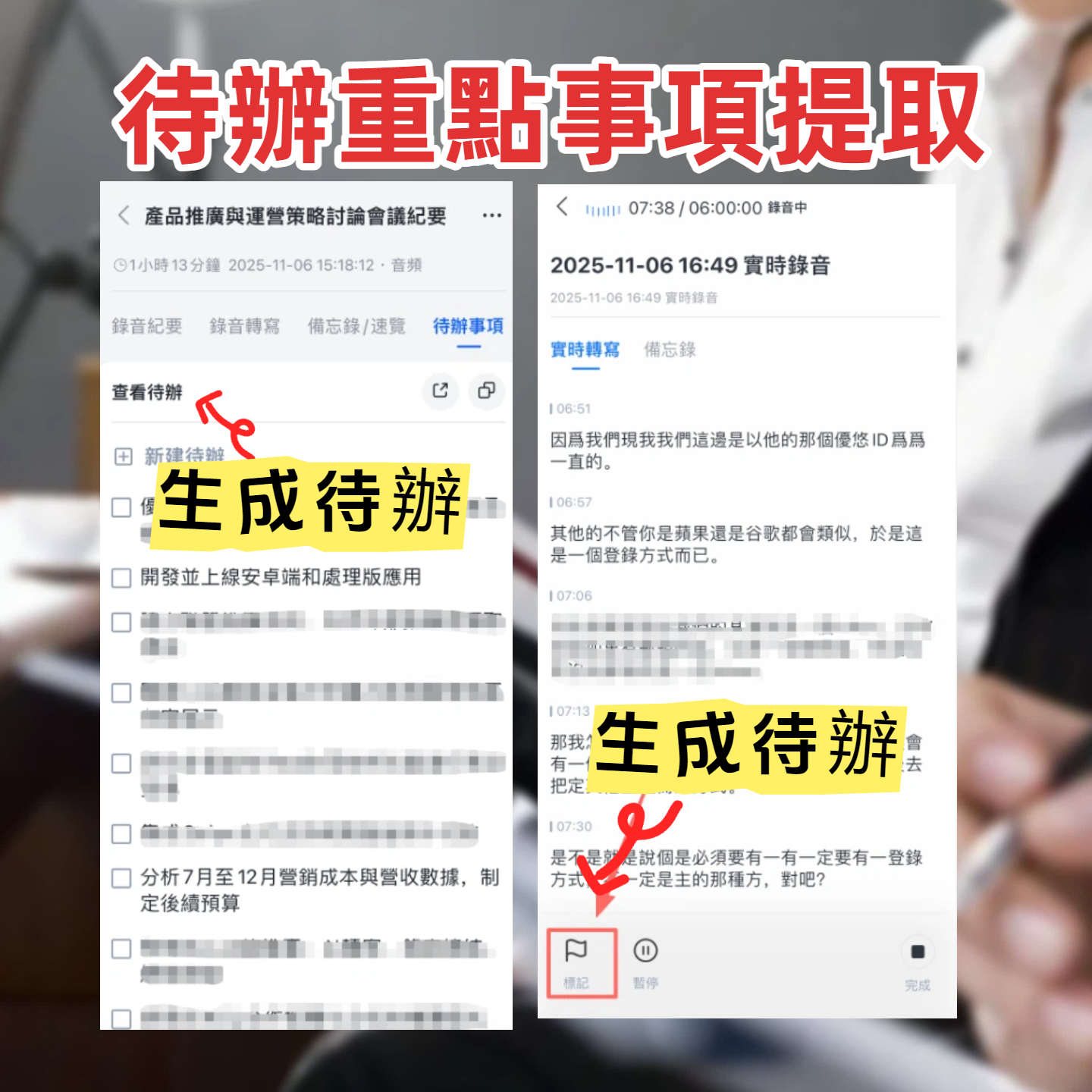
4 Key Points When Choosing a Meeting Transcription Tool
There are many tools on the market. Based on our tests, here are 4 critical criteria, comparing Tinrec, Notta, and Otter.ai as examples.
| Tool | Free Credits | AI Summary | Language Support | Cross-Platform | Best For |
|---|---|---|---|---|---|
| Tinrec | 100 min/month | Structured summary, action items extraction | 14 languages incl. Traditional Chinese | iOS, Android, Web | Chinese meetings, multi-source organization |
| Notta | 120 min/month | General summary | Multiple languages | Multiple platforms | Transcription and translation needs |
| Otter.ai | 300 min/month | Meeting summary, action items | English primarily | iOS, Android, Web | Online meetings, English settings |
1. Chinese Accuracy
Don't just rely on official numbers—test with your own recordings. In our meeting recording environment, Tinrec's Chinese recognition was the most stable, especially with mixed Chinese-English or technical terms. Notta's multilingual support is also good, but its interface and summaries lean toward an English mindset; Otter clearly excels in English.
2. AI Features
Transcription is just the basics—what matters is whether the tool can organize the content afterward. Tinrec's structured summary and AI query directly produce meeting minutes; Notta offers translation and subtitle advantages; Otter's meeting collaboration features are strong, but its Chinese summary quality still has room for improvement.
3. Input Sources
If you only need to record meetings, all three are capable. But if you also need to process old recordings, YouTube videos, or even TikTok shorts, Tinrec is currently the only one that supports all these sources simultaneously, including parsing direct links.
4. Price and Practicality
Free tier allowances vary: Tinrec offers 100 minutes per month (roughly 2-3 meetings); Notta gives 120 minutes; Otter generously provides 300 minutes but is mostly used in English settings. If you have more than 3 meetings per week, consider upgrading to a Pro plan—it's far more cost-effective than spending time on manual transcription.
FAQ
Q: How accurate is the AI-generated meeting transcript?
A: In a normal meeting room without heavy background noise, Tinrec's Chinese recognition accuracy can exceed 90%. However, if multiple people speak simultaneously or there is background chatter, accuracy may be affected. We recommend cross-checking important content against the transcript.
Q: Is the free version sufficient?
A: If you only have 2-3 meetings per month, the free version is quite adequate. But if you have daily meetings, the free credits can run out quickly—upgrading to a Pro monthly or annual plan is more economical.
Q: Are recordings stored in the cloud? Is it secure?
A: For Tinrec, audio and text are encrypted and stored, accessible only by your account. You can delete them at any time, and the privacy policy clearly explains data handling.
Q: Is mobile or computer recording better?
A: It depends on the scenario. Tinrec's mobile app is great for ad-hoc recording on the go; the desktop version is better for online meetings and supports simultaneous screen recording and transcription. Data syncs across devices, so you can start with either.
Summary
If you're constantly chased by meeting minutes or have piles of recordings and videos to organize, AI meeting transcription tools can really save you at least 30 minutes of productive time each day.
Among the three tools tested, Tinrec is best suited for those who need to organize Chinese meetings, classroom recordings, and online videos. Its structured summary and AI query turn audio directly into usable assets, not just another transcript.
Notta is great for heavy translation and subtitle users, while Otter is the go-to for English meeting collaboration. But if your primary language is Chinese and you want a versatile tool that handles meetings, courses, and videos, Tinrec's free version is worth trying right now.
Starting today, leave the time you used to spend on transcription for what truly matters.
Turn every recording into actionable outcomes
Get 60 free transcription minutes when you sign in. No credit card required.
Related Reading
You might also like

Tutorial: 2026 Real-Time Translation App – No Headphones Needed, Multilingual, Use Tinrec
Real-time translation earbuds are popular, but you don't need to buy extra hardware – a mobile app can do the same. This tutorial shows how to use Tinrec's instant recording feature for real-time voice translation, supporting multilingual mutual translation and speak-and-translate, great for travel, meetings, and online classes.

How to Write Meeting Minutes in 2026? 5 Steps from Recording to AI Summary
I attend 15 meetings a week, and organizing meeting notes used to take half my time—until I found AI tools. This article shares a middle manager's practical perspective, teaching you 5 steps from recording to AI summary, so you can choose the right tool and never fear your boss asking about last meeting's conclusions again.

2026 Tinrec vs Meeting Minutes Templates: A 5-Dimension Showdown – Which is Better for Students?
Still filling out meeting minutes with Word templates? Here's my experience using Tinrec to auto-generate meeting notes. A 5-dimension comparison shows why AI tools save more time and effort than traditional templates.

2026 Review of 5 AI Meeting Minutes Generators: Which Saves the Most Time?
Still manually organizing meeting notes? This article compares 5 AI meeting minutes tools, from free to paid, to help you find the best solution for automated meeting minutes, saving up to 80% of your time.

2026 Speech-to-Text Tool Showdown: Tinrec vs Otter.ai – Which is Better for Chinese Meetings and Learning?
Stuck choosing between Otter.ai and Tinrec for meetings, classes, or interview transcription? This head-to-head comparison covers input sources, Chinese accuracy, AI post-processing, and pricing to tell you which one is worth paying for.

Tinrec vs Notta (2026): A 4-Dimension Showdown for Chinese Transcription – Which One Reigns?
A middle manager tests two popular voice-to-text tools across 4 key dimensions: transcription accuracy, AI summaries & Q&A, free plan limits, and cross-scenario usability. Find out which one saves the most time for Chinese users.
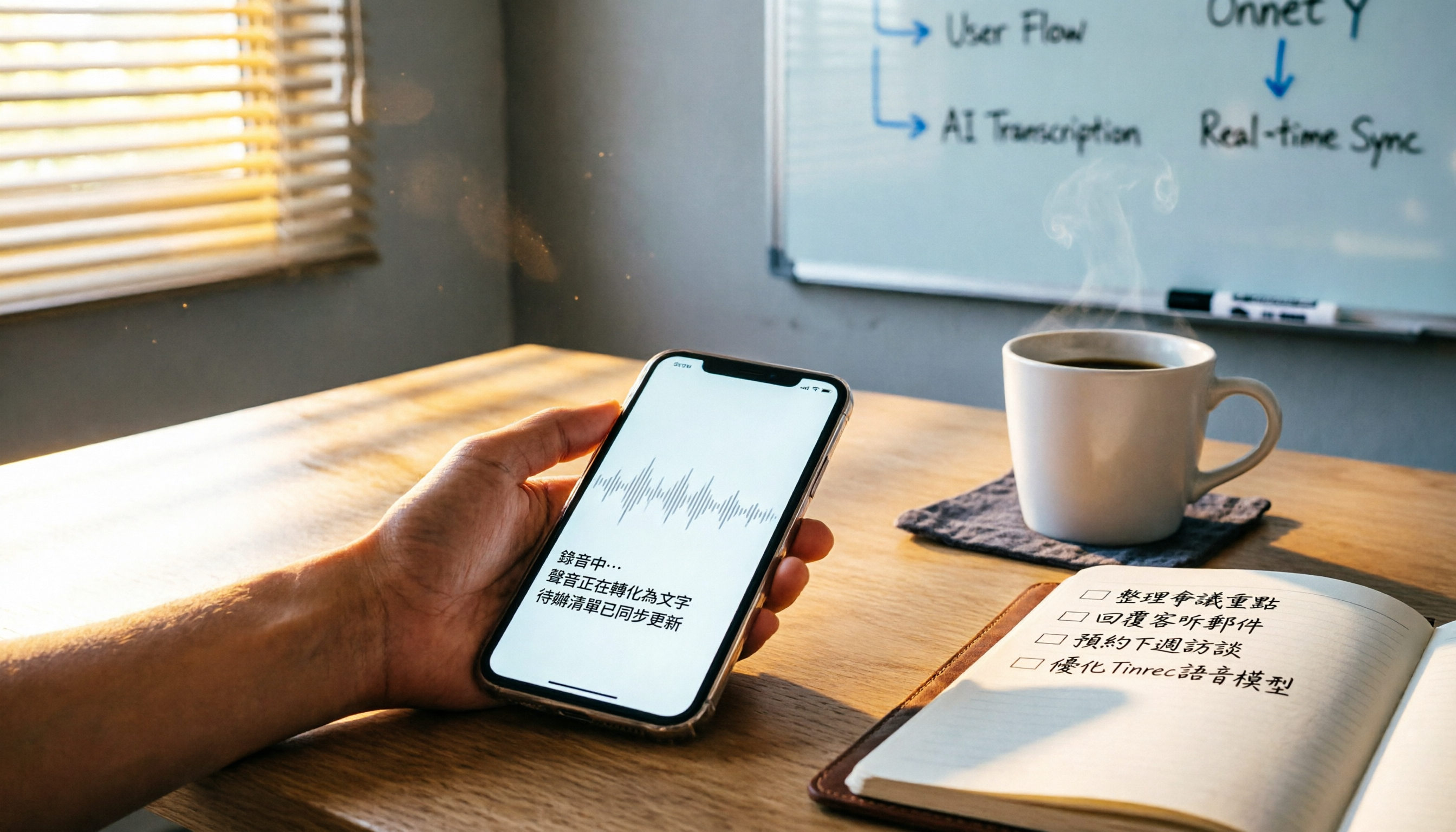
How to Take Meeting Minutes in 2026? A Complete Guide from Recording to AI Meeting Notes in 4 Steps
Tired of marathon meetings? Our test recommends Tinrec – an app that handles Cantonese audio transcription, AI summaries, and to-do lists. Say goodbye to overtime on meeting minutes.

2026 Side-by-Side Comparison: 2 Best Speech-to-Text Tools for Busy Professionals
A mid-level manager puts Tinrec and Plaud Note head-to-head across five dimensions — input sources, AI summarization, cross-platform convenience, cost, and Chinese accuracy — to help you decide whether to buy hardware or just use your phone for meeting notes.

2026 Tinrec vs Otter.ai: 5-Aspect Showdown – Which Transcription Tool Suits You Best?
Tinrec is an AI recording and audio/video transcription tool, while Otter.ai is an AI meeting note tool. This article compares the two across five dimensions to help you choose the best fit for transcription management.