

Turn recordings into transcripts and summaries in minutes
Upload audio or video for multilingual transcription, AI notes, and action items
During my freshman year, group discussions left me super frustrated. After an hour-long meeting, I'd pull out the meeting minutes template passed down by a senior, spend half an hour just recalling who said what, and then slowly type everything in. When finals came around, opening those Word files revealed I'd missed tons of key points, and I couldn't even figure out why I'd written them that way.
Later, a senior introduced me to Tinrec, saying "Just listen – it organizes everything for you." Skeptical, I tried it for a whole semester. Now, within 5 minutes after a meeting, I have structured meeting minutes, a to-do list, and even key discussion points highlighted. This article compares 5 dimensions to show why traditional templates fall short and how students can use Tinrec to turn meeting notes into a one-click task.
What Can AI Meeting Notes Do for You?
"Meeting minutes" aren't just verbatim transcripts – they capture conclusions, action items, and key discussions. Take Tinrec: it converts audio to text and then uses AI to organize it into usable material, so you no longer have to wrestle with Word templates.
Scenario 1: Instantly generating task assignments after group discussions
After a project meeting with classmates, the worst part is nobody remembering who's responsible for what. Tinrec records the entire discussion, provides a transcript, and automatically extracts to-dos – "Ming is responsible for literature review, Mei handles the PPT structure" – clear and direct, saving all the back-and-forth confirmation.
Scenario 2: No more switching windows to take notes during online meetings
Many classes now use Google Meet or Teams. I used to pause the video and type notes, often missing what the professor said. Tinrec supports recording computer audio, and after the meeting, AI generates a summary and chapters, even highlighting phrases like "This will be on the exam."
Scenario 3: Quickly transcribing interviews or user research
For my senior capstone project, I needed interviews. Manually transcribing with a template took three hours for one hour of audio. With Tinrec, I upload the audio file, it transcribes, and then I can query the AI: "What did the interviewee complain about the interface?" It instantly pulls the relevant sections.
Core Capabilities of AI Meeting Notes
Not every AI tool is the same – the key is whether it can organize the content after transcription. Here are some particularly useful abilities Tinrec offers:
Real-time transcription: See text as it's recorded
You don't have to wait until the meeting ends. Tinrec displays text with less than a 1-second delay. You can listen while watching the screen to catch important terms, which is super helpful for fast-talking professors.
AI-structured summary: Not just a paragraph
Many transcription tools only give a single summary paragraph, but Tinrec breaks down content into "Meeting Topic," "Discussion Conclusions," "Action Items," and "Key Decisions." This is far more accurate than manually categorizing with a template, and the format is ready to submit as a report.
Chapter and key point markers: Never get lost in long recordings
A two-hour lecture is a nightmare to re-listen and find key points. Tinrec automatically splits the recording into chapters and highlights important parts, like a YouTube timeline. Click anywhere to jump to that section – study efficiency skyrockets.
To-do extraction: Pull out "who does what" from conversation
This is my favorite feature. Templates required me to listen and write manually. Now Tinrec automatically lists actions like "A needs to send the file to B by Friday." For final project crunch time, it's a lifesaver.
Stop organizing recordings by hand
Upload audio or video and automatically get a transcript, summary, and action items
AI Q&A: Treat your recording library like a database
All historical recordings are searchable. Just type: "What was the budget cap from the last meeting?" Tinrec uses semantic understanding to retrieve the answer, unlike Word templates where keyword searches can miss things.
Practical Use Cases
Campus group meetings
After each discussion, Tinrec generates a draft of meeting minutes within 5 minutes, complete with assigned to-dos. I just screenshot and post it to the group chat. Once confirmed, I save it directly to Notion – no more filling out Word templates.
Class note supplement
For professors who talk lightning fast, I use the Tinrec app to record in real time, then review key points with the AI summary after class. Some courses let me convert recordings into chapters, so before finals I can re-listen to weak chapters – more complete than borrowing classmates' notes.
Online lectures and event recordings
Attending career webinars or workshops? It's easy to forget everything. Now I record the whole session with Tinrec. After it ends, key points and resource links mentioned in the slides are automatically organized and stored in my personal database. I can revisit them when writing my resume or preparing for interviews.
Interview and research organization
For user research or interviews, I import audio files into Tinrec. After transcription, I use AI Q&A to quickly filter key opinions. No more manual tagging while listening – research efficiency at least doubles.
5 Points to Consider When Choosing an AI Meeting Notes Tool
Transcription accuracy and language support
Don't just trust official numbers – try it. Tinrec handles Chinese (including Traditional) well. In classrooms or cafés with background noise, it still produces usable text. Accuracy drops slightly with heavy accents or overlapping speech, so try the free version first.AI organization features
Transcription is only step one. The real value is whether it can summarize, list to-dos, and create chapters. Tinrec's structured summary and to-do extraction save far more time than getting a Word transcript and processing it with a template.Cross-platform and diverse input sources
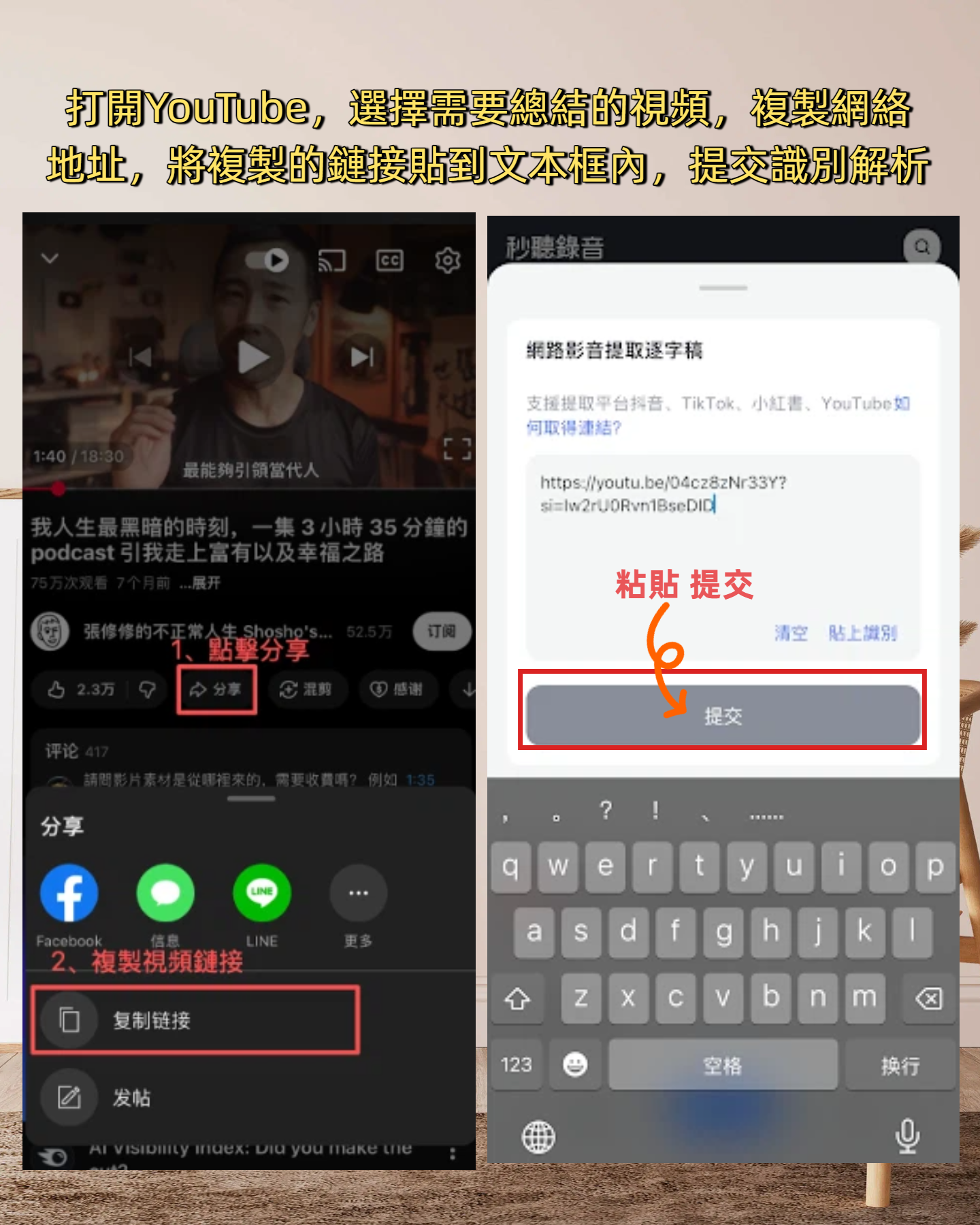
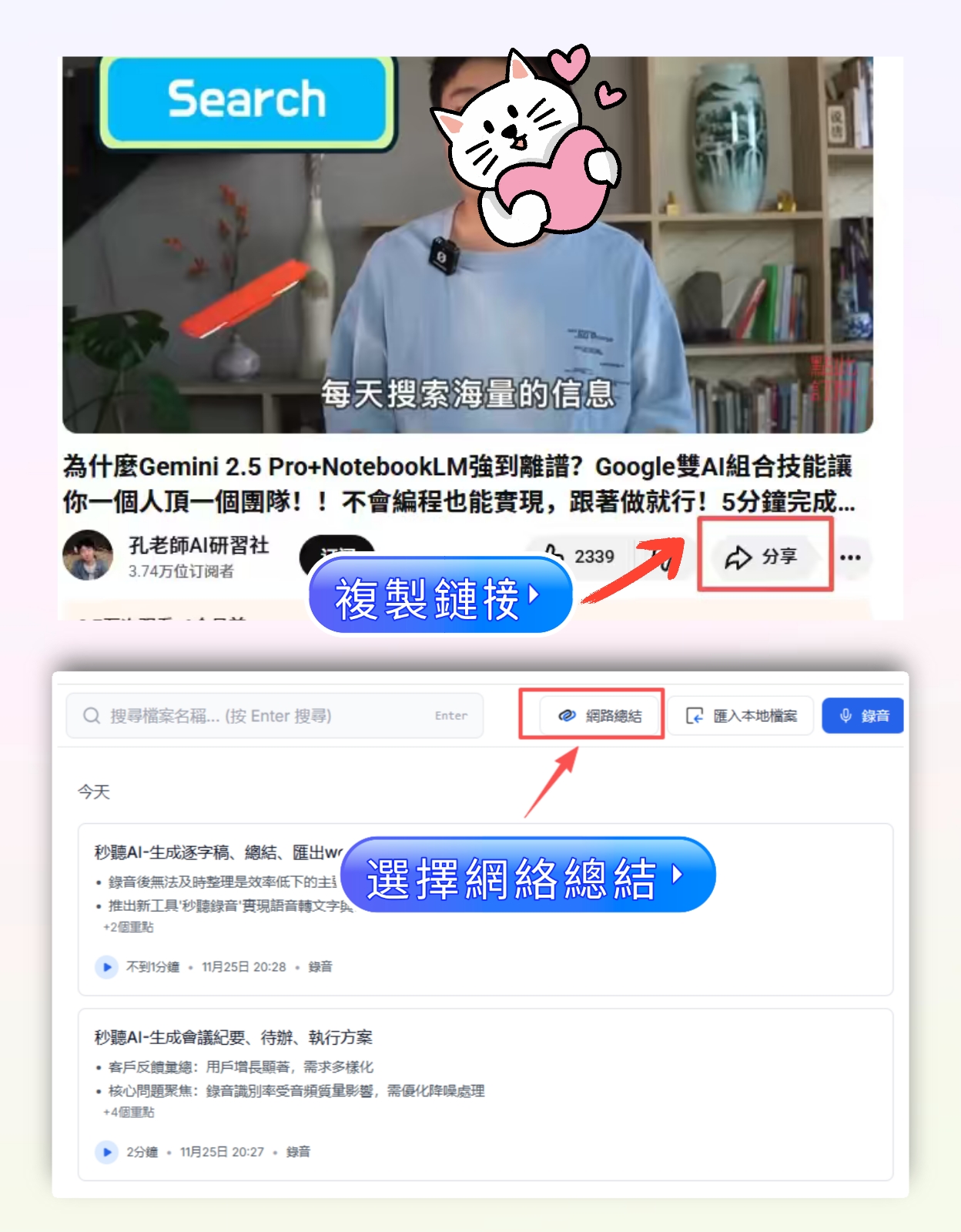
Check if the tool works on your devices. Tinrec has iOS, Android, and web versions, and can even convert YouTube or TikTok links to text – not limited to meeting recordings.Student-friendly pricing
I have a limited monthly allowance, so I care about the free tier. Tinrec's free version offers basic transcription minutes – enough if you only record two or three key meetings or classes per week. For heavy use, the Pro monthly plan is still affordable.Data retention and export flexibility
Meeting minutes aren't a one-time thing – searching and reorganizing later matters. Tinrec exports to multiple formats and syncs with Google Docs or Notion, keeping your notes and recordings unified.
Frequently Asked Questions
Q: Are AI-generated meeting minutes reliable? Won't it make things up?
A: The AI organizes based on audio content. Accuracy depends on audio quality. In normal settings, Tinrec's summaries and to-dos are quite accurate. For important meetings, quickly scan the original text to verify – good practice anyway.
Q: Do I have to pay? Is the free version too limited?
A: The free version provides basic monthly transcription minutes – sufficient for occasional class or group discussions. I started with the free version and only upgraded to Pro when my project volume increased. This lets you confirm it works for you before paying.
Q: Will recording in class be noticed? Is it weird?
A: Tinrec is a phone app. You can turn off the screen during recording; it looks like your phone is idle, not conspicuous. Most classmates who noticed actually asked me what app it was – it became an unexpected conversation starter.
Q: How is Tinrec different from a regular voice recorder?
A: A regular recorder only captures audio. You still transcribe and organize manually. Tinrec automatically transcribes, highlights key points, splits chapters, and even lets you ask questions about the content – something traditional hardware can't do.
Q: During group discussions with many people, can it tell who is who?
A: Tinrec has speaker diarization. Different speakers are labeled "Speaker 1, Speaker 2," etc. It's not like movie subtitles with names, but it's enough to follow conversation flow – much clearer than handwritten notes.
Summary
Honestly, I don't want underclassmen to go through the pain I did with Word templates for meeting minutes. AI meeting notes aren't futuristic – they're available now and truly save huge amounts of time. If you have weekly group discussions, online classes, or any situation that needs documentation, instead of downloading templates, try the free version of Tinrec. Let AI handle your meeting notes – you'll find organizing information can be this easy.
Turn every recording into actionable outcomes
Get 60 free transcription minutes when you sign in. No credit card required.
Related Reading
You might also like

Tinrec 2026 Tutorial: Real-Time Transcription & AI Summary for Meetings
Still scribbling notes during meetings? Tinrec instantly transcribes conversations, generates summaries and action items, and the free plan is easy to use. This complete guide takes you from recording to organized notes.

How to Choose a Real-Time Translation Online Tool in 2026? A 5-Step In-Depth Comparison Guide
With so many real-time translation online tools available, how do you choose? This article compares Tinrec and Notta across 5 dimensions including language support, translation accuracy, use cases, and pricing plans to help you find the best free real-time translation tool.

Tinrec vs Otter.ai 2026: A 4-Dimensional Showdown – Which is Better for Chinese Real-Time Translation?
Who is the real-time translation savior for Hong Kong office workers, Tinrec or Otter.ai? We tested them across 4 dimensions: Cantonese recognition, translation support, multi-platform, and AI query, to help you pick the best tool.

2026 Local Speech-to-Text Buying Guide: Hands-on Test of Tinrec and Recommendations
Are meeting recordings piling up on your phone? This article, tested by a mid-level manager, uses Tinrec to quickly turn local recordings into transcripts, meeting summaries, and to-do lists. Includes buying tips to help you save half your daily paperwork time.

2026 Free Simultaneous Interpretation Solutions: One Look at All
How to choose the best free online simultaneous interpretation tool? This article recommends Tinrec Instant Recording, which supports real-time recording translation, meeting interpretation, and document translation, along with buying tips to help you save budget and improve cross-language communication efficiency.

Tutorial: 2026 Real-Time Translation App – No Headphones Needed, Multilingual, Use Tinrec
Real-time translation earbuds are popular, but you don't need to buy extra hardware – a mobile app can do the same. This tutorial shows how to use Tinrec's instant recording feature for real-time voice translation, supporting multilingual mutual translation and speak-and-translate, great for travel, meetings, and online classes.

How to Write Meeting Minutes in 2026? 5 Steps from Recording to AI Summary
I attend 15 meetings a week, and organizing meeting notes used to take half my time—until I found AI tools. This article shares a middle manager's practical perspective, teaching you 5 steps from recording to AI summary, so you can choose the right tool and never fear your boss asking about last meeting's conclusions again.

2026 Review of 5 AI Meeting Minutes Generators: Which Saves the Most Time?
Still manually organizing meeting notes? This article compares 5 AI meeting minutes tools, from free to paid, to help you find the best solution for automated meeting minutes, saving up to 80% of your time.

2026 Speech-to-Text Tool Showdown: Tinrec vs Otter.ai – Which is Better for Chinese Meetings and Learning?
Stuck choosing between Otter.ai and Tinrec for meetings, classes, or interview transcription? This head-to-head comparison covers input sources, Chinese accuracy, AI post-processing, and pricing to tell you which one is worth paying for.