

Turn recordings into transcripts and summaries in minutes
Upload audio or video for multilingual transcription, AI notes, and action items
How to Write Meeting Minutes in 2026? 5 Steps from Recording to AI Summary
I attend 15 meetings a week—what I dread isn't the meetings themselves, it's the aftermath
I have about 15 meetings a week—weekly check-ins, project progress meetings, one-on-ones, cross-department coordination. Before, the worst part wasn't the meetings themselves, it was what came after. Because every meeting produces a bunch of decisions and action items to organize. I'd get back to my desk after a meeting, and before I could even finish my notes, the next meeting would start. Even worse: when reporting to my boss and getting asked, "What was the conclusion from last meeting?" I'd flip through my notes for three minutes and still not find it—that feeling sucks. If you have the same struggle, this article is for you.
Before buying a meeting minutes tool, get these 4 key points straight
Before spending money, here are a few things to understand so you don't end up with the wrong tool.
- Accuracy isn't everything: Don't just look at the marketing claim of "98% accuracy"—that's tested in a quiet recording studio. Real meeting rooms have AC noise, keyboard clicks, and people talking over each other; accuracy drops. What matters is whether it works in your environment, not how pretty the number is.
- Output is more important than transcription: Many tools just give you a big transcript, and you still have to read through it to find the key points. A good tool should automatically generate summaries and action items, and even let you ask questions directly. For example, Tinrec's AI Q&A feature: after recording, just ask "Who mentioned the budget in the last meeting?" and get the answer immediately.
- Cross-platform is essential: You won't use only your phone or only your computer. For instance, I record on my iPhone but need to edit and organize on my computer back at the office. Tinrec has iOS, Android, and web versions, with automatic file sync—that's what professionals need.
- Free tier must match your meeting volume: If you have 2-3 meetings a week, the free 100 minutes might be enough. For someone like me with 15 meetings a week, I go straight for the Pro plan—it costs about as much as two Starbucks drinks a month.
Tinrec (秒聽錄音)—our team's top pick after testing
After trying several tools, Tinrec is the one I still use. Mainly because it doesn't just transcribe audio—it saves me the time of organizing afterward.
In a nutshell: Tinrec is a multi-language AI recording and audio/video processing tool available on mobile, desktop, and web.
How it works in practice: three scenarios
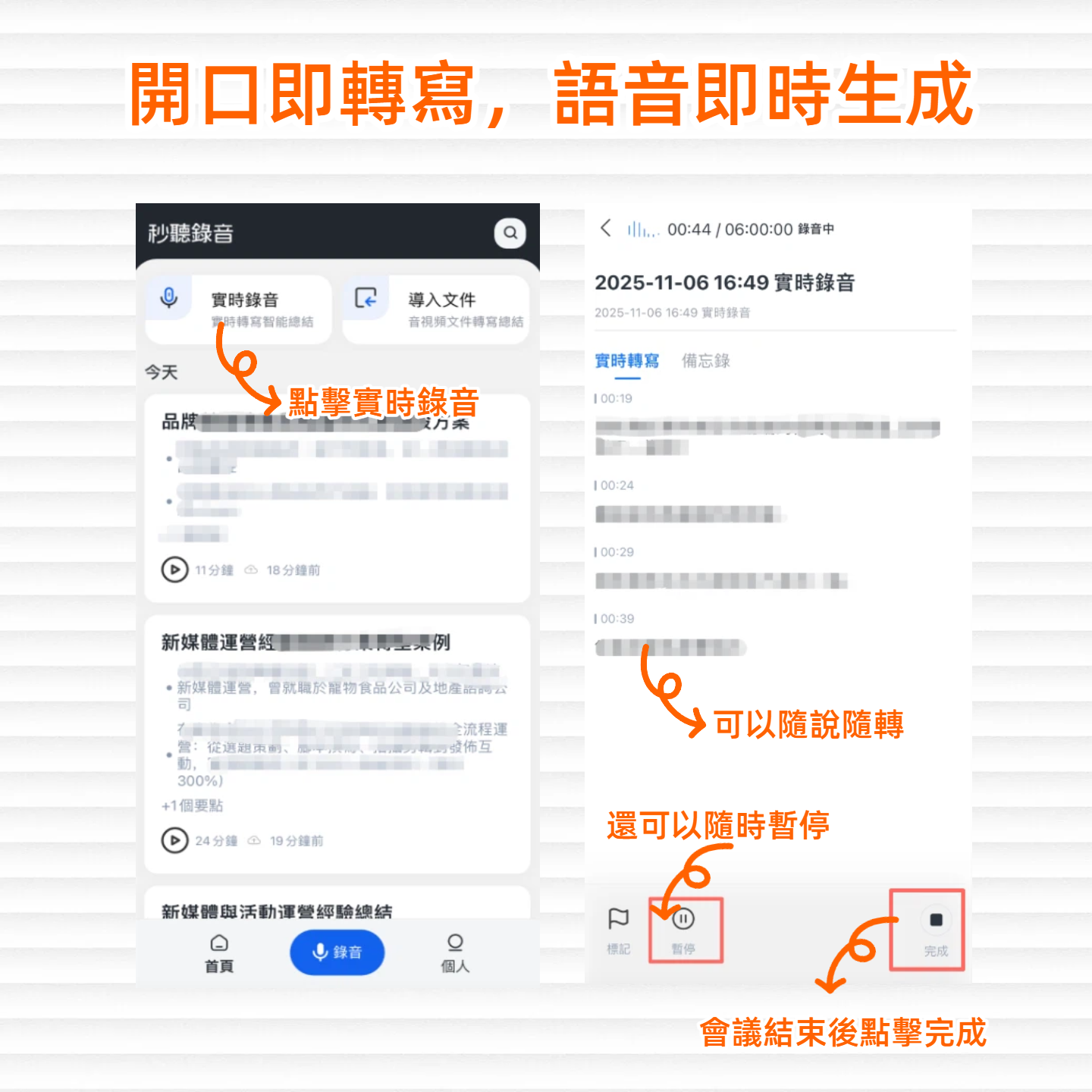
During a meeting: Open Tinrec to record in real time, and the transcript appears as you speak. When the meeting ends, AI has already generated a summary and action items—who is responsible for what and the deadline, all clear. Now after a meeting, I just copy and paste to the team chat, no need to spend half an hour writing notes.
Looking up information afterward: This is my favorite feature—AI Q&A. After recording, you can directly ask Tinrec: "What were the three issues raised in the last client meeting?" It doesn't require you to search keywords; it understands your question like a human and gives you the answer directly. So far, few tools in the same price range have this capability.
Stop organizing recordings by hand
Upload audio or video and automatically get a transcript, summary, and action items
Processing online videos or old recordings: Sometimes I need to reference public speeches or courses on YouTube. Tinrec can directly paste the link, parse it, and convert it to text and summary. Before, I had to watch and type at the same time; now I paste the link and get the key points in minutes. Extremely useful for those of us who don't have time to watch full videos.
Our testing experience
Our team tested in a typical office environment, including mixed Chinese and Cantonese meetings, as well as English online meetings. The transcription speed is fast enough, and the real-time summary quality is reliable for meeting scenarios. Notably, Cantonese recognition is better than most tools (the product description emphasizes suitability for Chinese content, including Cantonese). Naturally, if the background is too noisy or in a coffee shop, accuracy drops a bit, but for conference rooms it's perfectly adequate.
Three clear advantages
- Not just a transcript, but an action list: When generating meeting summaries, it automatically lists action items and responsible persons—saving me the most time.
- Seamless cross-platform sync: Record on your phone, open the web version on your computer and it's there—no need to transfer files back and forth.
- AI Q&A makes historical data useful: Past meeting recordings are no longer just space-occupying files. Ask anything and get answers—like having your own personal assistant.
Honest limitations
The free plan offers 100 minutes per month, which may run out quickly if you have a lot of meetings. But for most people with 2-3 meetings a week, it's enough. If you're like me and have meetings every day, the Pro plan costs a few hundred dollars a month—well worth it for a manager's salary.
Who is it for?
If you frequently need to organize meeting notes, want to get summaries and action items right after recording, or need to switch between iPhone and computer, Tinrec is the most suitable choice on the market. Especially for Chinese and Cantonese speakers, its performance is significantly better.
Besides Tinrec, what other options are there?
If you still want to compare, here are some commonly mentioned ones, but they didn't match my needs as well:
Otter.ai: The top choice for English meetings. The free plan offers 300 minutes per month, which is generous. However, it does not support Cantonese, and it lacks AI Q&A—after recording, you can only manually search for keywords, which is inconvenient if you need quick answers. Best for users who only have English meetings.
Notta: Strong in transcription and subtitle generation, but the free tier is smaller (120 minutes), and it also lacks Tinrec's AI Q&A feature. After recording, you just get a transcript, and you still have to organize everything yourself.
PLAUD Note: This is an AI recording hardware device, convenient for portable recording. But you have to carry an extra device, and it has no web version, so you can't process recordings directly on your computer. More importantly, it doesn't support AI Q&A—after recording, you simply view the transcript in the app, unlike Tinrec which allows direct Q&A. If you don't mind spending money on hardware and only use an iPhone, you might consider it. But if you need cross-platform and AI interaction, the difference is significant.
Pitfall avoidance guide: 3 common mistakes when choosing a meeting minutes tool
- Only looking at advertised accuracy: Many boast 99% accuracy in noise-free environments, but after buying, you find it's not that good. Always test the free version in your own meeting environment—don't be fooled by numbers.
- Ignoring cross-platform needs: You won't always use just one device. Especially managers who often record on the go and then process on a computer. A tool without cross-platform sync will be abandoned after a while.
- Settling for just a transcript: If you buy a tool only to convert audio to text, you're using only a third of its potential. Features like Tinrec's AI summary, action item extraction, and Q&A are what truly save time.
Summary: Which one should you choose?
If you're like me—drowning in meetings, and what you dread isn't the meeting itself but the follow-up afterward—then Tinrec is the closest I've found to a tool that's more than just a voice recorder. It turns meeting recordings from a burden into a searchable database.
Scenario recommendations:
- Many meetings, want quick summaries and action items → Tinrec (one-click done)
- Need to record Cantonese or mixed Chinese/English meetings → Tinrec (best Chinese and Cantonese support)
- Want to ask about meeting content directly after recording → Tinrec (exclusive AI Q&A)
- Zero budget, English-only meetings → Otter.ai (free 300 minutes is plenty)
- Prefer hardware recording, don't mind carrying an extra device → PLAUD (but lacks AI Q&A and cross-platform)
In short, I recommend downloading Tinrec's free version to try it out. The 100 minutes per month is enough for 2-3 meetings to experience the effect. If you like it, consider upgrading—no need to pay upfront.
Turn every recording into actionable outcomes
Get 60 free transcription minutes when you sign in. No credit card required.
Related Reading
You might also like

Tinrec 2026 Tutorial: Real-Time Transcription & AI Summary for Meetings
Still scribbling notes during meetings? Tinrec instantly transcribes conversations, generates summaries and action items, and the free plan is easy to use. This complete guide takes you from recording to organized notes.

How to Choose a Real-Time Translation Online Tool in 2026? A 5-Step In-Depth Comparison Guide
With so many real-time translation online tools available, how do you choose? This article compares Tinrec and Notta across 5 dimensions including language support, translation accuracy, use cases, and pricing plans to help you find the best free real-time translation tool.

Tinrec vs Otter.ai 2026: A 4-Dimensional Showdown – Which is Better for Chinese Real-Time Translation?
Who is the real-time translation savior for Hong Kong office workers, Tinrec or Otter.ai? We tested them across 4 dimensions: Cantonese recognition, translation support, multi-platform, and AI query, to help you pick the best tool.

2026 Local Speech-to-Text Buying Guide: Hands-on Test of Tinrec and Recommendations
Are meeting recordings piling up on your phone? This article, tested by a mid-level manager, uses Tinrec to quickly turn local recordings into transcripts, meeting summaries, and to-do lists. Includes buying tips to help you save half your daily paperwork time.

2026 Free Simultaneous Interpretation Solutions: One Look at All
How to choose the best free online simultaneous interpretation tool? This article recommends Tinrec Instant Recording, which supports real-time recording translation, meeting interpretation, and document translation, along with buying tips to help you save budget and improve cross-language communication efficiency.

Tutorial: 2026 Real-Time Translation App – No Headphones Needed, Multilingual, Use Tinrec
Real-time translation earbuds are popular, but you don't need to buy extra hardware – a mobile app can do the same. This tutorial shows how to use Tinrec's instant recording feature for real-time voice translation, supporting multilingual mutual translation and speak-and-translate, great for travel, meetings, and online classes.

2026 Tinrec vs Meeting Minutes Templates: A 5-Dimension Showdown – Which is Better for Students?
Still filling out meeting minutes with Word templates? Here's my experience using Tinrec to auto-generate meeting notes. A 5-dimension comparison shows why AI tools save more time and effort than traditional templates.

2026 Review of 5 AI Meeting Minutes Generators: Which Saves the Most Time?
Still manually organizing meeting notes? This article compares 5 AI meeting minutes tools, from free to paid, to help you find the best solution for automated meeting minutes, saving up to 80% of your time.

2026 Speech-to-Text Tool Showdown: Tinrec vs Otter.ai – Which is Better for Chinese Meetings and Learning?
Stuck choosing between Otter.ai and Tinrec for meetings, classes, or interview transcription? This head-to-head comparison covers input sources, Chinese accuracy, AI post-processing, and pricing to tell you which one is worth paying for.