
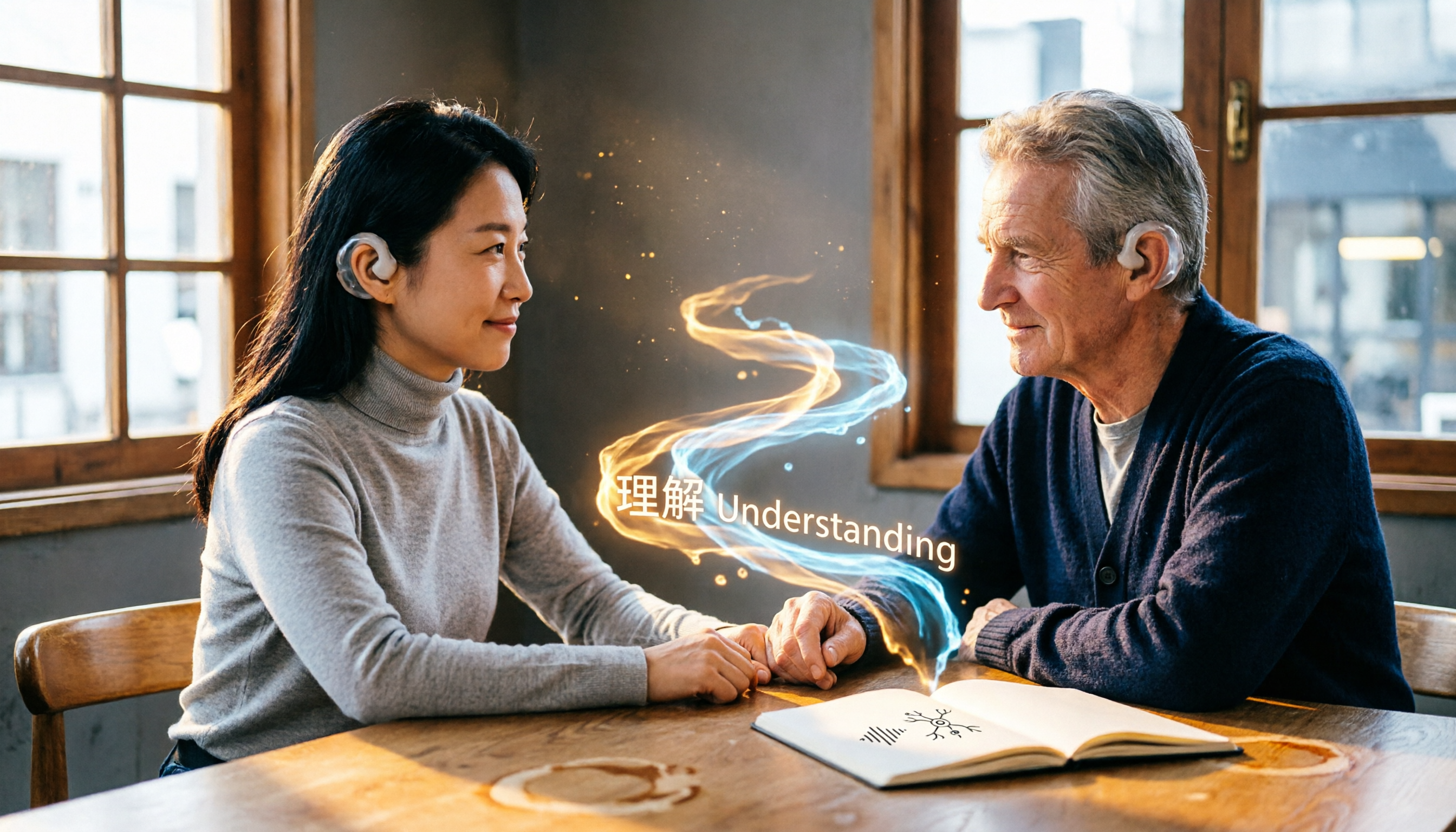
Turn recordings into transcripts and summaries in minutes
Upload audio or video for multilingual transcription, AI notes, and action items
Last month, I attended a cross-border online seminar.
The presenter spoke rapidly in English while the slides displayed keywords in Japanese.
I thought to myself: if only I could record this conversation and later organize it into text I can easily understand.
Unfortunately, while trying to listen and take notes simultaneously, I still missed several key points.
Later, I tried a different approach: I turned on Tinrec's real-time speech-to-text transcription. By the time the meeting ended, a complete transcript was already there.
I could even ask it in Chinese: "What was that part about market strategy?"
It not only told me the original text but also organized it into a coherent Chinese summary.
It turns out that real-time voice translation isn't about having a universal translator—it's about turning foreign content into material you can further process and query.
In this article, I'll demonstrate my complete workflow using Tinrec.
What Can Real-Time Voice Translation Do for You?
Before opening Tinrec, you might wonder: do I really need such a tool?
From my experience, these three scenarios most often present language barriers:
Scenario 1: International Meetings
Discussing with overseas colleagues in English—even if you understand, it's hard to take meeting notes simultaneously.
For example, with Tinrec, just place your phone or computer nearby to record; it transcribes in real time.
As soon as the meeting ends, a bilingual or foreign-language transcript is ready.
You can also ask AI to summarize, turning a half-hour discussion into five key points.
(Screenshot: Real-time transcription interface, arrow pointing to "Start Recording" button and generated text)
Scenario 2: Foreign Language Classes or Lectures
After an English or Japanese lecture, your notes are scattered.
In this case, I record it, use Tinrec to transcribe, then quickly review with AI Q&A.
For example: "Explain the key points of the second paragraph in Chinese," and it will compile them directly.
(Screenshot: AI chat interface, arrow pointing to query box where a Chinese question is entered)
Scenario 3: Personal Travel or Daily Conversations
When traveling abroad, asking for directions or ordering food—if it's too fast to understand, just record a short clip.
After Tinrec transcribes the text, use AI to translate it into Chinese—like having a very perceptive assistant with you.
In short, real-time voice translation is not just about "understanding"—it's about turning content into a format you can work with after listening.
What Are the Core Capabilities of Real-Time Voice Translation?
Many people think real-time translation means "subtitles as you speak," but in reality, few tools achieve that smoothly.
Tinrec takes a different path: turn recording into text, then let AI help you understand.
This approach is actually more practical because there's much more you can do afterward.
I've identified four key capabilities:
Real-Time Transcript
Tinrec's real-time transcription has very low latency—text appears almost as you speak.
This lets you check during meetings or classes to see if you've missed any points.
If the speaker mixes multiple languages, it tries to recognize the original language without forcing a single translation.
(Screenshot: Real-time transcription interface, arrows indicating speaker differentiation and timestamps)
Multi-Language Support
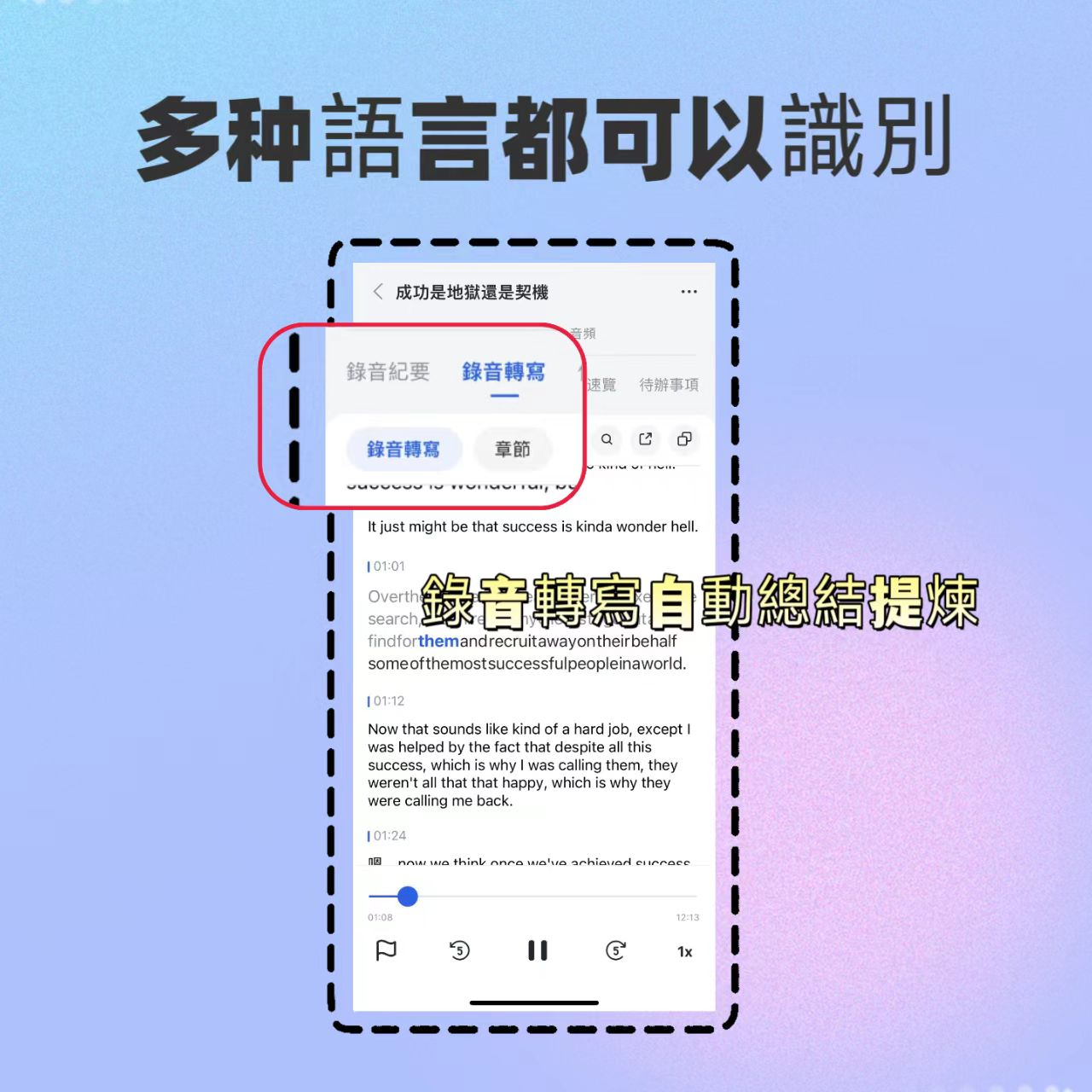
Tinrec currently supports transcription in multiple languages, including Chinese, English, Japanese, Cantonese, and more.
If you record in these languages, it provides corresponding transcripts.
Once transcribed, you can use AI Q&A or summary functions to organize foreign content into Chinese.
This is essentially a "post-translation" workflow.
AI Semantic Understanding and Q&A
This is the feature I use most often.
After transcription, you can directly ask Tinrec: "What is this section about?" "What are the keywords?" "List three key points in Chinese."
It answers based on the recording content—not just a translation, but a synthesized understanding.
(Screenshot: AI answer results page, arrow pointing to the Chinese summary)
Multi-Device Sync and Export
Record on your phone, view on your computer.
You can also export translated text or summaries to Word, TXT, or even save directly to Notion or Google Docs.
Stop organizing recordings by hand
Upload audio or video and automatically get a transcript, summary, and action items
This way, you're not locked into a single app, giving you more freedom for subsequent organization.
(Screenshot: Export options interface, arrows pointing to various format buttons)
Practical Application Scenarios
How can you combine these capabilities? Here are three practical examples.
Get a Chinese Summary Five Minutes After a Meeting
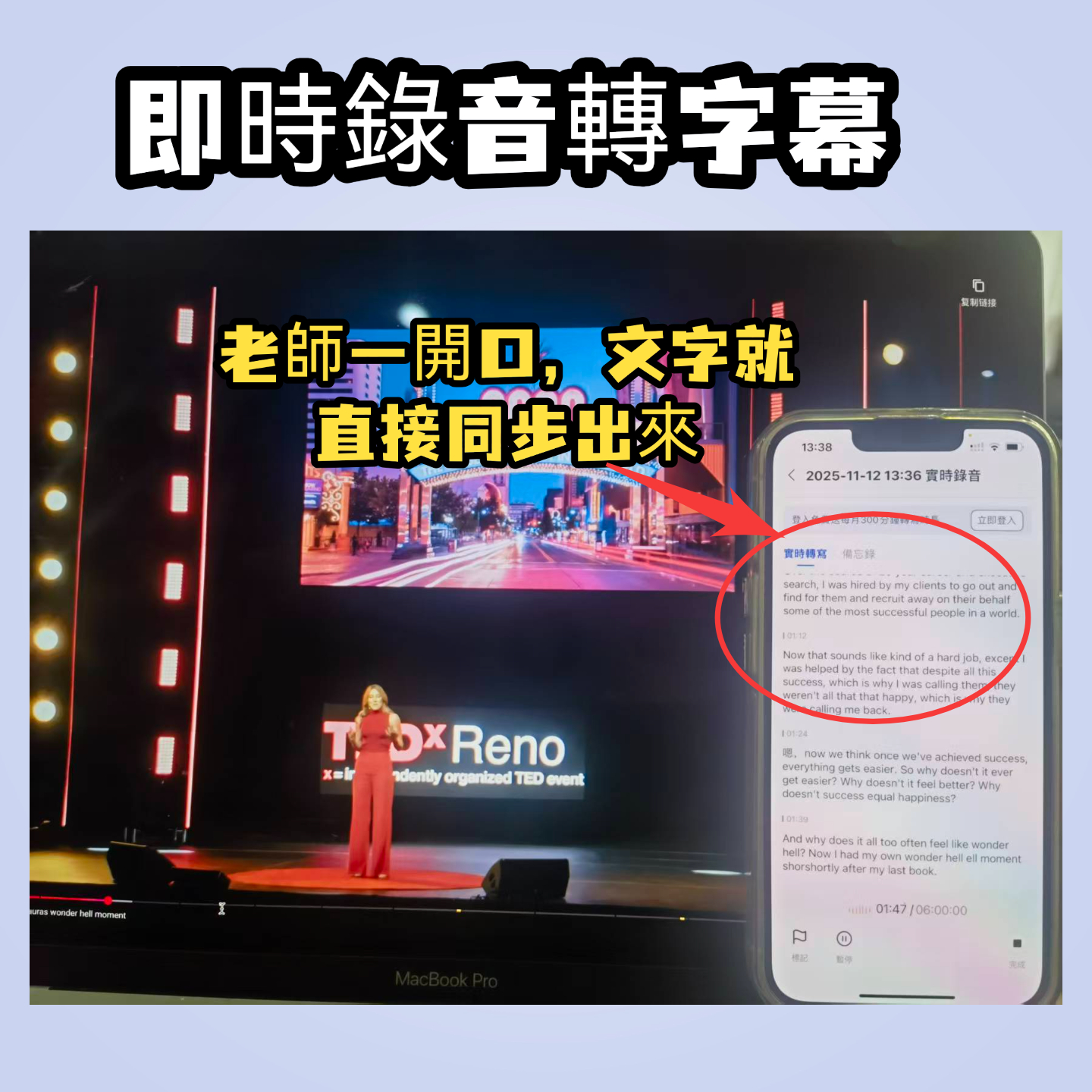
- Open Tinrec's real-time recording to capture the entire English meeting.
- After the meeting, click "AI Summary" to automatically generate a structured English recap.
- Copy the summary and paste into the AI chat with the prompt: "Please translate to Traditional Chinese and list conclusions and action items."
- A Chinese meeting record is complete.
Previously, I would spend half an hour re-listening and translating; now it takes minutes.
Record a Class and Turn It into Chinese Study Notes
Many online courses are only in English or Japanese; I used to take handwritten notes.
Now I do this:
- Record the entire class (using Tinrec's real-time recording).
- At home, use the "Chapter Organization" feature to automatically split the course into segments.
- For each chapter, use AI Q&A to ask it to summarize key points in Chinese.
- Finally, export as Markdown notes and add to my knowledge base.
This not only saves re-listening time but also gives me a bilingual course summary.
(Screenshot: Chapter organization page, arrow pointing to automatically split section titles)
Watch Foreign Videos and Quickly Extract Key Points
Suppose you find a Japanese interview on YouTube and want to quickly understand its content.
Tinrec supports pasting public video links; it will directly extract the audio and transcribe it.
After transcription, use AI Q&A: "Please summarize the five key viewpoints of this video in Chinese."
No need to translate yourself.
(Screenshot: Video link parsing interface, arrow pointing to the input field for pasting a link)
4 Things to Consider When Choosing a Real-Time Voice Translation Tool
There are many services claiming "real-time voice translation" on the market, but when choosing, I suggest considering these four aspects:
1. Transcription Accuracy Is the Foundation, Not the Only Factor
Accuracy is affected by background noise, accents, and multiple speakers—don't blindly trust "99%" ad claims.
Test with your own recordings.
In a typical office environment, Tinrec performs well for Chinese, English, and Japanese recognition; importantly, it retains the original text without random translations.
2. Breadth and Flexibility of Language Support
Make sure the tool supports the language combinations you commonly use.
Some tools only translate a single language and get stuck when the speaker switches languages.
Tinrec can recognize multilingual content and then use AI Q&A to translate into your desired language, offering greater flexibility.
3. Can It Help You Organize After Transcription?
Translation tools that only provide transcripts are only half done.
What really saves effort is a tool like Tinrec, which offers summaries, tasks, Q&A, and export after transcription.
These are the key features that let you avoid re-listening to recordings.
4. Privacy and Security
For business meetings or private conversations, recording content is uploaded to the cloud, so privacy protection is crucial.
Tinrec uses encrypted transmission for data processing, and you can delete recordings when needed.
Before purchasing, check each provider's privacy policy.
Frequently Asked Questions
Q: Can Tinrec translate different languages in real time?
A: Tinrec transcribes recordings into text (retaining the original language), then you can use AI Q&A or summary functions to have it translate into your specified language. It's not sentence-by-sentence real-time interpretation, but a "transcribe then understand and translate" workflow, which offers greater flexibility.
Q: Which languages are supported?
A: Currently supports 14 languages, including Chinese, English, Japanese, Korean, Cantonese, Spanish, French, and more. It automatically detects the language during transcription; if the speaker mixes two languages, it outputs based on actual pronunciation.
(Screenshot: Language selection interface, arrow pointing to the list of supported languages)
Q: Is the accuracy poor?
A: It depends on audio quality. In a quiet environment with clear articulation, accuracy for Chinese, English, and Japanese is quite good. For extremely precise legal or medical content, manual verification is recommended.
Q: Is the free version enough?
A: If you only need to translate a couple of conversations occasionally, the monthly transcription allowance in the free version should suffice. But if you frequently have meetings or classes to process, the Pro plan is more suitable.
Summary
Real-time voice translation doesn't require a sci-fi gadget that lets you understand foreign languages through earphones synchronously.
A more practical approach is to turn your phone or computer into a tool that records, transcribes, and then helps you understand.
Tinrec makes this process very intuitive:
Record → Transcribe → AI Summary or Translate to Chinese → Export Notes.
If you often struggle with foreign language content, start with the free version.
Record an English meeting or Japanese course, let Tinrec organize it, and experience the feeling of turning sound into actionable knowledge.
Finally, here's a quick start you can follow right away:
- Download the Tinrec App (available for iOS, Android, and web).
- Next time you have a meeting or class, turn on the real-time recording function.
- After recording, tap AI Summary to see the machine-generated result.
- Enter the AI chat and input: "Please translate into Traditional Chinese and list key points."
- Export the result to your note-taking tool.
- That's it—your first AI-translated note is ready.
Test it step by step, and you'll gradually master this method.
Turn every recording into actionable outcomes
Get 60 free transcription minutes when you sign in. No credit card required.
Related Reading
You might also like

Can't Record on Google Meet in 2026? Capture Your Meetings and Generate Minutes with Tinrec
Google Meet's built-in recording feature has many limitations. Can't record your meeting? This article explains why and introduces Tinrec, a tool that records meetings across platforms, generates AI summaries and action items, so you never miss a thing.

Tinrec vs Otter.ai 2026: 5-Dimension Showdown - Which AI Subtitle Tool Offers Better Value?
Choosing an AI subtitle tool? This comparison breaks down Tinrec and Otter.ai across 5 dimensions including free tier, Chinese recognition, and AI features to help you pick the right one.

Tinrec vs Notta 2026: A 5-Dimensional Comparison – Which Is the Best AI Subtitle Generator for Chinese Speakers?
Looking for an AI subtitle generator? Tinrec handles recordings, videos, AI summaries, and Q&A – far more than just transcription. This article compares Tinrec and Notta across 5 dimensions including language support, feature depth, and pricing to help you find the best choice for Chinese content.

How to Get Free Simultaneous Interpretation in 2026? 4-Step Real-Time Translation Tutorial
I've tried a bunch of so-called free simultaneous interpretation apps, and either the delay was so bad it felt like listening to an echo, or the translated Chinese was incomprehensible. Until I tried Tinrec's real-time translation feature and realized it could be this smooth. This guide takes you from download to actual use, 4 steps to get free simultaneous interpretation, and also tells you how to choose without stepping on landmines.

Free Voice Translation Plans in 2026: A Look at 3 Options
Need voice translation without spending money? This article rounds up 3 free voice translation solutions, highlighting Tinrec's translation features and showing you how to use free tools for cross-language meetings, classes, and interviews.

2026 Voice-to-Text Tool Comparison: Tinrec, Otter.ai, Notta & PLAUD — Which One Actually Saves You Time?
Struggling with meeting notes, lecture transcripts, or interview recordings? We tested Tinrec, Otter.ai, Notta, and PLAUD on accuracy, AI features, pricing, and cross-platform support to help you find the best voice-to-text solution for real-world use.

Free Voice Translation Apps in 2026: 4 Best Options Compared
How to choose a voice translation app? We tested 4 apps on free quotas, translation quality, and cross-platform support to help you find the best fit.

2026 Free Real-Time Translation Tools Comparison: Which One Translates Chinese Most Naturally?
Want to know which free real-time translation tool is best? This article tests 5 top recommended real-time translation apps and websites in 2026, including Google Translate, DeepL, Microsoft Translator, and introduces an AI tool Tinrec that can simultaneously transcribe and translate recordings, helping you find the most suitable solution.

2026 Hands-On Comparison of 5 Real-Time Translation Apps: Which Has the Most Natural Voice Translation?
This article provides a hands-on comparison of 5 popular real-time translation apps, evaluating voice translation accuracy, feature completeness, and free plans to help you find the best option for travel, meetings, and learning.