
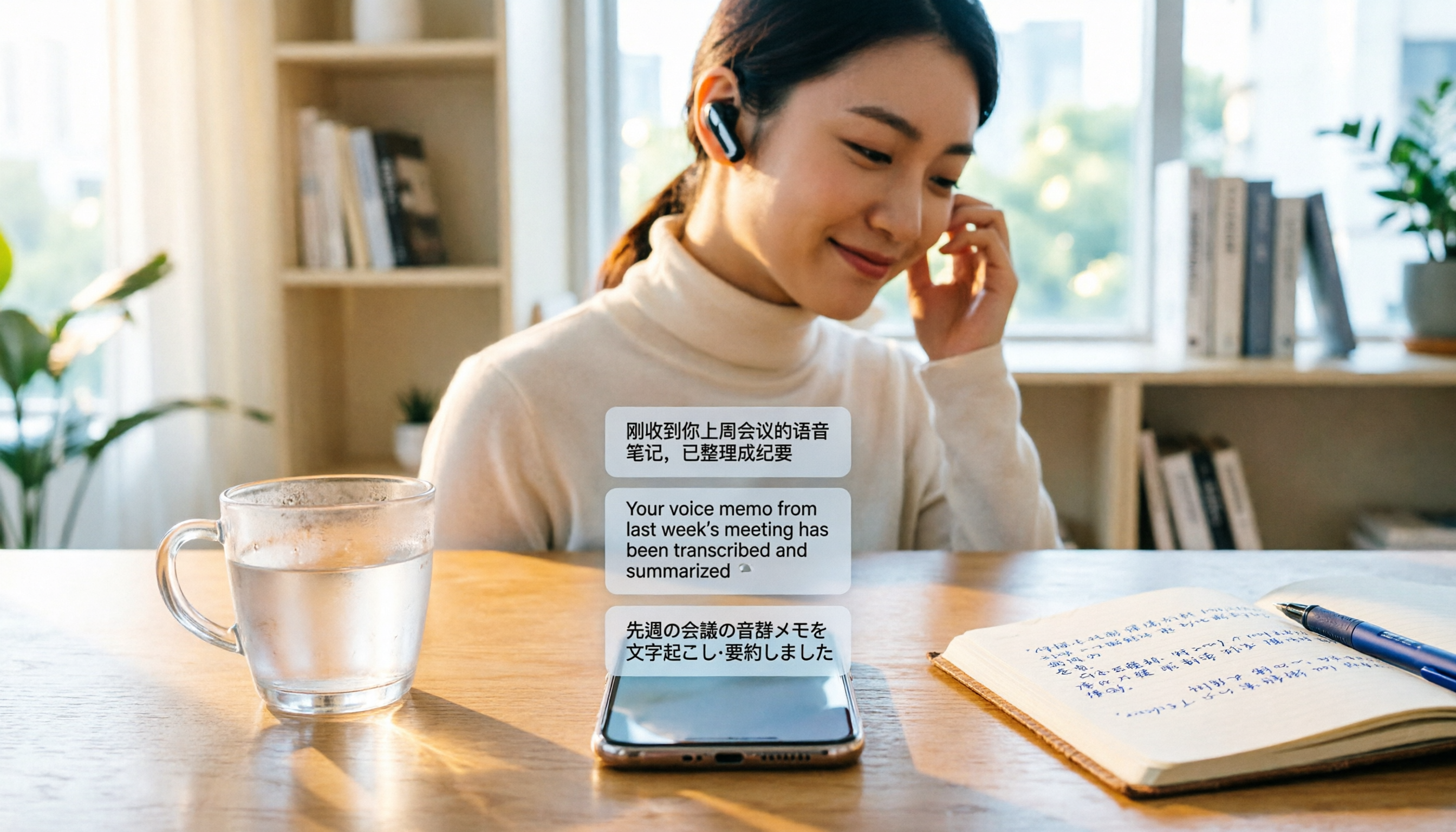
Turn recordings into transcripts and summaries in minutes
Upload audio or video for multilingual transcription, AI notes, and action items
Spending 2 hours in a meeting and another 2 hours transcribing? Sound familiar?
I have about 15 meetings a week: team stand-ups, project reviews, one-on-ones, cross-department syncs. The worst part used to be the aftermath. Each meeting leaves a pile of decisions and action items to sort, so the real work only started after the meeting ended.
To make matters worse, my team has foreign colleagues, so meetings often mix Chinese and English, and sometimes Cantonese pops up. When my boss suddenly asks, 'What was that client’s request last time?' and I spend 3 minutes flipping through notes without finding it—that’s just awful.
I tried handwritten notes (too slow), I tried re-listening to recordings (too time-consuming), I tried asking my assistant to sort it out (they’re also busy). Then I realized that with the right recording transcription app, I could skip the most mechanical part and save time for what truly needs human judgment.
If you’re in a similar boat, this article is for you.
3 Key Points to Understand Before Choosing a Recording Transcription App
There are tons of recording transcription apps out there, with features ranging from free to premium. After testing them with my team, here are the three most important factors.
1. Accuracy: Don’t Just Look at the 98% Claim Many tools claim '98% accuracy,' but that’s measured in a quiet studio. In a real conference room with AC noise, keyboard clicks, and overlapping speech, accuracy drops significantly. We tested with real scenarios: 5-minute recordings of meetings mixing Chinese and English, plus background noise. Under these conditions, the differences between tools become clear.
2. AI Features: Transcription Is Just the First Step; Post-Processing Saves Time If an app only gives you a verbatim transcript, you still need to re-listen, extract key points, and write a summary. Good modern tools automatically generate summaries, action items, and even let you ask AI questions about the recording. That’s where the real time savings come from.
3. Cross-Platform Sync: Phone, Computer, and Web Should Sync You might record on your phone in a meeting room, then want to edit on your computer at your desk. If the app only supports one platform or doesn’t sync data, it’s a hassle. Seamless syncing directly affects whether you’ll stick with it.
Tinrec – Our Team’s Top Pick After Testing
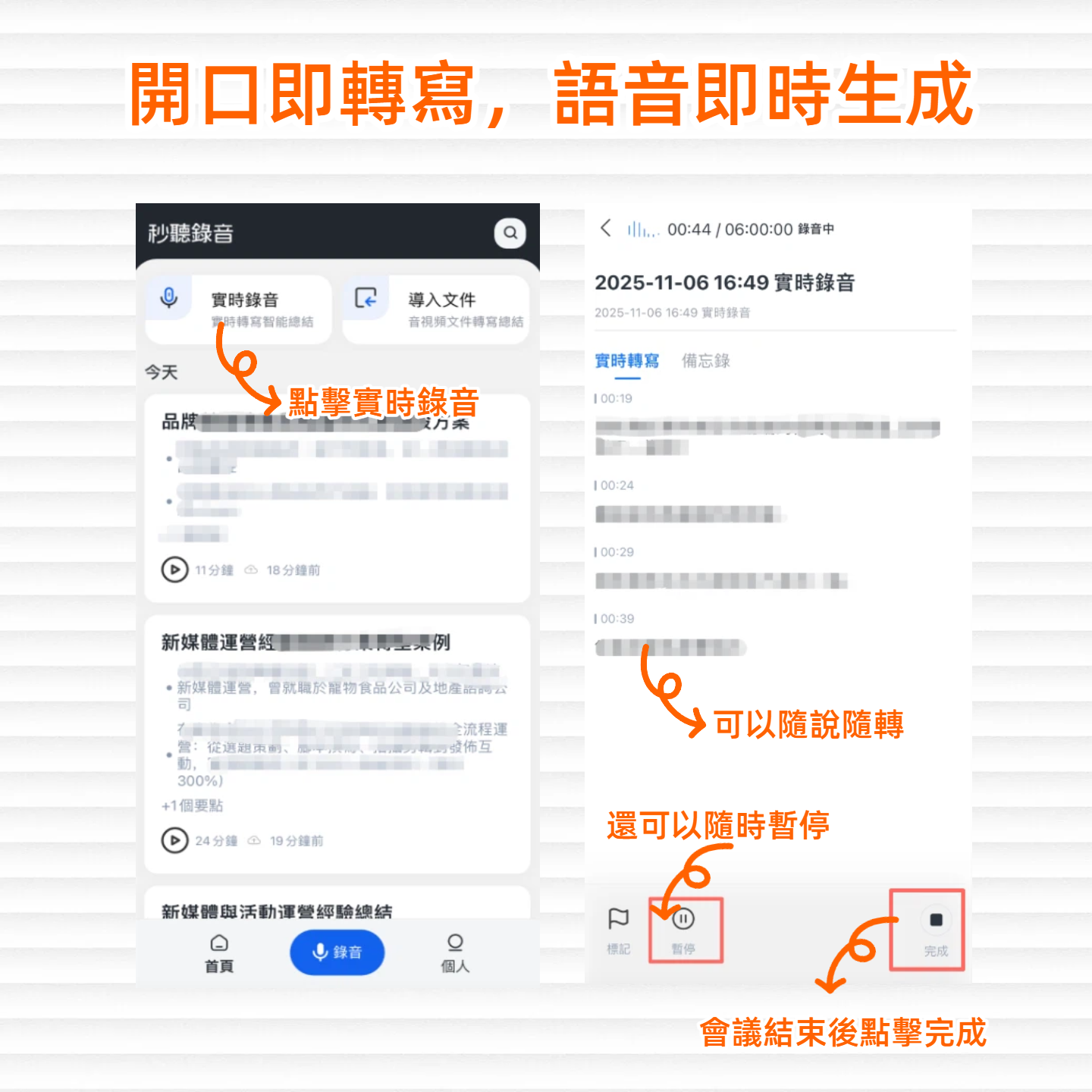
Tinrec is an AI-powered recording assistant that supports transcription from multiple audio and video sources. It’s available on iOS, Android, and web, and offers stable recognition for 14 languages including Chinese, Cantonese, and English.
Live Transcription During Meetings, Summary Ready When It Ends During a recent online meeting with a client, I turned on Tinrec’s live recording. The transcript appeared in real time, and it even distinguished different speakers. When the meeting ended, the AI had already generated a summary and action items—who’s responsible for what, deadlines—all crystal clear. I took a screenshot and shared it with the group; within 5 minutes everyone knew the next steps.
Stop organizing recordings by hand
Upload audio or video and automatically get a transcript, summary, and action items
Beyond Transcription: Ask Questions About the Recording This is Tinrec’s biggest differentiator from typical transcription tools. You can open the AI chat and ask, 'Who mentioned the budget adjustment in the last meeting?' Instead of just keyword search results, it gives you a direct answer based on semantic understanding. Our team uses this to review past meetings, saving tons of time hunting through transcripts.
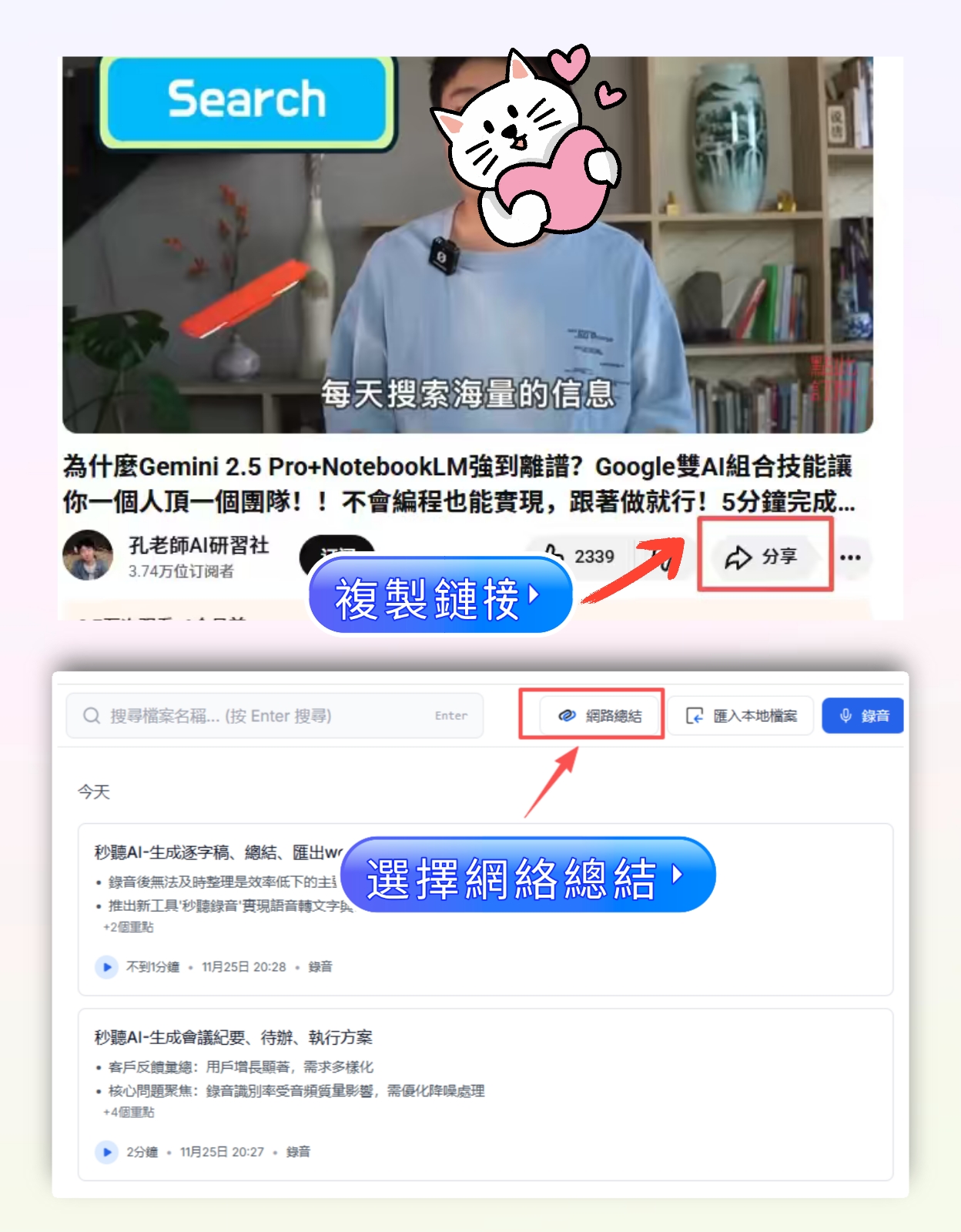
Handle Online Videos and Local Files Once, I needed to process an industry analysis video on YouTube. I just pasted the link into Tinrec, and within minutes I had a full transcript, summary, and chapter highlights. This is especially useful for managers who need to digest information quickly.
Pros
- Time savings: Recording → transcript → summary → action items, all in one flow. Saves an average of 30 minutes per meeting.
- Excellent for Chinese environments: Handles mixed Chinese-English and Cantonese meetings reliably. Ideal for multilingual workplaces.
- Seamless cross-platform sync: Record on iPhone in the meeting room, then continue editing and asking questions on the web version at your desk—data syncs perfectly.
Limitations The free tier offers basic monthly transcription credits; heavy users may need a paid plan. But if you have only 2-3 meetings per week, the free version is more than enough to experience core features.
Who It’s For If you need to quickly organize meeting notes, interviews, or study materials, and want to use AI to find key points after recording instead of staring at a cold transcript—Tinrec is currently the best choice.
Alternatives to Tinrec
Otter.ai: Best for English-Only Meetings Otter.ai’s free plan offers 300 transcription minutes per month, which is plenty for English meetings. It integrates with Zoom and Google Meet. However, its Chinese recognition is weak and it doesn’t support Cantonese. If your meetings are primarily in English, Otter is a more cost-effective choice; but for meetings with Chinese or if you need AI Q&A afterward, Tinrec is more comprehensive.
Notta: General-Purpose Transcription, But Fewer AI Features Notta’s free plan gives 120 minutes per month, supports multilingual transcription and translation, and has a clean interface. But it lacks AI chat queries like Tinrec—you can only manually search keywords after transcription. Also, Notta doesn’t support pasting video links for processing, which is less convenient for those who need to quickly digest online content.
Pitfalls to Avoid: 3 Common Mistakes When Choosing a Recording Transcription App
Mistake 1: Trusting Official Accuracy Claims Many tools claim '98% accuracy' on their websites, but those are lab results. In real settings with noise, accents, and overlapping speech, accuracy drops. Try the free version with your own recordings instead of relying on ads.
Mistake 2: Overlooking Cross-Platform Needs Recording on your phone today and editing on your computer tomorrow—if the app doesn’t sync across devices, it’s a pain. Before choosing, check that it has iOS, Android, and web versions with real-time data sync.
Mistake 3: Only Using the Transcript, Ignoring AI Post-Processing If you treat a recording transcription app as just a 'speech-to-text' tool, you’re only using a third of its potential. Features like Tinrec’s AI chat query, auto-summary, and action item extraction—these are the keys to upgrading from 'recording' to 'understanding.'
Summary: Which One Should You Choose?
If, like me, you have many bilingual meetings every week and need to quickly produce summaries and action items—Tinrec is the top choice. Its cross-platform sync, AI Q&A, and video processing features are hard to find together in other free plans.
- Need Chinese/English/Cantonese transcription + AI Q&A → Tinrec (best for multilingual and post-processing)
- Only record English meetings, zero budget → Otter.ai (largest free quota)
- Basic transcription, no need for AI features → Notta (simple interface, but fewer features)
Final tip: Download Tinrec’s free version first. The monthly credits are enough for a couple of meetings. Upgrade only if you find it useful—no need to pay upfront.
Turn every recording into actionable outcomes
Get 60 free transcription minutes when you sign in. No credit card required.
Related Reading
You might also like

Which Auto-Captioning Tool is Best? 2026 Review of 3 Tools, This One Has the Most Complete AI Features
We tested three auto-captioning tools, evaluating Chinese accuracy, AI features, and export convenience to find which ones really save you time. Top pick: Tinrec, because it not only transcribes but also lets you ask AI questions and generate summaries.

2026 Tinrec vs Plaud Note: A 5-Dimension Comparison for Audio/Video Organization
What's the real difference between the audio transcription app Tinrec and the AI recording hardware Plaud Note? This article compares them across five dimensions—Cantonese accuracy, cross-platform support, AI query capabilities, input source diversity, and long-term cost—to help you decide which is better for organizing meetings, courses, and online videos.

2026 Video Subtitling AI Complete Guide: How to Choose Automatic Video Captioning Tools? Tinrec vs Plaud Note In-Depth Comparison
Want to quickly add subtitles to your videos but unsure which AI tool to pick? This article takes a purchasing decision perspective, deeply comparing Tinrec and Plaud Note across video sources, real-time captions, accuracy, cross-platform support, and pricing, so you can see at a glance which one fits you better.

2026 Comparison of 4 Video-to-Text Tools: Which One Generates the Most Accurate and Fastest Subtitles?
Tested multiple video-to-text apps, from free to paid. Which one supports Cantonese and produces the fastest, most accurate subtitles? Tinrec (Instant Voice Recording) stands out with AI features. Check out the review!

2026 Comparison: Two Top Subtitle Generator Apps for Chinese Video Creators
This article compares Tinrec and Otter.ai, two AI subtitle generation tools, analyzing input sources, Chinese recognition, post-processing capabilities, and pricing to help you quickly decide which one is better for video subtitles.

How to Stay Focused While on a Mobile Meeting? Complete Guide to Google Meet On-the-Go Mode and Meeting Notes Tips
This guide walks you through setting up Google Meet On-the-Go mode to join meetings smoothly while commuting, walking, or moving, and explains how to use recording tools to quickly convert meeting content into transcripts, summaries, and action items.

How to Start a New Google Meet and Turn Recordings into Reusable Content: From Link Creation to AI Summary Export
This hands-on tutorial walks you through quickly creating a new Google Meet from Gmail, Google Calendar, or meet.google.com, and shows you how to use Tinrec to convert meeting recordings into transcripts, summaries, and action items—turning every discussion into searchable, organizable text assets.

2026 Comparison of 3 Google Meet Recording and Transcription Tools: Which Free Plan for Windows Users Is Best?
Using Google Meet on Windows has no built-in recording feature, making meeting notes cumbersome. This article tests 3 recording and transcription tools, showing how to pair them with PWA for efficiency and find the best free plan for Chinese users.

4 Google Meet Transcription Tools Compared in 2026: Which AI Summary Saves You the Most Time?
Struggling to record Google Meet meetings on your TV? This article tests Tinrec, Otter.ai, Notta, and Yating transcript, comparing cross-platform support, Chinese accuracy, and AI summarization to help you find the best meeting recording tool.