
Turn recordings into transcripts and summaries in minutes
Upload audio or video for multilingual transcription, AI notes, and action items
Faced with a two-hour meeting recording or interview file, have you ever felt overwhelmed trying to produce a transcript? Manual typing is not only time-consuming but also prone to missing key information. For students, journalists, administrative staff, or content creators, an accurate speech-to-text tool is a lifesaver.
This article reviews the noteworthy voice-to-text solutions in 2026. We have compiled free tools, open-source software, and advanced tools with AI summarization capabilities. Whether you need simple transcripts or want AI to automatically generate meeting minutes and to-do items, this article will help you choose from three dimensions: Traditional Chinese support, free credits, and use cases.

Quick Guide: Which Tool Is Right for You?
- For quick, short recordings: Use Google Live Transcribe or iOS Dictation.
- For privacy-focused tech enthusiasts: Choose OpenAI Whisper or Whisper Desktop (offline processing).
- For Taiwanese accent and Taiwanese Hokkien: Go with Yating.
- For post-meeting actions and AI summaries: Recommended Tinrec, ideal for professionals who need meeting conclusions and cross-platform search.
2026 Popular Speech-to-Text Tool Reviews and Comparisons
Tools on the market can be roughly divided into "built-in free tools" and "professional services." According to statistics, about 70% of users need no more than 5 hours per month. For such light usage, free tools usually suffice. However, for lengthy meetings, multilingual requirements, or structured note generation, professional tools can significantly reduce time.
Below we have selected five representative tools for multi-dimensional comparison:
Feature and Specification Comparison Table
| Tool Name | Platform | Traditional Chinese Support | Core Feature | Price/Free Credits |
|---|---|---|---|---|
| Google Live Transcribe | Android | Good | Built-in, real-time recognition, completely free | Free (Android only) |
| Yating | App/Web | Excellent (includes Hokkien) | Optimized for Taiwanese accent, developed locally | Live recording free / Upload: 20 min/month free |
| OpenAI Whisper | PC (deployment required) | Good | Very high accuracy, offline privacy | Open source free (requires hardware) |
| Tinrec | iOS/Android/Web | Excellent (multilingual) | Voice to text + AI meeting minutes + intelligent chat query | Free: 100 min/month (Subscription from $4.9/mo) |
| Otter.ai | App/Web | Not supported | Strong English recognition, integrates with Zoom/Meet | 300 min/month (English only) |
In-depth Analysis: Choosing the Right Tool for Each Scenario
1. Zero cost, everyday light use: Google and built-in features
If you only occasionally need to record in class or want to avoid typing when writing, built-in tools are the best choice.
- Google Live Transcribe: A lifesaver for Android users. It can recognize environmental sounds (e.g., applause, dog barking), making it suitable for hearing assistance or classroom notes, but transcriptions are only saved for 3 days.
- Windows / Apple Dictation: Windows + H or Mac dictation is great for "speech input" scenarios but not suitable for processing existing audio files.
2. Advanced meetings and knowledge management: Tinrec
For enterprise users, researchers, or content creators, a simple transcript often has low information density. Tinrec positions itself not just as a transcription tool, but as a way to turn recordings into "actionable notes."
Stop organizing recordings by hand
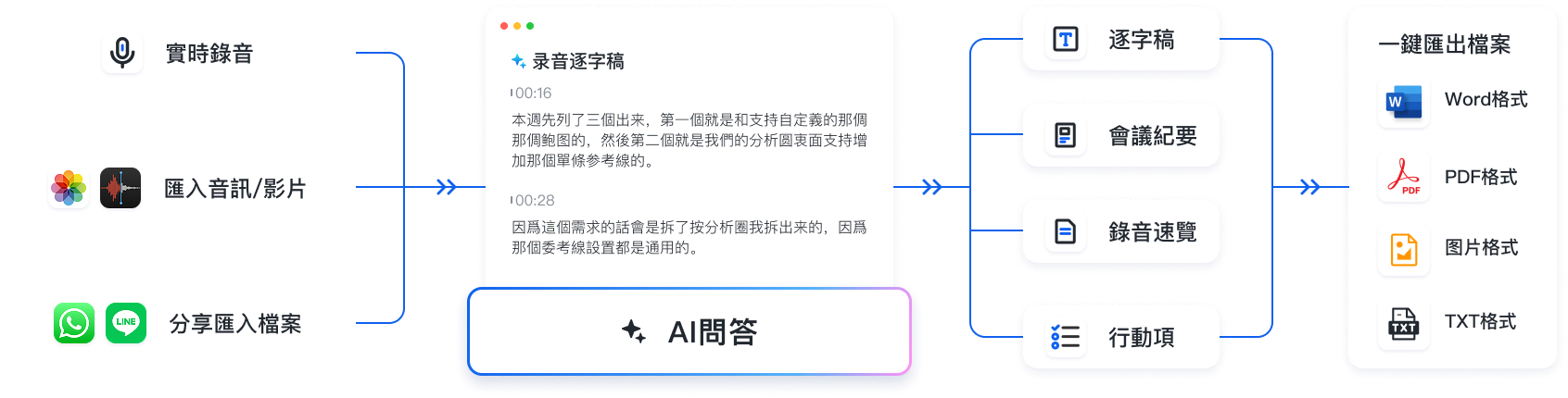
Upload audio or video and automatically get a transcript, summary, and action items
Tinrec's Key Differentiators:
- From "text" to "conclusions": Traditional tools give you a 10,000-word transcript; Tinrec uses AI to automatically generate meeting summaries, key conclusions, and action items. This solves the pain point of "recording but never having time to listen again."
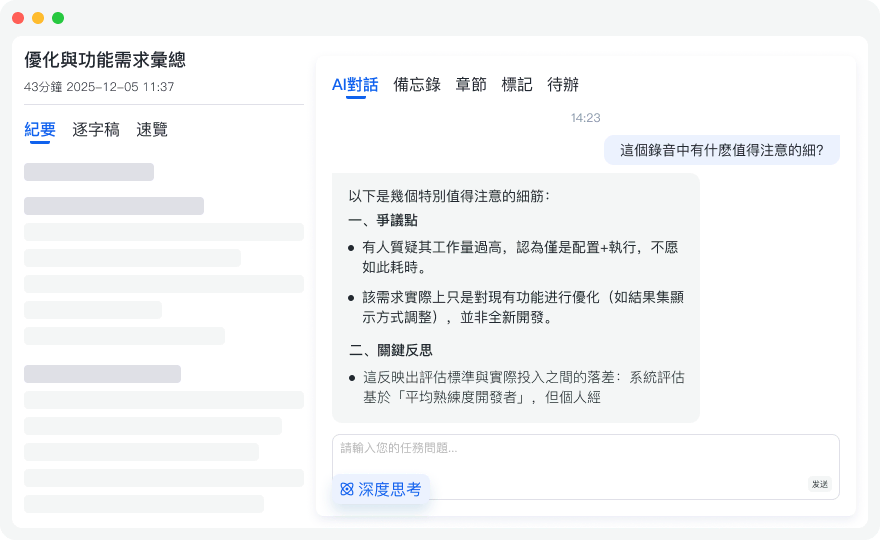
- AI Chat Query: A killer feature for long recordings. Instead of using Ctrl+F, you can ask AI directly: "What was the decision about the marketing budget in this meeting?" The system will answer based on the recording content.
- Multi-device sync and multi-format support: Supports iOS, Android, and web versions, and can handle audio files, YouTube links, or podcast links, ideal for modern professionals working across devices.
3. Best for Taiwan localization: Yating
Developed by the Taiwan AI Labs (AILabs), its biggest advantage is recognition of Taiwanese Mandarin, mixed Chinese-English, and Taiwanese Hokkien. If your interviewees are elderly or use dialects heavily, Yating is a reliable choice. Its live recording feature is free, but the free credit for uploaded files is limited (20 minutes), suitable for light users.
4. For tech and privacy enthusiasts: Whisper Desktop
If you have a high-end GPU and are very sensitive about data privacy (don't want to upload recordings to the cloud), desktop tools based on OpenAI Whisper (e.g., Whisper Desktop or MacWhisper) are the best. It supports 99 languages and is completely free, but requires hardware resources and lacks AI summarization and real-time mobile integration.
Practical Tutorial: How to Turn Meeting Recordings into Structured Notes Using Tools
Below, we use Tinrec as an example to show how to turn a chaotic 60-minute meeting into meeting minutes that your boss will love, all within 5 minutes.
Step 1: Import or Start Recording
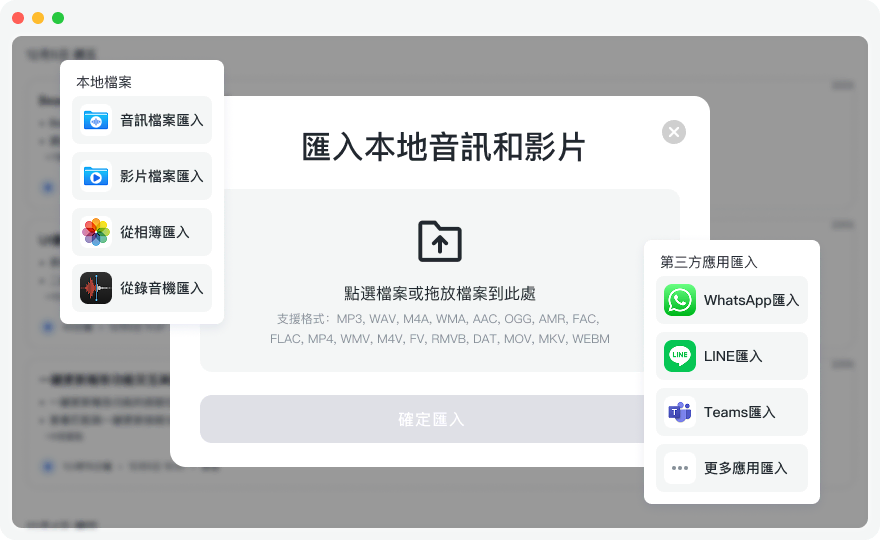
You can either start recording directly in the app during the meeting or upload an audio file after the meeting.
- Live recording: Use the Live Transcription feature to see text as you record.
- File processing: If you have existing MP3/M4A files, use Audio to Text upload.
- Online video: For public courses or seminars on YouTube, use the Podcast/Online Video to Text feature by pasting the link.
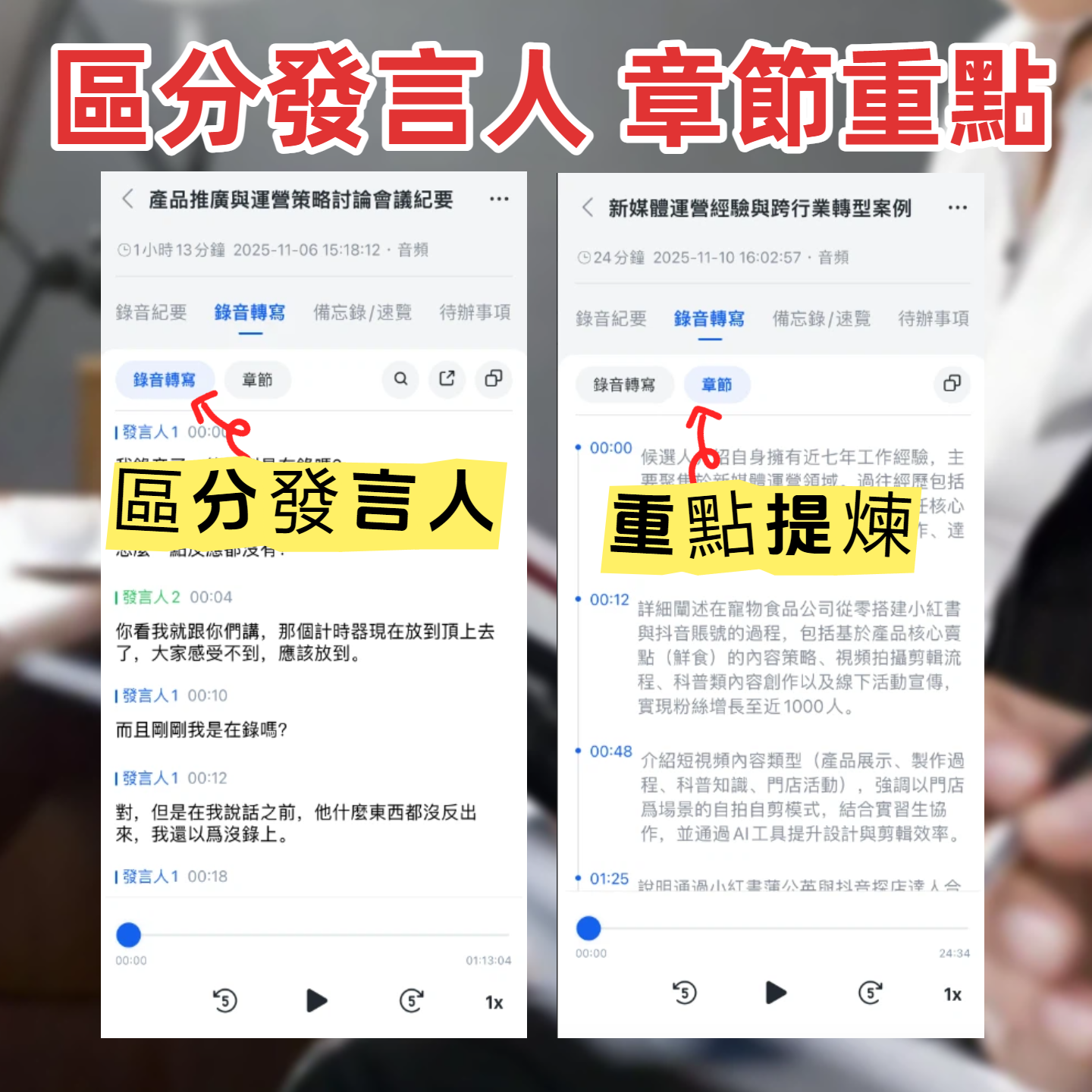
Step 2: Identify Speakers and Review the Transcript
After processing (usually a 1-hour recording takes only a few minutes), first review the transcript. Tinrec supports automatic speaker diarization. You can quickly label who is the "host" and who is the "project manager" to make the conversation context clearer.
Step 3: Generate AI Summary and Action Items
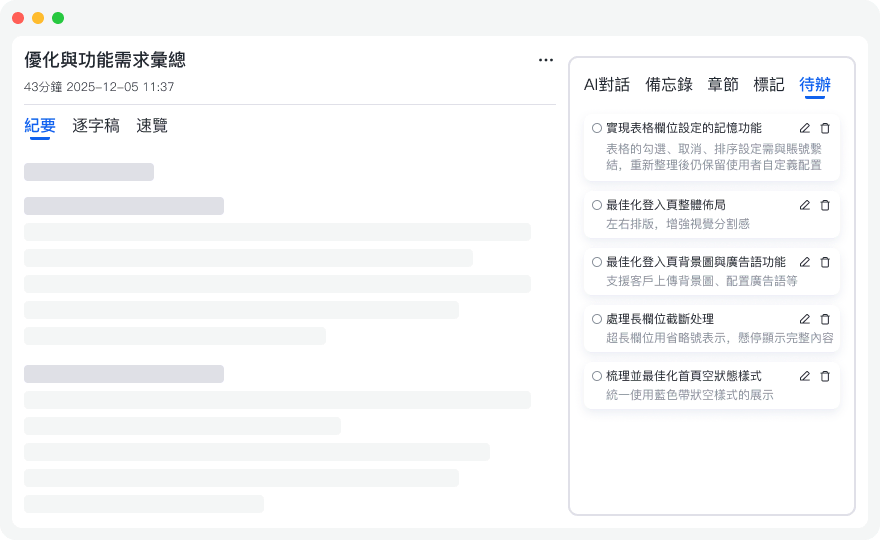
This is the most crucial step. Click the AI analysis function, and the system will automatically produce:
- Full summary: Quickly grasp the meeting's main points.
- Key points: What topics were discussed.
- To-do list: Who needs to do what and by when.
Step 4: Use AI Chat to Fill in Details
If the summary misses specific data, use the AI Chat Query feature. For example, ask "What was David's Q3 sales forecast?" The AI will extract the answer from the recording, saving you the trouble of re-listening.
Frequently Asked Questions (FAQ)
Q1: Is the accuracy of free speech-to-text tools sufficient?
In quiet environments with standard pronunciation, modern AI tools (like Google, Whisper, Tinrec) typically achieve an accuracy rate of 90-95%. However, in noisy meetings or with poor audio quality, accuracy drops. It's recommended to stay close to the microphone or use a directional recording device.
Q2: Can I transcribe audio directly on my iPhone or Android phone?
Yes. The iPhone's built-in Voice Memos does not have transcription (you would need dictation). It's recommended to download a dedicated app like Tinrec or Yating. Android users can directly use the Live Transcribe app.
Q3: What if the recording is very long (over 1 hour)?
Many free tools (e.g., MyEdit, Otter free tier) have length limits per file. For long recordings, we recommend Whisper (unlimited but hardware-dependent) or Tinrec's paid plan (no file length limit, with 600-1200 minutes per month).
Q4: What is the main difference between Tinrec and other tools?
Most tools only solve the "transcription" problem (Speech-to-Text). Tinrec goes a step further to solve the "understanding" problem (Text-to-Insight). With AI summaries and chat queries, it serves more as a productivity assistant for work and learning, rather than just a transcriber.
Q5: How to handle recordings with mixed Chinese and English?
Mixed Chinese and English is common in Taiwanese workplaces. Yating has been specially optimized for this. Tinrec also supports multilingual mixed recognition; you can select the primary language in settings to improve accuracy.
Q6: Is data security guaranteed?
When using online services, we recommend reading the privacy policy. Tools like Tinrec offer privacy protection mechanisms. For extremely sensitive data (e.g., legal, medical), consider fully offline solutions (like Whisper local deployment).
Turn every recording into actionable outcomes
Get 60 free transcription minutes when you sign in. No credit card required.
Related Reading
You might also like
5 Best Speech-to-Text Tools in 2026: From Free to Team Collaboration, Tinrec Is the Top Pick
How do you choose a speech-to-text tool? This article compares 5 tools including Tinrec, Otter.ai, and Notta, covering free quotas, bot-free meeting recording, AI summaries and Q&A, and team spaces, to help you find the best meeting notes and transcription solution.

Tinrec vs Notta in 2026: A 5-Dimension Comparison to Help You Choose
How to choose an online audio-to-text tool? This article compares Tinrec and Notta across 5 key dimensions, from meeting capture, post-processing, team management to Chinese language experience, helping you find the best AI transcription solution.

Tinrec vs Notta 2026: 4-Dimension Comparison for Online Meeting Transcription
A middle manager's hands-on test: How to choose an online meeting transcription tool? From bot-free recording, AI summaries, Chinese accuracy to team collaboration, real meeting scenarios show why Tinrec is better suited for professionals.
2026 Free Speech-to-Text Solutions: 5 Tools Compared
This article tests 5 free speech-to-text tools, from Tinrec to MyEdit and NotebookLM, comparing free quotas, transcription quality, and post-processing features to help you find the truly worthwhile option.

2026 Free AI Speech-to-Text Tools Compared: Why Tinrec Is the Best Fit for You?
After testing several free AI speech-to-text tools, we found that not all free versions are sufficient. This article focuses on Tinrec, examining its free tier limits, features, and real-world experience to help you choose the most time-saving solution.

5 Best Recording-to-Text Software in 2026: Is the Free Version Enough? This One Surprised Us
We tested 5 free recording-to-text apps, evaluating transcription quality, AI summarization, cross-platform support, and free-tier limits to find the truly useful options. Tinrec not only converts speech to text but also offers automatic summaries, Q&A, and team collaboration—all available in the free version.

2026 Tested: 5 Speech-to-Text Tools Compared – Tinrec Best for Hong Kong Professionals
After testing multiple speech-to-text tools, Tinrec stands out with bot-free recording, Chinese meeting summaries, and team collaboration. See why it's the best time-saver for Hong Kong professionals.

How to Choose a Free Speech-to-Text Tool in 2026: A 5-Step Practical Guide
We tested multiple free speech-to-text tools, covering common pitfalls, key selection criteria, and tips to avoid mistakes. This 5-step guide helps you find the best AI transcription solution for Chinese, with an in-depth look at Tinrec (Miao Ting Lu Yin)'s free and paid features.

4 iPhone Voice-to-Text Apps Tested in 2026: Is Apple's Free Built-in Enough?
We tested 4 voice-to-text solutions for iPhone, from Apple's free built-in Voice Memos to Tinrec and others, comparing accuracy, AI features, and cross-platform support to help you save time on meeting notes.