

Turn recordings into transcripts and summaries in minutes
Upload audio or video for multilingual transcription, AI notes, and action items
Recently, I was chatting with a friend who runs online courses. He complained that after each Google Meet session, even though he had the recording, sorting it into text notes was exhausting. I asked if he'd tried Zoom, and he said yes, but it wasn't much different. That's when I realized many people overlook a key point: when comparing these two tools, the real question isn't about video quality or interface design—it's about whether they can actually turn meeting content into usable knowledge after the call ends.
So in this article, I'm not going to dive into specs. Instead, I'll look at a knowledge worker's daily workflow and see which tool—Google Meet or Zoom—truly helps you "make use of meeting content."
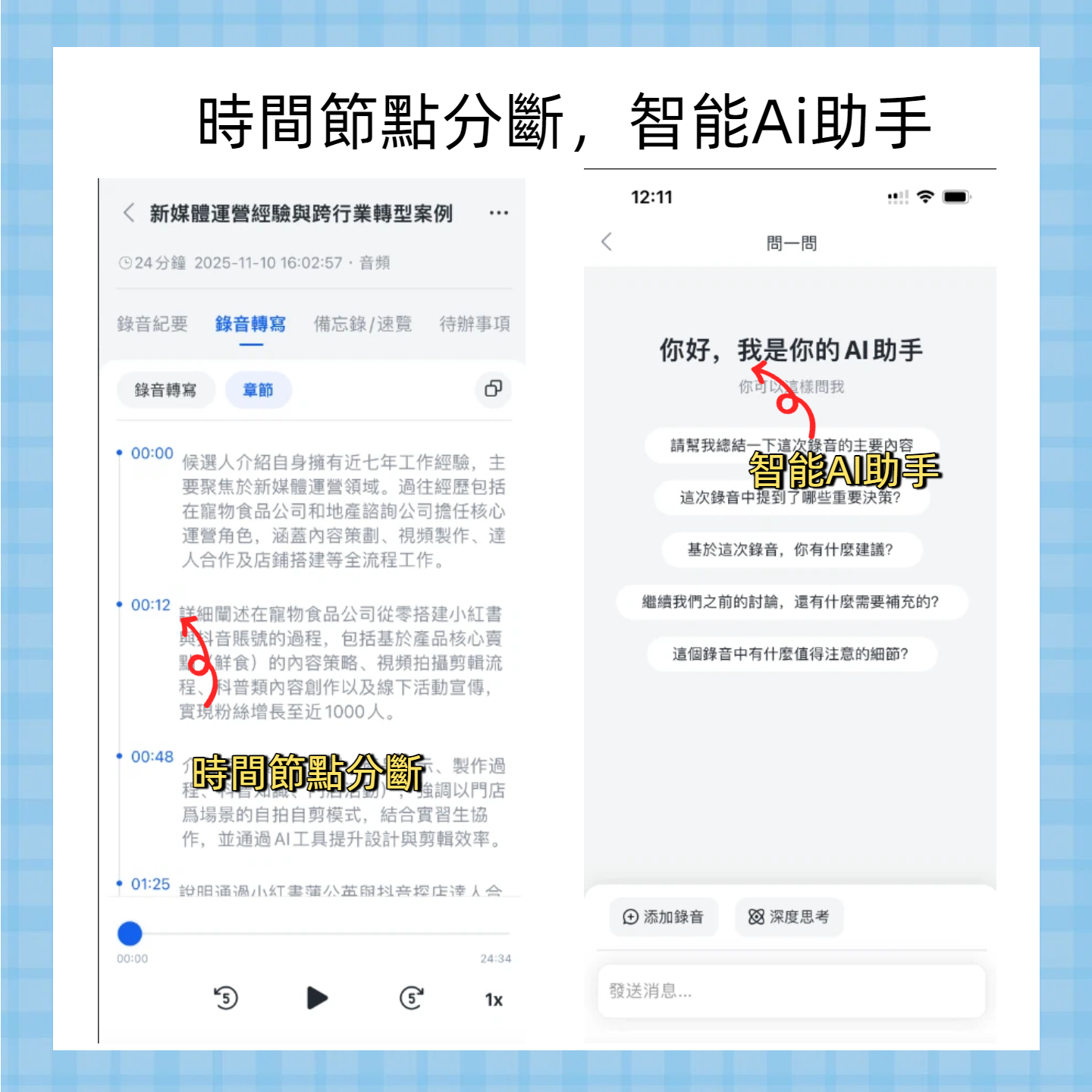
(Screenshot: Side-by-side interface comparison of Google Meet and Zoom, with arrows pointing to each tool's recording and transcription features)
Google Meet vs Zoom|Quick Overview
Many teams hesitate between Google Meet and Zoom, both of which are the most mainstream online meeting services. Google Meet, deeply integrated with Google Workspace, is convenient for teams already using Gmail and Google Calendar. Zoom, known for stable connections and rich interactive features (like breakout rooms and whiteboards), has also added more AI capabilities in recent years.
Price-wise, both have free plans, but free versions differ in meeting time limits and recording capabilities. Platform-wise, Google Meet mainly works in browsers and mobile devices, while Zoom has a full desktop app. But these basics have been compared many times. I want to focus on the "post-meeting knowledge management" dimension and compare from four angles.
Dimension 1|Meeting Note Capabilities on Free Plans
Google Meet's free version allows recording, but the file is temporarily stored in Meet's cloud and doesn't automatically generate transcripts or meeting notes. Also, if you're not a Workspace paid user, recording features may be limited. Zoom's free version offers local recording but lacks built-in AI transcription—you need to take the audio file to another tool.
Simply put, both free plans only solve the "record it" problem, not the "understand the content" problem. If you have multiple meetings per week, just reviewing recordings or manually taking notes eats up a lot of time.
→ This dimension: Tie. Neither free plan produces usable meeting notes.
Dimension 2|AI Transcription and Summarization Features
Zoom's paid plans include AI Companion, which can auto-generate meeting summaries, transcripts, and action items. However, this typically requires a Pro plan or higher, and Chinese language support is still being optimized, with inconsistent summary quality. Google Meet can extend via Gemini for Workspace, also requiring additional payment, and setup is more complex. The output tends to be key highlights rather than structured records.
In other words, while both claim to have AI features, if you expect "a clean, editable meeting summary right after the call," their built-in solutions still fall short.
Stop organizing recordings by hand
Upload audio or video and automatically get a transcript, summary, and action items
(Screenshot: Zoom AI Companion summary screen and Google Meet summary screen side by side, with arrows pointing to blurry or incomplete sections)
→ This dimension: Tie. Built-in AI features are still immature, especially for Chinese environments.
Dimension 3|Cross-Platform and Content Archiving
Google Meet works on almost any device because it's browser-based, but it's hard to consolidate meeting content into a single database. You can't easily search for key points from a meeting three months ago. Zoom's cloud recordings can be stored centrally, but search is weak—you rely on filenames, and if you need to review, you have to watch the video again.

→ This dimension: Tie. Both lack long-term meeting knowledge management capabilities.
Dimension 4|Transcription and Organization Experience in Chinese Environments
This is the most critical point for me. Our team once heavily used Zoom's AI transcription for cross-department meetings, but because the meetings often mixed Chinese and English along with specialized terms, the transcript quality was inconsistent, requiring a lot of post-editing. Google Meet is similar: Chinese transcription accuracy is affected by background noise and pronunciation clarity, and it completely fails with mixed-language content.
(Screenshot: Transcription result of a meeting recording with mixed Chinese and English, with arrows marking errors)
→ This dimension: Tie. Built-in transcription support for Chinese and multilingual content is limited.
What Unique Advantages Does Each Have?
Google Meet's Unique Advantages
- Seamless integration with Google ecosystem: If you already use Google Calendar, Gmail, and Google Drive, starting and scheduling Meetings is smooth with almost zero learning curve.
- Works in browser: No extra software needed, friendly for light meetings or external client communication.
Zoom's Unique Advantages
- Rich meeting interaction tools: Whiteboards, breakout rooms, remote control—these make Zoom better for highly interactive workshops or educational settings.
- High connection stability: In large meetings, Zoom's audio/video quality is generally considered more reliable.
But if you look closely, these advantages are all about "during the meeting," not "after the meeting." That's the real blind spot we need to address.
Conclusion: Which Should You Choose?
• If you just need a stable, easy-to-use online meeting tool and don't care about post-meeting content organization → Either Google Meet or Zoom works; pick the one that fits your ecosystem.
• If you want automatically generated, editable, and searchable transcripts and meeting notes after each meeting → Neither is sufficient; you need a complementary tool like Tinrec (a tool for instant audio transcription and meeting notes).
• If you want a complete workflow from "meeting → recording → organization → Q&A → export" instead of fragmented files → Just hand your meeting recordings to Tinrec. It supports recordings from Meet, Zoom, or other platforms, and can also take a meeting recording link and parse it into structured text, summaries, action items, and even let you ask AI follow-up questions.
In a nutshell: Google Meet and Zoom are great online meeting platforms, but they are not meeting knowledge management tools. If you truly want to turn meeting content into actionable knowledge, what you need is not to compare them, but to add the final mile to your workflow.
Quick Start Guide (6 Steps)
- Record the meeting in Google Meet or Zoom, or obtain a recording link.
- Open Tinrec, paste the video link or upload the audio file.
- Within minutes, get the transcript, AI summary, and chapters.
- Use the AI Q&A feature to clarify key details from the meeting.
- Mark action items and highlights, then export as Markdown, PDF, or sync to Notion.
- Anytime later, return to Tinrec's database to search past meeting content.
(Screenshot: Tinrec workspace showing the flow from meeting recording to exported notes)
Test it step by step, and you'll gradually master this method.
Turn every recording into actionable outcomes
Get 60 free transcription minutes when you sign in. No credit card required.
Related Reading
You might also like
How to Choose a Smart Voice Recorder in 2026: A 4-Step Guide from Recording to AI Summaries
A smart voice recorder is more than just hardware; choosing the right approach makes recordings truly useful. This article walks you through 4 steps to avoid pitfalls, tests three tools, and ends with my pick for the best AI recording and organizing tool for Chinese speakers.
5 Best Speech-to-Text Tools in 2026: From Meetings to Learning, Organize Efficiently
I've compiled 5 AI speech-to-text tools I've tried over the past year, using Tinrec as an example to show you how to turn meeting, course, and interview recordings into usable text with a single workflow—no more piling up transcripts.

2026 Tested: 5 Recording Solutions Compared—Are Mobile Apps Really Better Than Voice Recorders?
Still debating whether to buy a voice recorder? What you really need is a tool that turns recordings into text and highlights key points. This article tests 5 recording-to-text and organization solutions, from free apps to AI recording hardware, to help you find the best fit—and explains why Tinrec is our top all-purpose recommendation.

2026 Long-Battery Voice Recorder Free Options: 5 Picks Reviewed
Running out of battery on your voice recorder during class is a nightmare? We tested 5 recording and AI organization tools, from free apps to paid plans, from a student's perspective to tell you which is best for long recordings, comparing battery life, audio quality, and AI features.

Tinrec vs Otter.ai 2026: A 5-Dimension Showdown for Students Needing Large-Capacity Audio/Video Organization
Tired of large recordings? A senior student tests Tinrec and Otter.ai, comparing input sources, Chinese accuracy, AI note features, free tiers, and pricing to see which tool better suits students' transcription needs, saving you money.

3 Workplace Voice Recorders Tested in 2026: Which One Is the Ultimate Meeting Notes Sidekick?
How should you choose a voice recorder for the workplace? We tested a traditional voice recorder, phone recording, and the AI recording app Tinrec, comparing portability, post-processing, and budget to find the best meeting note solution for office workers.

Voice Recorder vs. Phone Recording in 2026: How to Choose? 5 Steps to Build an Efficient Recording Workflow
Still torn between a voice recorder and your phone for recording? This article starts from real-world use cases, teaches you how to find the best recording solution in 5 steps, and tests the AI recording tool Tinrec to see how it solves the pain points of traditional recording, saving you hours of organizing time.

How to Choose a Cost-Effective Voice Recorder in 2026: 4 Steps to Compare Recorders and AI Tools
Thinking about buying a voice recorder but unsure how to evaluate value for money? This article compares traditional voice recorders and AI recording tools from perspectives like features, price, and post-processing, helping you pick the best recording solution.

2026 Test: AI Software vs. Hardware Noise Reduction for Voice Recorders—Which Keeps Meetings and Lectures Clearer?
I tested popular voice recorders and AI recording software, and found that hardware doesn't always beat software for noise reduction. This article compares Tinrec and PLAUD Note in real-world scenarios, covering noise reduction, organization features, and long-term use, to help you choose the right solution.