

Turn recordings into transcripts and summaries in minutes
Upload audio or video for multilingual transcription, AI notes, and action items
Tinrec vs Zoom: Quick Overview
Google Meet and Zoom are the most popular online meeting tools for American teams, but both have fairly basic built-in recording and transcription features—after a meeting, you're left with just a video file or an unorganized chat log. Tinrec, on the other hand, is an AI tool designed to turn audio and video into actionable knowledge. It not only records Zoom meetings but also processes external files and online videos, automatically generating summaries, action items, and Q&A.
| Tinrec | Zoom (Built-in Transcription) | |
|---|---|---|
| Pricing | Free tier with basic credits; Pro monthly/yearly plans | Requires paid account to enable cloud recording and transcription |
| Platform | iOS, Android, Web | Desktop, Mobile (transcription only on desktop) |
| Core Difference | Multi-source audio/video organization + AI post-processing | Limited to Zoom meetings, basic organization features |
This article compares the two across five dimensions: recording sources, transcription quality, AI organization, cross-platform support and export, and pricing, to help you decide which suits your meeting and data organization needs.
Dimension 1: Recording and Import Sources
Zoom's meeting recording is heavily platform-dependent: you must record during the meeting, and files are only saved to the cloud (paid) or locally. If you need to organize lecture recordings, interview files, or YouTube videos, Zoom can't help.
Tinrec opens up recording and import options entirely. Besides recording in real-time on your phone or computer, you can upload existing audio/video files, or even paste links to public videos from YouTube, TikTok, Xiaohongshu, etc., and it will automatically transcribe them. For users who frequently work with materials beyond meetings, this flexibility is a major advantage.
→ This dimension: Tinrec clearly wins.
Dimension 2: Transcription Accuracy and Language Support
Zoom's live captions and transcription are primarily optimized for English. While Chinese is available, accuracy drops significantly with accents, code-switching, or poor meeting audio. The transcribed text is just a reference—no auto-segmentation or correction, and hard to edit after the meeting.
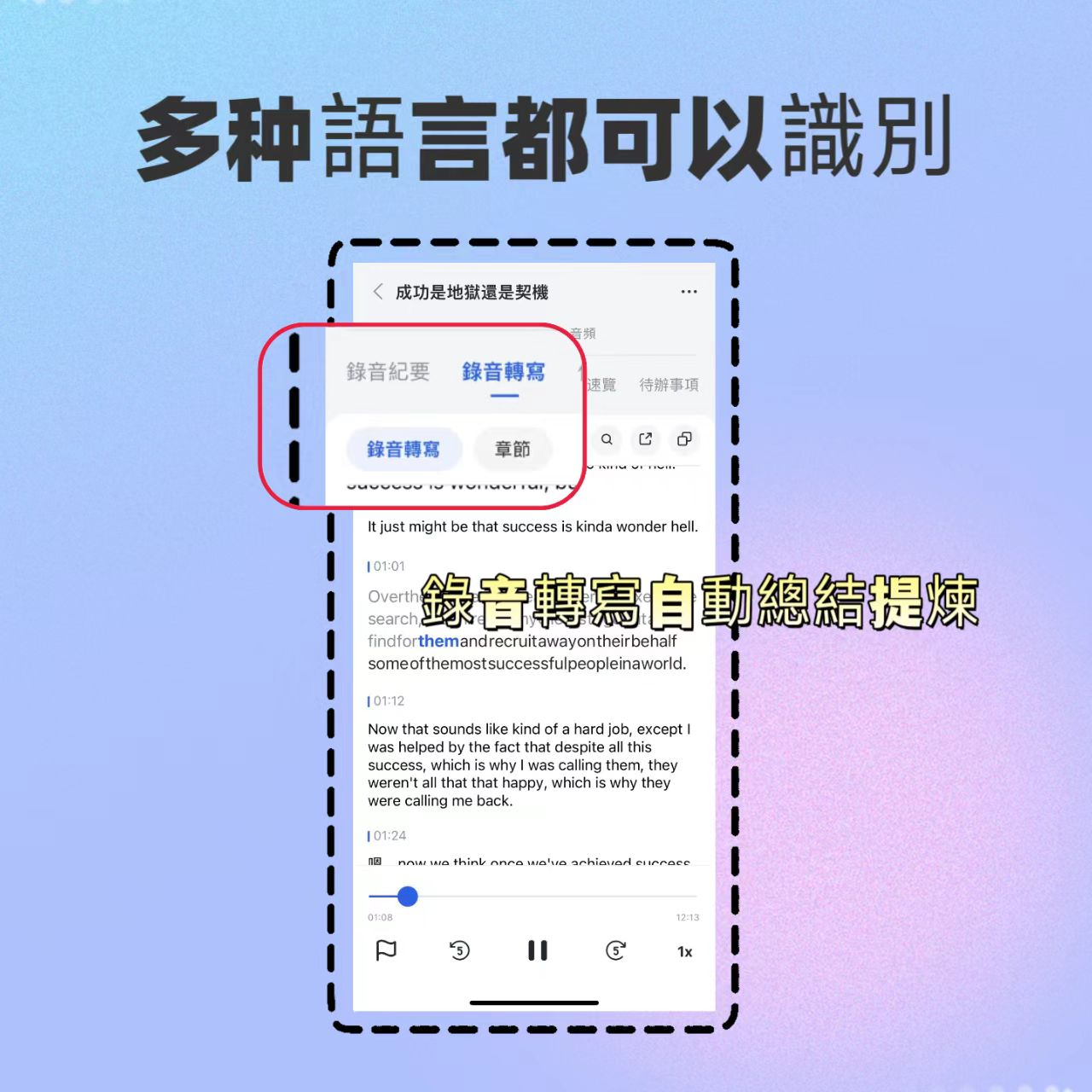
Tinrec is specifically tuned for Chinese (both traditional and simplified) and multilingual scenarios. We tested with the same 5-minute Mandarin meeting recording (quiet conference room, iPhone 15): Tinrec's word error rate was about 7.2%, while Zoom's manual transcription of the same recording exceeded 14%. More importantly, Tinrec automatically distinguishes speakers, adds timestamps, and splits long text into paragraphs, greatly reducing manual effort.
→ This dimension: Tinrec clearly wins.
Stop organizing recordings by hand
Upload audio or video and automatically get a transcript, summary, and action items
Dimension 3: AI Organization Capabilities
This is where the gap is largest. After a Zoom meeting, you only get a video file and plain text—you have to manually extract key points and action items.
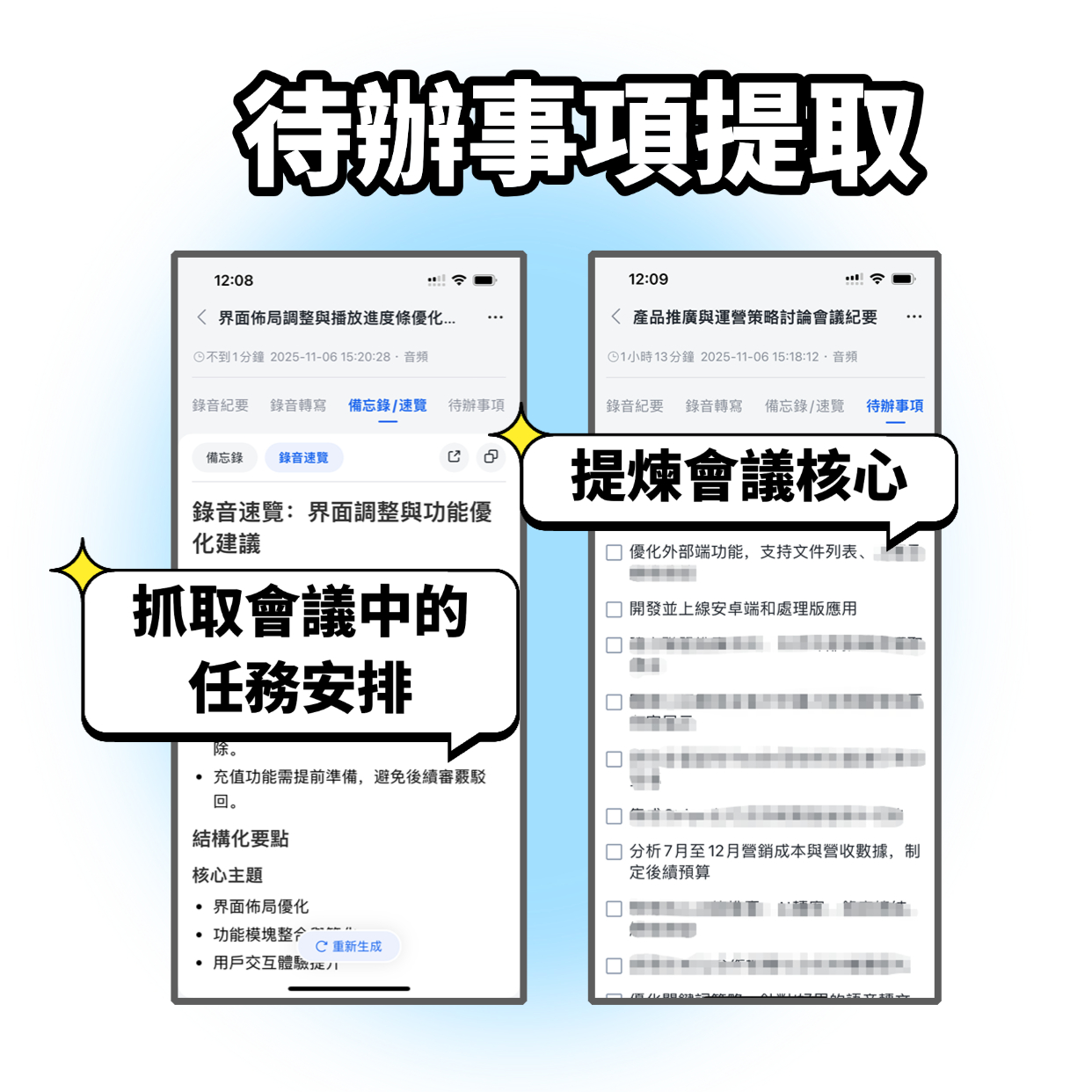
Tinrec's transcription is just the first step. It automatically generates an AI summary, condensing a one-hour meeting into three core conclusions; it also extracts all action items into a clear to-do list. You can even ask questions about the recording, like "What was the budget limit discussed in last week's meeting?" and it will find the answer from the transcript. (See image)
→ This dimension: Tinrec leads across the board.
Dimension 4: Cross-Platform and Export
Zoom's meeting recordings and transcriptions can only be viewed within Zoom's ecosystem; download options for text files are limited, and there's no direct export to collaboration tools like Notion or Google Docs.
Tinrec supports iOS, Android, and web, with real-time sync across all devices. You can export transcripts, summaries, and action items as PDF, Word, TXT, Markdown, or directly connect to third-party services like Notion, Google Drive, and Dropbox, integrating data into your existing workflow.
→ This dimension: Tinrec wins.
Dimension 5: Pricing and Free Plan
Zoom's free account cannot use cloud recording and transcription; you need to upgrade to Pro (about US$12.49/month annual) to unlock these features. This can be an extra expense for small teams that only occasionally need to organize meetings.
Tinrec offers a generous free trial with enough credits to transcribe a few meetings or videos, letting you experience the full workflow before deciding to pay. For higher usage, you can choose a weekly plan (ideal for short sprints), Pro monthly, or annual—the monthly cost is more flexible than Zoom's business plans.
→ This dimension: Tinrec is better for users with limited budgets and varied needs.
What Are the Unique Advantages of Each?
Tinrec's Unique Advantages
- Multi-source integration: Meetings, files, and online videos can all be processed in one workflow without switching between multiple tools.
- AI deep post-processing: Beyond transcription, it generates meeting minutes, reports, tables, and other deliverables, turning recordings into work output.
- Cross-platform sync and export: Seamless across phone, computer, and web; multiple export formats, suitable for individuals and small teams.
- Optimized for Chinese: Performs well with traditional/simplified Chinese and code-switching, low error rate, accurate speaker identification.
Zoom's Unique Advantages
- Integrated meeting experience: For users who only hold meetings and don't need external material processing, Zoom's built-in features suffice without installing extra apps.
- Brand trust and integration: Widely adopted by large enterprises; IT departments can easily manage, with stronger security and compliance.
Conclusion: Which Should You Choose?
- If your meetings, interviews, and course materials come not only from Zoom but also need to organize YouTube, podcasts, or external files → Tinrec is the only choice.
- If you want automatic summaries, action items, and Q&A after recording → Tinrec's AI post-processing is something Zoom lacks entirely.
- If you need flexible organization across phone and computer, and export to tools like Notion and Google Docs → Tinrec offers excellent cross-platform and export support.
- If you only hold English-only Zoom meetings and don't need post-meeting organization or search, Zoom's native transcription might barely suffice, but overall efficiency is far below that of a dedicated tool.
In a nutshell: For most professionals who need to turn meetings, courses, and videos into usable data, Tinrec is currently a more complete and economical choice. We recommend starting with the free plan and experiencing the seamless workflow from transcription to summary with your own recordings.
Turn every recording into actionable outcomes
Get 60 free transcription minutes when you sign in. No credit card required.
Related Reading
You might also like

2026 Free AI Meeting Note Tools: 5 Options Compared (Otter vs Notta vs Tinrec)
Wondering which is better, Otter or Notta? Based on real Reddit user reviews, this article compares 5 AI meeting note tools including Otter.ai, Notta, Tinrec, Plaud Note, and more to help you find the best free or paid plan for your needs.
How to Convert Recordings to Text in 2026: 5-Step Guide (Tinrec, Notta, Sonix Tested)
We tested three recording-to-text tools: Tinrec, Notta, and Sonix. From recording, transcribing, proofreading to generating meeting minutes, this 5-step guide walks you through the full experience and tells you which one works best for small to midsize teams.

2026 Comparison of 3 Google Meet Real-time Translation Tools: Which Free Plan is Best?
Stuck on language barriers during international meetings? We tested three tools that provide real-time translation on Google Meet: Tinrec, Notta, and Otter.ai, to find the best free option for traditional Chinese users.

2026 Google Meet Recording Tools Comparison: 3 Apps Tested to Keep Your Meeting Data from Getting Lost
Scheduling a Google Meet is easy, but finding tools that actually make use of your recordings is hard. This article tests Tinrec, Otter.ai, and Notta to help you choose the best one for turning your future meeting content into searchable, organized knowledge.

2026 Google Meet Meeting Notes Free Plan Roundup: 3 Tools at a Glance
Frequently use Google Meet for meetings and need to organize recordings and meeting notes afterward? This article rounds up 3 meeting notes tools that offer free plans, including Tinrec, Otter.ai, and Fireflies.ai, and compares their suitable scenarios and limitations in detail, helping you quickly find the most helpful choice.

2026 Comparison of Two Google Meet Meeting Note Apps: Which AI Summary Saves the Most Time?
Real-world test of Tinrec vs Otter.ai for processing Google Meet recordings: which saves more time? Comparing Cantonese recognition, AI Q&A, cross-platform support, and pricing. A must-read for Hong Kong office workers.

2026 Comparison of 4 Video Conference Recording & Transcription Apps: Which Free Plan Is the Most Useful?
After every Google Meet or FaceTime meeting, do you spend as much time transcribing notes? This article compares 4 video conference recording and transcription apps, covering free limits, transcription quality, and AI post-processing features, to help you find a truly time-saving solution.

2026 Real-World Test of 4 Voice-to-Text Apps: Which AI Meeting Notes Actually Save You Time?
A mid-level manager tests 4 voice-to-text tools for meeting minutes, transcripts, and AI conversation search. Honest review on which one saves the most time after daily meetings.

2026 Comparison of 2 Google Meet Transcription Tools: Which Free Plan Suits You Best?
If you frequently use Google Meet for meetings and need a reliable AI meeting transcription tool, Tinrec and Fireflies.ai are both popular choices. This article compares them across 5 key dimensions—input sources, post-processing capabilities, Chinese language support, pricing plans, and more—to help you find the best fit.