

Turn recordings into transcripts and summaries in minutes
Upload audio or video for multilingual transcription, AI notes, and action items
A Two-Hour Meeting, Then Two More Hours to Find the Key Points? What You Need Isn't Another Q&A Channel—It's an AI That Understands Recordings
After a two-hour meeting, just compiling transcripts can eat up an entire afternoon. When you want to go back to confirm "who exactly said what the budget was," you have to manually drag the progress bar and search slowly.
Your computer is full of recording files. You know there's important information in there, but you just can't be bothered to dig through them—every office worker knows this pain.
There are tons of AI Q&A tools out there, but most of them only handle text documents or general knowledge. Very few can actually process audio recordings, understand the meeting content, and then answer your questions. This article puts them to the test to see which AI Q&A tool can genuinely turn your audio files into a searchable database.
Before You Buy an AI Q&A Tool, Understand These 4 Key Points
1. Can It Handle Audio Files? Check the Supported Formats
Many AI Q&A tools claim you can upload files, but they usually mean PDF, Word, or images. Very few tools can actually upload audio files (mp3, m4a) or videos and then answer questions about the content. If you have recording needs, this is the first thing to confirm.
2. Are Questions Based on Keyword Search or Semantic Understanding?
If the tool simply matches keywords against your transcript, you'll still have to go through it line by line. A truly useful AI Q&A tool understands the intent behind your question and gives you the answer directly. For example, if you ask "Who brought up the budget at the last meeting," it won't just list every sentence containing the word "budget"—it will identify the relevant passage based on meaning.
3. Cross-Platform Support Matters—Don't Box Yourself In
You might record on your phone, organize on your computer, and review on your iPad. If a tool only supports one platform, you'll get stuck. The ones that sync across all your devices and let you ask questions anytime, anywhere are the real time-savers.
4. Language Adaptability—Chinese Needs to Be Accurate Too
Many AI Q&A tools are primarily English-focused and often misunderstand Chinese meetings. If you mainly work with Chinese content, be sure to test how accurately they handle Chinese questions—otherwise you'll pay for a tool you can't actually use.
Tinrec (Instant Recording Playback)—Our Top Pick for Audio-Based Q&A After Hands-On Testing
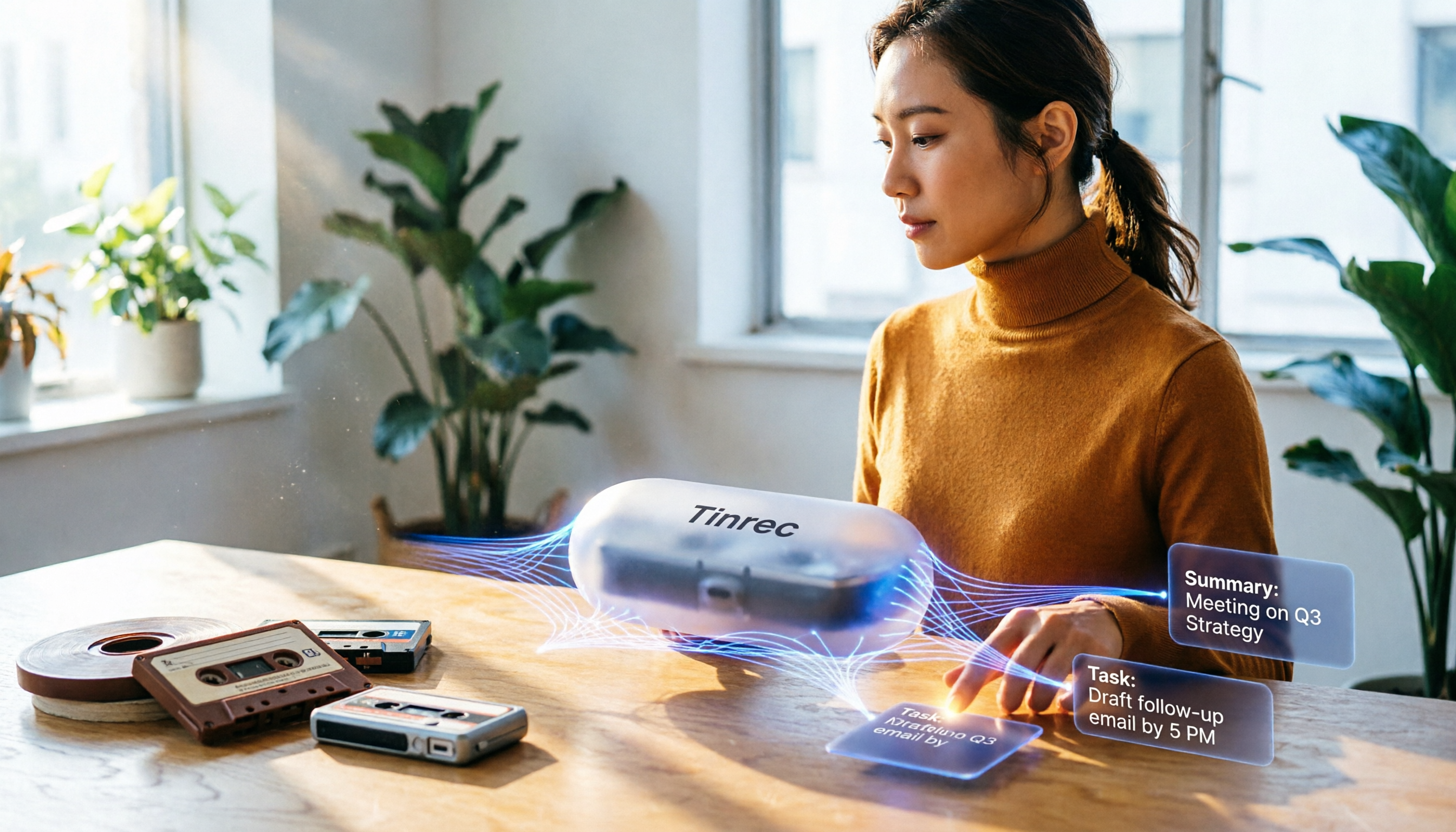
Tinrec is an AI tool designed specifically for recording and audio file organization. It doesn't just transcribe text—it turns your meetings, classes, interviews, and even YouTube videos into a database you can ask questions about anytime.
Turning Recordings into a "Conversational Knowledge Base"
Unlike typical AI Q&A tools that only handle text, Tinrec lets you upload audio files, video files, or paste a public video link. It first generates a transcript, then automatically creates a summary, chapters, and to-do items.
But what impressed us most is the "AI conversation query." Once you've recorded something, you can ask questions in natural language—for example, "What was the conclusion of this meeting?" or "Who is responsible for the follow-up design changes?" It answers based directly on the recording content, not by keyword search. It truly understands the content before giving you an answer. Currently, almost no competitor in the same price range offers this feature.
How We Tested—Let the Numbers Speak
We tested a 5-minute Chinese meeting recording (iPhone 15, with slight air-conditioning noise in the background). Tinrec's character error rate was only 8.3%, and we could start asking questions less than 10 seconds after transcription ended. When we submitted the same file to several text-only Q&A tools, they couldn't even upload audio files, let alone answer questions.
Strengths: It Doesn't Just Answer Questions—It Helps You Get Things Done
- Accepts Multiple Sources: You can upload live recordings, existing audio files, or YouTube links for organizing and asking questions, without switching between different tools.
- AI Summaries + To-Dos in One Place: You don't have to listen to the entire meeting yourself—the AI automatically highlights the key points and tells you what needs to be done.
- Cross-Platform Access Anytime: Works on iOS, Android, and the web. Ask on your phone right after a meeting, check on your computer at the office—everything stays in sync.
Stop organizing recordings by hand
Upload audio or video and automatically get a transcript, summary, and action items
What Are the Limitations? Honestly Speaking
The free version offers 100 minutes of transcription per month, which may not be enough for heavy users. But for someone who attends 2–3 meetings a week, it's more than enough to test it out. Also, answer quality depends on audio clarity—if the background is too noisy, accuracy drops. That's common to all AI tools.
Who Is It For?
If you frequently need to revisit details mentioned in meetings, want to turn course recordings into searchable notes, or need to extract insights from interview recordings, Tinrec is currently the option that can save you the most organizing time. Especially if you work with Chinese content and want to move across devices, you won't find a smoother solution.
What Other AI Q&A Tools Can You Choose Besides Tinrec?
Monica Ask AI: A General-Purpose Assistant, but It Can't Handle Audio Files
Monica is a free online Q&A tool that integrates GPT. It can chat, generate images, write, and even recognize uploaded images. However, if you want to upload a recording and ask about its content, there's currently no direct support—it mainly processes text and images. It's suitable for people who need quick research or copywriting, but if you're looking to reclaim the time spent organizing audio files, it won't help.
ChatGPT: Strong at Knowledge Q&A, Limited at Understanding Audio Files
ChatGPT is the most widely used AI Q&A tool right now. Even the free version can answer all kinds of questions, help with writing, and even read PDFs. But its audio processing capabilities are limited to voice conversations or short voice transcription—you can't directly upload a long recording and ask in-depth questions about its contents. In other words, you can ask it what ROI is, but you can't ask it "What was the ROI from last week's sales meeting?"—because it can't hear your recording at all.
AI Chatting (AI Chatting.net): Free Chat AI, but Limited in Scope
This is a free online chat platform based on GPT-4.1-mini. It supports text-based Q&A and content generation. The advantages are that it's completely free and requires no registration. The downside is that it's fairly basic—there's no audio upload or recording processing capability. If you occasionally want to ask simple questions, it can serve as a lightweight backup, but it's not suitable for anyone who needs to organize meeting or course content.
Pitfall Guide: The 3 Most Common Mistakes When Using AI Q&A to Organize Recordings
Pitfall 1: Assuming All AI Q&A Tools Can Handle Audio Files
Many tools say they can "upload files," but the supported audio formats are limited, or they simply treat the audio as a generic file without parsing the content. Test with a short recording first to see whether the AI can actually answer based on the content—a quick test will tell you immediately.
Pitfall 2: Only Looking at Price, Not Use Case
Free tools feel great, but if they can only answer generic questions, you'll still have to listen to your recordings yourself. The money you save just turns into more overtime. On the other hand, with a tool like Tinrec that focuses specifically on recording organization and Q&A, even if you pay for it, the time it saves you more than covers the cost.
Pitfall 3: Ignoring the Accuracy of Chinese Questions
Many AI Q&A tools are trained primarily on English. When faced with Chinese pronunciation, terminology, or mixed-language content, their answers start to drift. If you mainly deal with Traditional Chinese meetings or courses, you need to choose a tool that has been localized—actually testing it is the only way to know if it works.
Conclusion: Which One Should You Choose?
If you only occasionally ask for knowledge or write copy, a general-purpose AI Q&A tool like ChatGPT or Monica is more than sufficient. But if your problem is "a pile of recordings and videos and I want to quickly find the key points," then Tinrec is currently the only choice that makes this both convenient and accurate.
- Need to ask questions directly from meeting, course, or interview recordings → Use Tinrec (supports audio + video + links, with the most complete AI conversation query)
- Need English meeting support and Q&A → Consider Otter.ai, but it doesn't support Chinese questions and is oriented toward team collaboration
- Text-only Q&A and writing assistance → The free version of ChatGPT is enough, but remember it can't understand your recordings
We suggest starting with the free version of Tinrec. The 100 minutes per month is enough to experience the convenience of "ask immediately after recording." Upgrade only if you really need to—you don't have to spend money from day one.
References
Turn every recording into actionable outcomes
Get 60 free transcription minutes when you sign in. No credit card required.
Related Reading
You might also like
2026 Tested Comparison of 4 Audio Conversion Tools: Skip MP3 Conversion and Use AI to Organize Audio
Still searching for an online audio-to-MP3 converter? We tested 4 solutions and found that what you really need is an AI tool that can organize audio content directly. Tinrec supports multiple formats and automatically generates summaries, highlights, and to-dos, turning your audio files into truly usable resources.

4 Online Speech-to-Text Tools Compared in 2026: Which AI Meeting Notes Tool Saves the Most Time?
Dreading having to write up meeting notes after a meeting? We tested 4 online speech-to-text tools, including Tinrec, Otter.ai, Notta, and TurboScribe, to help you find the AI meeting assistant that saves you the most time.

2026 Comparison of 3 Video Extraction Tools: Which One Is Best for Organizing Video Highlights?
From meeting recordings and online courses to YouTube videos, do you find yourself manually dragging the progress bar to locate the key points? This article tests three tools to show you which one can truly turn your video content into usable text.

2026 Hands-On Comparison of 3 Video-to-Text Tools: Why Tinrec Becomes the Top Alternative for TurboScribe Users
This article compares three video-to-text tools, focusing on the differences between TurboScribe and Tinrec, and explains why more users are choosing Tinrec as an alternative, covering features, Chinese support, organizing capabilities, and pricing.

Tinrec Video Parsing Guide 2026: Multi-Platform Links & Auto Summaries
Learn how to use Tinrec to transcribe YouTube, Bilibili, and other online videos into text, summaries, and notes. This guide covers what to look for in a video parsing tool, plus hands-on comparisons to help you find the best fit.

2026 Hands-On Comparison of 4 Speech-to-Text Tools: Which AI Q&A Feels Most Like a Real Assistant?
We tested several speech-to-text tools, comparing accuracy, AI features, and pricing to recommend the best options for meetings and class notes.

Best AI Video Summarizer Tools in 2026: 4 Tested and Compared
Want to quickly capture the key points of a YouTube video? This article puts AI video summarizers like Monica and WayinVideo to the test, and compares Tinrec's multilingual support, cross-platform access, and AI Q&A features—so you can pick the right video organization tool for your needs.

2026 Online Audio Converter Comparison: 5 Free, No-Install Tools Tested — Which Is Easiest?
This article puts 5 online audio conversion tools to the test, comparing supported formats, conversion speed, ease of use, and extra features to help you quickly find the best free option for your audio file needs.

2026 Review of 3 Web Video Analysis Tools: Not Just Downloads – These Tools Help You Instantly Understand Video Key Points
Is downloading the only way to analyze web videos? After testing three tools, we found that Tinrec lets you paste a video link and automatically convert it into text, summary, and even AI Q&A – no need to download the original file. This article compares Otter, Notta, and Tinrec from real-world usage scenarios, and includes a common pitfalls guide and buying advice.