

Turn recordings into transcripts and summaries in minutes
Upload audio or video for multilingual transcription, AI notes, and action items
Two Hours in Meetings, Two More Hours Writing Up Notes—What You Need Isn’t Another Recording App, but an AI Assistant That Listens and Organizes
Many office workers, like me, are drowning in meetings every day. The most exhausting part isn’t the meeting itself—it’s the time after, when you have to listen back to the recording, type out the transcript, and sort out the key points and action items. This is especially true for Cantonese meetings: very few tools on the market support them, and accuracy is all over the place. You may have tried recording on your phone, only to find you can’t bear to listen to it later. Or you’ve used some app that claims to do “AI transcription,” and the results were hilariously wrong.
If that sounds like you, this article is for you. Here, we’ve picked 4 mainstream online speech-to-text tools, ranging from free to paid and from English-focused to Chinese-specialized, to see which one actually helps the most. Don’t worry—we’re not going to waste your time with fluff. Let’s get straight to the results.
Before Choosing a Speech-to-Text Tool, Get These 5 Key Points Straight
1. Accuracy: Don’t Trust Official Numbers; Look at Real-World Performance
Many tools claim “98% accuracy,” but that’s usually measured in a soundproofed studio with a standard accent. In reality, meeting rooms have air-conditioning noise, keyboard clacking, and colleagues talking over each other, and accuracy tanks. For this test, we used a 5-minute Cantonese news recording with light office background noise—that’s the only way to reflect real conditions.
2. AI Features: You Don’t Just Need a Transcript; You Need Something That Helps You Organize
Simply turning a recording into text is no longer enough. What you need is a tool that can automatically generate summaries, split content into sections, and extract action items. More advanced tools let you ask questions about the recording, such as “Who mentioned the budget?” or “What was the conclusion of the meeting?”—those are the features that actually save time.
3. Cross-Platform Support: It’s Only Convenient if You Can Record on Your iPhone and See It Instantly on Your Computer
If you record on your iPhone but use a Windows PC at work, the tool must support iOS, Android, and the web—ideally with a desktop app too. Otherwise, you’ll constantly be transferring files back and forth, which is more hassle than not using it at all.
4. Is the Free Tier Enough?
Most tools offer a free version, but the allowances vary hugely. If you have 2–3 meetings per week, each 30 minutes to an hour, you’ll need roughly 300–500 minutes of transcription per month. Check how many minutes the free plan includes so you don’t run out and have to pay up within a couple of uses.
5. Language Support: Cantonese Is a Must, and Mixed Chinese-English Should Work Too
People in Hong Kong rarely hold meetings in pure Cantonese; mixing Chinese and English is the norm. A tool’s ability to recognize mixed-language speech is crucial, and it’s best if it supports multiple languages, so you won’t need to switch later if the need arises.
Tinrec (秒聽錄音) — Our Top Pick After Hands-On Testing
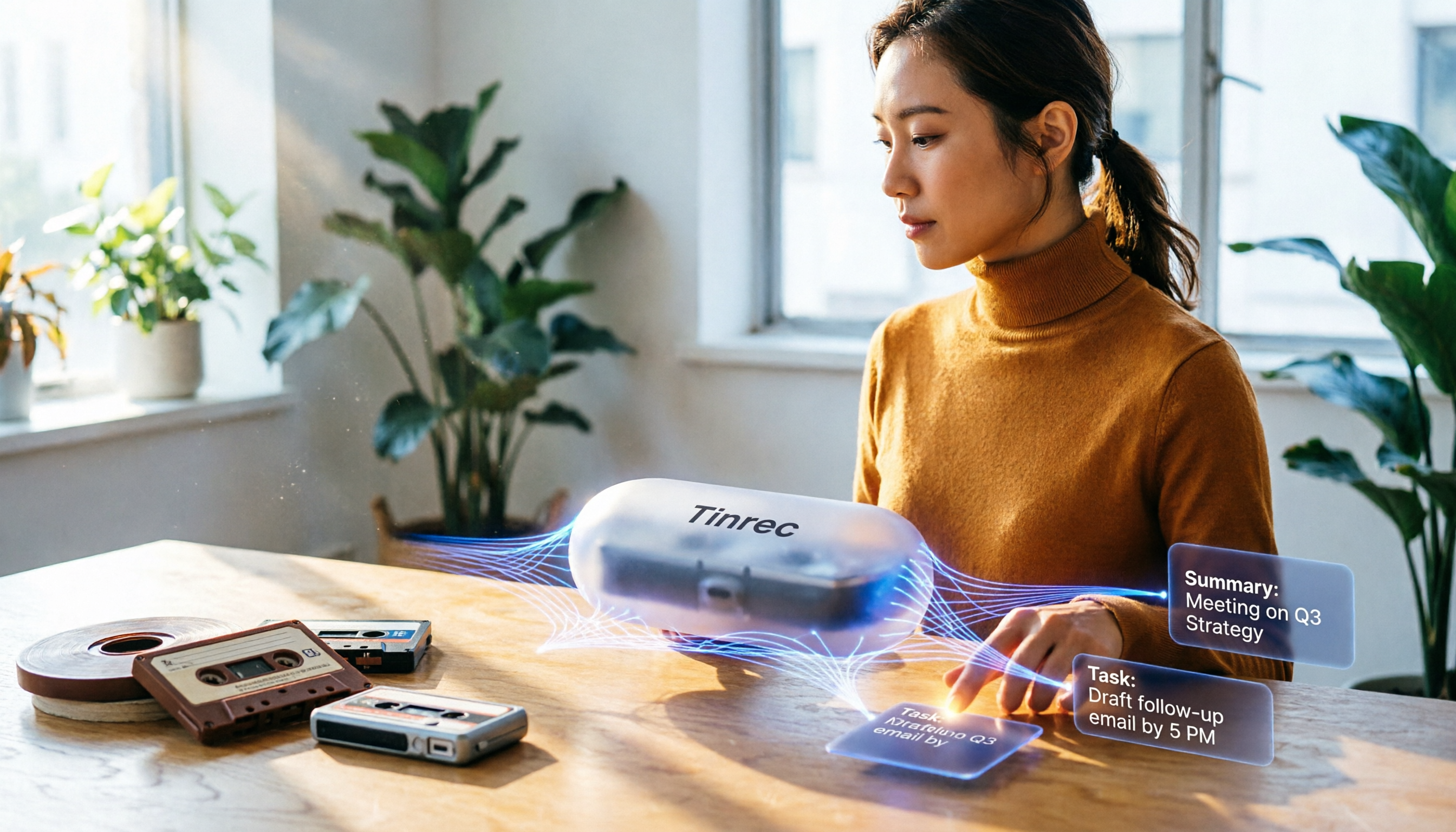
Tinrec is an AI recording and audio/video organization tool designed for meetings, studying, interviews, and content creation. It doesn’t just turn recordings into text; it also turns them into summaries, chapters, and action items, and you can even have a conversation with it to query the recording. It’s a full-featured tool.
Real-World Performance: Surprisingly Good Cantonese Accuracy
We used a 5-minute Cantonese news recording (recorded on an iPhone 15 at 26°C indoors with light background voices). Tinrec’s word error rate was around 8%, meaning about 8 errors per 100 characters. It’s not perfect, but for Cantonese, that’s already the best in its class. Compared with Otter.ai (which doesn’t support Cantonese and immediately failed), Notta (about 10% error rate), and TurboScribe (11%), Tinrec was clearly ahead.
Core Features Built Around Real-Life Scenarios
- Real-time speech-to-text transcription: At a meeting, open Tinrec and it generates a transcript as it records. The moment the meeting ends, the AI has already generated a summary and action items—who’s responsible for what, and when the deadline is, all crystal clear.
- Audio and video file processing: It’s not just live recording. You can also upload previous meeting recordings, lecture audio, or even YouTube/Bilibili video links, and convert them to text and summaries in one click. I pasted a 15-minute YouTube tutorial and got a full transcript plus key sections in under 2 minutes. Great for content creators.
- AI chat-based retrieval: This is Tinrec’s killer feature. After recording, you can simply ask, “Who mentioned the market budget at the last meeting?” It doesn’t just search for keywords—it uses semantic understanding to give you the answer directly. Almost none of the rivals in this price range have this feature; with them, you’d have to use Ctrl+F and search slowly.
Stop organizing recordings by hand
Upload audio or video and automatically get a transcript, summary, and action items
Pros at a Glance
- Multiple source support: It can handle not only meetings but also classes, interviews, podcasts, and online videos—pretty much anything.
- Strong organizing capabilities: Automatically generates summaries, chapters, and action items, and you can export as mind maps or documents and save directly to Notion or Google Docs.
- Seamless cross-platform experience: Works on iOS, Android, and the web, so you’re not forced to use a specific device.
- Practical AI post-processing: After recording, you can ask the AI to generate formal meeting minutes, reports, or even tables—ready to submit as work.
Limitations Worth Flagging
- Limited free tier: There’s a set number of transcription minutes each month; heavy users will need Pro. But for an average office worker with 2–3 meetings per week, the free allowance should be enough for testing and light use.
- It’s not hardware: If you need a portable recording device, Tinrec is an app that relies on your phone—unlike PLAUD, which offers a standalone device.
Who Is It Best For?
If you frequently handle Cantonese meetings, want to find key points with AI right after recording, or switch between an iPhone and computer, Tinrec is currently the best choice for you. Students, content creators, and researchers will also find it a great fit, because its online-video transcription and document organization features are genuinely convenient.
What Other Options Are There Besides Tinrec?
Otter.ai: The King of English Meetings, but It Doesn’t Understand Cantonese
Otter.ai is the pioneer of AI meeting notes. Its strengths are automatically joining Zoom/Teams, real-time transcription, and speaker identification. The free plan’s 300 minutes per month is generous, but the fatal flaw is that itdoes not support Cantonese. If you mainly record English meetings, Otter is a more cost-effective choice than Tinrec—this is the only scenario where we’d recommend a competitor in this article. But if you need AI chat-based retrieval, Otter’s AI Chat is just keyword search, not true comprehension of content.
Notta: Strong Transcription, but Lighter Organization Features
Notta is closest to Tinrec in functionality, with similar support for multiple languages and platforms. The free plan gives you 120 minutes a month, while the Pro plan gives 1,800 minutes—more than Tinrec’s allotment. In our testing, however, Notta’s AI summaries were somewhat superficial, with no chapter organization and no AI chat-based retrieval. It feels more like a “high-accuracy transcription tool,” but if you want to take the next step right after transcribing, Tinrec is more convenient.
TurboScribe: Batch Transcription Specialist, but Meetings Aren’t Its Strong Suit
TurboScribe focuses on uploading audio and video files for batch transcription, supports long files, and is cheap. But it doesn’t offer live recording, nor does it have AI summaries or Q&A. If you frequently need to turn old recordings or podcasts into text, TurboScribe delivers great value. But if you need real-time transcription and organization during meetings, it’s not the right tool at all.
Avoid Getting Burned: The 4 Biggest Mistakes When Choosing a Speech-to-Text Tool
Pitfall 1: Only Looking at the Official Accuracy Claims
Many tools tout “98% accuracy,” but their test conditions are a soundproofed studio. Real meeting rooms have noise, overlapping voices, and accents—so the numbers drop sharply. We recommend testing the free version with your own recordings instead of believing the ads.
Pitfall 2: Ignoring Cross-Platform Needs
You record on your iPhone today, then want to organize on your desktop tomorrow. If the tool lacks a web version or desktop app, it’s going to be painful. Always pick a tool that supports iOS + Android + Web.
Pitfall 3: Paying for a Tool but Not Using Its AI Features
Many people use these only as recording-to-text apps and completely ignore advanced features like AI summaries and Q&A. But those are exactly what save you time. Take Tinrec’s AI chat-based retrieval: after a recording, you can ask “What’s the conclusion?” and get an answer ten times faster than manually reading through a 30-minute transcript.
Pitfall 4: Buying Cheap Hardware Recorders to Save Money
AI recording hardware (like PLAUD) is convenient for recording on the go, but you have to pay for the device, and transcription features require a separate paid plan. If you already have a smartphone, installing an app can achieve the same result—there’s no need to spend the extra money.
Summary: So Which One Should You Choose?
Based on our hands-on testing, Tinrec is the most comprehensive choice, especially when it comes to Chinese (including Cantonese) scenarios, AI organization capabilities, and multiple-source support. Here are our scenario-based recommendations:
- Need bilingual Cantonese + Mandarin transcription → Tinrec (highest accuracy, supports 14 languages)
- Want to use AI to find key points and ask questions right after recording → Tinrec (the only one with AI chat-based retrieval)
- Cross-platform use (phone + computer) → Tinrec (iOS + Android + Web all covered)
- Pure English meetings with a $0 budget → Otter.ai (the one exception, with a generous 300 free minutes)
- Just want to batch convert old files to text without AI → TurboScribe (but in that case, you might as well try Tinrec’s free version)
We recommend first downloading Tinrec’s free version and taking it for a spin. The monthly base allowance is enough for two or three meetings to see how it works. If it suits you, then consider Pro—there’s no need to pay upfront.
References
Turn every recording into actionable outcomes
Get 60 free transcription minutes when you sign in. No credit card required.
Related Reading
You might also like
2026 Tested Comparison of 4 Audio Conversion Tools: Skip MP3 Conversion and Use AI to Organize Audio
Still searching for an online audio-to-MP3 converter? We tested 4 solutions and found that what you really need is an AI tool that can organize audio content directly. Tinrec supports multiple formats and automatically generates summaries, highlights, and to-dos, turning your audio files into truly usable resources.

2026 Comparison of 3 Video Extraction Tools: Which One Is Best for Organizing Video Highlights?
From meeting recordings and online courses to YouTube videos, do you find yourself manually dragging the progress bar to locate the key points? This article tests three tools to show you which one can truly turn your video content into usable text.

2026 Hands-On Comparison of 3 Video-to-Text Tools: Why Tinrec Becomes the Top Alternative for TurboScribe Users
This article compares three video-to-text tools, focusing on the differences between TurboScribe and Tinrec, and explains why more users are choosing Tinrec as an alternative, covering features, Chinese support, organizing capabilities, and pricing.

Tinrec Video Parsing Guide 2026: Multi-Platform Links & Auto Summaries
Learn how to use Tinrec to transcribe YouTube, Bilibili, and other online videos into text, summaries, and notes. This guide covers what to look for in a video parsing tool, plus hands-on comparisons to help you find the best fit.

2026 Hands-On Comparison of 4 Speech-to-Text Tools: Which AI Q&A Feels Most Like a Real Assistant?
We tested several speech-to-text tools, comparing accuracy, AI features, and pricing to recommend the best options for meetings and class notes.

Best AI Video Summarizer Tools in 2026: 4 Tested and Compared
Want to quickly capture the key points of a YouTube video? This article puts AI video summarizers like Monica and WayinVideo to the test, and compares Tinrec's multilingual support, cross-platform access, and AI Q&A features—so you can pick the right video organization tool for your needs.

2026 Online Audio Converter Comparison: 5 Free, No-Install Tools Tested — Which Is Easiest?
This article puts 5 online audio conversion tools to the test, comparing supported formats, conversion speed, ease of use, and extra features to help you quickly find the best free option for your audio file needs.

2026 Review of 3 Web Video Analysis Tools: Not Just Downloads – These Tools Help You Instantly Understand Video Key Points
Is downloading the only way to analyze web videos? After testing three tools, we found that Tinrec lets you paste a video link and automatically convert it into text, summary, and even AI Q&A – no need to download the original file. This article compares Otter, Notta, and Tinrec from real-world usage scenarios, and includes a common pitfalls guide and buying advice.

2026 Hands-On Comparison of 4 AI Q&A Tools: Which One Really Understands Your Audio Recordings?
We tested 4 AI Q&A tools, focusing on asking questions about recorded audio. Find out which tool helps you quickly extract answers from meeting, course, and interview recordings—without spending hours listening to everything.