
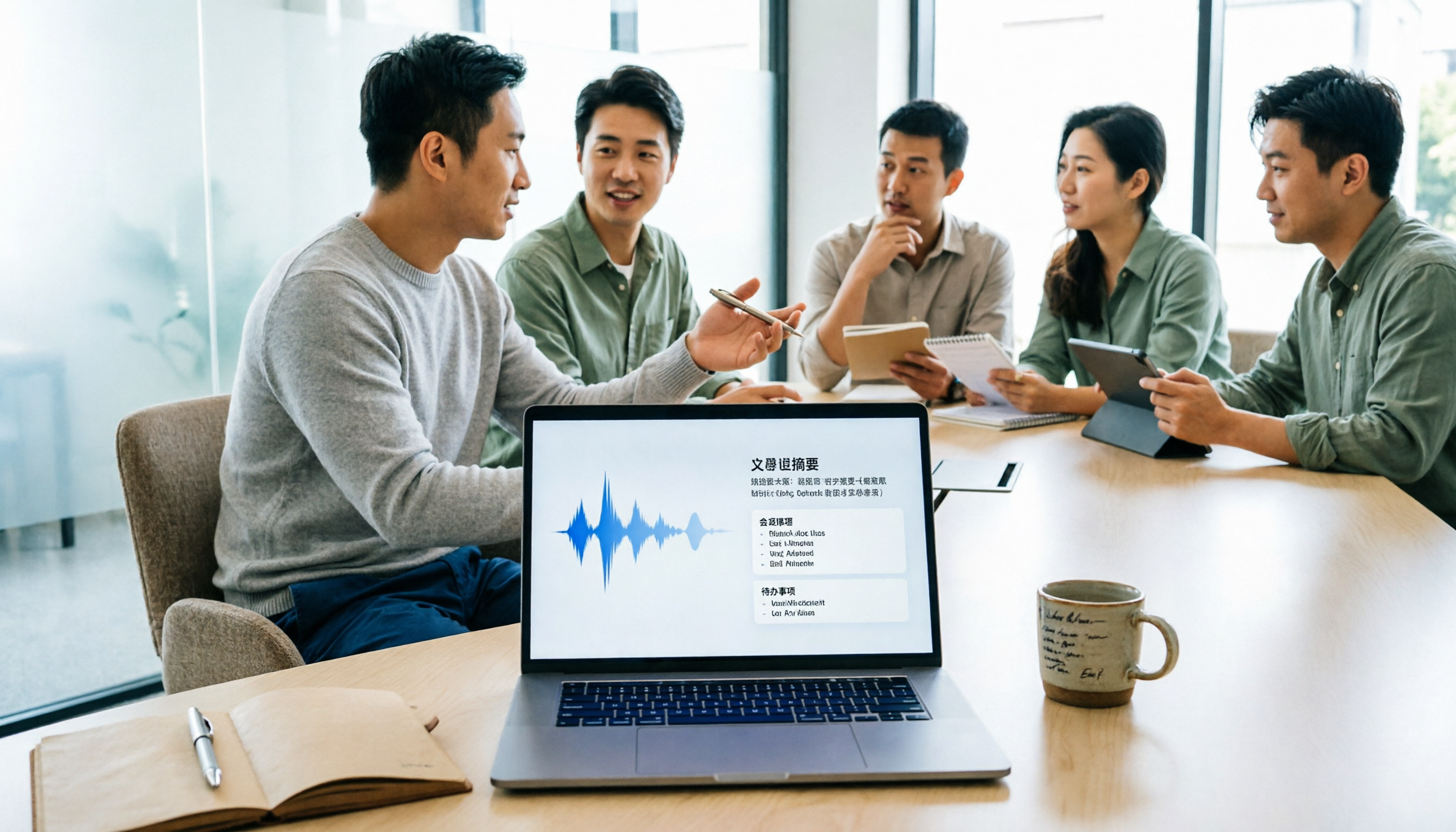
Turn recordings into transcripts and summaries in minutes
Upload audio or video for multilingual transcription, AI notes, and action items
What Do You Have Left When the Meeting Ends?
The project meeting started at 2 PM and ended at 4 PM. You close the video call, and two lines you typed are still on the screen: "Q3 budget to be confirmed," "Submit version next week."
But the trade-offs discussed during those two hours, who opposed which proposal, and the concerns the client casually mentioned—all of that is still in the recording.
Most office workers leave the recording to "listen later when there's time." The reality is, you almost never open it again. By the time you actually need it, you can't even remember which meeting it was.
Another common scenario: the meeting is on Teams or Google Meet, and you want to record on the fly, so you put your phone nearby to record. The audio is poor with lots of noise, and you still have to listen from the beginning afterward.
This article isn't about "which app records the clearest," but about which one truly turns meetings into data you can use later—transcripts, summaries, action items, and even the ability to ask questions directly about the content after the meeting.
Before Choosing Meeting Minutes Software, Understand These 4 Key Points
1. Recognition Performance for Chinese and Mixed Chinese-English
Meetings in Taiwan are rarely pure Chinese. "This feature will release next week" is the norm. During testing, I deliberately pick a recording with mixed Chinese and English to see how it handles sentence segmentation and proper nouns, rather than just looking at the accuracy rate stated on the official website.
2. How Meeting Audio Gets into the Tool
There are currently three methods: a meeting bot joins as a participant, desktop version captures system audio, or upload the audio file after the meeting. The bot is the most convenient, but for external meetings, having an extra "AI assistant" join may bother some people. Desktop system audio capture is currently the least intrusive approach for participants in my opinion.
3. Are Post-Meeting Outputs Sufficient?
A transcript alone is not enough. A two-hour meeting equals 20,000 words, which is too low in information density. I look at whether it can automatically segment chapters, extract conclusions and action items, and ideally allow me to continue asking questions about the content.
4. Quotas and Team Authorization
For personal use, look at monthly minutes; for teams, note that "roles" and "seats" are two different things—who can manage the team and who can actually record and upload are usually calculated separately. Many people only discover this during procurement.
Tinrec (Miao Ting Recording) — My Current Main Tool
Tinrec (Miao Ting Recording) is an AI meeting notes and collaboration tool for individuals and teams, supporting web, desktop, and mobile.
No Need to Invite a Bot for Online Meetings
The desktop version directly captures computer system audio, so meetings played on Zoom, Google Meet, Microsoft Teams, and Webex can all be recorded without an extra bot joining the meeting room. For those who frequently meet with external clients, this difference is significant.
Note that this is not "automatically joining all calendar meetings." You need to open Tinrec yourself to start recording; the tool won't jump into meetings on its own.
Transcribe While Recording, Get Key Points Directly After the Meeting
Start real-time recording and transcription during the meeting, and the transcript is generated synchronously. After the meeting ends, AI summaries, chapters, and action items are already organized—who is responsible for what and which items are still undecided—much faster than going through the transcript from the beginning.
Ask Questions About Meeting Content (My Most-Used Feature)
After recording, you can directly ask it: "What concerns did the client mention in the last meeting?" "How was the budget matter finally decided?" It answers based on the meeting content, rather than giving you a list of keyword search results. Among tools in the same price range, not every one has this capability.
Turn It into Formal Documents After the Meeting
Supports export to Notion, Google Docs, OneNote, Dropbox, and can also generate reports, tables, and meeting minutes documents through Agent post-processing. There is also real-time translation, so cross-language meetings can be viewed in original, translated, or bilingual format.
Team Edition Keeps Data in the Team's Hands
The team edition is an independent team space, not multiple people sharing a personal account. You can create multiple teams, invite members via join links, set owners, admins, and regular members, and allocate or revoke seats.
Meeting data belongs to the team. When a member leaves or is removed, their resources need to be handed over to other active members, so data won't disappear with the personal account.
Stop organizing recordings by hand
Upload audio or video and automatically get a transcript, summary, and action items
Admins can also view usage trends, member rankings, export audit logs, and use the audio recycle bin to handle accidental deletions. Team hotwords allow maintaining company-specific terminology, making recognition of technical terms closer to actual usage.
Currently, the team edition offers a 7-day trial for first-time eligible users, 1 free seat, and 300 minutes of team shared import quota; monthly payment is USD 29.80 per paid seat per month, annual payment is USD 199 per paid seat per year (equivalent to about USD 16.58 per month). Paid seats provide 2,000 minutes of team shared import quota per month, and real-time recording is currently not deducted by minutes under valid plans and seats.
How to Choose the Personal Edition
The free version lets you experience recording, import, summaries, and transcription; for short-term intensive meetings or interviews, consider the weekly card; for stable weekly needs, use the Pro monthly card; for long-term data accumulation, the annual card is more cost-effective.
Things to Note
Tinrec does not promise a fixed accuracy rate; actual performance is affected by recording quality, accents, multiple people talking over each other, and proper nouns. For important content, it's recommended to go back and verify the transcript timestamps.
Also, the team edition is currently team-level sharing, with governance controlled by roles and usage eligibility controlled by seats, not fine-grained file-level permissions. This should be confirmed first when evaluating security requirements.
Who It's For
People who frequently hold online meetings, need Chinese and mixed Chinese-English recognition, want to use AI to find key points directly after meetings, or need to accumulate meeting data as team assets.
Besides Tinrec, Here Are 4 Other Options
Otter.ai
A mature choice for English meetings. Basic is free with 300 minutes per month; Pro annual payment is about USD 8.49 per user per month, including 1,200 minutes per month and 10 file imports. It integrates smoothly with Zoom, Meet, and Teams for English scenarios, but Chinese meetings and mixed Chinese-English are not its strong suit. As for further generating reports and tables from meeting content, Tinrec's Agent post-processing is currently ahead.
Notta
A common choice for multi-platform transcription and translation. Free is 120 minutes per month, with a maximum of 3 minutes per content; Pro annual payment is about USD 8.17 per month, 1,800 minutes per month; Business annual payment is about USD 16.67 per seat per month. Transcription and translation are complete, but online meetings mainly rely on bots or post-meeting uploads; Tinrec's desktop version can record directly without inviting a bot, and also has action items and Agent post-processing after the meeting.
Granola
Bot-free AI meeting notes. Basic is free, Business is USD 14 per user per month. It emphasizes combining your handwritten notes with AI, and does well in continuing context across meetings. However, it does not support uploading pre-recorded audio files, nor does it save meeting audio—if you need to keep recordings for later review and verification, this is a clear difference, and Chinese meetings are also not its main scenario.
TurboScribe
A cost-effective file transcription tool. Free allows 3 files per day (max 30 minutes per file), Unlimited annual payment is USD 120, and paid version allows up to 10 hours per file. Long files and batch uploads are its strengths, but it lacks the structured summaries and post-meeting workflows needed for meeting minutes.
Pitfalls Guide: The 4 Most Common Mistakes When Choosing Meeting Minutes Software
Pitfall 1: Only Looking at the Accuracy Rate on the Official Website.
"98% accuracy" is usually measured in a quiet environment with a single person reading aloud. Real meeting rooms have air conditioning noise, keyboard sounds, and three people talking over each other. It's recommended to test with your own meeting recordings; the difference will show then.
Pitfall 2: Treating "Having a Transcript" as "Having Meeting Minutes."
A transcript is raw material, not a finished product. What you need are conclusions, decisions, and action items. A tool that only provides a transcript is essentially returning the organizing work to you unchanged.
Pitfall 3: Ignoring How Meeting Audio Is Recorded.
Having a bot join is convenient, but for external quotation meetings, interviews, and client interviews, having an extra bot on the list makes a difference. Thinking clearly about your meeting types in advance is easier than remedying later.
Pitfall 4: Sharing a Personal Account for Team Use.
When a colleague leaves, whose account the data is in becomes a big problem. The point of the team edition is not just quotas, but the governance logic of "members, roles, seats, and data ownership."
Conclusion: Which One Should You Choose for Your Situation?
- Frequently hold Zoom/Meet/Teams meetings and don't want a bot to join → Tinrec (desktop version captures system audio)
- Need Chinese and mixed Chinese-English transcripts, and want to ask follow-up questions after the meeting → Tinrec (AI Q&A and summaries)
- Meeting data should stay in the team, and need member and usage management → Tinrec Team Edition (space, seats, audit, recycle bin)
- Pure English meetings, zero budget → Otter.ai free version (300 minutes per month)
- One-time large batch of long file transcription → TurboScribe (strengths in batch and long files)
- Used to taking handwritten notes during meetings → Granola (notes combined with AI)
Simply put, the value of meeting minutes software is not "how fast it transcribes," but "how much time you still have to spend after the meeting." If you have more than three meetings per week, run two or three of your own real meetings with the free version first, then decide whether to upgrade—that will be more accurate than any review.
References
- 2026 Meeting Minutes App Recommendations: 5 Tools Tested and Compared, Tinrec AI Dialogue Query Solves the Pain of Re-listening - Miao Ting Recording Blog
- Which Meeting Minutes App Is Good? Conclusion First: 6 Recommendations for 2026 Including Tinrec Test - Miao Ting Recording Blog
- Which Meeting Minutes Tool Is Good? Tested 1 in 2026, This Free Version Is More Than Enough - Miao Ting Recording Blog
- AI Meeting Notes Generator
- 4 Must-Have AI Meeting Minutes Tools for 2026, Generate Key Points with One Click and Get Rid of Tedious Notes - Miao Ting Recording Blog
Turn every recording into actionable outcomes
Get 60 free transcription minutes when you sign in. No credit card required.
Related Reading
You might also like

4 Transcription Tools Compared (2026): Free Tiers, AI Summaries, and Post-Meeting Organization
Transcription isn't the problem—organizing is. Based on real meeting scenarios, this article compares four transcription tools' free tiers, meeting capture methods, AI summaries, and post-meeting outputs, and explains which tool fits which use case.

2026 Comparison of 4 Meeting Minutes Word Solutions: Manual Templates vs. AI Auto-Generation—Which Is Faster?
Most people searching for "meeting minutes Word" download a template first, but still end up scrambling to fill in details afterward. This article starts with common pitfalls and compares the meeting minutes workflows of manual Word templates, Tinrec, Otter.ai, Notta, and Granola. It also covers essential fields for Word meeting minutes, a guide to avoiding mistakes, and selection advice.

5 Audio-to-Text Transcription Tools Tested for 2026: Which Free Version Is Good Enough?
How do you choose an audio-to-text transcription tool? This guide breaks down core capabilities like real-time transcription, AI summaries, action item extraction, export, and team collaboration based on real-world use cases. It includes hands-on testing with Tinrec, plus a look at free quotas, team plan pricing, and buying considerations to help you decide which option truly fits your needs.

Tinrec vs Yating Transcription 2026: 5-Dimension Comparison — Which Is More Practical for Team Meeting Transcripts?
There are many transcript generation tools, but what really affects your daily下班 time is 'what you can do after recording.' This article compares Tinrec and Yating Transcription from the perspective of a mid-level manager, across 5 dimensions: input sources, post-meeting organization, Chinese recognition, cross-platform, and team knowledge retention. It also covers suitable scenarios for cSubtitle and inFin, plus 4 key pitfalls to avoid when choosing a tool.

5 AI Meeting Transcription Tools Tested for 2026: Free Tiers, Chinese Recognition, and Post-Meeting Organization Compared
Meeting transcription isn't just about uploading a recording. This article addresses two common misconceptions, compares five approaches to meeting transcription, and uses Tinrec (Miao Ting Lu Yin) as a hands-on example to break down the complete workflow: real-time transcription, bot-free recording, summary chapters, AI Q&A, export, and team knowledge retention. Includes details on free and paid quotas.

2026 Comparison of 4 Speech-to-Text Tools: Free Tiers and Post-Meeting Organization—Which Is Enough?
Many people think speech-to-text just means dropping an audio file into a tool and waiting for the text. What really slows things down is post-meeting organization, finding key points, and tracking action items. This article compares Tinrec, Notta, Otter.ai, and Granola using real meeting scenarios—from free tiers, Chinese transcription, bot-free recording, AI Q&A, to team data retention—to help you decide which one best fits your workflow.

2026 Comparison of 3 AI Transcription Tools: Free Tiers, Chinese Recognition, and Post-Meeting Organization—Which One Really Saves Time?
Most people misunderstand AI transcription—they think it's just about turning voice into text. This article addresses three common misconceptions, explaining that transcripts are only raw material; the real time savings come from post-transcription summaries, action items, Q&A, and team knowledge retention. Using Tinrec as an example, it walks you through features, use cases, purchasing considerations, and FAQs.

2026 Guide: Turn AI Transcripts into Meeting Minutes & Action Items in One Go
Meeting transcripts are often long and messy, taking more time to organize than the meeting itself. This guide, from a mid-level manager's real work scenario, breaks down four key steps for transcript organization, tests Tinrec's bot-free recording and AI Q&A workflow, and honestly compares Notta, Otter.ai, and Granola's applicable boundaries, with three common mistakes and selection advice.

4 Interview Recording-to-Text Tools Tested: Which One Handles Visit Notes and Thank-You Letters in One Go?
The real trouble starts after the interview ends: no one wants to organize the transcript, key points rely on memory, and the thank-you letter gets delayed until the third day. This article uses real scenarios from student project interviews and corporate visits to test 4 tools that turn interview recordings into text, and summarizes selection criteria, the 4 most common pitfalls, and whether the free version is actually enough.