

Turn recordings into transcripts and summaries in minutes
Upload audio or video for multilingual transcription, AI notes, and action items
5 AI Meeting Transcription Tools Tested for 2026: Free Tiers, Chinese Recognition, and Post-Meeting Organization Compared
Many people make the same mistake the first time they use AI to organize a meeting: they think that once they upload the recording and get a transcript, the job is done.
But when they open that text, it's a mix of Chinese and English, speakers aren't labeled, and conclusions are mixed with small talk. They still have to read through it from the beginning, essentially trading "audio typing" for "reading typing," and the time saved is given back.
Another common inefficient approach is to invite a meeting bot into the room just for an online meeting. Participants see an unfamiliar account on the list and have to explain it before the meeting even starts.
This article doesn't list specs. I compare five common approaches on the market—meeting bot type, pure file transcription type, AI recording hardware type, platform built-in type, and desktop bot-free recording type—and use Tinrec (Miao Ting Lu Yin) as the primary hands-on subject to see how far it can go in the "record → transcribe → organize → follow-up → team knowledge retention" workflow.
What Can a Meeting Transcription Tool Do for You?
Scenario 1: After the meeting, the minutes are already formed
Previously, a two-hour meeting would take about another hour to organize afterward. Now, as the meeting ends, the transcript, summary, chapters, and action items are all in the same document. With Tinrec, for example, after transcription is complete, it automatically generates a summary and chapters, so you don't have to scroll through the transcript to find conclusions.
Scenario 2: Turn interviews into citable material
A one-hour interview recording, once transcribed, can be searched by keyword to find that quotable sentence, and you can click back to the corresponding paragraph to verify the original audio. This is much faster than dragging the progress bar and listening ten times.
Scenario 3: Let historical meetings be "asked"
Tinrec's AI Q&A allows you to continue asking questions about the meeting content—"What were the client's concerns about pricing?" "Who was responsible for the last decision?"—without re-listening to the entire recording.
Scenario 4: Move meetings from personal hard drives to team spaces
Personal version data is managed by individual accounts. The team version is a separate team space where meeting data belongs to the team. New members can view historical data, and when members leave, they won't take the entire meeting record with them.
What Are the Core Capabilities of Meeting Transcription?
1. Real-time transcription: transcribe while recording, not after
Tinrec supports real-time audio-to-text, suitable for offline meetings, interviews, and on-site notes. During the meeting, you can visually confirm whether key points are missed, rather than discovering after the meeting that a segment wasn't recorded clearly.
2. Bot-free online meeting recording
This is where Tinrec differs most from other approaches. The desktop version directly captures the computer's system audio and can handle online meetings on Zoom, Google Meet, Microsoft Teams, Webex, etc., without adding an extra account to the meeting room.
Note that this does not mean "automatically join all calendar meetings." You still need to actively open Tinrec to start recording; you just don't need to invite a bot to participate.
3. Summary, chapters, and action items: not just condensing the transcript into one paragraph
Tinrec's AI summary breaks long meetings into chapters and key points, and extracts action items from the discussion. For a 90-minute cross-departmental meeting, this structured organization is much more useful than a simple transcript—you want "what was decided, who needs to do what," not a line-by-line dialogue.
4. AI Q&A: the real value comes after transcription
The transcript is the raw material; Q&A is the processing. Tinrec lets you ask questions directly about the meeting content, and it answers based on semantic understanding, not just keyword matching. It's especially useful for organizing historical meetings and reviewing client requirements.
5. Export and post-processing: bring results back to your existing workflow
Tinrec supports exporting results to Notion, Google Docs, OneNote, Dropbox, and other tools, and can also generate reports, tables, and documents through Agent post-processing. It also offers real-time translation, allowing you to view the original, translation, or bilingual versions—very useful for cross-language meetings.
Practical Application Scenarios
Online weekly meetings and cross-departmental meetings
Regular weekly meetings are best left to AI. Use Tinrec desktop's bot-free recording to get the transcript, chapters, and action items right after the meeting; if you prefer the team version, data is stored uniformly in the team space, and you can refer to the previous record when reviewing progress next time.
Client interviews and requirement confirmation
The pain point for sales and customer success teams is "I heard it at the time, but can't recall the details afterward." Use Tinrec to record requirement interviews, then use AI Q&A to confirm the client's concerns, commitments, and follow-up actions, and export as a deliverable record.
Stop organizing recordings by hand
Upload audio or video and automatically get a transcript, summary, and action items
Courses, lectures, and internal training
A two-hour internal training recording, once transcribed, can be searched by specific chapters, and you can quickly jump to the section you want to review through chapter segmentation. For those who often need to rewatch materials, this is more efficient than linear video playback.
Content creation and transcript reuse
Interview drafts, podcast scripts, and article materials are essentially "audio first, text later." Tinrec's transcript plus AI Q&A can quickly extract citable paragraphs, then go into Agent post-processing to organize into documents or tables.
5 Things to Note When Choosing a Meeting Transcription Tool
1. Recording method: do you need to invite a bot to the meeting?
If your meetings often have external clients, an extra bot participant account can be awkward. Tinrec takes the approach of capturing system audio on the desktop, without adding extra participants; but the trade-off is that you must open it on your own computer and cannot rely entirely on cloud automatic scheduling.
2. What else is there after transcription?
A tool that only provides a transcript essentially returns the organizing work to you unchanged. When choosing, look directly at whether it has summaries, chapters, action items, and Q&A. Tinrec puts all these in the same meeting document, which is the biggest difference from pure transcription tools.
3. Performance with Chinese and mixed Chinese-English
Don't just look at official promotional numbers; it's best to try with a real recording of your own. Tinrec covers Chinese, Traditional Chinese, and multilingual scenarios, and supports team hotword maintenance for technical terms; however, actual performance is still affected by recording quality, ambient noise, accents, overlapping speakers, and proper nouns. Important content should still be verified against the original audio.
4. How quotas are calculated and whether the free version is enough
Tinrec's personal version has a free version, weekly card, Pro monthly card, and Pro annual card. Choose based on usage frequency: for occasional transcription of a recording, the free version is sufficient; for short-term intensive meetings, consider the weekly card; for stable weekly needs, go for Pro.
The team version currently costs USD 29.80 per paid seat per month, or USD 199 per paid seat per year (equivalent to about USD 16.58 per month); each paid seat provides 2,000 minutes of team shared import quota per month. Under an active team plan and active seats, real-time recording is currently not deducted by minutes; file and web imports consume the team shared quota. Eligible teams can enjoy a 7-day trial, 1 free seat, and 300 minutes of team shared import quota for the first time. Prices and benefits are subject to the official purchase page.
5. Team governance: roles, seats, and data ownership
In the team version, it's important to distinguish between "roles" and "seats." Roles determine who can manage the team, members, and audits; seats determine whether members can record, upload, edit, import, and export. Members who are active but have no seat can still view, play, and read team data, but cannot perform resource usage operations.
Tinrec's team version also provides usage analysis, audit logs, team hotwords, and an audio recycle bin. Currently, the recycle bin retention period is 30 days; audio can be restored before permanent deletion, but TODOs are not covered by the recycle bin.
Frequently Asked Questions
Q1: Is the free version enough, or should I go straight to paid?
First, look at your meeting frequency. Tinrec's free version provides a basic quota and allows you to run through the complete process of recording, importing, summarizing, and transcribing once, so you can confirm whether the transcription quality meets your needs before deciding. Quota and plan details are subject to the official website announcement.
Q2: Is AI transcription accuracy sufficient?
It depends on your recording conditions. Quiet environment, clear microphone, and non-overlapping speech yield the best performance; otherwise, it may be reduced. Tinrec does not promise a fixed accuracy rate; for important content, it is recommended to combine transcript paragraphs with audio playback for verification—this is also a more honest usage.
Q3: Do I need to invite a meeting bot to Zoom or Meet?
Not necessarily. Tinrec desktop directly captures computer system audio and does not require an extra account to join the meeting. But this is not "automatically join all meetings"—you still need to actively start recording.
Q4: What's the difference between the team version and the personal version?
Personal version data belongs to the individual account; the team version is a separate space where data belongs to the team, and it adds member management, roles, seat allocation, shared benefits, usage analysis, and audit logs. When a member exits or is removed, their team resources need to be handed over to other active members; data does not follow the person directly.
Q5: Can deleted team recordings be recovered?
After audio enters the team recycle bin, it can be restored before permanent deletion begins; the current retention period is 30 days. After the period expires or manual permanent deletion, it cannot be recovered. It is recommended to export and back up important meetings first.
Conclusion
The real value of meeting transcription is not in the moment of "converting to text," but in whether you can immediately find conclusions, action items, and next steps after transcription.
If your problem is that the transcript is too messy and you have to re-read it after the meeting, or you don't want to add a bot account to client meetings, Tinrec's "bot-free recording + summary chapters + AI Q&A + export" workflow is worth a try. Start with the free version on one of your own meetings and see if what it organizes is something you would actually dare to send directly to your boss.
Recording and transcription involve the rights of participants. Please comply with local regulations and company policies when using, and obtain consent when necessary.
References
- Master Meeting Minutes! How to Do AI Speech-to-Transcript? Gemini Notebook, Gemini, EchoScript Operation Analysis | 104 Career Power
- How to Use AI for Meeting Minutes? How to Organize Meeting Transcripts? | AI Speech-to-Transcript Tutorial | 104 Career Power
- Meeting Speech-to-Text, Transcripts: Which AI Tool to Use? Free vs Paid Features Comparison | Manager Today
- No Time Limit! 3 Free AI Transcript Tools, Highly Recommended! AI Voice Notes Generate Meeting Records, Presentations, Mind Maps | 104 Career Power
- Meeting Minutes = Transcript? Professional Meeting Minutes Only Record 3 Key Points | Writing Tips and Templates at a Glance | 104 Career Power
Turn every recording into actionable outcomes
Get 60 free transcription minutes when you sign in. No credit card required.
Related Reading
You might also like

4 Transcription Tools Compared (2026): Free Tiers, AI Summaries, and Post-Meeting Organization
Transcription isn't the problem—organizing is. Based on real meeting scenarios, this article compares four transcription tools' free tiers, meeting capture methods, AI summaries, and post-meeting outputs, and explains which tool fits which use case.

2026 Comparison of 4 Meeting Minutes Word Solutions: Manual Templates vs. AI Auto-Generation—Which Is Faster?
Most people searching for "meeting minutes Word" download a template first, but still end up scrambling to fill in details afterward. This article starts with common pitfalls and compares the meeting minutes workflows of manual Word templates, Tinrec, Otter.ai, Notta, and Granola. It also covers essential fields for Word meeting minutes, a guide to avoiding mistakes, and selection advice.

5 Audio-to-Text Transcription Tools Tested for 2026: Which Free Version Is Good Enough?
How do you choose an audio-to-text transcription tool? This guide breaks down core capabilities like real-time transcription, AI summaries, action item extraction, export, and team collaboration based on real-world use cases. It includes hands-on testing with Tinrec, plus a look at free quotas, team plan pricing, and buying considerations to help you decide which option truly fits your needs.

Tinrec vs Yating Transcription 2026: 5-Dimension Comparison — Which Is More Practical for Team Meeting Transcripts?
There are many transcript generation tools, but what really affects your daily下班 time is 'what you can do after recording.' This article compares Tinrec and Yating Transcription from the perspective of a mid-level manager, across 5 dimensions: input sources, post-meeting organization, Chinese recognition, cross-platform, and team knowledge retention. It also covers suitable scenarios for cSubtitle and inFin, plus 4 key pitfalls to avoid when choosing a tool.

2026 Comparison of 4 Speech-to-Text Tools: Free Tiers and Post-Meeting Organization—Which Is Enough?
Many people think speech-to-text just means dropping an audio file into a tool and waiting for the text. What really slows things down is post-meeting organization, finding key points, and tracking action items. This article compares Tinrec, Notta, Otter.ai, and Granola using real meeting scenarios—from free tiers, Chinese transcription, bot-free recording, AI Q&A, to team data retention—to help you decide which one best fits your workflow.

2026 Comparison of 3 AI Transcription Tools: Free Tiers, Chinese Recognition, and Post-Meeting Organization—Which One Really Saves Time?
Most people misunderstand AI transcription—they think it's just about turning voice into text. This article addresses three common misconceptions, explaining that transcripts are only raw material; the real time savings come from post-transcription summaries, action items, Q&A, and team knowledge retention. Using Tinrec as an example, it walks you through features, use cases, purchasing considerations, and FAQs.
5 Meeting Minutes Software Compared: Which One Actually Saves Time with Chinese Recognition and Post-Meeting Organization?
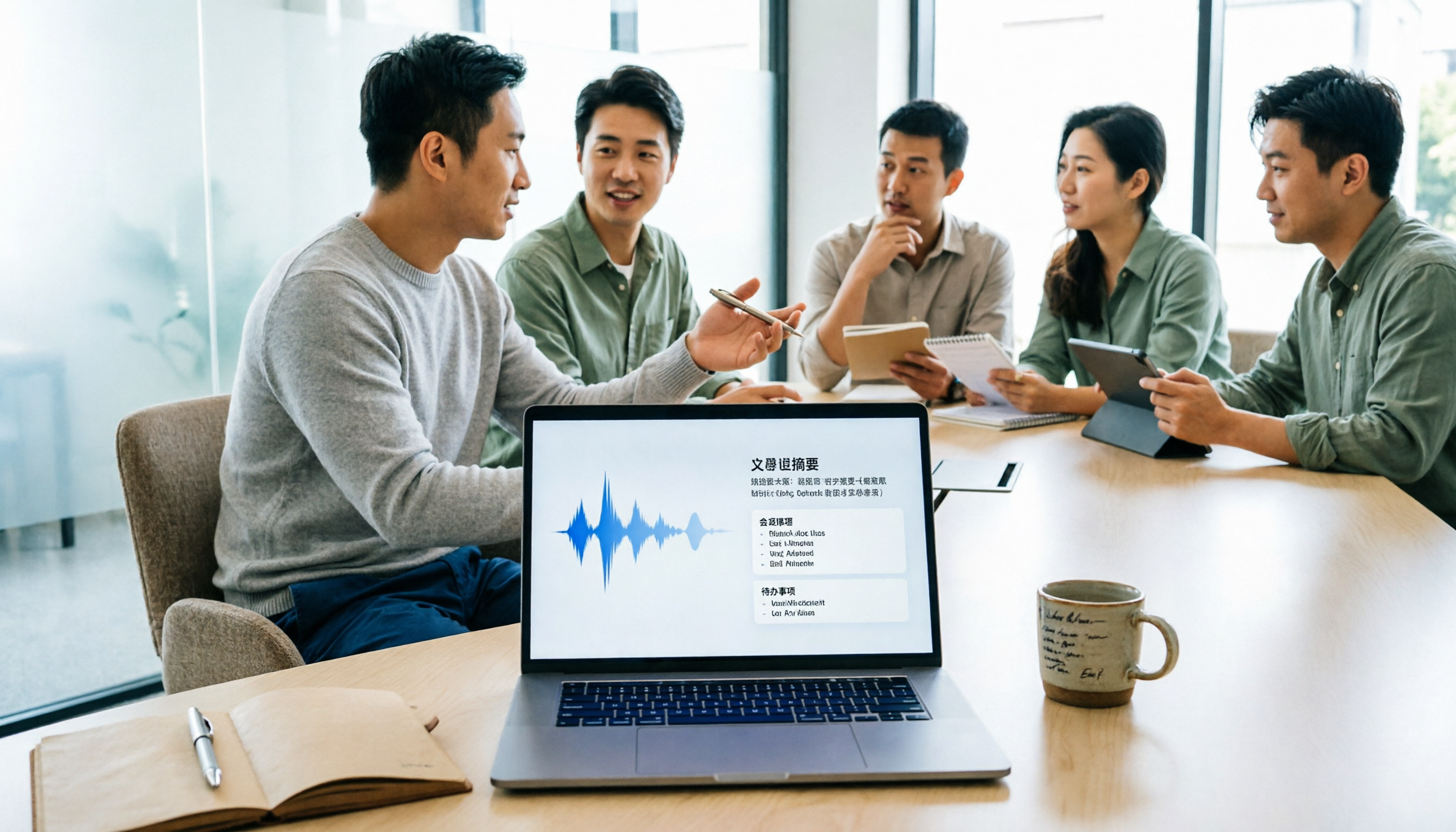
After a meeting, you're left with just two lines of notes while two hours of discussion stay locked in the recording? This article starts from real meeting scenarios, breaks down the 4 key dimensions for choosing meeting minutes software, and compares Tinrec, Otter.ai, Notta, Granola, and TurboScribe on Chinese recognition, meeting capture methods, post-meeting outputs, and team authorization differences. It also includes a pitfalls guide and selection advice.

2026 Guide: Turn AI Transcripts into Meeting Minutes & Action Items in One Go
Meeting transcripts are often long and messy, taking more time to organize than the meeting itself. This guide, from a mid-level manager's real work scenario, breaks down four key steps for transcript organization, tests Tinrec's bot-free recording and AI Q&A workflow, and honestly compares Notta, Otter.ai, and Granola's applicable boundaries, with three common mistakes and selection advice.

4 Interview Recording-to-Text Tools Tested: Which One Handles Visit Notes and Thank-You Letters in One Go?
The real trouble starts after the interview ends: no one wants to organize the transcript, key points rely on memory, and the thank-you letter gets delayed until the third day. This article uses real scenarios from student project interviews and corporate visits to test 4 tools that turn interview recordings into text, and summarizes selection criteria, the 4 most common pitfalls, and whether the free version is actually enough.