

Turn recordings into transcripts and summaries in minutes
Upload audio or video for multilingual transcription, AI notes, and action items
Last Semester, I Almost Failed a Class Because of My Notes
Last semester I took a class called "Introduction to Information Management." The professor talked at what felt like 2× podcast speed and flipped through slides faster than I scrolled on my phone. I tried taking handwritten notes, but when I opened my notebook before the midterm, I couldn't even understand what I'd written—"ERP's what integration?" "What's the difference between SCM and CRM?" What was I even writing?
Later, a senior recommended a few audio-to-text apps and said I could just record lectures and organize them later. At first I thought, "Won't I still have to listen to the whole recording from start to finish?" But after using one all semester, it helped me organize key points for both the midterm and final, and my grade jumped from a C- to a B+.
This article shares my experience actually using three tools. If you're on a limited budget like me, definitely read the free-plan analysis at the end—some free versions are nothing but trial traps.
What Can Meeting Video Summarization Do for You?
Imagine this: a two-hour class produces a roughly 300MB recording. In the past, you'd need to listen to the entire two hours again just to pick out the key points. But now with an AI meeting video summarization tool, you only need to do two things:
- Turn on recording on your phone during class: no need to stare at the screen the whole time; let the tool transcribe as it records.
- Get the key points 5 minutes after class: the AI has already organized summaries, chapters, and to-dos, and you can even ask it directly, "What did the professor just say about ESG?"
Take Tinrec, the tool I currently use. Since the second semester of my junior year, I stopped taking handwritten notes. I record lectures and open the AI summary afterward. Over the semester, the accumulated class materials become a searchable knowledge base where I can ask questions anytime. Before finals, I spent just two evenings reviewing the AI summaries for all subjects—clearer than borrowing a classmate's notes.
What Are the Core Capabilities of Meeting Video Summarization Tools?
Not all tools are created equal. Among the ones I've used, these are the features that truly help students (I'll use Tinrec for each example because it's the one I ended up keeping):
Real-time transcription: it transcribes as it records, with latency under 1 second. During class, you can listen to the professor while glancing at the text to make sure you haven't missed anything. I used another tool before that only transcribed after recording, and the transcription took 10 minutes to process—by then class was over and I couldn't use it.
AI semantic summarization: rather than condensing the transcript into one paragraph, it structures the information. Tinrec, for example, breaks it down into "topic," "discussion conclusions," "action items," and "owner." After a group discussion, who's responsible for what is laid out immediately—no more "who said they'd print the questionnaire?" after the meeting.
AI conversational search: you can directly ask Tinrec, "What are the three ERP drawbacks the professor mentioned last week?" It answers based on the recording content. It's not keyword search; it actually understands semantics. My roommate didn't believe it at first, but after watching me study for midterms like I was chatting with AI, he quietly installed it too.
Online video transcription: this feature is a lifesaver when writing final papers. Paste a link to a YouTube speech or tutorial video into Tinrec, and it generates a transcript and summary directly, so you don't have to manually transcribe quotes.
Real-World Use Cases: How My Classmates and I Put Them to Use
Scenario 1: Recording Large Lecture Classes and Pulling Up Summaries Right After Class
Many business school classes have over a hundred students, and professors don't pause for you to take notes. I now use my phone to record with Tinrec and set the screen on my desk without disturbing the class. When class ends, I open the app and the AI summary is already there: "This session covered the four major modules of supply chain management, focusing on the causes and solutions of the bullwhip effect. The next quiz covers pages 102–135." It's more complete than anything I could have written.
Scenario 2: Group Discussions That No Longer Go in Circles
Senior-year capstone discussions were all over the place—two hours of everyone talking at once, and after the meeting no one remembered the conclusion. I suggested we record with our phones (who goes to a meeting without one?). After the discussion, Tinrec immediately generated action items: "Student Wang is responsible for the literature review draft, upload by Friday; Student Li is responsible for questionnaire design, test by next Monday." Since then, no one has dared to say "I didn't hear that."
Stop organizing recordings by hand
Upload audio or video and automatically get a transcript, summary, and action items
Scenario 3: Quickly Reviewing Online Lectures and Guest Talks
Our department often brings in industry professionals to share insights, packing an hour with practical content. I usually use Tinrec's "online video transcription" feature: I drop the live stream link in, and I can review the key points that same evening. When writing reflection reports, I don't have to rewatch the video; I just search for key phrases in the transcript and cite with timestamps. My professor even said my report was "clearly structured."
Scenario 4: Turning All Recordings Into a Question Bank Before Finals
Before finals this time, I uploaded recordings from all subjects across the semester into Tinrec and asked the AI, "Which concepts were mentioned more than three times, and how did the explanation differ each time?" It organized the high-frequency exam points and marked which classes the professor emphasized. The time this saved let me get ten extra hours of sleep.
4 Things to Watch When Choosing a Meeting Video Summarization Tool
Even if your budget is limited, don't just look at price—there are tons of traps in free versions. Here are the pitfalls I've hit:
Free quotas aren't necessarily better—look at how they're calculated
Some tools give 300 minutes per month, but "imported files" and "online videos" are counted separately. One lecture recording plus one YouTube video can burn through the quota quickly. Tinrec's free plan includes a monthly base transcription quota. I calculated that if you only record key classes (3 per week, 90 minutes each), it's roughly enough. If you need to record every class, skipping two late-night snacks covers a Pro monthly plan.Measure AI summary usefulness by testing with your own recordings
Official demos look great, but in practice, some tools' summaries are just "copy and paste the first few sentences." Tinrec's summaries capture structured conclusions and action items, especially during group discussions—it can identify who said what and tag the speaker. That's crucial for class presentations and project meetings.Language support: Chinese, Chinese-English mix, and technical jargon all need to be recognized
Our classes often mix Chinese and English (e.g., "Let's align this KPI with our OKRs"), and some tools just blank out on English words. Tinrec performs much better with Chinese content than other international tools—I've never had a whole section turn into garbled text.Can you export? Can it integrate with your note-taking tools?
If you can't export the transcript, all your effort is wasted. Tinrec allows exporting to PDF, Word, and TXT, and it also syncs directly to Notion (I use Notion for all my notes, so that's a huge plus).
FAQ
Q: Is the free version really enough?
A: It depends on your course load. In my senior year, I had about 12 classes a week, but only 6 needed full recording, so Tinrec's free version was sufficient. If you record every class or often need to process YouTube videos, I'd recommend the Pro monthly plan—just skip two bubble teas a month.
Q: Can I turn off the phone screen while recording?
A: Yes. Tinrec supports background recording. You can open the recording, swipe the app away, and it won't interrupt the session.
Q: Is the accuracy 100%?
A: It's impossible to be 100%, even manual transcription makes mistakes. In my experience, in a quiet classroom with clear pronunciation from the professor, Tinrec achieves roughly 90% accuracy or higher. If you sit in the back or people around you are talking, some technical terms may be off. For important content, I recommend double-checking against the original timeline.
Q: Are there privacy concerns? Is uploading recordings to the cloud safe?
A: Tinrec has privacy protection mechanisms. Recordings are stored encrypted, and user data isn't sold to third parties. Personally, I find it safer than dumping recordings on a free cloud drive.
Q: What if I'm the only one in my group who has it—does that matter?
A: You only need one person to have it. Record with your phone, let Tinrec transcribe and summarize, then export the result as a PDF and share it to the group. You'll be the "meeting notes hero" everyone admires.
Conclusion
Meeting video summarization tools aren't some futuristic technology anymore—they're practical weapons that today's college students can use to save time and protect their grades. I've tried random free apps since my sophomore year, and the one that finally stayed on my phone is Tinrec. Not because it's the cheapest, but because it truly means I no longer have to relisten to recordings, no longer have to beg for classmates' notes, and I can turn all my course recordings into a searchable personal database.
If you have more than 10 classes a week or feel like flipping a table after every group discussion, I recommend starting with Tinrec's free version. The monthly basic quota is enough to try it on a few classes and see what it feels like when AI organizes the key points for you. Once you realize midterm review only takes half the time and you don't have to pull all-nighters to organize notes, then consider Pro—but by then, you'll probably never want to give it up, just like me.
References
Turn every recording into actionable outcomes
Get 60 free transcription minutes when you sign in. No credit card required.
Related Reading
You might also like

Tinrec 2026 Tutorial: Voice-to-Text Recording and Cross-Device Sync
Are meeting notes eating up your day? Tinrec is an AI tool that turns recordings into text and syncs across devices, with support for iOS, Android, and web. It also auto-generates summaries and action items. Based on hands-on testing, this article explores Tinrec's cross-device sync performance and compares other popular tools.
2026 Meeting Note Tools Compared: 5 Options From Free to Paid, Explained
We tested 5 popular meeting note tools and compared them from free to paid. Looking for a Chinese meeting organization tool that's ideal for office workers in Taiwan? This comparison saves you from trial and error.
2026 Comparison of 4 Real-Time Voice-to-Text Tools: Which One Has the Most Practical Floating Subtitles?
Want to record audio and get text in real time, and even see it in a floating window during meetings or lectures? We tested several real-time voice-to-text apps to see whose floating subtitle feature best suits Hong Kong office workers.

Which Simultaneous Interpretation Tool Is Best? We Tested 3 Tools in 2026—This One Has the Most Complete Records
Still looking for simultaneous interpretation software? We tested Transgull, Transync AI, and Simultaneous Interpretation King, but found a more complete solution: Tinrec doesn't just record your meetings; it also automatically generates meeting minutes, action items, and key points, making your cross-language communication more efficient.
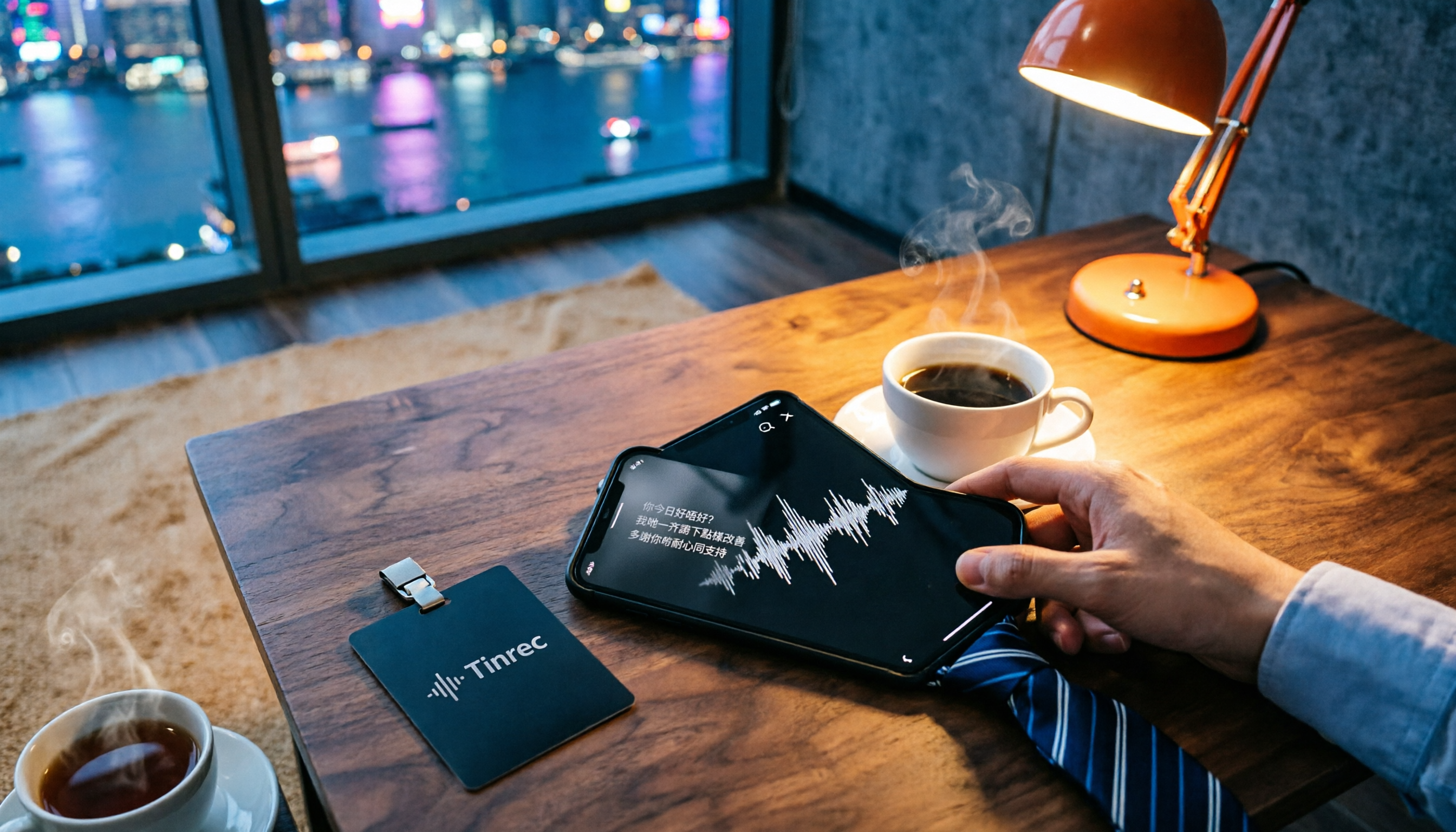
2026 iPhone Voice Memo Transcription Guide: Built-in vs Tinrec – Which One Keeps You From Working Overtime?
iPhone's built-in Voice Memos now supports Cantonese word-for-word transcription, but does it save more time than third-party app Tinrec? We test 5 dimensions to see if the built-in feature is enough or if you need a more complete audio management tool.

4 AI Meeting Notes Tools Worth Recommending in 2026: Our Top Pick After Hands-On Testing
A middle manager tested multiple AI meeting note tools and distilled the most practical selection guide from hundreds of meetings, helping you save time and boost efficiency.
2026 Hands-On Comparison of 4 Online Speech-to-Text Tools: Which One Has the Best AI Q&A and Chinese Organization?
We tested 4 online speech-to-text tools and compared transcription accuracy, AI summaries, cross-platform support, and pricing plans to help you find the best free or paid option.

2026 Free Audio-to-Text Solutions: 4 Tools Compared
Do you still manually transcribe meeting, class, or interview recordings? This article selects 4 free audio-to-text tools, including Tinrec, VEED, MyEdit, and tests their features, accuracy, and free quotas, helping you find the most efficient solution.

2026 Comparison of 3 Video-to-Text Tools: Which Is Best for Chinese Speakers?
This article tests three popular video-to-text tools—Tinrec, Otter.ai, and Notta—comparing transcription quality, Chinese support, AI post-processing, and pricing to help you pick the best speech-to-text assistant for meeting minutes, study notes, and content creation.