

Turn recordings into transcripts and summaries in minutes
Upload audio or video for multilingual transcription, AI notes, and action items
Best Real-Time Translation Tools in 2026: 4 Tested, Top Free Pick for Meetings
There are many free real-time translation tools, but the real challenge isn't whether they can translate—it's whether you need to translate a webpage, a video, or a cross-language meeting.
If you're just looking up words, your phone's built-in translation is enough. If you need to recover decisions, action items, and owners after a meeting, what you need isn't a translator but a tool that can retain the meeting content.
That's the core conclusion after testing four tools: for ad-hoc translation, look at free quotas; for meeting translation, look at whether it's usable after the meeting.
Choosing a Free Real-Time Translation Tool: First, Know What You're Translating
The first scenario is reading. Foreign news, papers, product documents—you want quick bilingual comparison, and you're done after translating.
The second scenario is conversation. Ordering food abroad, asking for directions, casual chat with foreign clients—you need to understand in the moment, and low latency is more important than anything.
The third scenario is meetings. Participants speak in Chinese, English, or even mixed languages. You not only need to understand in the moment but also need to search, organize, and hand off to the team afterward.
These three needs all seem to be called "real-time translation," but tool designs are completely different. Using a web translator for meetings usually leaves you with scattered text afterward; using a meeting tool to look up words is overkill.
So before choosing, ask yourself: Do I need to "translate a sentence" or "retain a meeting"?
Before Buying a Real-Time Translation Tool, Understand These 4 Key Points
1. Is the free quota for "trial" or "enough to use" Many tools claim to be free, but limits vary greatly. Some are free for basic features but charge for advanced ones; some give a fixed number of minutes per month; some free versions only handle short content. Look at your usage frequency first, not just the word "free."
2. Supported input sources Does it only translate typed text, or can it handle voice, images, videos, and meeting system audio? If you need to record online meetings, whether the tool can capture computer playback audio is more critical than how many languages it supports.
3. What's left after translation The value of real-time translation isn't just in the moment. Whether it can retain transcripts, automatically summarize, extract action items, and allow people to search back determines whether you "understand once" or "retain usable data."
4. Data ownership for team use For personal use, data in your own account is fine. For team use, consider whether data remains after members leave, who has permission to record and import, and how usage is tracked. These needs are not strengths of general translation apps.
Prioritize these four points, and you'll find: if your needs lean toward meetings and team collaboration, you should look for a meeting tool that handles recording, transcription, translation, and post-meeting organization—not just a general translator.
Tinrec — Top Pick for Cross-Language Meetings After Testing
Tinrec is an AI meeting notes and collaboration tool for individuals and teams. It supports real-time audio-to-text, desktop bot-free recording of online meetings, audio and video file import, and real-time translation during recording. Its biggest difference from general translation apps is that translation is just one part; it's followed by transcripts, summaries, action items, Q&A, and team data retention.
In actual cross-language meetings, Tinrec's desktop version can directly capture computer system audio, handling Zoom, Google Meet, Microsoft Teams, Webex, and other online meetings without inviting an extra meeting bot. The participant list won't show an extra recording account, which is especially useful for external client meetings. During recording, you can view the original text, translation, or bilingual content to confirm key points while listening.
After the meeting, Tinrec organizes content into transcripts, AI summaries, chapters, and highlights, and extracts action items from discussions. You can continue asking AI about the meeting, such as "What did we decide to do first next week?" or "What budget constraints did the client mention?" without re-listening to a 30-minute recording. When you need to bring it into other workflows, you can export to Notion, Google Docs, OneNote, Dropbox, etc., or further generate reports, tables, and meeting minutes.
For team use, Tinrec's team plan provides independent team spaces where meeting data belongs to the team, not tied to an individual's personal account. The team plan allows creating multiple team spaces, inviting members via join links, setting owners, admins, and regular members, and distinguishing roles and seats: roles determine who can manage the team, seats determine whether members can record, upload, edit, import/export. Members with valid access but no seat can still view, play, and read team data. Admins can also view team usage trends, member rankings, usage details, query and export audit logs, and handle accidentally deleted audio via the audio recycle bin.
Stop organizing recordings by hand
Upload audio or video and automatically get a transcript, summary, and action items
The team plan is currently USD 29.80 per paid seat per month, or USD 199 per paid seat per year (about USD 16.58 per month); first-time eligible teams get a 7-day trial with 1 free seat and 300 minutes of shared team import quota. Paid seats include 2,000 minutes of shared team import quota per month. Under an active team plan and active seats, real-time recording currently does not deduct minutes; file and web imports consume shared team import minutes. Actual prices and benefits are subject to the official purchase page.
Tinrec's free version offers a basic quota to experience recording, import, summaries, and transcription; the personal plan offers a weekly card, Pro monthly, and Pro annual, suitable for short-term intensive meetings or long-term data retention. Note that the free version is a basic quota, and heavy users will still need to pay; real-time translation and transcription quality can also be affected by recording quality, noise, accents, overlapping speech, and technical terms. For important content, verify with transcript timestamps and recording playback. Also, Tinrec is not a general translator for webpages or videos, nor a bot that automatically joins all calendar meetings—users need to actively start recording.
Simply put, if you need a cross-language meeting that connects recording, real-time translation, transcripts, summaries, action items, and team sharing, Tinrec is the smoothest choice in our tests. It's especially suitable for Chinese and multilingual meetings, bot-free recording of online meetings, and those who want to leave data for the team afterward.
Besides Tinrec, What Other Free Real-Time Translation Options Are There?
Google Translate: Free, no installation, works on web and app, supports text, voice, and camera translation—convenient for quick word lookups or travel emergencies. Its positioning is general translation; it doesn't retain meeting recordings or automatically generate meeting summaries and action items. If you just need to translate a sentence, it's enough; but if you want to retain an entire meeting, Tinrec turns recordings into searchable, queryable transcripts and team data.
Immersive Translate: A browser extension focused on bilingual webpage comparison, PDF, and video subtitle translation. The free version has basic features; advanced features require payment. It's suitable for people who read a lot of foreign materials, allowing you to see original and translated text directly on the page. However, its strength is reading assistance, not meeting recording and post-meeting action organization; Tinrec turns meeting speech into transcripts, summaries, and action items and puts them into team spaces.
Transync AI: Focuses on multilingual real-time AI translation, meeting subtitles, and voice translation, supporting over 60 languages. After registration, it offers 40 minutes of free use; personal plans start at USD 8.99 per month, organization plans start at USD 24.99 per user per month. It's suitable for real-time interpretation-style conversations and short meetings. If you value retaining recordings after meetings, importing existing audio and video, generating summary action items, and team seat governance, Tinrec's meeting data workflow is more complete.
Pitfall Guide: 3 Most Common Mistakes When Choosing Free Real-Time Translation
Pitfall 1: Only looking at "free," not what happens after the quota runs out Free quotas are usually for trial, not unlimited use. Rather than registering a bunch of free accounts, first confirm your usage frequency: occasional word lookups—Google Translate is fine; weekly meetings—find a tool whose free version lets you try the full workflow once.
Pitfall 2: Treating "real-time translation" as "meeting notes" Understanding in the moment doesn't mean you can find it afterward. Many translation tools end after translating, with no transcript structure, no summary, no action items. After the meeting, you still have to re-listen to the recording. When choosing a tool, rather than comparing how many languages it supports, ask: Can it let me find who is responsible for what within three minutes after the meeting?
Pitfall 3: Team sharing one personal account When multiple people use it, if everyone shares one account, you'll soon face questions like who can delete data, who owns data after members leave, and how usage is calculated. Team plans should have independent team spaces, roles, and seat concepts. For example, Tinrec's team plan separates management permissions from usage eligibility, and team resources can be handed over when members change—much clearer than sharing a personal account.
Also note that recording and transcription involve personal data and communication privacy. Comply with local regulations and obtain participant consent when needed.
Conclusion: Which One Should You Choose?
Bottom line: there's no single answer for free real-time translation, but if you're dealing with cross-language meetings, Tinrec is the most worth trying based on our tests.
- Cross-language online meetings, no meeting bot wanted → Tinrec, desktop captures system audio, records, transcribes, and translates simultaneously.
- Offline interviews, client communication, need transcripts and action items afterward → Tinrec, generates summaries, chapters, and action items directly after recording.
- Team needs to share meeting data, members change → Tinrec team plan, team spaces, role seats, usage and audit management in one place.
- Just occasional word lookups, travel emergencies → Google Translate, free and no installation, the only exception.
- Reading lots of foreign webpages and PDFs → Immersive Translate can assist reading; but meeting notes are still better with Tinrec.
We recommend starting with Tinrec's free version, using the basic quota to run through a real meeting workflow: record, view real-time translation, generate summaries and action items. If it fits your workflow, then consider the weekly card, Pro, or team plan—no need to pay upfront.
Note: Competitor prices and free quotas are subject to their official pages and may change over time; Tinrec plans and team benefits are subject to the official purchase page.
References
- [AI Translation Tools] 2026 Top 5 Recommended AI Real-Time Translators, Automatically Translate Any Language, Free vs Subscription, Pros and Cons Comparison! | 104 Career Power
- Top 10 Best Real-Time Translation Interpreter Apps (Free and Paid)
- AI Online Translation Website - Free English Translator | Wordvice AI
- Translate - Instant Translation: Voice Translation, Photo Translation, Conversation Translation, Translation Software App - App Store
- Real-Time Translation Tool | Transync AI
Turn every recording into actionable outcomes
Get 60 free transcription minutes when you sign in. No credit card required.
Related Reading
You might also like
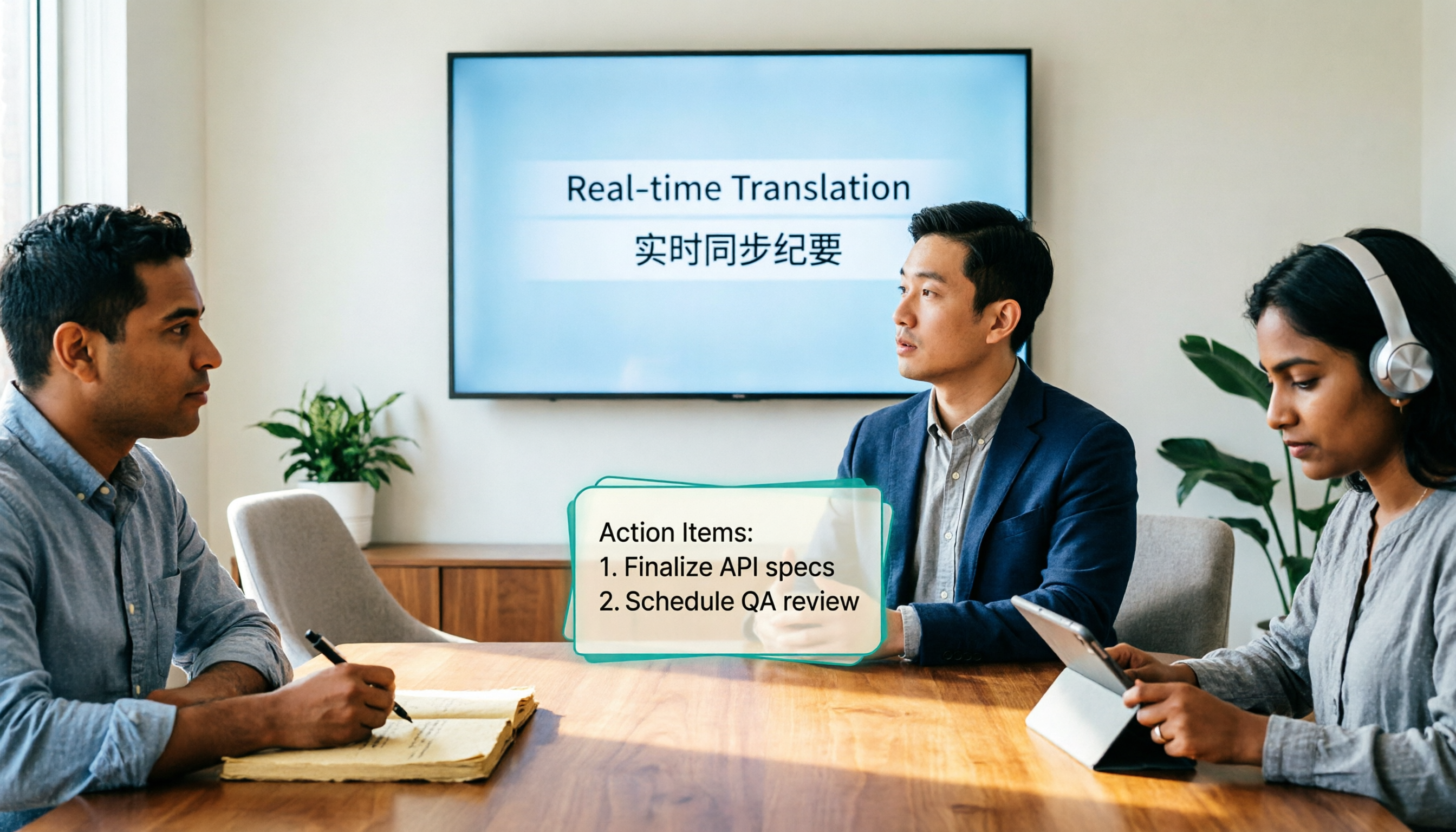
4 Real-Time Translation Tools Tested for 2026: Which One Leaves You With Usable Meeting Notes?
Real-time translation tools solve the problem of understanding in the moment, but the real cost comes after the meeting. This article compares Tinrec, Transync AI, Vurbo.ai, and Notta on real-time translation, bilingual transcripts, post-meeting AI Q&A, and team management, and provides 4 key purchasing criteria, 3 common pitfalls to avoid, and scenario-based recommendations to help you explain clearly why you chose a particular tool.

Tinrec vs Notta 2026: Real-Time Translation AI 5-Dimension Comparison, Which Is Better for Chinese Meetings?
Real-time translation AI isn't just about the number of languages—it's also about meeting capture methods, bilingual subtitles, post-meeting organization, AI Q&A, and team data ownership. This article compares Tinrec and Notta across 5 dimensions and explains which Chinese meeting scenarios each suits.

4 Free Simultaneous Interpretation Tools Tested: Which Offers Enough Free Minutes and Post-Meeting Value?
How to choose a free simultaneous interpretation tool? This article reviews four free-trial real-time translation tools—Tinrec, JotMe, Transgull, and Felo Translate—comparing them across five aspects: free quota calculation, translation presentation, recording and transcript retention, post-meeting organization, and team collaboration. It also includes a pitfalls guide and buying advice to help you find the one that truly saves time.

2026 Comparison of 3 Meeting Transcription Tools: Tinrec Turns Transcripts into Action Items
Turning meeting recordings into transcripts isn't hard—the hard part is post-meeting organization. Starting from meeting transcription needs, this article compares Tinrec, Notta, Good Tape, and Yating Transcript, covering transcription, online meeting recording, summary and to-dos, AI Q&A, and team collaboration to help you find the right meeting notes tool.

2026 Online Simultaneous Interpretation Guide: Tinrec Real-Time Translation + Bilingual Transcripts as an Alternative to Traditional Translation Apps
Online simultaneous interpretation is not just about real-time translation—it also depends on whether post-meeting materials are usable. This article addresses common misconceptions and explains how Tinrec uses desktop bot-free recording, real-time transcription, and bilingual translation, combined with summaries, action items, AI Q&A, and team spaces, to turn cross-language meetings into searchable, collaborative records.

How to Use Real-Time Voice Translation in 2026: 5 Steps from Recording to Bilingual Transcript
In cross-language meetings, front-desk reception, and international calls, real-time voice translation needs to solve more than just "understanding in the moment"—it also needs to leave you with usable records afterward. This article breaks down real-time voice translation tools using 5 key selection criteria, compares Tinrec, Transync AI, Vurbo.ai, and JotMe in hands-on testing, and summarizes 4 common pitfalls to help you choose the one that truly works for you.

How to Generate Transcripts with Tinrec in 2026: Bot-Free Recording + AI Summaries and Action Items
Transcript generation isn't just about feeding an audio file into a tool. This guide tackles four common pitfalls and compares Tinrec with Yating Transcription across meeting capture, Chinese recognition, post-meeting organization, AI Q&A, export, and team governance to help you decide which workflow truly saves time.

2026 Comparison of 3 Transcription Tools: Which One Actually Turns Meeting Recordings into Usable Data?
The real difference between transcription tools isn't speed—it's whether the output is ready to use. Starting from the question 'Do you want text or results?', this article outlines 4 key buying criteria, compares Tinrec, Notta, Otter.ai, and Granola on meeting recording, transcript organization, AI Q&A, export, and team collaboration, and includes a pitfalls guide and scenario-based recommendations.

How to Transcribe Audio to Text in 2026: Record Meetings Without Bots + AI Q&A to Find Key Points
How to choose an audio transcription tool? This guide breaks down 5 key factors: meeting capture methods, post-meeting outputs, audio retention, Chinese language experience, and team governance. It also tests and compares Tinrec, Granola, Notta, and TurboScribe to help you decide which fits your meetings and budget.