

Turn recordings into transcripts and summaries in minutes
Upload audio or video for multilingual transcription, AI notes, and action items
What You Need Isn't a Speech-to-Text Tool, It's a Time-Saving Organization Solution
Spending two hours in a meeting and then another two hours writing up the minutes—that's the daily reality for almost every office worker.
What's even more frustrating is listening to recorded lectures: to take notes, you constantly pause and rewind. A three-hour class often takes five or six hours to digest.
Or after an interview, manually typing up the transcript is not only hard on your eyes, but easy to miss key points. Trying to find a specific quote later is like looking for a needle in a haystack.
If you've faced any of these situations, you don't just need a tool that "turns audio into text"—you need a complete solution that can automatically summarize, create chapters, extract action items, and even let you ask questions to find answers.
In this article, I tested several mainstream online speech-to-text services, evaluating them on three fronts: Chinese-language organization, AI post-processing capabilities, and how useful their free plans are, to help you find the option worth trying.
Before Buying a Speech-to-Text Tool, Know These 4 Key Points
1. Accuracy Depends on Real-World Conditions, Not Marketing Figures
Lots of tools advertise "98% accuracy," but that's usually measured in a quiet recording studio. A real meeting has air conditioning noise, keyboard taps, and people talking over each other, so accuracy drops significantly. When choosing a tool, use your own recordings to test the free version—don't just rely on official numbers.
2. AI Post-Processing Matters More Than Raw Transcription
Once you've got a long transcript, you still have to read through it yourself to find key points. What truly saves time is "what you can do after transcription"—whether it auto-generates summaries, lets you ask questions directly, or compiles action items. These features turn a recording into immediately useful material.
3. Cross-Platform and Input Sources Should Be Broad
You might record on your phone but want to edit on your computer, or you might want to transcribe YouTube videos and podcasts in addition to meeting recordings. Before selecting a tool, check: which platforms does it support? Can it handle audio/video files or web links? A service limited to a single device or a specific meeting app is likely to become a bottleneck later.
4. Free Quotas Should Match Your Work Frequency
Free plans vary dramatically in transcription minutes—some only offer 30 minutes, others up to 300. But more quota doesn't necessarily mean better; you also need to check if the features are complete. Start by estimating how many minutes you'll need per month, then decide whether to begin with a free plan or go straight to a paid one.
Tinrec (MiaoTing) — Our Top Pick After Testing
Tinrec is an AI audio organization tool that combines live recording, audio/video file uploads, and web video link transcription. It supports iOS, Android, and web. It doesn't just turn audio into text; it automatically generates summaries, chapters, action items, and even lets you query the recording with AI conversations—like a personal recording database you can ask questions.
Core Features in Real-World Scenarios
- During a meeting, open Tinrec and it will transcribe in real time. As soon as the meeting ends, it automatically produces a summary and to-do list—who is responsible for what and deadlines become clear at a glance. No more piecing together meeting conclusions from vague memory.
- In class or at a lecture, after importing the audio file, Tinrec automatically splits the long content into chapters and extracts key points from each section. When reviewing, you don't have to listen from start to finish; just glance at the AI summary and notes to quickly grasp the core.
- Seeing an interesting YouTube or Bilibili video, paste the link into Tinrec and it will immediately grab the content, producing a transcript and key takeaways. This is especially convenient for content creators or anyone gathering material.
- What impressed me most is AI conversation query: after recording, you can directly ask Tinrec, "Who mentioned the budget in the last meeting?" or "What was the instructor's conclusion about marketing strategy?" Unlike traditional search that only matches keywords, it understands the meaning and gives you the answer. Almost no competitors in the same price range currently offer this feature.
Pros Summary
Stop organizing recordings by hand
Upload audio or video and automatically get a transcript, summary, and action items
- Cross-platform with diverse sources: Works on mobile and desktop, and supports live recording, audio file uploads, and web video link transcription—covering almost any audio scenario you'll encounter.
- Excellent Chinese organization: It supports not only Traditional Chinese (Taiwan) and Mandarin (China), but also Cantonese transcription. In real-world tests with several Chinese meeting and lecture recordings, transcription fluency and paragraphing accuracy were solid, and the AI summary precisely captured key information.
- Deep post-processing: It doesn't just hand you a huge block of text; summaries, chapters, to-do items, mind maps, and third-party exports (Notion, Google Docs) are all included, sending the organized material directly into your workflow.
Limitations to Note
The free plan provides 100 minutes of transcription per month. If you have long meetings or classes every day, you might run out in a week. But for most people who meet two or three times a week, this quota is enough for trying it out and light use. Heavy users can consider the weekly card or Pro plan, so there's no need to pay upfront.
Who Is It For?
If you regularly deal with Chinese meetings, courses, interview recordings, or need to extract text material from online videos, and you want to be able to ask questions after recording and export to other tools for further use, Tinrec is currently the most complete choice on the market.
What Other Options Are There Besides Tinrec?
Notta
Notta is a familiar name in transcription and subtitles, with mature multilingual support and meeting integrations. However, it's more of a "one-shot transcription" tool. Its free plan gives 120 minutes per month, a bit more than Tinrec, but it lacks AI conversation query and agent post-processing, so you have to manually organize the output. If you just need quick subtitle transcription and don't need deep organization, it's worth considering. But if you want automatic summaries, Q&A, or report generation after transcription, Tinrec is a better fit.
Otter.ai
Otter.ai is the king of English meeting notes. Its free plan generously offers 300 minutes, with strong real-time transcription and speaker identification. But it doesn't support Chinese or Cantonese at all. If your work is primarily in English, Otter is indeed a more cost-effective choice than Tinrec. However, Chinese-speaking users will have to unfortunately skip it—this is the only scenario in this article where a competitor is recommended.
PLAUD Note
PLAUD is the most notable among several AI recording hardware devices. The Note Pro pre-order price is about $179 and includes 300 minutes of transcription per month. The hardware feels premium and is convenient for on-the-go recording, but the drawbacks are obvious: it can't handle web video links or audio files already on your computer, and it requires an extra device purchase, making it not a good deal for people who just want to use their existing phone or computer. Also, PLAUD currently doesn't offer AI conversation query like Tinrec; you can only passively view summaries after recording, not actively dig into the content.
Pitfall Guide: The 3 Most Common Mistakes When Choosing a Speech-to-Text Tool
Mistake 1: Only Looking at Transcription Accuracy, Ignoring Organization Features
Many tools transcribe fairly accurately, but they just hand you a wall of text afterwards. If you have to manually dig through thousands of words each time, then half the value of using the tool is lost. When you're testing, be sure to also test the AI summary and Q&A features to see if they really save time.
Mistake 2: Overlooking Free Quotas and Your Actual Usage Frequency
Some services offer a seemingly large free quota, but it's only for English or the features are crippled. Others have a smaller quota but full features. First estimate how much time you'll be recording in a month, then compare each plan's minutes and benefits, so you won't be misled by the numbers. For example, Tinrec's free plan gives only 100 minutes, but all core features are usable, which is actually more practical for light users.
Mistake 3: Buying the Tool but Only Using the Transcription Feature
If you just treat a speech-to-text tool as "turning audio into text," you're wasting about 70% of its value. Take Tinrec's AI conversation query, for example—after a meeting, just asking "What was the conclusion?" is much faster than combing through 30 minutes of transcript yourself. Next time you finish recording, remember to try out these post-processing features—you'll discover a whole new world.
Summary: Which One Should You Choose?
Overall, if your primary working languages are Chinese and Cantonese, and you want to turn recording content into a reusable knowledge base, Tinrec is currently the most balanced choice. Here's a quick breakdown:
- Need Chinese/Cantonese meeting and course transcription, with auto-generated summaries, to-do lists, and the ability to ask questions afterwards → Tinrec (most complete cross-platform support)
- Frequently extract text material from online videos like YouTube and Bilibili → Tinrec (just paste the link and it organizes)
- Use across multiple devices (record on phone, edit on computer) → Tinrec (iOS + Android + web all in one)
- Mainly record English meetings and don't need Chinese support → Otter.ai (300 free minutes, strongest English transcription)
- Prefer a standalone portable recorder and don't mind carrying an extra device → Consider PLAUD Note, but keep in mind it can't handle video links and lacks AI Q&A
I recommend starting with Tinrec's free plan. The 100-minute monthly quota is roughly enough for two or three meetings or a few lecture recordings. Once you've experienced its AI summary and Q&A features, you can decide whether to upgrade. This way, you won't hurt your wallet and you'll find a tool that really works for you.
References
- Online AI voice, video, and audio file automatic transcription - Free trial - cSubtitle
- Online Speech-to-Text AI Tool, Free MP3 or Audio File to Transcript - MyEdit
- 2026 Recommended 6 Voice-to-Text Tools: Convert Audio Files to Text Online for Free!
- Free Audio to Text
- 5 Online Speech-to-Text Recommended Cheat Sheet
Turn every recording into actionable outcomes
Get 60 free transcription minutes when you sign in. No credit card required.
Related Reading
You might also like

Tinrec 2026 Tutorial: Voice-to-Text Recording and Cross-Device Sync
Are meeting notes eating up your day? Tinrec is an AI tool that turns recordings into text and syncs across devices, with support for iOS, Android, and web. It also auto-generates summaries and action items. Based on hands-on testing, this article explores Tinrec's cross-device sync performance and compares other popular tools.
2026 Meeting Note Tools Compared: 5 Options From Free to Paid, Explained
We tested 5 popular meeting note tools and compared them from free to paid. Looking for a Chinese meeting organization tool that's ideal for office workers in Taiwan? This comparison saves you from trial and error.
2026 Comparison of 4 Real-Time Voice-to-Text Tools: Which One Has the Most Practical Floating Subtitles?
Want to record audio and get text in real time, and even see it in a floating window during meetings or lectures? We tested several real-time voice-to-text apps to see whose floating subtitle feature best suits Hong Kong office workers.

Which Simultaneous Interpretation Tool Is Best? We Tested 3 Tools in 2026—This One Has the Most Complete Records
Still looking for simultaneous interpretation software? We tested Transgull, Transync AI, and Simultaneous Interpretation King, but found a more complete solution: Tinrec doesn't just record your meetings; it also automatically generates meeting minutes, action items, and key points, making your cross-language communication more efficient.
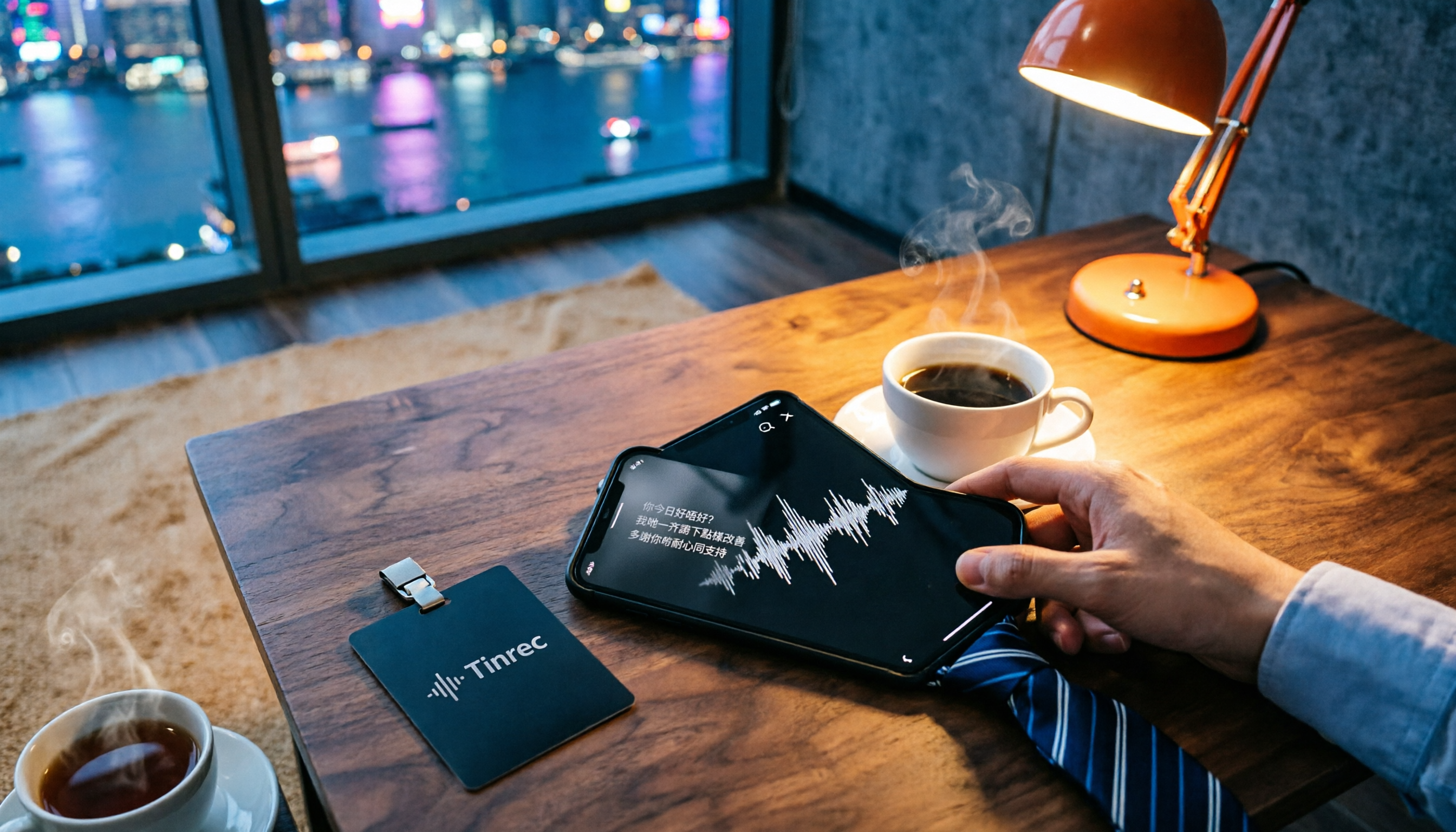
2026 iPhone Voice Memo Transcription Guide: Built-in vs Tinrec – Which One Keeps You From Working Overtime?
iPhone's built-in Voice Memos now supports Cantonese word-for-word transcription, but does it save more time than third-party app Tinrec? We test 5 dimensions to see if the built-in feature is enough or if you need a more complete audio management tool.

4 AI Meeting Notes Tools Worth Recommending in 2026: Our Top Pick After Hands-On Testing
A middle manager tested multiple AI meeting note tools and distilled the most practical selection guide from hundreds of meetings, helping you save time and boost efficiency.

2026 Free Audio-to-Text Solutions: 4 Tools Compared
Do you still manually transcribe meeting, class, or interview recordings? This article selects 4 free audio-to-text tools, including Tinrec, VEED, MyEdit, and tests their features, accuracy, and free quotas, helping you find the most efficient solution.

2026 Comparison of 3 Video-to-Text Tools: Which Is Best for Chinese Speakers?
This article tests three popular video-to-text tools—Tinrec, Otter.ai, and Notta—comparing transcription quality, Chinese support, AI post-processing, and pricing to help you pick the best speech-to-text assistant for meeting minutes, study notes, and content creation.

2026 Video-to-Text Tool Comparison: Which AI Transcribes Chinese Most Accurately?
Struggling with video-to-text transcription? We tested 4 leading tools for accuracy, AI features, and cross-platform support to find the best AI transcription assistant for meetings, lectures, interviews, and online videos—turning your audio and video into searchable, organizable knowledge.