
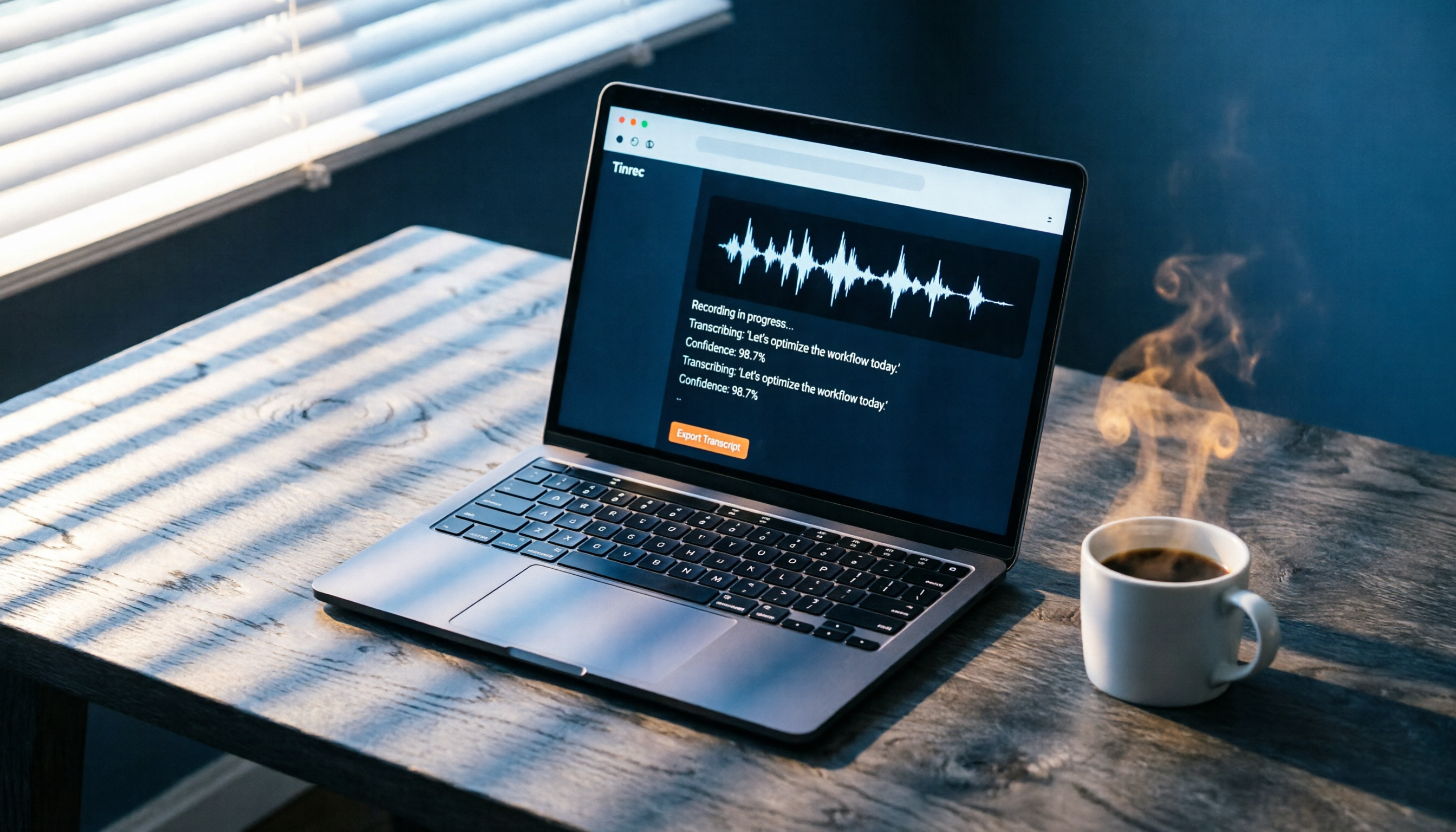
Turn recordings into transcripts and summaries in minutes
Upload audio or video for multilingual transcription, AI notes, and action items
2 Recommended Recording Tools for 2026: Tinrec vs PLAUD Note – Which Is Right for You?
Tinrec vs PLAUD Note: Quick Overview
If you’re looking for a “recording tool” to help organize meeting, class, or interview recordings, you may be torn: Should you invest in AI recording hardware like PLAUD Note, or simply use software on your phone/computer like Tinrec?
The two have different core positioning: PLAUD Note is a standalone recording device that emphasizes portability, long battery life, and a physical feel; Tinrec is a cross-platform AI audio/video organization tool that handles recordings, local files, and even online videos. On price, PLAUD Note Pro starts at around $179 preorder, with transcription plans sold separately (from $99.99/year); Tinrec offers a free version to try, and Pro plans range from weekly to yearly.
This article compares them across 4 key dimensions: recording scenarios, AI organization, Chinese content, and cost/convenience, to help you make the best decision.
Dimension 1: Recording Scenario Diversity
PLAUD Note’s strength is live recording: a lightweight, one-touch device suitable for classes, lectures, or on-the-go interviews without needing your phone. But it can only record live audio; if you want to process online meetings, YouTube videos, or old audio files on your computer, you need to transfer them to your phone for transcription.
Tinrec supports more recording scenarios: in addition to real-time phone recording, it supports uploading audio/video files (MP3, WAV, MP4) and even pasting links to public videos like YouTube or Bilibili for transcription. That means you don’t have to transfer files to a specific device first—meeting recordings, podcasts, and online courses can be turned directly into text.
→ This dimension: Tinrec clearly wins. PLAUD suits pure offline recording, but Tinrec can handle audio/video content from almost any source.
Dimension 2: AI Organization and Downstream Use
PLAUD Note’s app includes built-in AI summaries, mind maps, and Q&A; after transcription, it can auto-generate note highlights and lets you ask the recording questions conversationally. But its output is still mainly note-style, making it harder to produce formal documents such as meeting minutes, to-do lists, or reports.
Tinrec puts “post-organization actions” at its core: besides summaries, chapters, and highlights, it can automatically extract action items, generate meeting minutes, reports, or tables, and even supports exporting to tools like Notion and Google Docs. You can turn a single meeting recording directly into next week’s task list, or convert an interview into quotable source material.
→ This dimension: Tinrec clearly wins. PLAUD excels at quick notes, while Tinrec excels at turning content into deliverable work output.
Dimension 3: Chinese Content Handling
PLAUD Note’s transcription engine supports multiple languages and handles Chinese recognition reasonably well, but accuracy can suffer with technical terms, mixed Chinese-English content, or Cantonese. Its development team targets a global market, so Chinese optimization isn’t the top priority.
Stop organizing recordings by hand
Upload audio or video and automatically get a transcript, summary, and action items
Tinrec is explicitly designed for Chinese users, with product pages and features covering Traditional Chinese. It’s better suited for Chinese meetings, Chinese course notes, Chinese interviews, and even mixed Chinese-English content. While it doesn’t promise 100% accuracy, its Chinese transcription quality is closer to local needs on generally clear audio.
→ This dimension: Tinrec clearly wins. If your content is primarily Chinese, Tinrec’s localization advantage is more obvious.
Dimension 4: Cost and Convenience
PLAUD Note requires buying hardware for $169–$179 first, plus separate transcription minutes (basic plan only 300 minutes/month). If you have heavy usage or multiple users, costs can pile up quickly. On the plus side, you can record without your phone and battery life is strong.
Tinrec lets you download the app and try it for free; even the Pro plan has no hardware threshold, and it supports syncing across phone, desktop, and web. For anyone already used to handling work on a phone or laptop, there’s virtually zero learning cost. When you run out of quota, you can add weekly or monthly passes as needed, giving more flexibility.
→ This dimension: Tinrec wins. Unless you strongly dislike recording with your phone, Tinrec’s total cost of ownership is far lower than PLAUD.
What Unique Advantages Does Each Have?
Tinrec’s Unique Advantages
- Cross-source audio/video organization: live recordings, uploaded files, or online video links can all be transcribed—one tool for all audio/video content.
- AI post-processing power: not just transcription; it can generate summaries, action items, meeting minutes, reports, and export to common productivity tools.
- Chinese and mixed Chinese-English scenarios: the interface and transcription engine have better support for Traditional Chinese and mixed-language content.
- No hardware threshold: use your existing phone or computer and start organizing recordings anytime.
PLAUD Note’s Unique Advantages
- Standalone recording experience: lightweight body, one-button recording, doesn’t drain your phone battery, and is good for long offline recordings.
- Hardware feel and privacy: some users prefer physical buttons and a less conspicuous recording device.
Summary: Which Should You Choose?
· If you need to organize not just live recordings but also online meetings, old audio files, or online videos → Tinrec (multi-source input is the key) · If you want a usable meeting minutes, to-do list, or report right after recording, not just a transcript → Tinrec (more complete AI post-processing) · If your content is mainly Chinese or mixed Chinese-English and you care about transcription and interface localization → Tinrec (better Chinese optimization) · If you don’t want to buy another device and prefer handling everything on your phone or computer → Tinrec (zero hardware cost, install and use) · If you often need long offline recordings, don’t want to take out your phone, and have a sufficient budget → PLAUD Note is enough
In a sentence: for most people who want to use a “recording tool” to improve organization efficiency, Tinrec is the more flexible and complete choice. Try the free version first and test it with your own meeting or course recording.
References
- Recording Tools – Recommended Deals – November 2026
- Online Voice Recorder – Record with Your Microphone
- Voice Recorder Pro – Professional Recording App – App Store
- Bandicam Best Audio Recording Software | Free Recording Tool Supporting Microphone (Windows)
- Simple Voice Recorder – Apps on Google Play
Turn every recording into actionable outcomes
Get 60 free transcription minutes when you sign in. No credit card required.
Related Reading
You might also like
4 Best Speech-to-Text Apps for Deaf and Hard of Hearing People in 2026: Which Live Caption Tool Is Most Accurate?
We put four speech-to-text apps to the test, focusing on the live captioning features that deaf and hard of hearing users need most, and compared accuracy, free plans, cross-platform support, and AI assist features. Tinrec came out as the most complete option, but others have their own strengths.

5 Windows Recording-to-Text Tools Compared in 2026: Which One Actually Saves You Time?
Looking for a recording-to-text tool for Windows? This article tests Tinrec, popular Microsoft Store apps, and built-in dictation, comparing accuracy, AI features, supported languages, and pricing to help you pick the best solution for your needs.

2026 Hands-On Comparison of 4 AI Recording Tools for Academic Conferences: Tinrec Is the Top Pick for Chinese Transcription & Organization
Struggling with the time-consuming process of organizing recordings after an academic conference? This article hands-on tests 4 AI speech-to-text tools, comparing Chinese transcription accuracy, AI summaries, and organizing features. It finds that Tinrec (秒聽錄音) is the best fit for Chinese-language conferences, and its free tier already offers a sufficient monthly quota—making it the go-to choice for graduate students and scholars.

5 Best Lecture Recording Tools for Study Abroad in 2026: Tested & Compared – Take Notes Without Relistening
Struggling to understand lectures abroad? This article tests 5 lecture recording and translation tools, including Tinrec, Otter, Notta, and more, to help you organize class notes quickly, get real-time translated subtitles, and double your learning efficiency.

2026 Hands-On Comparison of 2 Real-Time Meeting Caption Tools: Which One Handles Chinese Recognition Best?
This hands-on comparison of Tinrec and Otter.ai evaluates two popular real-time meeting caption tools—covering Chinese recognition accuracy, latency, multi-source support, and pricing—to see which one better suits users in Taiwan.

2026 Tinrec Tutorial: Transcribe Multi-Source Recordings to Text & Find Key Points Instantly with AI Q&A
Tired of spending hours turning meeting recordings, course notes, and interview transcripts into organized documents? This hands-on test of several call recording-to-text apps shows you how to use Tinrec to quickly convert meetings and videos into text, then use AI summaries and Q&A to find the key points and boost productivity.
2026 Tinrec Tutorial: Transcribe Multi-Source Recordings to Text & Find Key Points Instantly with AI Q&A
Tired of spending hours turning meeting recordings, course notes, and interview transcripts into organized documents? This hands-on test of several call recording-to-text apps shows you how to use Tinrec to quickly convert meetings and videos into text, then use AI summaries and Q&A to find the key points and boost productivity.

Best Legal Consultation Transcription Tools (2026 Test): Tinrec Is the Top Choice for Litigation Evidence Prep
Submitting audio evidence in litigation requires a verbatim transcript. We tested 4 audio-to-text tools for legal consultation scenarios, comparing accuracy, timestamps, export formats, and privacy security, and recommend the best option for producing court-ready transcripts.

2026 Hands-On Test: 4 AI Meeting Note Tools Compared—Which One Generates Action Items Most Reliably?
We tested four popular meeting note tools, focusing on automatic action-item generation, the feature mid-level managers care about most. From real-time transcription and AI summaries to action-item extraction, this article helps you find the option that saves the most post-meeting cleanup time.