

Turn recordings into transcripts and summaries in minutes
Upload audio or video for multilingual transcription, AI notes, and action items
Your Podcast Needs a Transcript, But Manual Transcription Takes Too Long?
Podcast creators know that transcripts aren't just accessibility aids—they're also key to getting your show discovered on Google. A 30-minute episode can take 1-2 hours to transcribe manually, and you're likely to miss words or make typos. If you're not a full-time creator, you simply don't have that kind of time. In this article, we put 4 tools to the test, from free to paid, so you can save time on transcription and focus on creating great content.
Before Choosing a Podcast-to-Text Tool, Understand These 4 Key Factors
- Transcription accuracy: Don't just trust the official "98% accuracy" claim—that's usually measured in a quiet recording studio. Real podcasts may have background noise, multiple speakers, or non-standard accents. We recommend testing a free trial with your own audio file to see how readable the output actually is.
- AI organization features: Getting a raw transcript is only the first step. If the tool can also generate auto-summaries, chapter breaks, highlight key points, or even let you query the content through Q&A, creating show notes and promotional copy becomes much faster. Many basic transcription tools don't offer this.
- Language support: Many tools excel at English transcription but struggle with Chinese (especially colloquial speech or code-switching). If your podcast is primarily in Chinese, prioritize services that handle Asian languages well.
- Pricing and quotas: Free plans may limit minutes or features, while paid plans need to fit your budget. If you only transcribe an episode occasionally, a free tier may be enough. But if you publish several episodes a week, look for a cost-effective plan.
Tinrec — Our Top Pick for Podcast-to-Text After Testing
Tinrec is an AI audio/video organization tool that goes beyond simple transcription. It supports live recording, file uploads, and even lets you paste a podcast or YouTube link directly for transcription. What makes it especially appealing to podcasters is that you can keep organizing your content after transcription.
We tested it with a 25-minute Chinese-language interview podcast (two people talking, with light background music). After pasting a SoundCloud link, Tinrec produced a full transcript in about 3 minutes, complete with auto-generated chapters and key points. Even more impressive was its AI Q&A feature—after transcription, you can ask something like "What marketing cases did the guest mention?" and it will answer based on the content, not just return keyword search results. This is incredibly useful if you need to quickly extract highlights or write social media posts.
Pros:
- Multiple input sources: You can upload audio files or paste podcast platform/YouTube links directly, saving the hassle of downloading and re-uploading.
- Impressive AI organization: Auto-summaries, chapters, to-do items, and the ability to ask follow-up questions like you would a friend—perfect for creating in-depth show notes.
- Strong Chinese performance: In our test, Chinese conversations were transcribed smoothly, even with slight accents. It didn't mix up homophones like mistaking "這樣" for "降".
Limitations to note:
- The free plan includes a monthly base number of minutes; heavier users will need to upgrade to the Pro plan. But if you publish only 1–2 episodes a week, the free quota is usually sufficient.
- The AI Q&A feature requires an internet connection and is not available offline.
Who it's for: If you want to convert podcasts to text and then quickly generate key summaries, ask direct questions about the content, and often work with Chinese or multilingual content, Tinrec is an ideal choice.
Stop organizing recordings by hand
Upload audio or video and automatically get a transcript, summary, and action items
What About Alternatives to Tinrec?
MyEdit: A no-install online podcast transcript generator that supports 9 languages including Traditional Chinese. It's simple: upload your audio, select a language, and download the transcript. Its segment detection is decent, making it a good choice if you just need a plain text version and don't want to learn a new tool. However, MyEdit lacks AI summaries or Q&A features, so you'll still need to read through the entire transcript to get the key points. If you want the transcript organized for you after transcription, Tinrec will save you more time.
Otter.ai: A top choice for English podcast transcription. The free plan offers a generous 300 minutes per month, and its meeting summaries and speaker identification are quite accurate. However, its support for Chinese is limited. If your podcast is mainly in Chinese, Otter's recognition quality may disappoint you. Additionally, Otter excels at meeting scenarios rather than handling direct podcast platform links like Tinrec—you'll have to download the audio file and then upload it.
Apple Podcasts transcripts: If you distribute your show on Apple Podcasts, it will automatically generate transcripts with good recognition quality for 11 languages including English. The downside is that it's confined to the Apple Podcasts ecosystem—you can't use it to transcribe content from other platforms, and there are no customizable summaries or Q&A features. It's a passive add-on, not an active productivity tool.
Pitfall Guide: 3 Most Common Mistakes When Choosing a Podcast-to-Text Tool
Mistake 1: Assuming "Free" Means Everything Is Free. Many online tools either limit minutes on the free plan or quietly lock AI organization features. When testing, make sure to check: What does the free plan include? Do you get just plain text, or also summaries and chapters?
Mistake 2: Ignoring How You'll Use the Output. After you get the transcript, what do you plan to do with it? If you're just posting it on a blog, plain text is fine. But if you're creating highlight reels, writing social media captions, or compiling guest quotes, you need tools that can auto-segment, label speakers, and search specific content. Don't just look at transcription speed—also consider the post-transcription organization efficiency.
Mistake 3: Not Testing Your Own Recording Quality. Each tool has a different speech model, and your recording environment (room echo, background noise, multiple people talking at once) heavily impacts accuracy. We recommend testing a short sample of your own audio on 2–3 tools rather than relying on vendor demos. During our tests, for example, Tinrec handled podcasts with background music while keeping vocals clear, but some tools transcribed music noise into weird text.
Conclusion: Which One Should You Choose?
If you produce a Chinese-language podcast or need to quickly extract key points from audio and have a "conversation" with the content to generate more material, Tinrec is currently the most complete choice. Its free plan already lets you experience transcription and AI Q&A, so it's a great option to try first. Here's our direct recommendation based on common scenarios:
- Want to save time and get key points without even listening to the whole episode? → Tinrec (AI Q&A summarizes for you)
- Only need a basic transcript with no further organization? → MyEdit (simple and free)
- You only produce English content and need large monthly minute quotas? → Otter.ai (the free 300 minutes are plenty)
- Your show is only on Apple Podcasts and you don't expect extra features? → Apple Podcasts transcript is enough
If you're still unsure which tool fits you best, start with Tinrec's free plan—it includes a monthly base quota. Transcribe an actual episode, see how convenient the AI-organized content is, and then decide whether to upgrade.
References
- Turn Podcasts into Text | Transcribe App & Online Editor
- Online Podcast Transcript Generator: Free Podcast Recording to Text
- How to Quickly Produce Podcast Transcripts? Free Audio-to-Text Software for Faster, More Efficient Podcast Transcripts
- Apple Podcasts Transcripts Feature - Apple Podcasts Creator Resources
- r/podcasts on Reddit: What's the quickest way to generate a transcript for any podcast episode?
Turn every recording into actionable outcomes
Get 60 free transcription minutes when you sign in. No credit card required.
Related Reading
You might also like

2026 Tinrec vs 訊飛聽見 Hands-on Comparison: Which AI Recording Tool Is the Better Choice for Taiwan Users?
Can't register for 訊飛聽見 in Taiwan? This hands-on comparison evaluates Tinrec (秒听錄音) against 訊飛聽見 across five key dimensions—Taiwan-user availability, input sources, AI post-processing, privacy, and pricing—to reveal which speech-to-text solution is a better fit for Taiwan scenarios.

2026 Horizontal Comparison of 2 Tibetan Audio-to-Text Tools: Tinrec vs Tibetan Translator – From Recording to AI Organization, Which Is Better?
How to choose a Tibetan audio-to-text tool? This article compares Tinrec and Tibetan Translator side by side, covering 5 dimensions including speech recognition, AI summarization, multilingual support, and export capabilities, to help you find the most suitable Tibetan audio organization solution.
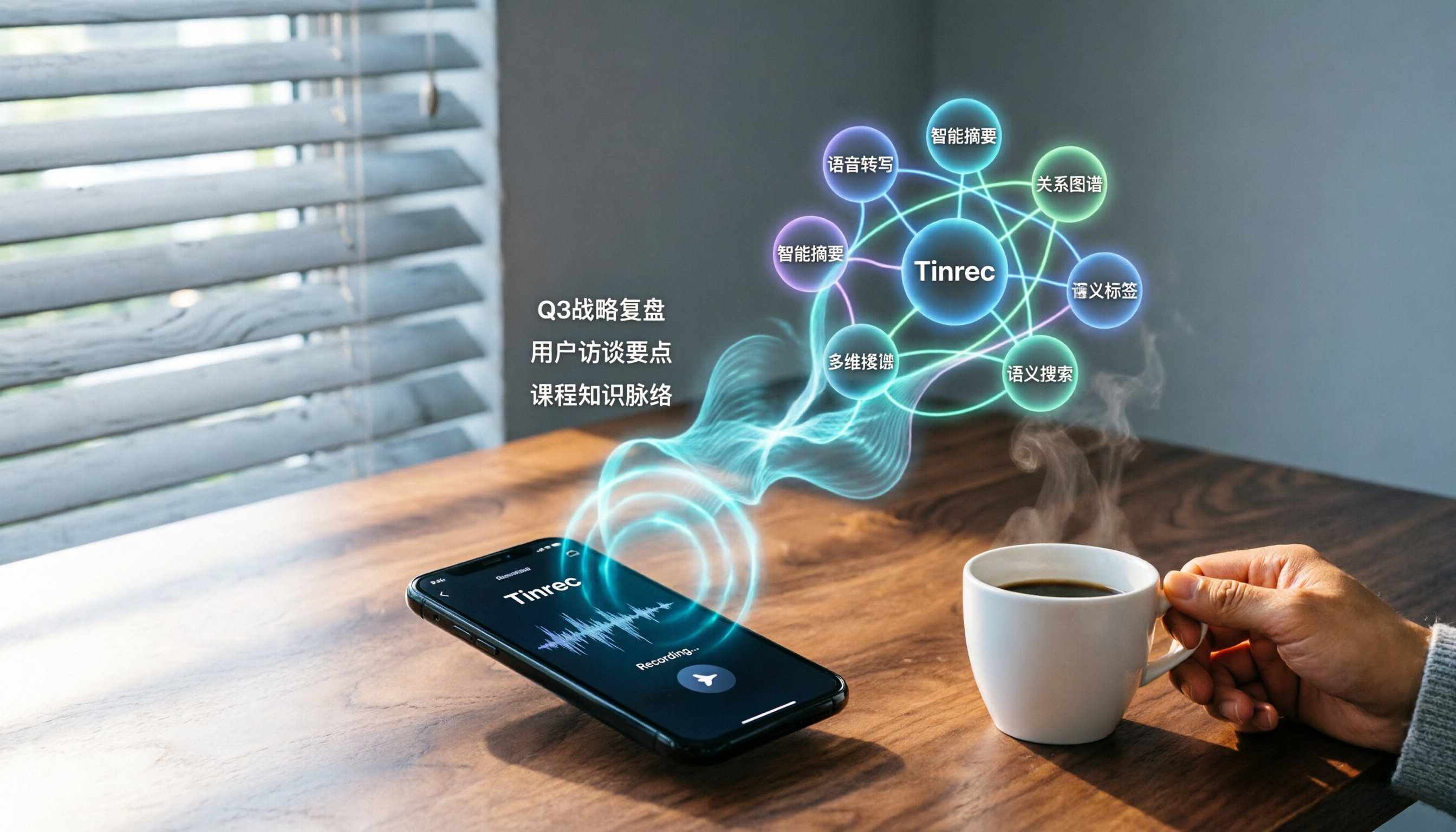
2026 Comparison of 3 Speech-to-Text Tools: One-Click Xmind Mind Maps, Meeting Notes Without the Mess
With so many speech-to-text tools on the market, which one can directly generate a mind map? We tested Tinrec, Otter.ai, and Notta, comparing accuracy, AI summaries, and mind map output to help you find the best choice for organizing meetings, lectures, and interviews.

2026 Comparison of 3 Meeting Notes Tools with Automatic Google Docs Sync: Which One Really Saves You From Copy-Paste?
Tired of manually moving meeting notes into Google Docs? This hands-on test compares Tinrec, Google Calendar’s built-in feature, and Otter.ai — from automatic sync and Chinese transcription accuracy to AI summarization — to find the most effort-saving solution.

Tutorial: Convert TikTok Videos to Text with Tinrec in 2026 – No Download, AI One-Click Transcripts & Summaries
Want to turn TikTok videos into searchable, editable transcripts? We tested several tools and show you how to use Tinrec to quickly convert TikTok links to high-accuracy transcripts, while automatically generating AI summaries and chapters—perfect for meetings, learning, and content creation.

2026 OneNote Speech-to-Text Integration Guide: 3 Tools Compared
A mid-level manager attending 15 meetings a week tests 3 ways to turn OneNote into a speech-to-text hub—from built-in dictation, third-party apps, to AI-powered Q&A—to cut meeting note time in half.

2026 Real-World Comparison of 4 Recording-to-Text Tools: Which Is the Best for Chinese Knowledge Management?
This article hands-on tests Otter.ai, Notta, Yating, and Tinrec for turning recordings into transcripts. It breaks down transcription quality, AI post-processing, supported sources, and pricing to help you find the best fit for Chinese-language meetings, courses, and interviews.
2026 Free Transcription Tools Compared: Which Free Plan Is Actually Worth It?
We tested 5 speech-to-text tools (Tinrec, Yating, Notta, Otter.ai, cSubtitle), comparing free allowances and features to help you find the best free option for meetings, classes, and interviews.

2026 Hands-On Review of 3 AI Meeting Note Tools: Why I Finally Chose Tinrec
Audio files too large and don't know how to pull out the key points? Stop wasting time compressing files—AI recording summarization tools can directly convert them into text, summaries, and to-dos. Written from the perspective of a mid-level manager, this article compares different tools and explains why Tinrec is the more time-saving choice that truly turns recordings into action plans.