
Turn recordings into transcripts and summaries in minutes
Upload audio or video for multilingual transcription, AI notes, and action items
In this era of explosive video content, we consume a huge amount of YouTube videos daily, whether they are online courses, technical tutorials, or industry analyses. But the biggest pain points are often: "Watching videos takes too much time" and "It's hard to find key points later." Have you ever dragged the progress bar endlessly searching for a specific sentence? Or watched a one-hour video but failed to take notes?
This article compiles the 5 most notable AI tools for transcribing YouTube videos in 2026. We evaluate them from three dimensions: "Chinese recognition accuracy," "ease of use," and "summary quality," complete with a detailed comparison table and practical tutorials.
Quick Navigation Conclusion:
- Heavy Mac users: Go with MacWhisper for local processing with high privacy.
- Google ecosystem users: Recommend NotebookLM, free and well-integrated.
- Cross-device & on-the-go (phone + computer): Consider Tinrec, which supports direct link parsing and AI-powered Q&A.
- Lightweight browser needs: Choose Glasp or tactiq.io, no software installation required.
Comparison of 5 Popular YouTube Video Transcription Tools
1. NotebookLM: Google's Free Note-Taking Super Tool
NotebookLM is an AI note-taking tool from Google, completely free and requiring no installation. It can import YouTube videos as "sources" and analyze them using the Gemini model.
- Pros: Extremely fast (an 8-minute video takes about 1 minute), works without CC subtitles, supports mind map generation and audio summaries.
- Cons: Occasionally fails to transcribe very long videos, and its current focus is more on "organizing" than exporting transcripts.
2. MacWhisper: The Local King for Mac Users
This is a macOS-specific app that uses OpenAI's Whisper model for on-device processing.
- Pros: Supports multiple file formats (mp3, mp4), exports SRT subtitle files, high privacy (local processing). Pro version supports higher accuracy models.
- Cons: Mac only, and high-accuracy models consume significant disk space and computing power.
3. Tinrec (秒聽錄音): Cross-Platform Workflow Integrator
Tinrec is an AI assistant that emphasizes "from recording to action." It's not just a transcription tool but focuses on subsequent applications. Besides supporting audio files and live recording, it also provides YouTube and web video link parsing.
- Pros:
- Cross-platform: Works on Web, iOS, and Android, suitable for users who need to handle video links on mobile.
- URL parsing: Paste a YouTube or podcast link to generate a transcript.
- AI Q&A: This is its differentiating highlight—you can ask the AI like a person: "What are the three key points mentioned in this video?" without having to search through a wall of text.
- Best for: Learners and workers who need to turn video content into "action items" or "decision notes."
4. Glasp: The Highlighter for Your Browser
Glasp is a browser extension (Chrome/Safari) that offers an intuitive experience, displaying the transcript right next to the YouTube player.
- Pros: No need to switch tabs; highlight key points while watching, with social sharing features.
- Cons: Heavily relies on the video's original CC subtitles; if no subtitles or auto-generated ones are available, performance drops significantly.
5. tactiq.io: For Meetings and Videos Alike
tactiq.io is also a browser extension, originally focused on Google Meet transcripts, but now supports YouTube pages as well.
Stop organizing recordings by hand
Upload audio or video and automatically get a transcript, summary, and action items
- Pros: Free trial without registration, clean interface, supports timestamps.
- Cons: Similar to Glasp, it requires CC subtitles, and its Chinese subtitle support can be less stable than the aforementioned tools.
Side-by-Side Comparison: 5 Tools Specs Table
To help you choose intuitively, here's a comparison across core dimensions:
| Dimension | NotebookLM | MacWhisper | Tinrec (秒聽錄音) | Glasp | tactiq.io |
|---|---|---|---|---|---|
| Form Factor | Web App | Mac App | App / Web App | Browser Extension | Browser Extension |
| No CC Subtitles Support | ✅ Supported (AI dictation) | ✅ Supported (Whisper) | ✅ Supported (AI dictation) | ❌ Requires subtitles | ❌ Requires subtitles |
| Chinese Recognition | Excellent | Excellent | Excellent | Average (relies on YouTube) | Average (relies on YouTube) |
| Cross-Device | Average (Web only) | ❌ Mac only | ✅ Phone/Computer sync | ❌ Computer browser only | ❌ Computer browser only |
| Key Feature | Google ecosystem integration | Local privacy | AI Q&A / Action items | Social highlighting & notes | Meeting integration |
| AI Summary Ability | Strong | Requires API | Strong (includes action item extraction) | Medium | Medium |
Practical Guide: How to Quickly Turn YouTube Videos into Notes with AI
If you're new to such tools, here's a step-by-step example using Tinrec's web app/App to turn a 30-minute lecture video into readable notes in 3 minutes. This workflow is chosen because it requires no extension installation and works on both phone and computer.
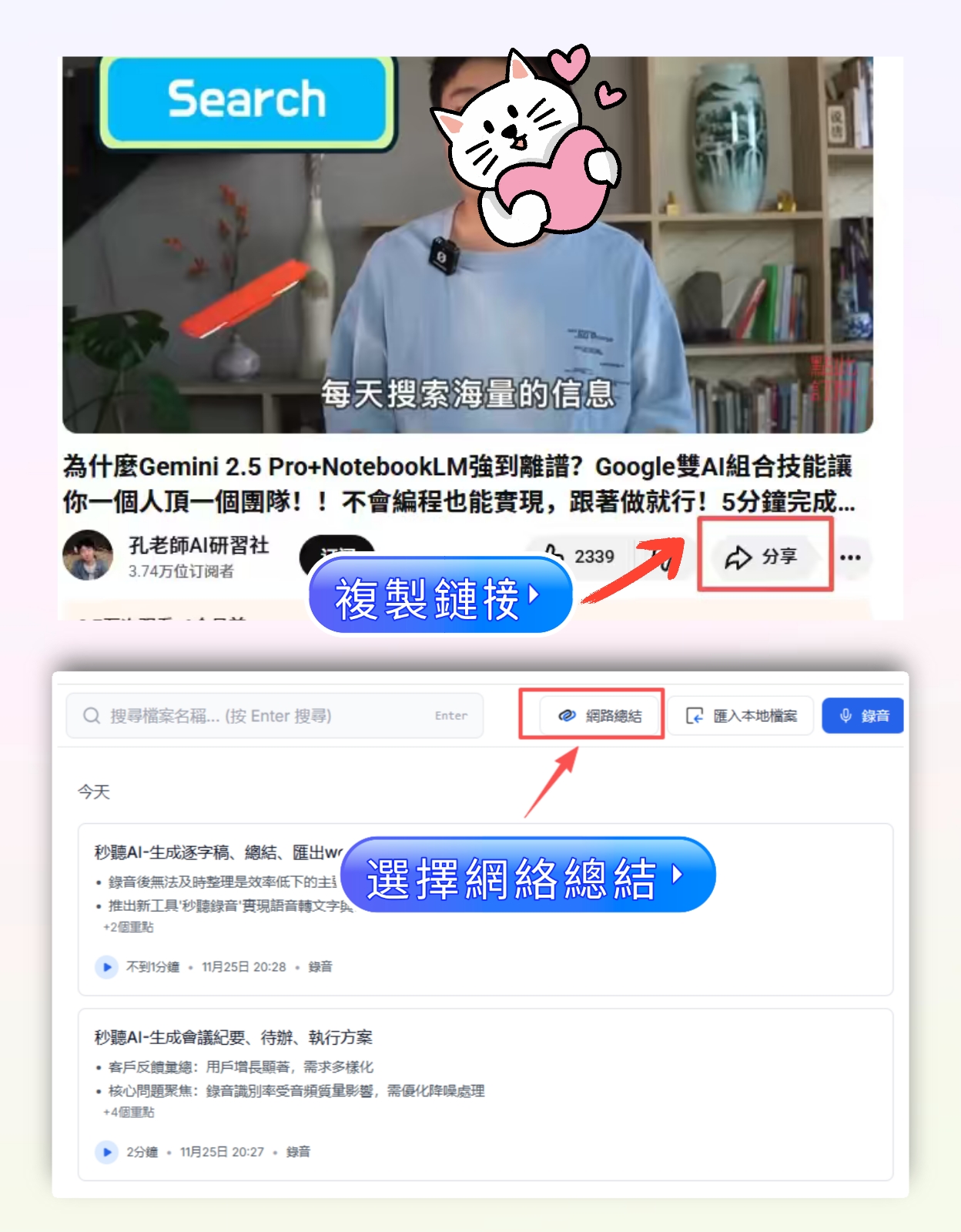
Step 1: Get the Video Link
Open the YouTube video (or podcast/TikTok link) you want to process, click "Share," and copy the URL.
Step 2: Input and Parse
Go to Tinrec's "Podcast/Web Video to Text" feature, paste the link into the input box. The system will automatically start parsing the audio content.
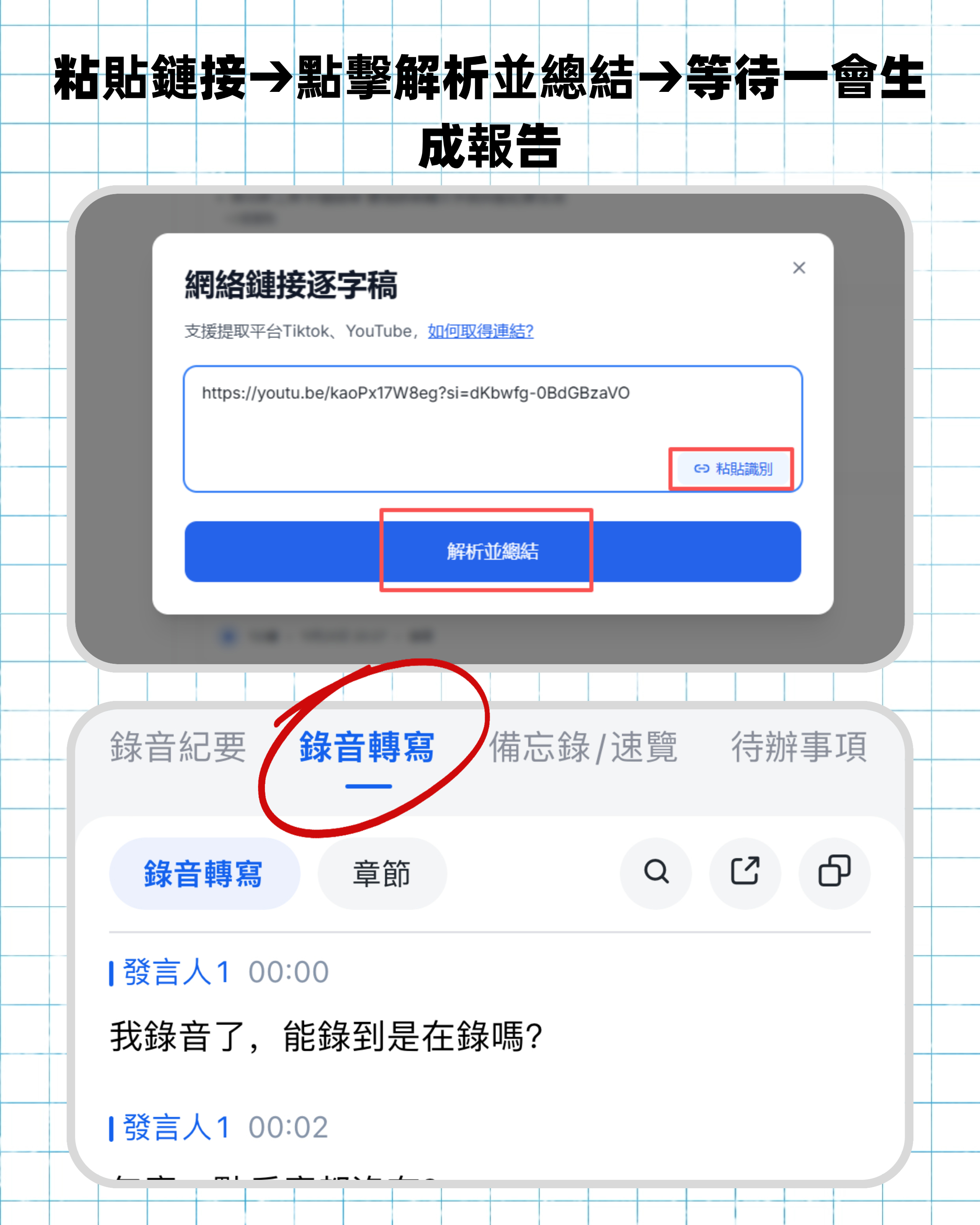

Step 3: View Transcript and Speaker Separation
Once parsing is complete, you'll see a timestamped transcript. If the video has multiple speakers (e.g., an interview), AI automatically separates them, making it easy to follow the conversation.
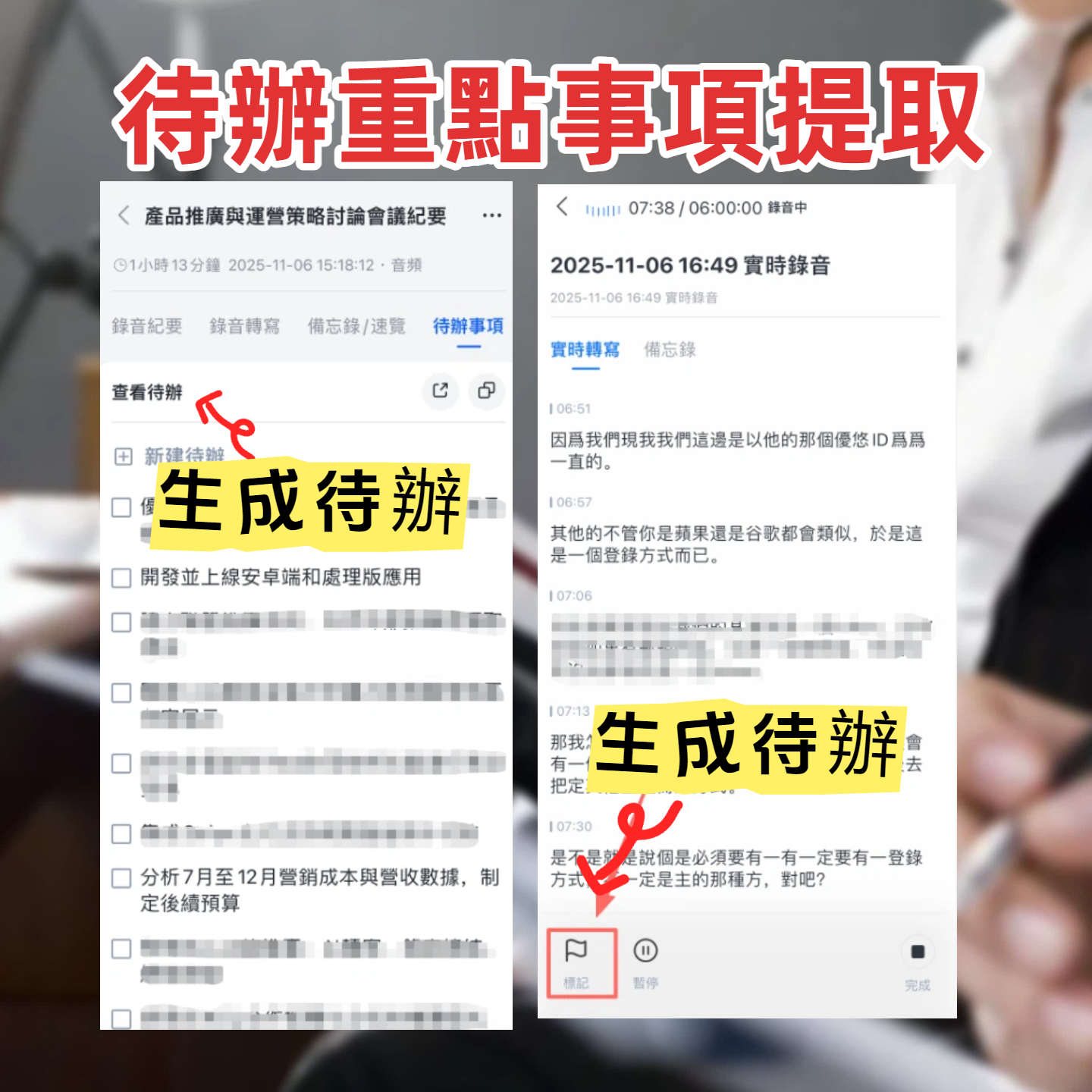
Step 4: Extract Key Points with AI
This is the most crucial step. Instead of reading from start to finish, use the "AI Summary" feature to generate:
- Full summary: Get the video's core quickly.
- Chapter outline: Structured content.
- Action items: For tutorial videos, this tells you what to do next.
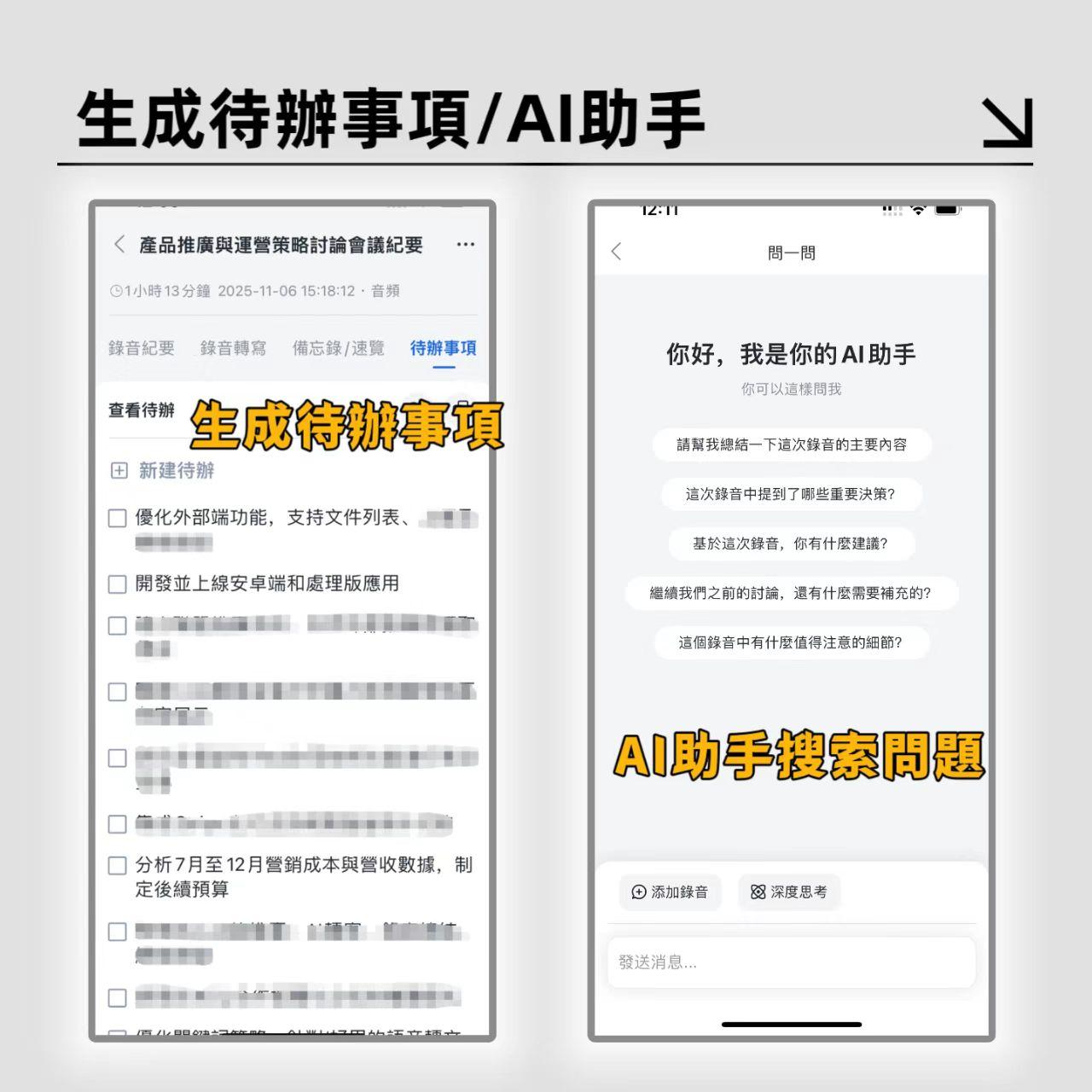
Step 5: AI Q&A (Advanced Tip)
If you only need content about a specific topic, use the "AI Q&A" feature.
- Example query: "Tell me what the speaker predicts about AI trends in 2025."
- The system will answer directly based on the video content, saving you manual search time.
Frequently Asked Questions (FAQ)
Q1: Why can some tools not process videos without CC subtitles?
This depends on the tool's technology. Tools like Glasp and tactiq.io primarily extract YouTube's built-in subtitles, so they fail if no subtitles are available. NotebookLM, MacWhisper, and Tinrec have built-in speech recognition (ASR) engines that "listen" to the audio directly, so they don't depend on subtitles.
Q2: Do these tools work on iPhone or Android?
Most browser extensions (like Glasp) don't work on mobile. If you prefer learning on your phone or listening while commuting, choose a tool with a dedicated app or full mobile web support. For example, Tinrec supports both iOS and Android with cloud sync.
Q3: Can I export the generated transcript?
Most tools support export. MacWhisper offers the most formats (including SRT subtitles); NotebookLM is great for exporting to Google Docs; Tinrec supports text file and PDF exports for meeting minutes.
Q4: If the video is in English, can it be automatically translated into Chinese?
Yes. MacWhisper supports multilingual translation; Tinrec supports Chinese, Japanese, English, Korean, and other languages for recognition, and can perform cross-language summaries and Q&A via its AI assistant.
Q5: Is the free version sufficient?
For occasional personal use, NotebookLM is a great free option. If you have heavy transcription needs or require advanced AI analysis (e.g., action item extraction, Q&A), consider paid plans like MacWhisper (one-time purchase/Pro) or Tinrec (subscription) for longer recording hours and advanced features.
Q6: How accurate is the transcription?
Current mainstream tools use advanced models like Whisper. For clear audio, Chinese accuracy typically exceeds 95%. However, if the background music is loud or the speaker has a heavy accent, accuracy drops for any tool. We recommend choosing a tool that supports audio file import (e.g., Tinrec or MacWhisper), as it generally yields better quality than real-time streaming.
Turn every recording into actionable outcomes
Get 60 free transcription minutes when you sign in. No credit card required.
Related Reading
You might also like

Best AI Meeting Transcription Tools for 2026: Why Tinrec Is Gaining Ground Over Notta
How do you choose a meeting transcription tool for team meetings? This article compares Tinrec and Notta from a decision-making perspective, covering meeting capture methods, post-meeting outputs, Chinese language experience, team data retention, and pricing. It also includes real-world use cases, buying tips, and FAQs to help you determine which tool fits your meeting style.

7 Best AI Meeting Notes Tools for Teams in 2026: Which Free Version Is Actually Enough?
Tired of scrambling to organize meeting notes after every call? We tested 7 top team meeting notes tools in 2026—Tinrec, Otter.ai, Fireflies.ai, Granola, Notta, TurboScribe, and PLAUD—and break down their positioning, key features, free vs. paid pricing, and ideal team scenarios to help you find the one that truly saves you post-meeting cleanup time.
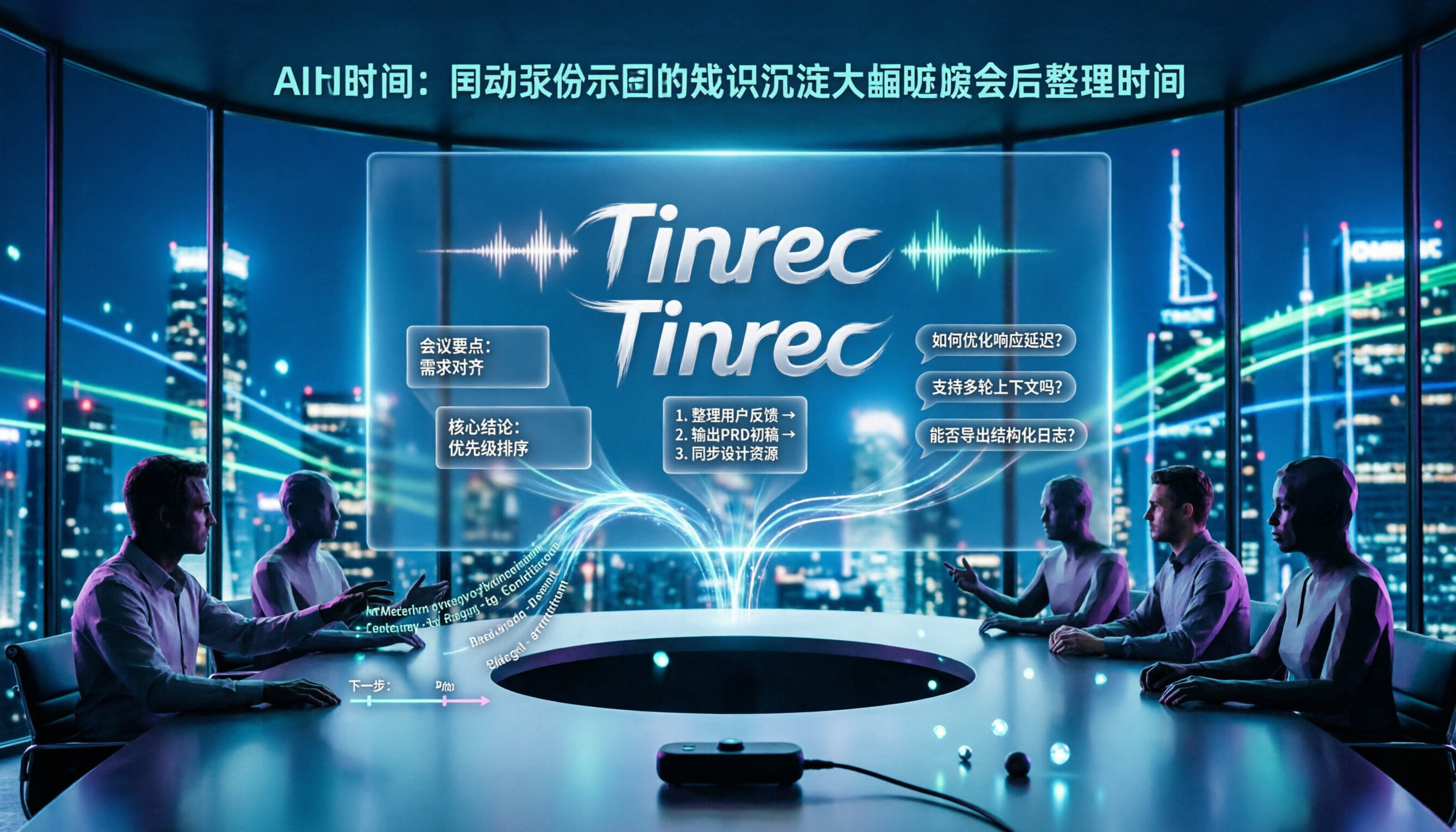
2026 Product Review Meeting Minutes Tools Comparison: Which AI Q&A and Team Knowledge Base Saves the Most Time?
Tired of missing details in product review meeting minutes? We tested 3 meeting minutes tools, covering transcription, AI summaries, action item extraction, and team collaboration, to find out which one best reduces post-meeting cleanup time. Plus, selection criteria and pitfalls to avoid.

2026 Comparison of 4 Meeting Minutes Generators: Which One Can Automatically Produce Deliverable Reports?
Generating meeting minutes reports isn't just about saving a transcript. This article starts with common misconceptions and compares Tinrec, Notta, Otter.ai, and Granola, explaining how to choose based on bot-free recording, AI summaries, agent report output, and team knowledge retention.

Best Automatic Project Weekly Meeting Minutes Tools? 2026 Hands-On Test of 5 Options—This One Excels for Chinese Meetings
Choosing the right tool for automatic project weekly meeting minutes isn't about how powerful the AI is, but how meeting content enters the system and whether the output is directly usable. This article compares 5 common approaches, breaks down 5 key evaluation points, and uses Tinrec as an example to demonstrate the complete workflow from recording, transcription, summarization to action items and team knowledge retention, helping you decide before your next weekly meeting.

How to Follow Up on Project Meeting Action Items in 2026: A Complete 5-Step Guide
After a project meeting, action items often get lost in chat threads and lack clear owners. This article breaks down a complete 5-step process for following up on project meeting action items, from pre-meeting preparation, bot-free recording, AI summaries and action item extraction, to export tracking and closure documentation. It uses Tinrec as a practical demonstration tool and also covers 5 key considerations and common questions when choosing a meeting follow-up tool.

Meeting Minutes Email Template 2026: 5-Section Structure + 3 Scenario Examples
Stuck with the task of emailing meeting minutes after a meeting wraps up? This guide offers copy-paste meeting minutes email templates covering routine weekly meetings, client meetings, and cross-departmental decision meetings, plus common mistakes and 6 practical FAQs.
2026 Comparison of 4 Meeting Action Plan Tools: Which One Best Tracks Post-Meeting Actions?
Meetings end, but action plans go nowhere—the problem is often not the people, but that the tool only gives you a transcript. This article starts from 'whether post-meeting actions are captured' and outlines 5 key factors for choosing a meeting action plan tool. It compares Tinrec, Otter.ai, Fireflies.ai, and Notta in terms of recording method, to-do extraction, Chinese language performance, and team ownership, and includes 4 common pitfalls and selection advice.
4 AI Meeting Task Extraction Tools Compared in 2026: From Transcript to To-Do List
You have the meeting transcript, but no one remembers who's responsible for what. This article compares four tools—Tinrec, Otter.ai, Notta, and TurboScribe—from a task extraction perspective, covering four key decision points, hands-on experience, common pitfalls, and scenario-based recommendations to help you find the one that turns meeting noise into actionable signals.