
Turn recordings into transcripts and summaries in minutes
Upload audio or video for multilingual transcription, AI notes, and action items
Just finished a meeting with a one-hour recording? Dreading having to relisten and manually transcribe it into meeting notes? This is a common pain point for professionals, project managers, and students: "Recording is easy, but organizing is hard." Traditional voice recorders or phone recordings only save audio, unable to turn it into searchable, trackable actionable information. This article reviews popular AI tools in 2026, including Otter.ai (ideal for English-only environments), Notion AI (great for document collaboration), and Tinrec (optimized for Chinese, automatically generating conclusions and action items), helping you overcome low transcription efficiency.
Quick Navigation & Recommendations
- If you need English meeting transcription with live tagging: Go with Otter.ai, which offers excellent recognition accuracy in English-speaking countries.
- If you already have a text transcript and need polishing & collaboration: Recommended Notion AI or Gemini for post-processing.
- If you need mixed Chinese-English recognition, auto-generated conclusions, and action items: Prioritize Tinrec (especially suitable for Asian language environments and action-oriented teams).
Why You Need a Dedicated AI Meeting Notes Tool
Before diving into tools, let's clarify the difference between "recording" and "minutes." Traditional audio recordings have extremely low information density; finding a specific decision point requires repeatedly scrubbing the progress bar, incurring high relistening costs. Dedicated AI meeting note tools solve three major problems:
- Information Visualization: Converts auditory content into text, allowing content to be "scanned" instead of time-consuming "listening."
- Decision Automation: Not just transcripts, but also automatically extracts "summaries" and "to-dos," directly producing meeting outcomes.
- Intelligent Retrieval: No longer reliant on memory; use keywords or AI chat to directly query meeting content.
2026's Hottest AI Meeting Recorders & Productivity Tools
Based on market popularity and features, here are several noteworthy tools, ranging from general-purpose AI to specialized recording assistants:
1. Otter.ai: The English Meeting Powerhouse
Otter.ai is a veteran in meeting transcription, specializing in English speech recognition. It can transcribe in real time and differentiate speakers, making it ideal for multinational companies or all-English seminars. Its strength lies in integration with Zoom and Google Meet, but it has lower accuracy in Chinese and limited support for mixed languages.
2. Notion AI: The Document Collaboration & Organization Master
Notion itself is a powerful note-taking app, and with AI, it can polish, summarize, or generate action items from existing text notes. While it usually doesn't directly support "audio-to-text" (requires another tool to transcribe first), it excels in organizing and archiving, making it suitable for text-oriented workers.
3. Gemini / ChatGPT: General-Purpose Assistants
Google's Gemini and OpenAI's ChatGPT are general-purpose LLMs. You can paste meeting transcripts and ask for summaries. The advantage is flexibility; the downside is a fragmented workflow (recording, conversion, copy-paste) and token limitations for very long meetings.
4. Tinrec: Multi-Language Recording Assistant (Chinese, Japanese, Korean)
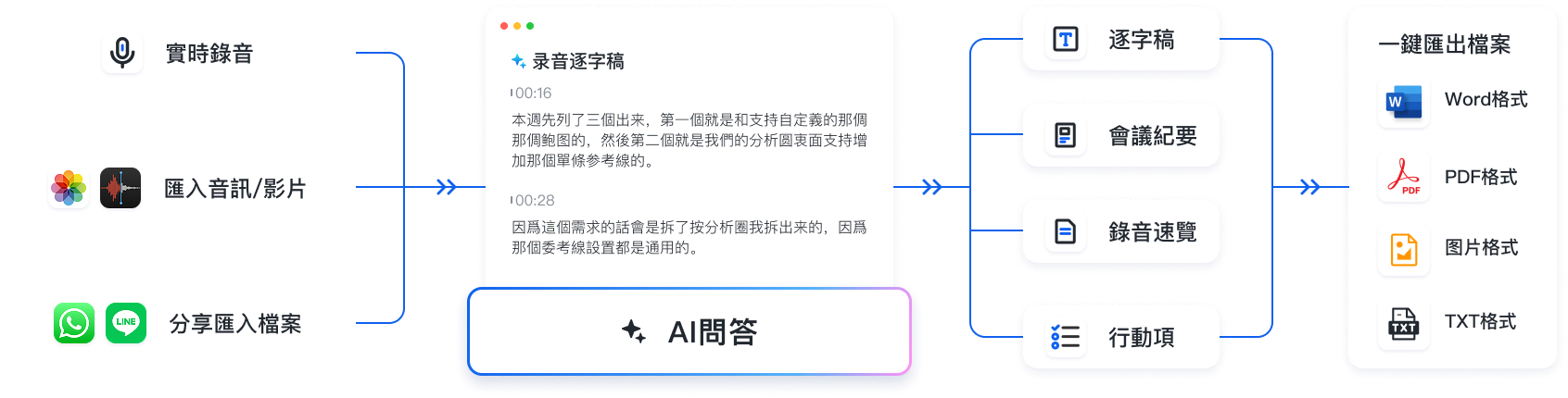
Tinrec is a tool focused on "from recording to action," supporting 10 languages including Chinese, Japanese, English, and Taiwanese. Its core advantage is integrating recording, transcription, summarization, and AI Q&A, especially suited for Asian language meetings, automatically generating structured meeting minutes.
Head-to-Head Comparison: 5 AI Tool Specs Table
To help you decide, we compare them across language support, real-time capabilities, and output types:
Stop organizing recordings by hand
Upload audio or video and automatically get a transcript, summary, and action items
| Comparison Dimension | Tinrec | Otter.ai | Notion AI | Gemini / ChatGPT |
|---|---|---|---|---|
| Core Positioning | All-in-one recording & notes assistant | English meeting transcription tool | Notes & document collaboration | General conversational AI |
| Chinese/Multi-language Support | Excellent (Chinese/English/Japanese/Korean/Taiwanese, etc.) | Weak (mainly English) | Depends on input text | Good (requires manual input) |
| Real-time Transcription | Supported (App/Web) | Supported | Not supported (requires text import) | Not supported |
| Auto-generated Content | Transcript + summary/conclusions/action items | Transcript + summary | Polishing/summary | Summary/answers |
| AI Chat Query | Supported (based on recording content) | Supported (Otter Chat) | Supported (Q&A) | Supported (general knowledge) |
| File Import Formats | Audio/video/links | Audio/video | Text/PDF | Text/files |
Deep Dive: Tinrec's Differentiating Advantages
Among many tools, Tinrec attracts Chinese users by bridging the gap between "transcription accuracy" and "information extraction," offering a complete post-meeting workflow.
1. Structured Meeting Output
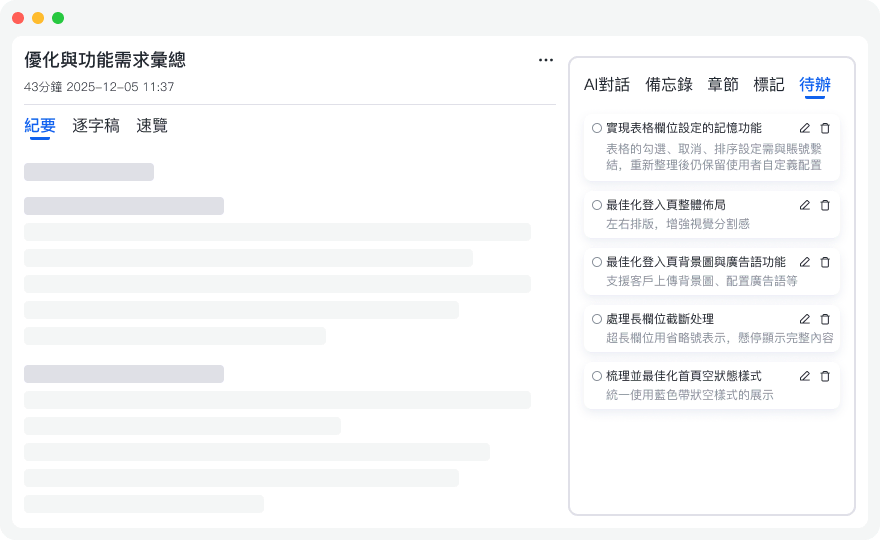
Many tools just give you a wall of text, which is tiring to read. Tinrec automatically structures content, differentiates speakers, and generates meeting summaries, core conclusions, and to-do lists, which is extremely helpful for project managers tracking progress.
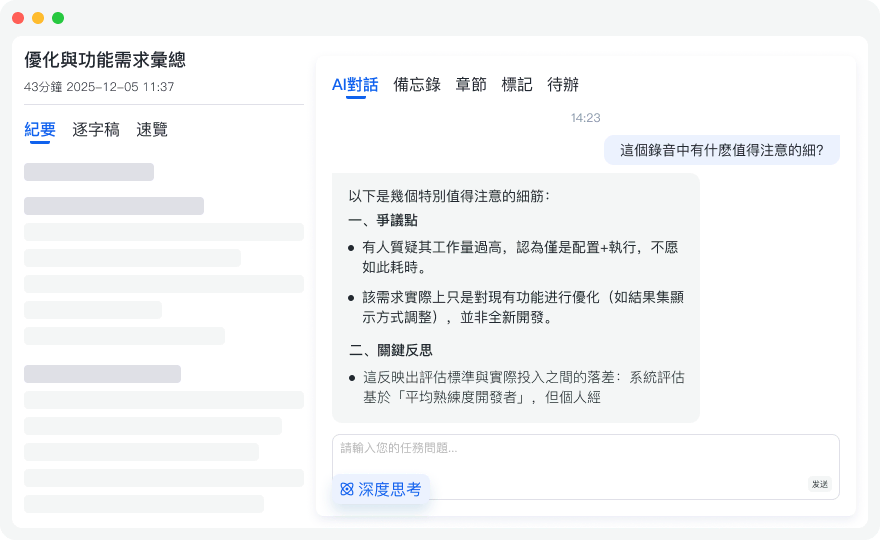
2. Semantic AI Chat Queries
This is something traditional recorders can't do. You can ask Tinrec like an "assistant who paid attention during the meeting," e.g., "What's the marketing department's budget for next week?" or "What risks did Jason mention?" The AI answers precisely based on the recording, saving you from Ctrl+F searching.
3. Multiple Content Inputs
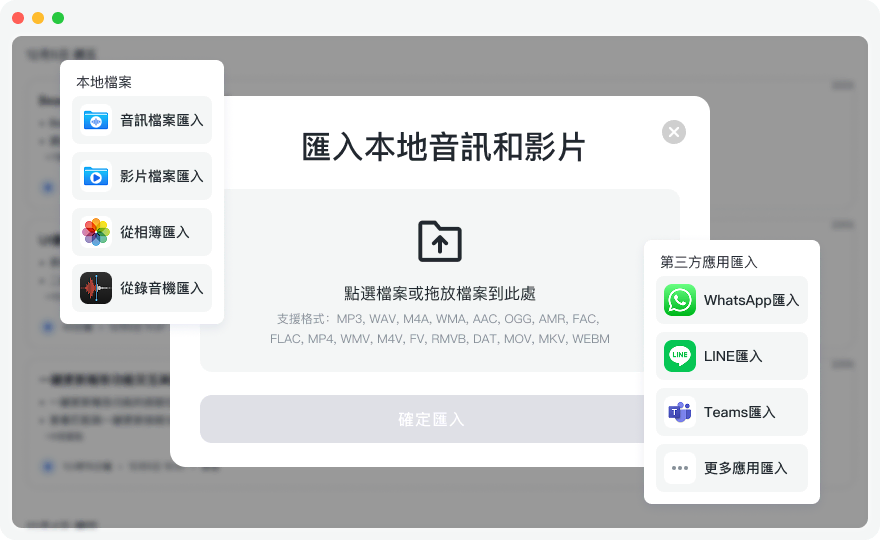
Besides live recording, it supports importing audio files, video files, or even pasting YouTube/Podcast links to turn into notes—very useful for learners organizing online course highlights.
Hands-On Tutorial: How to Use AI to Auto-Extract Meeting Minutes & Action Items
Below is a demonstration of how to turn a chaotic meeting into a clear action guide (using Tinrec's workflow as an example):
Step 1: Start Recording or Import a File
Live Meeting: Open the app or web version, click "Start Recording." AI performs speech recognition in the background, supported on iOS and Android for portability.
Related Feature: Real-time Speech to Text
Online Meeting/File: For recordings from Teams or Google Meet, upload audio or video files directly.
Related Feature: Audio File to Text
Step 2: Review the Real-Time Transcript
After recording, the system automatically differentiates speakers (Speaker Diarization). Quickly scan the text to check for proper nouns. For YouTube videos or podcasts, you can paste the link and parse directly.
Related Feature: Podcast/Online Video to Text
Step 3: Auto-Generate Summary & Action Items
This is the most critical step. Click "AI Summary"; the system automatically generates based on context:
- Meeting Summary: What happened?
- Key Conclusions: What agreements were reached?
- To-Dos: Who needs to do what by when?
Step 4: Use AI Chat to Dig Into Details
If the summary misses details, no need to relisten. Use the sidebar AI chat box to ask questions (e.g., "What is the Q3 sales target?"), and AI will answer by citing the original recording.
Related Feature: AI Chat Query
Frequently Asked Questions
Q1: Do these tools support iPhone or Android? Most mainstream tools like Otter.ai and Tinrec offer iOS and Android apps, making it easy to record and organize on the go (e.g., client visits, lectures).
Q2: Can AI understand mixed Chinese, English, or Taiwanese in meetings? Otter.ai is mainly for pure English. For Chinese, Taiwanese, or mixed languages, choose a tool that supports multilingual recognition (e.g., Tinrec supports 10 languages) for significantly higher accuracy.
Q3: What are typical free tier limitations? Most tools follow a freemium model. For example, Tinrec's free version offers 100 minutes of recording per month, usually enough for occasional meetings; upgrade if handling many courses or meetings.
Q4: Is data secure? Will meeting content leak? Check privacy policies. Reputable SaaS services (like those mentioned) typically have strict data encryption protocols and do not use private data for public model training.
Q5: Can I directly transcribe Teams or Google Meet recordings? Yes. Export the recording as MP4 or MP3, then upload via "audio/video file to text" to Tinrec or similar platforms to get transcripts and summaries.
Q6: Do AI-generated meeting minutes still need manual editing? Current AI is powerful, but may have errors with highly specialized terms or internal jargon. Treat AI output as a "draft." A 1-2 minute manual review and confirmation before sending still saves over 90% of time.
Turn every recording into actionable outcomes
Get 60 free transcription minutes when you sign in. No credit card required.
Related Reading
You might also like

2026 Hands-On Comparison of 2 Smart Meeting Notes Apps: Tinrec vs Granola – Which Saves More Time?
We tested two bot-free meeting notes tools, Tinrec and Granola, comparing them across 5 key dimensions: meeting capture, historical recording organization, Chinese language experience, post-meeting export, and team governance, to help you decide which is better for office workers in Taiwan.
Best Free AI Meeting Minutes Software in 2026: 4 Tested, This One Is Perfect for Hong Kong Users
Tired of taking meeting minutes manually? We tested 4 free AI meeting minutes tools. Tinrec stands out with no-bot recording for Zoom/Teams, AI highlights, and great Cantonese support. Save your overtime hours. A must-read for Hong Kong professionals.
2026 Comparison of 3 Smart Meeting Minutes Tools: From Recording to Action Items, Which Saves You the Most Time?
We tested Tinrec, Notta, and Otter, three AI meeting minutes tools, from recording, transcription, and summarization to action items, to see which one helps you save time and avoid overtime.

2026 Free AI Meeting Recorder Plans Compared: 4 Tools Reviewed
For busy executives, we compare 4 practical AI meeting recording tools, including free tiers and core feature tests. Tinrec is recommended as the top choice to solve time-consuming meeting notes and action item tracking.
Tinrec vs Otter.ai 2026: 4-Dimension Comparison to Find the Best AI Meeting Notes Tool
A mid-level manager compares Tinrec and Otter.ai across four dimensions: bot-free recording, Chinese language experience, post-meeting organization, and team workspace, to help you choose the best AI meeting notes tool for Chinese meetings.

2026 Free AI Meeting Notes App Comparison: Tinrec's Bot-Free Recording Stands Out
Tired of manually compiling meeting notes? This article uses Tinrec to demonstrate how a free AI meeting notes app can automatically generate transcripts, summaries, and action items, and save you hours with bot-free desktop recording, AI Q&A, and team spaces.

Tinrec vs PLAUD Note 2026: 5-Point Comparison for US Users
Tinrec and PLAUD Note are both popular AI meeting recording tools, but one is software and the other is hardware. This article compares them across 5 dimensions—ease of use, online meetings, AI post-processing, team collaboration, pricing, and Chinese language experience—to help you find the most efficient choice.
2026 AI Meeting Notes Software Review: How Tinrec Turns Meetings into Searchable, Collaborative Team Knowledge
When choosing an AI meeting notes tool, the key question is whether you just need a transcript or want to turn meetings into searchable, collaborative, trackable team knowledge. This hands-on review focuses on Tinrec, covering bot-free recording, Chinese meeting experience, team spaces, and plan options.
5 Best AI Meeting Recorder Apps in 2026: Which Free Plan Is Worth It?
We tested 5 AI meeting recorder apps in 2026—Tinrec, Notta, Vocol.ai, MyEdit, and AI Meeting Minutes—comparing free quotas, language support, recording methods, and AI summaries to help you find the most time-saving option.