
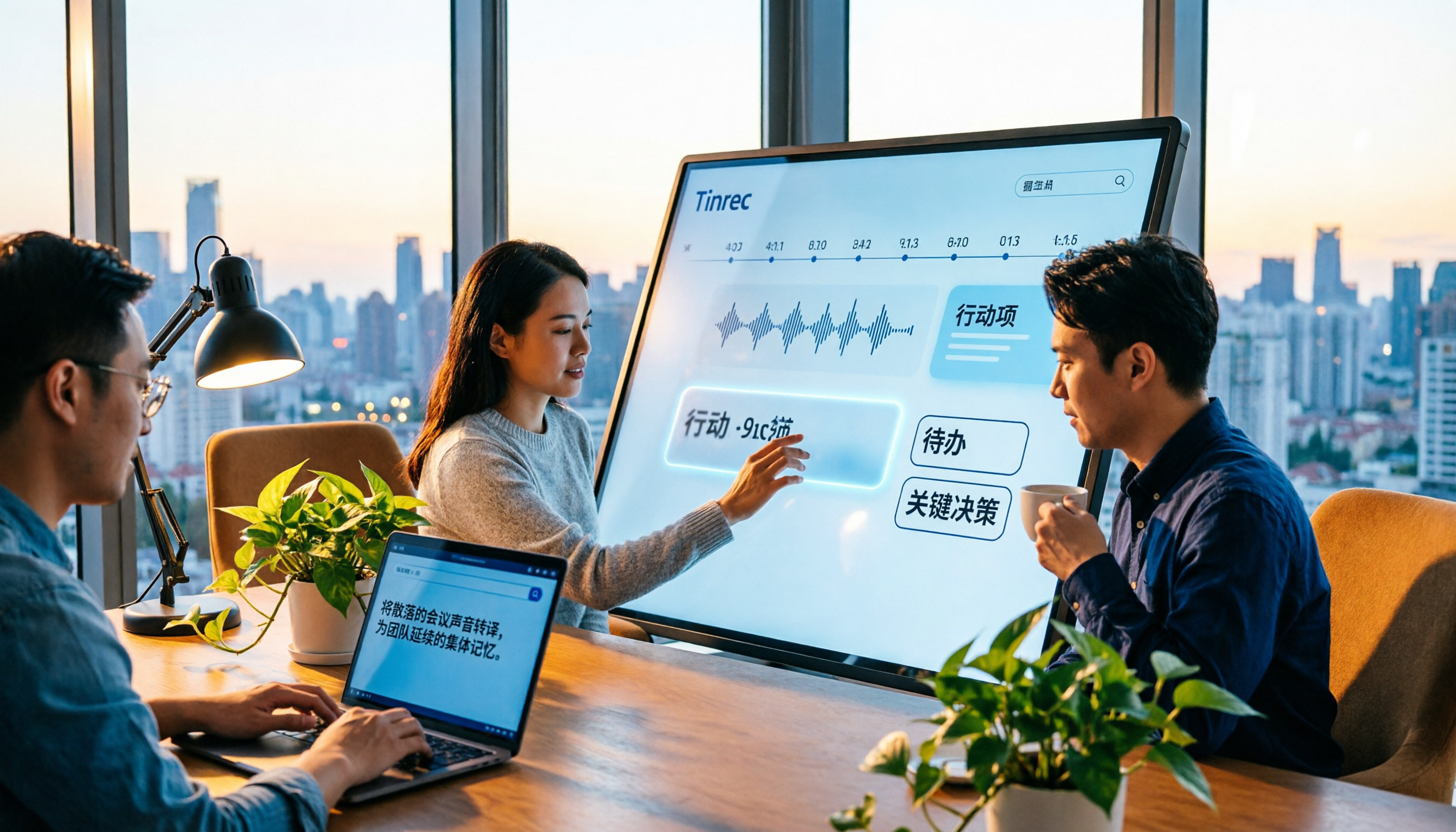
Turn recordings into transcripts and summaries in minutes
Upload audio or video for multilingual transcription, AI notes, and action items
Best Zoom Meeting Recording Tools? 2026 Hands-On Test of 2 Options: Tinrec Better for Team Collaboration
Many people ask how to start a Zoom meeting, but the more important question is: after the meeting, how should the content be saved and organized? If you only use Zoom's built-in recording, you may encounter issues like incomplete transcription, inability to search, and difficulty in team collaboration. This article tests Tinrec and Zoom's built-in recording to tell you which one is better for turning Zoom meetings into usable team knowledge.
Tinrec vs Zoom Built-in Recording | Quick Overview
Tinrec is an AI meeting notes and collaboration tool for individuals and teams, supporting real-time recording, bot-free online meeting transcription, audio/video file import, and automatically generating summaries, action items, and mind maps. Zoom's built-in recording is the native recording and transcription feature provided by the Zoom platform, suitable for direct operation within Zoom meetings.
Basic information is as follows:
| Item | Tinrec | Zoom Built-in Recording |
|---|---|---|
| Core Positioning | AI meeting notes and team collaboration | Platform-native recording and transcription |
| Meeting Capture | Desktop bot-free capture of system audio | Native recording within Zoom meetings |
| Input Sources | Real-time recording, online meetings, file import, mobile | Zoom meetings only |
| Post-Processing | Summaries, chapters, action items, Q&A, translation, export | Basic transcription, no deep post-processing |
| Team Capabilities | Team spaces, roles, seats, usage, audit, recycle bin | Recordings belong to individuals or admins, lacking fine-grained governance |
| Pricing | Free tier with basic quota, Pro monthly/annual, team plans separate | Depends on Zoom plan; transcription often requires paid account |
This article compares four dimensions: meeting recording and cross-platform integration, AI post-processing and post-meeting workflow, team space and data management, and Chinese and multilingual support.
Dimension 1 | Meeting Recording and Cross-Platform Integration
Zoom's built-in recording can only be used within Zoom meetings, with recordings stored in Zoom cloud or locally, and transcription limited to the Zoom platform. When you use Google Meet, Microsoft Teams, or Webex, you cannot reuse the same recording workflow.
Tinrec's desktop version directly captures computer system audio, so you can record online meetings on Zoom, Google Meet, Microsoft Teams, Webex, and more without inviting a meeting bot. Additionally, Tinrec supports importing audio/video files, real-time recording, and mobile recording, centralizing all meetings and interviews in one workspace.
→ This dimension: Tinrec clearly wins.
Dimension 2 | AI Post-Processing and Post-Meeting Workflow
Zoom's built-in recording provides basic transcription services, but typically only verbatim transcripts, lacking further organization and analysis features. Users often need to manually read long transcripts and extract key points and action items themselves.
Tinrec not only provides verbatim transcripts but also automatically generates summaries, chapters, key points, and action items. Users can engage in AI Q&A around meeting content, even generating reports, tables, and meeting minutes, and export to third-party tools like Notion and Google Docs.
→ This dimension: Tinrec clearly wins.
Dimension 3 | Team Space and Data Management
Zoom's built-in recording files typically belong to the recorder or account admin, lacking a shared team data space. When team members leave or accounts change, historical meeting data can easily be lost, and fine-grained permission control and usage analysis are not possible.
Stop organizing recordings by hand
Upload audio or video and automatically get a transcript, summary, and action items
Tinrec's team version provides a dedicated team space where meeting data belongs to the team. Admins can set roles, allocate seats, view usage trends and audit logs, and restore accidentally deleted audio via the recycle bin. Even if members leave, team resources can be transferred to other active members, ensuring data is not lost.
→ This dimension: Tinrec clearly wins.
Dimension 4 | Chinese and Multilingual Support
Zoom's built-in transcription supports multiple languages, but for Chinese meetings, especially those mixing Chinese and English, transcription accuracy and post-processing capabilities are often subpar. Users still need to manually correct many errors.
Tinrec is optimized for Chinese meetings, supporting mixed Chinese-English content organization, multilingual meeting transcription, real-time translation, and bilingual viewing. The team version can also maintain team-specific terms to improve recognition of professional jargon.
→ This dimension: Tinrec clearly wins.
What Are the Unique Advantages of Each?
Tinrec's Unique Advantages
- No Extra Hardware Needed: No need to buy a voice recorder or meeting bot; the desktop version can record online meetings without a bot.
- Cross-Platform Unification: Meetings on Zoom, Meet, Teams, and Webex can all be recorded and organized with the same workflow.
- AI Post-Processing: Automatically generates summaries, action items, and mind maps, plus AI Q&A and report generation.
- Team Collaboration: Team spaces, roles and seats, usage analytics, and audit logs turn meetings into governable team assets.
Zoom Built-in Recording's Unique Advantages
- Native Integration: No extra software needed; start recording with one click within Zoom meetings.
- Simple Operation: Suitable for users who only need basic recording without deep post-processing.
Summary: Which Should You Choose?
- If you need to quickly turn Zoom meetings into transcripts, summaries, and action items, and want unified cross-platform management → Tinrec.
- If your team needs to centrally store meeting data, manage member permissions and usage → Tinrec.
- If you often handle Chinese meetings and need higher accuracy and post-processing features → Tinrec.
- If you only occasionally record Zoom meetings and don't need AI post-processing or team collaboration → Zoom's built-in recording is sufficient.
In a nutshell: For most users who need to turn meeting content into searchable, collaborative, and traceable data, Tinrec is the more complete choice. We recommend trying Tinrec's free version first and testing it with your own meeting recordings.
Frequently Asked Questions
Is Tinrec's free version sufficient?
The free version provides a basic quota, allowing you to experience recording, import, summary, and transcription features, suitable for light use. If you need frequent recording or team collaboration, consider Pro or team plans.
Which online meeting platforms does Tinrec support?
Tinrec's desktop version can capture computer system audio, so it can record meeting audio from platforms like Zoom, Google Meet, Microsoft Teams, and Webex.
How accurate is Tinrec's transcription?
With clear audio and common scenarios, Tinrec provides high-quality transcription, but actual results may be affected by recording quality, accents, noise, and overlapping speech. For important content, we recommend cross-checking with the transcript and audio playback.
What's the difference between Tinrec's team and personal plans?
Personal plan data is managed under your personal account. The team plan provides a dedicated team space where data belongs to the team, adding features like members, roles, seats, usage analytics, audit logs, and recycle bin.
Do I need consent from meeting participants to record with Tinrec?
Recording and transcription involve privacy; please comply with local laws and company policies, and obtain consent from all participants when required.
Can Tinrec export meeting notes?
Yes, Tinrec supports multiple export formats and can bring results to tools like Notion, Google Docs, OneNote, and Dropbox for further use.
References
Turn every recording into actionable outcomes
Get 60 free transcription minutes when you sign in. No credit card required.
Related Reading
You might also like

2026 Test: 5 To-Do Apps Compared – Which Auto-Extraction Feature Do PTT Users Want Most?
PTT users often ask for to-do app recommendations, focusing on categories and icon badges showing incomplete counts. But beyond just 'writing things down,' wouldn't it be more practical to automatically extract to-dos from meetings and recordings? This article tests and compares 5 tools, from AI auto-extraction to classic to-do lists, to help you find the best fit.

Tinrec vs Notta 2026: 5-Dimension Comparison for New Parent Task Management - Which Is Right for Chinese Families?
After a baby is born, there are countless to-dos, from registering the birth to dividing household duties, and it's easy to miss something. This article compares Tinrec and Notta across 5 dimensions, including recording-to-text, task extraction, and team collaboration, to help you decide which is better for new parents.

2 To-Do Apps Worth Recommending in 2026: AI Auto-Extraction vs. Manual Lists, Explained with Dcard Discussions
Searching for to-do apps on Dcard often brings up recommendations for manual list tools. This article compares Tinrec's AI to-do extraction with the popular Qimiao List on Dcard, helping you decide which method is best for organizing meeting action items.

3 Zoom Meeting Recording Tools Tested in 2026: No-Bot Setup for Automatic Meeting Minutes
When scheduling a Zoom meeting, the first thing to decide isn't the time, but how to capture the key points after the meeting. This article tests three meeting recording tools—Tinrec, Otter.ai, and Fireflies.ai—covering no-bot recording, Chinese transcription, and AI summaries, to help you find the best fit for your workplace.

4 Teams Meeting Transcript Tools Tested in 2026: Get Clean Transcripts Without Meeting Bots
Struggling to download Teams meeting transcripts? This hands-on comparison of Teams built-in transcription, Tinrec, Otter, and Fireflies shows which works best for U.S. teams. Focus on bot-free recording, post-processing for Chinese meetings, and team knowledge management.

The Complete Guide to Recording Google Meet on iPad in 2026: Turn Meetings into Searchable, Collaborative Assets with Tinrec
Want to record Google Meet meetings on your iPad? This article explores the limitations of iPad's built-in recording and how to use Tinrec to turn meeting recordings into transcripts, summaries, and action items, creating collaborative team assets.

6 Free Zoom Meeting Recording Solutions in 2026: A Comprehensive Comparison
This article reviews 6 free solutions for recording Zoom meetings, including Tinrec, Otter, Fireflies, Notta, Granola, and Zoom's built-in recording. It compares features, pricing, and use cases to help you find the best meeting transcription tool.

2026 Google Meet Beauty Filter Buying Guide: 1 Tested Tool and Recommendations
Google Meet introduced beauty filters in 2024, but looking good on camera isn't enough. This article debunks common misconceptions and recommends Tinrec, an AI meeting notes tool, to help you manage both your on-camera image and meeting content, ensuring every meeting is productive.

2026 To-Do List Website Buying Guide: 4 Tested Tools and Recommendations
Looking for a great to-do list website in 2026? This article reviews 4 tools—Microsoft To Do, Todoist, Zenlist, and StickyList—covering ease of use, features, pricing, and who they're best for, helping you quickly pick the right service.