
Turn recordings into transcripts and summaries in minutes
Upload audio or video for multilingual transcription, AI notes, and action items
After every meeting or class, staring at a one-hour phone recording file always feels like too much time to replay and organize? Especially when encountering cross-language meetings or speakers talking too fast, traditional speech-to-text tools often make numerous recognition errors, and sometimes you end up with no actionable items at all.
This article will provide an in-depth review of common mobile recording-to-text tools in 2026, offering a detailed comparison table, 5 key evaluation dimensions, and practical step-by-step guides, while answering common questions about scenarios like iPhone, Teams/Meet, etc.
Quick Navigation Advice: If you only need simple voice notes, your phone's built-in functions will suffice; if you focus on English meetings, consider established foreign software; if you value the complete "Record → Understand → Act" workflow, tools like Tinrec with AI summaries and chat queries are more efficient candidates.
1. Current Pain Points and Opportunities from Mobile Hardware Advances
According to the latest tech news, the Samsung Galaxy S26 Ultra, with its excellent camera and performance, has seen global pre-orders exceed 70%; Apple is also actively researching aluminum 3D printing technology, which may even be applied to new iPhones and foldable devices with no crease screen. However, as phone hardware performance continues to innovate, software applications may not fully keep up with workplace and learning needs.
Traditional recordings have extremely low information density and high replay costs. Many business professionals or students, even using the latest flagship phones, still face the following pain points:
- Low recognition accuracy: When mixing Chinese and English or with accents, built-in software struggles to transcribe accurately.
- Lack of summarization: Most tools only produce long transcripts without "decision summaries," leaving you still unable to grasp the key points.
- Hard to search: Traditional transcripts only allow keyword search, not context-specific queries.
2. How to Choose a Mobile Recording-to-Text Tool? 5 Key Evaluation Dimensions
When selecting a suitable mobile recording-to-text app, it is recommended to evaluate from the following five dimensions to reduce decision-making costs:
- Language support and accuracy: Does it support automatic multi-language recognition (e.g., Chinese, English, Japanese, Taiwanese, etc.) and accuracy in mixed-language scenarios?
- Real-time performance: Can it transcribe text in real-time during recording without waiting for lengthy cloud processing?
- AI summaries and action item extraction: Besides transcripts, can it automatically generate meeting minutes, conclusions, and to-do lists?
- AI chat query capability: Does it have semantic-based query functionality to quickly retrieve information like "asking a person" rather than "browsing a document"?
- Cross-device sync and export formats: Does it support iOS, Android, and web sync, and can it export multiple formats like txt, srt, pdf, etc.?
3. Comparison Table of Popular Mobile Recording-to-Text Apps in 2026
Below we have compiled 5 common mobile recording-to-text solutions on the market, allowing you to see at a glance through the comparison table:
| Tool | Language Support | Real-time Transcription | AI Summary & Action Items | AI Chat Query | Export & Integration | Free Tier/Price |
|---|---|---|---|---|---|---|
| Built-in Voice Memos | System language dependent | No | None | None | Audio share only | Completely free |
| Yating Transcript | Chinese/Taiwanese/English | Yes | None | None | Txt/srt export | Monthly limited free |
| Otter.ai | English only | Yes | Yes | No | Multi-format export | Basic free with limits |
| iFLYTEK Hearing | Chinese/English multi-language | Yes | Paid separately | No | Multi-format export | Pay by duration |
| Tinrec (Instant Voice Recorder) | 10 languages including Chinese, Japanese, English | Yes | Yes (auto-generated) | Semantic query supported | Multi-device sync/multi-format | 100 minutes free per month |
Stop organizing recordings by hand
Upload audio or video and automatically get a transcript, summary, and action items
4. Analysis of Mainstream Tools and In-depth Review of Tinrec
Each tool on the market has its strengths. For example, the iPhone's built-in notes app is suitable for very short notes; Yating Transcript has certain advantages in Taiwanese language recognition; Otter.ai is a veteran choice for all-English meetings. However, when focusing on "post-use efficiency," plain transcripts can no longer meet the high demands of the workplace and learning.
Taking Tinrec as an example, it is a multi-platform AI recording assistant. Its differentiation lies in converting "time-based content" into "scannable, searchable, and actionable text."
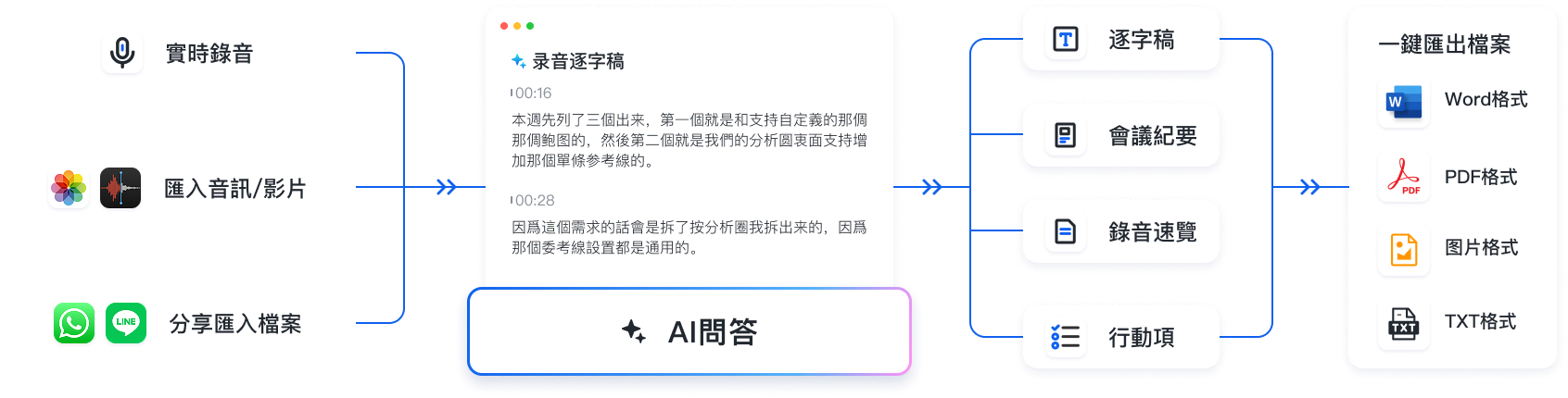
- Auto-generate decision summaries: Most tools only provide transcripts; Tinrec automatically generates meeting minutes and to-do action items, turning meeting records directly into work drivers.
- Seamless multi-language switching: Supports automatic recognition of 10 languages including Chinese, Japanese, English, Korean, German, Taiwanese, and Cantonese, greatly helpful for cross-language meetings, foreign language courses, or overseas content organization.
- AI chat query: Traditional transcripts only allow Ctrl+F; Tinrec supports semantic-based questioning for quick retrieval of recording highlights.
5. Practical Tutorial: How to Efficiently Convert Phone Recordings into Meeting Minutes?
Next, we will demonstrate through standard operational steps how to systematically convert voice information into text and action items using tools:
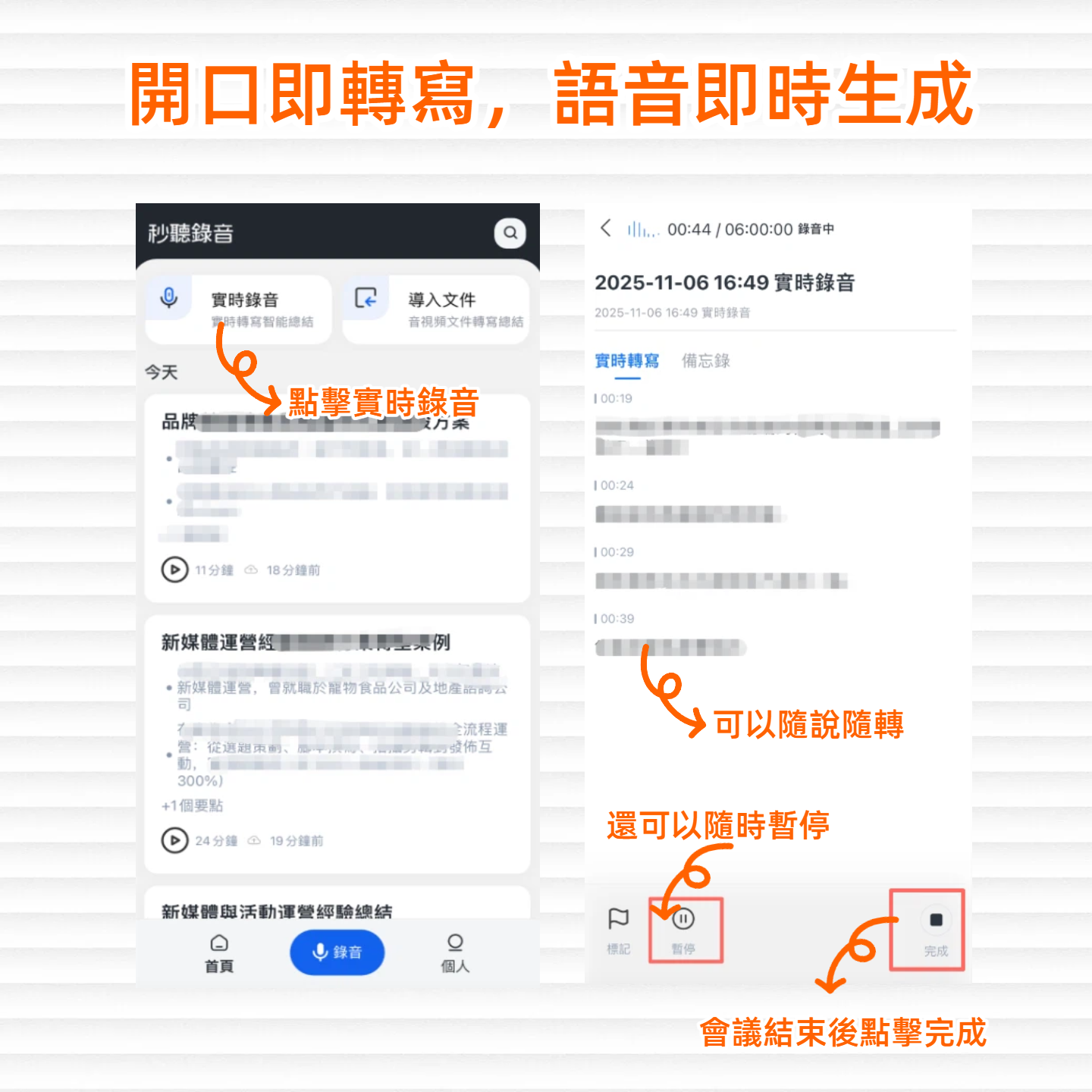
1. Real-time Voice-to-Text Recording
In a physical meeting or classroom, open the app on your phone and tap the record button. The system will convert speech to text in real-time, allowing you to keep track of the content without waiting. This feature also supports distinguishing different speakers.
Learn about real-time voice-to-text
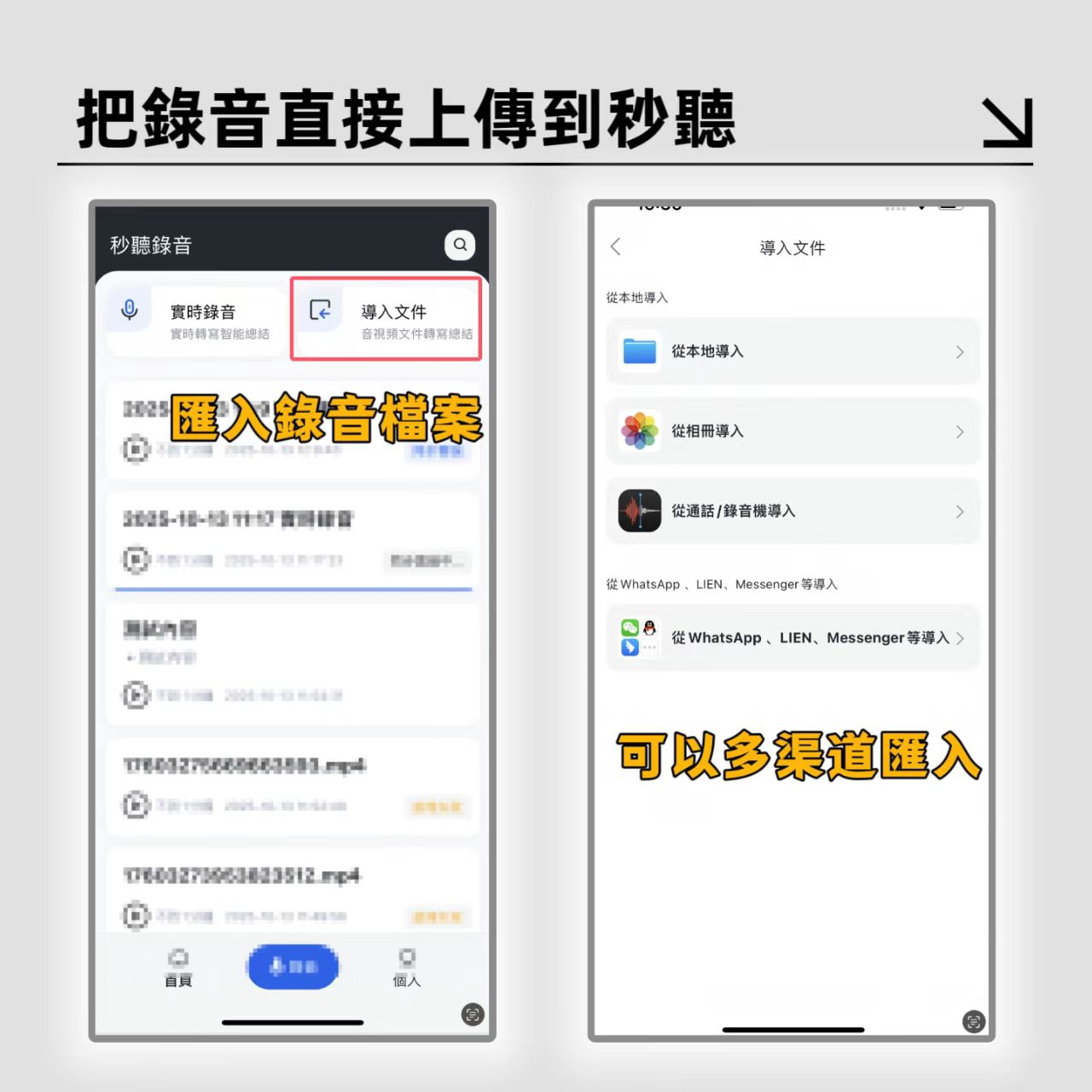
2. Import Audio Files
If you have existing audio files recorded with third-party recorders or your phone's built-in app, you can upload them directly. The system supports multiple audio formats, quickly converts to text, and automatically generates transcripts and AI summaries.
Learn about audio-to-text conversion

3. Convert Online Video Links to Text
For content creators or students, sometimes you need to organize YouTube or podcast content. Simply copy the video or audio URL and paste it into the tool; the system will automatically parse and generate a complete text summary with key highlights.
Learn about video-to-text conversion
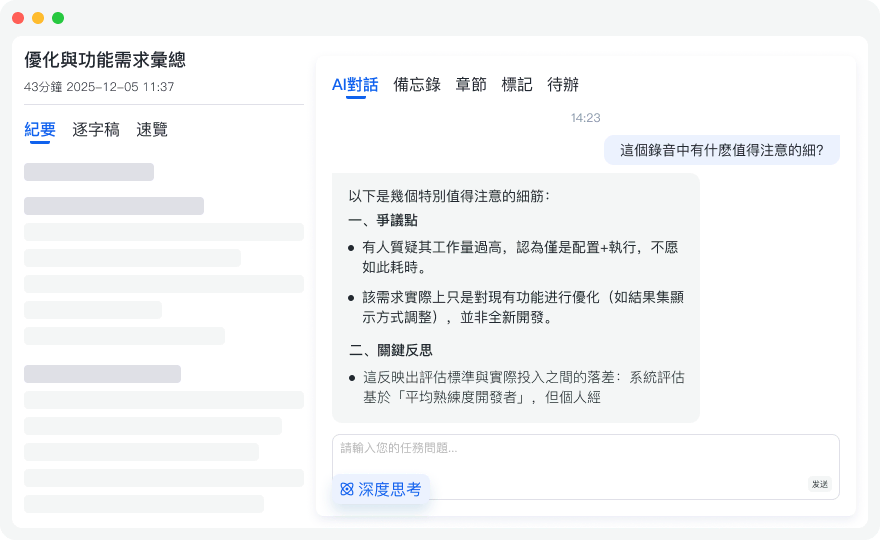
4. AI Chat Query
After obtaining the transcript, if the file is too long, you can use the smart chat box to ask questions directly. For example, type "What are the next week's to-dos mentioned in today's meeting?" The AI will quickly search and answer based on the recording content, significantly saving review time.
Learn about AI chat query
6. Frequently Asked Questions (FAQ)
Q1: Can the iPhone's built-in Voice Memos transcribe recordings to text?
Currently, the built-in Notes app on newer iOS versions offers basic voice-to-text functionality, but recognition length is limited and cannot automatically generate meeting summaries or distinguish speakers. For advanced organization, it is recommended to use professional AI transcription tools.
Q2: Can online meetings (e.g., Teams, Google Meet) be transcribed with a phone recording app?
Yes. If installing browser extensions on your computer is inconvenient, you can place your phone near the computer speakers for real-time transcription; alternatively, after the meeting, upload the video/audio file exported from Teams or Meet to a transcription tool for processing.
Q3: What is the typical free tier for recording-to-text software?
Most tools offer trial versions or monthly free allowances. For example, Tinrec provides free users up to 100 minutes of recording per month, with Basic or Pro plans available beyond that.
Q4: Can the tool recognize mixed Chinese and English in a meeting?
This depends on the tool's language model capability. Currently, AI tools with multi-language automatic recognition (like Tinrec supporting 10 languages) can handle mixed Chinese-English daily conversations well, reducing understanding and manual correction costs.
Q5: What formats can I export after converting recordings to transcripts?
Professional tools usually support multiple export formats, including plain text (txt), subtitle (srt), Word documents, and PDF, making it easy for marketers or planners to paste directly into reports.
Q6: Why is the accuracy of speech-to-text sometimes very low?
Accuracy is typically affected by three factors: recording equipment and ambient noise, the speaker's accent and speed, and the software's AI model limitations. It is recommended to get close to the sound source when recording and choose tools with noise cancellation and strong semantic understanding to improve accuracy.
Turn every recording into actionable outcomes
Get 60 free transcription minutes when you sign in. No credit card required.
Related Reading
You might also like

5 Best AI Meeting Recorders Tested in 2026: Which One Works Best for Chinese Meetings and Team Collaboration?
Struggling with meeting notes and post-meeting cleanup? This hands-on comparison of 5 AI meeting note tools, led by Tinrec, covers bot-free recording, Chinese transcription, AI summaries, and team collaboration to help you decide which one is worth it.

2026 Tinrec Smart Meeting Minutes Review: Cantonese Transcription, AI Auto-Generated To-Dos
Tired of spending hours after meetings transcribing recordings? We tested Tinrec, a smart meeting minutes app that uses AI to save you overtime. It supports Cantonese transcription, auto-generates to-dos, and can record online meetings without a bot.

2026 Smart Meeting Minutes Tools Compared: Hands-On Test of 5, Why Tinrec Is Our Top Pick
Spending two hours in a meeting and another two hours writing up the minutes? This article evaluates Tinrec, Otter.ai, Notta, PLAUD Note, and others based on practical criteria like bot-free recording, Chinese transcription, AI post-processing, and team collaboration, to tell you which one is most worth using.

The Complete Guide to AI Meeting Notes Apps in 2026: Auto-Generated Summaries, Action Items, and Team Collaboration
This guide starts by addressing common pitfalls, helps you understand the key factors in choosing an AI meeting notes app, and shares hands-on experience with Tinrec (秒听录音) on how it uses bot-free recording, AI summaries, and team collaboration to save you time after meetings.

2026 Review of 5 Online AI Meeting Minutes Tools: Which Free Version Is Most Useful?
This hands-on comparison, focusing on Tinrec, breaks down the core features, real-world use cases, buying considerations, and FAQs of online AI meeting minutes software to help you decide if the free version is sufficient.

What Is AI Meeting Minutes in 2026? A 4-Step Comparison of Tinrec vs. Otter
AI meeting minutes go beyond speech-to-text, turning meetings into searchable, queryable, and collaborative assets. This article compares Tinrec and Otter across four key dimensions to help you understand the core features of AI meeting minutes and choose the right AI meeting tool for your needs.
5 Best AI Meeting Note Apps Tested in 2026: No-Bot Recording, Chinese Meetings & Team Collaboration
Tired of manually writing meeting minutes? This article tests Tinrec (秒听录音) as the main focus, covering no-bot recording, Chinese meeting transcription, AI summaries, and team collaboration. It provides buying tips and FAQs to help you find a truly time-saving AI meeting notes tool.
How to Create Smart Meeting Minutes in 2026: 5 Steps to Choose the Right Software for Automatic Transcripts and Summaries
A practical guide for mid-level managers and professionals on using AI meeting minutes software to automatically generate transcripts, summaries, and action items. It highlights hands-on testing of Tinrec (秒听录音), briefly reviews Notta, Otter.ai, and Plaud Note, and offers tips to avoid common pitfalls and make the right choice.
2026 Smart Meeting Recorder Alternatives: 5 Tested Advantages of Tinrec
Still considering buying a smart meeting recorder? This article tests Tinrec, an AI meeting notes tool, comparing it with hardware voice recorders. From bot-free online meeting recording, AI summaries, team collaboration to cost, find out why a software solution is better for most office workers.