
Turn recordings into transcripts and summaries in minutes
Upload audio or video for multilingual transcription, AI notes, and action items
When dealing with large volumes of meetings, interviews, or customer service recordings, businesses and development teams often face the pain points of "low voice information density, exhausting manual organization, and time-consuming replaying." As a result, many instinctively look for a "speech-to-text API" to integrate into automated workflows. However, developing your own API requires engineering resources, and subsequent maintenance and AI prompt tuning are labor-intensive.
This article will provide a comprehensive evaluation of mainstream speech-to-text solutions in 2026. We will cover:
- Core evaluation dimensions and a pitfall avoidance guide
- A comparison table of 4 popular APIs and no-code alternatives
- Zero-barrier hands-on step-by-step operations
- Common FAQ about Teams/Meet/iPhone applications
Quick Navigation Advice: If you have a dedicated engineering team and need high customization, consider OpenAI or Google APIs first. If you want "zero development cost" and direct access to cross-platform real-time transcription, multi-language support, and automated AI meeting summaries, an out-of-the-box AI tool will be a more efficient alternative.
Why You Need to Reevaluate Speech-to-Text APIs? Common Pitfalls and Buying Guide
Before committing to an API, many teams fall into traps due to underestimating ongoing development costs:
- Only transcripts, no conclusions: Most basic APIs merely convert speech to text. For a one-hour meeting, you get a 10,000-word log that requires manual reading to find action items.
- Real-time streaming development is difficult: Implementing "speak-and-transcribe" real-time recognition requires WebSocket network transmission and packet handling, which is far more complex than simply uploading static audio files.
- Lack of Speaker Diarization: The inability to automatically distinguish who is speaking makes multi-person meeting records hard to read and archive.
- Minimal Decision Rule: Assess if your team has engineers available for ongoing maintenance. If not, strongly consider a SaaS service that wraps API core capabilities into a finished product, significantly reducing decision and maintenance costs.
2026 Mainstream Speech-to-Text APIs and Alternatives Comparison Table
We have selected three of the most common API services and added one out-of-the-box alternative for comparison, helping you quickly find the right fit:
| Dimension | OpenAI Whisper API | Google Cloud STT | AssemblyAI | Tinrec (No-Code Alternative) |
|---|---|---|---|---|
| Language Support | Supports multiple languages | Supports over 125 languages | Primarily English, weaker multilingual support | Automatic recognition of 10 languages including Chinese, Japanese, English, Taiwanese Hokkien, Cantonese, etc. |
| Real-time Transcription | No native streaming; requires additional technical architecture | Supports streaming real-time transcription | Supports streaming real-time transcription | Built-in recording with real-time transcription; no waiting |
| Summaries & Action Items | None; requires separate LLM integration | None; pure text transcription | Built-in LeMUR model for analysis | Automatically generates meeting minutes, conclusions, and action items |
| AI Query | Not supported | Not supported | Basic Q&A API | AI-powered semantic chat queries |
| Export & Integration | JSON/VTT/SRT | JSON | JSON/SRT | Multi-format export; supports iOS/Android/Web |
| Price/Free Tier | Pay per minute (no free tier) | 60 minutes free per month | Limited free API calls per month | Free tier: 100 minutes/month; Paid: from $4.9/month (600 minutes) |
In-Depth Review of 4 Speech-to-Text Solutions
1. OpenAI Whisper API: The Open-Source Accuracy King
The Whisper model offers extremely high recognition accuracy, especially in multilingual scenarios. However, the API itself lacks speaker diarization and has file size limits for single uploads. Developers must write custom code to split and merge long audio files, making it suitable for teams with AI experience.
Stop organizing recordings by hand
Upload audio or video and automatically get a transcript, summary, and action items
2. Google Cloud Speech-to-Text: Enterprise-Grade High Concurrency Choice
Google's speech API is widely adopted by large enterprises, offering powerful real-time streaming and custom vocabulary to improve domain-specific term accuracy. The downside is that Google Cloud backend setup and permission configuration are relatively complex, and pricing can be opaque for individuals or small teams.
3. AssemblyAI: Speech Intelligence API for Developers
Beyond basic speech-to-text, AssemblyAI's highlight is direct integration with large language models (LLMs), enabling summary or key point extraction via API. However, its training data is primarily Western, and recognition accuracy for Traditional Chinese and Asian languages (e.g., Taiwanese Hokkien, Cantonese) still has room for improvement.
4. Tinrec: Zero-Development Workflow
If your team lacks development resources and simply needs to quickly convert speech into actionable text assets, Tinrec offers an excellent alternative. It is a multi-platform AI recording assistant that not only provides transcription but focuses on "post-use efficiency." It seamlessly packages speech recognition with AI decision summaries, turning time-based content into scannable, searchable, and actionable text—covering the entire workflow from recording to understanding to action.
No API Integration Required! Hands-On Tutorial: 4 Steps to Put Speech Data to Work
To avoid weeks of API integration and testing, use an all-in-one tool to quickly build an automated workflow. Here are the practical steps:
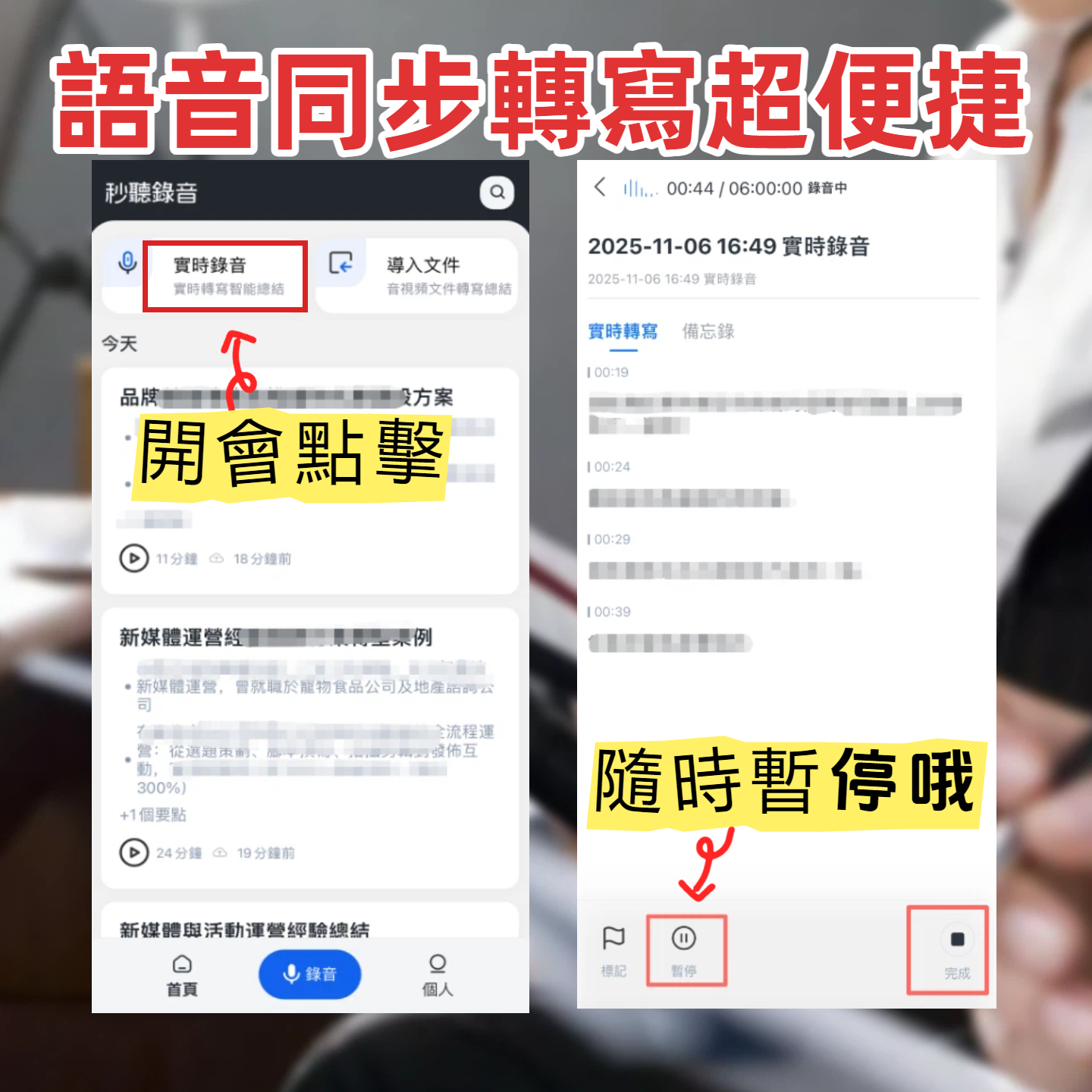
Step 1: Start Real-Time Recording and Transcription
In physical meetings or classroom interviews, no complex setup is needed.
- Open the web or mobile app and enter the real-time transcription interface.
- Tap the record button, and the system will transcribe speech to text in real time—no waiting. Stay on top of meeting progress.
Step 2: Process Existing Audio Files
If you have past meeting recordings or lecture audio, process them in batches.
- Navigate to the audio file to text feature module.
- Supports multiple common audio formats. After upload, the system generates a full transcript, identifies speakers, and automatically extracts meeting minutes and action items.

Step 3: One-Click Parsing of Online Videos and Podcasts
For online courses or multimedia material collection, skip tedious downloading and conversion.
- Copy the URL of a YouTube video, online podcast, or social media video.
- Paste it into the podcast/video to text parser. The system extracts the audio track in the cloud and converts it into a timestamped transcript and AI summary.
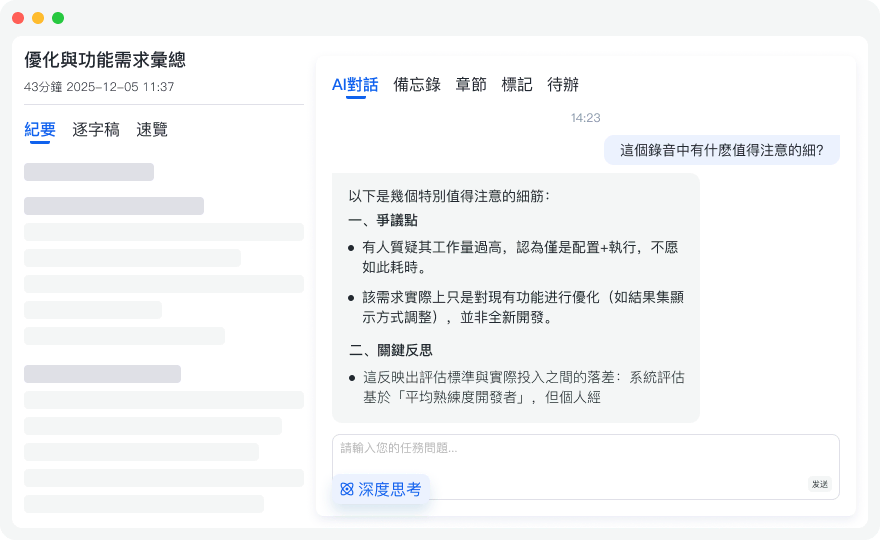
Step 4: Use AI Chat to Replace Ctrl+F
Facing a transcript of over 20,000 words, traditional keyword search (Ctrl+F) is inefficient and often misses context.
- After the transcript is generated, open the AI chat query panel.
- Ask the AI directly (e.g., "What was the final conclusion on the marketing budget?"). The AI will answer based on contextual understanding, like an assistant who attended the entire meeting.
Speech-to-Text and API Frequently Asked Questions (FAQ)
Q1: Do businesses have to pay to integrate a speech-to-text API for voice recognition?
Not necessarily. Unless you need to deeply "white-label" the feature into your own app or ERP system, using an off-the-shelf SaaS tool eliminates massive development and server maintenance costs, and provides cross-platform support (iOS/Android/Web) out of the box.
Q2: Do speech-to-text APIs support real-time meeting recording?
Most advanced APIs (like Google Cloud STT) support real-time streaming, but developers need to implement WebSocket architecture to handle live audio streams. If your team lacks frontend engineers, consider a mobile or web app with built-in real-time transcription.
Q3: Recording on iPhone is inconvenient—any recommended solution?
iPhone's built-in Voice Memos transcription is limited and hard to export. Choose a cross-platform AI recording app that supports iOS, bypassing system limitations and enabling cloud sync for seamless viewing and editing on desktop.
Q4: How to automatically generate transcripts from remote Teams or Google Meet meetings?
Some video software has built-in English captioning, but Chinese recognition or domain-specific terms may be poor. The fastest and least restrictive method: during the meeting, use an AI voice assistant on your computer or browser to capture audio, then the system automatically outputs a complete meeting record with key points and action items.
Q5: Which speech-to-text service offers the most generous free tier?
Pure APIs usually charge per second with almost no free tier (or require credit card binding). General SaaS tools often provide trial plans—for example, some offer 100 minutes of free transcription per month, sufficient for light personal use. Heavy users can consider subscriptions of a few dollars per month for thousands of minutes.
Q6: The transcript often comes out as a huge block of text without punctuation or highlights—what can I do?
This is the biggest difference between basic APIs and modern AI tools. Traditional APIs only output plain text strings, while LLM-powered tools automatically add punctuation, distinguish speakers via voiceprint, and generate structured decision summaries and to-do lists at the end.
Turn every recording into actionable outcomes
Get 60 free transcription minutes when you sign in. No credit card required.
Related Reading
You might also like

Which Google Meet Note-Taking Tool Is Best? 2026 Hands-On Test of 4 Options—This One Saves the Most Time for Chinese Meetings
People searching "google me" are either looking for their own online records or misspelled Google Meet. Starting from "how to capture meeting content," this article hands-on tests and compares four meeting note-taking tools—Tinrec, Otter.ai, Notta, and Granola—and outlines 4 key buying criteria and 3 common pitfalls to help you choose the right one.

How to Buy Google Meet India Plan in 2026? 4 Steps to Understand Workspace Subscription and Billing
Google Meet isn't sold separately—it's bundled in Google Workspace subscriptions, and India has its own pricing page and tax rules. This guide breaks down seats, participant limits, annual vs. monthly billing, and the actual 18% GST calculation in 4 steps, plus meeting notes tools to use after the call.

Google Meet Call History in 2026: 3 Methods Tested & How Tinrec Handles Post-Meeting Work
Where exactly is Google Meet's "Recent Calls"? This article tests 3 methods (Meet settings call history, Workspace calling page, Calendar and admin audit logs) and explains the limitations: call history only gives timestamps, not conclusions or action items. From a mid-level manager's perspective, it then shows how to use Tinrec desktop to record Google Meet without a bot, adding transcripts, summaries, action items, AI Q&A, and team knowledge retention, plus buying considerations and FAQs.

4 Recommended Benchmark Datasets Compared in 2026: Why Tenrec's Scale and True Negative Feedback Design Stand Out
Tenrec is a real user behavior dataset from two of Tencent's feed recommendation apps, covering four recommendation scenarios, about 5 million users, and 140 million interactions, and it includes both positive and true negative feedback. This article compares Tenrec with common benchmark datasets like MovieLens, Amazon Reviews, and MIND, examining scale, negative samples, cross-scenario overlap, feedback types, and feature fields to help you decide which one suits your research topic.

Google Meet Pricing Guide 2026: 5 Plans Tested and Recommendations
Google Meet has 5 tiers from Free to Enterprise, with paid plans starting at US$7 per user per month. Prices rose by US$1–4 in January 2026 due to Gemini being bundled into plans. This guide uses three variables—meeting size, session length, and post-meeting needs—to help you decide whether to upgrade and which tier to choose, and calculates the actual annual cost difference for an 8-person team.

Google Meet India Pricing in 2026: 4 Workspace Plans Compared and How to Choose a Meeting Notes Tool
Google Meet isn't sold separately in India; pricing is tied to Google Workspace plans, with the entry-level plan at about ₹99/user/month plus 18% GST. This article first explains the differences and limitations of the four plans, then discusses why most people still lack meeting notes even after buying a video plan, and how Tinrec fills the post-meeting organization gap.

2026 Google Meet Recording Options Compared: Tinrec's No-Bot Recording and Post-Meeting Workflow
We break down Google Meet purchase plans and free version limits, and compare three recording approaches: Google Meet built-in recording, Workspace Gemini notes, and Tinrec. If you need Chinese transcripts, AI Q&A, action item extraction, and team knowledge retention, Tinrec is a more focused choice for post-meeting workflows.

Google Meet vs Zoom in 2026: 3 Mistakes That Lead to the Wrong Choice
Google Meet or Zoom? This article breaks down three common mistakes from a procurement perspective, comparing Google Workspace integration, free plan limits, post-meeting organization, and actual pricing. It also explains how to use Tinrec to turn meeting recordings into searchable team data.

4 Google Meet Meeting Notes Tools Tested in 2026: Which One Can Actually Retrieve Your Recent Meetings?
Google Meet doesn't have a 'recent meetings' list that regular users can check—only Workspace admins can see the history. This article starts from that real pain point and compares four approaches: Tinrec, Otter.ai, Granola, and Notta. It outlines the most time-saving ways to retrieve recent meeting content and highlights the three most common pitfalls.