
Turn recordings into transcripts and summaries in minutes
Upload audio or video for multilingual transcription, AI notes, and action items
Current State and Pain Points of Speech-to-Text Models
During meetings or classes, it's common to encounter a mix of Mandarin, English, Taiwanese, and Hakka. Traditional speech-to-text models not only have high error rates but also leave you overwhelmed by thousands of words of transcripts. This article provides an in-depth analysis of the latest speech-to-text models and tools from both the underlying technology and application perspective, along with clear comparison tables, practical steps, and an FAQ.
Quick navigation suggestion: If you are an enterprise seeking to keep internal data secure and needing industry-specific tuning, consider enterprise-grade models like "myVoca"; if you are a development team with coding capabilities, the open-source "Whisper" is a good option; if you are an individual or team that needs an out-of-the-box solution for generating meeting summaries and action items right after recording, integrated tools like "Tinrec" are a priority.
Mainstream Speech-to-Text Models and Market Developments in 2026
Automatic Speech Recognition (ASR) technology has seen breakthrough developments in recent years. In the past, most tools could only handle single-language dictation and had very low accuracy for Taiwan's local mixed-language contexts, such as Mandarin mixed with Taiwanese, Hakka, or English technical terms. Additionally, traditional recordings had low information density, making reviewing costly; users often spent two to three times the recording length to find key points.
To address industry pain points, Taiwan Mobile partnered with Changwen Technology to launch myVoca, the latest ASR model supporting mixed Mandarin, Taiwanese, English, and Hakka recognition. According to tests, this model delivers impressive performance in computing efficiency, accuracy, and recognition speed, even surpassing the widely used OpenAI Whisper-large-v3 model. This proves that the key to model deployment is not just parameter size but the precision of industry-specific training data.
In-Depth Review of 3 Popular Speech-to-Text Models and Tools
For different use cases and technical barriers, we selected three representative models and tools for comparison:
1. Taiwan Mobile myVoca (Enterprise Custom Model)
As an ASR model built for domestic enterprises, myVoca improves mixed-language recognition accuracy by expanding general training data and cleaning and annotating industry-specific data (e.g., finance, healthcare, manufacturing, smart government). Through collaboration, its required computing power is only 1/8 of previous models, reducing hardware costs by 88%. After customization, the model can achieve up to 97% accuracy and real-time transcription within one second of speaking. Ideal for enterprises needing on-premises deployment and high security standards.
2. OpenAI Whisper-large-v3 (Open-Source General Model)
Whisper is one of the most commonly used open-source speech recognition models globally, with strong multilingual capabilities. Its advantages are being free and highly versatile. However, for enterprises or general users, it requires self-hosting servers or relying on third-party APIs, and its accuracy for Taiwan's local mixed languages (e.g., Taiwanese, Hakka) is still lower than specialized local models, with higher hardware costs.
3. Tinrec (Integrated AI Application)
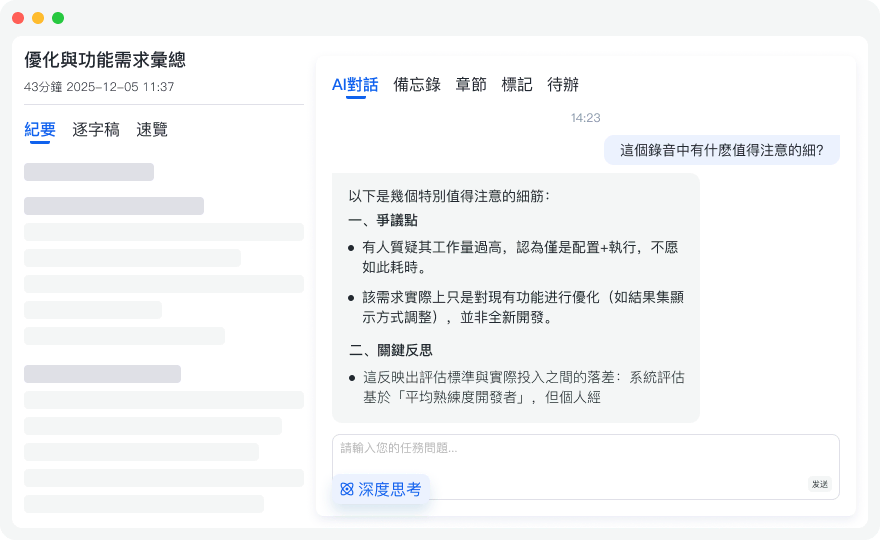
Unlike pure ASR models, Tinrec is a multi-platform AI recording assistant focused on the complete workflow: "Record → Understand → Act." It supports iOS, Android, and web, with built-in automatic recognition of 10 languages including Mandarin, English, Japanese, Korean, Taiwanese, and Cantonese. Its key differentiator is not just providing transcripts but also automatically generating decision summaries, action items, and even AI-powered conversational queries based on semantic understanding, turning time-based content into scannable, searchable text.
Core Solution Comparison Table
The following table compares these three solutions across six evaluation dimensions to help clarify your decision:
Stop organizing recordings by hand
Upload audio or video and automatically get a transcript, summary, and action items
| Dimension | Taiwan Mobile myVoca (Enterprise) | OpenAI Whisper (Open-Source) | Tinrec (Integrated App) |
|---|---|---|---|
| Language Support | Mandarin, Taiwanese, English, Hakka mixed | Multilingual (weaker local language support) | 10 languages including Mandarin, English, Japanese, Korean, Taiwanese, Cantonese |
| Real-Time Performance | <1 second real-time transcription | Depends on hardware, usually with latency | Supports real-time transcription with no delay |
| Summaries & Action Items | Requires additional LLM integration | Not available, only plain text output | Built-in, automatically generates meeting minutes and to-do items |
| AI Query Interaction | Requires enterprise-side development | None | Supported, allows asking questions and retrieving key points from recordings |
| Export & Integration | System API integration | Script-based export | Multi-format file export, cross-device cloud sync |
| Price / Free Tier | Project-based pricing (88% hardware cost reduction) | Model free, hardware/cloud costs separate | Free version (100 min/month) and subscription plans |
Practical Tutorial: 4 Efficient Steps from Recording to Decision Output
Once you understand the tools, how to put them into practice? Using the integrated tool Tinrec as an example, here are steps for four common scenarios:
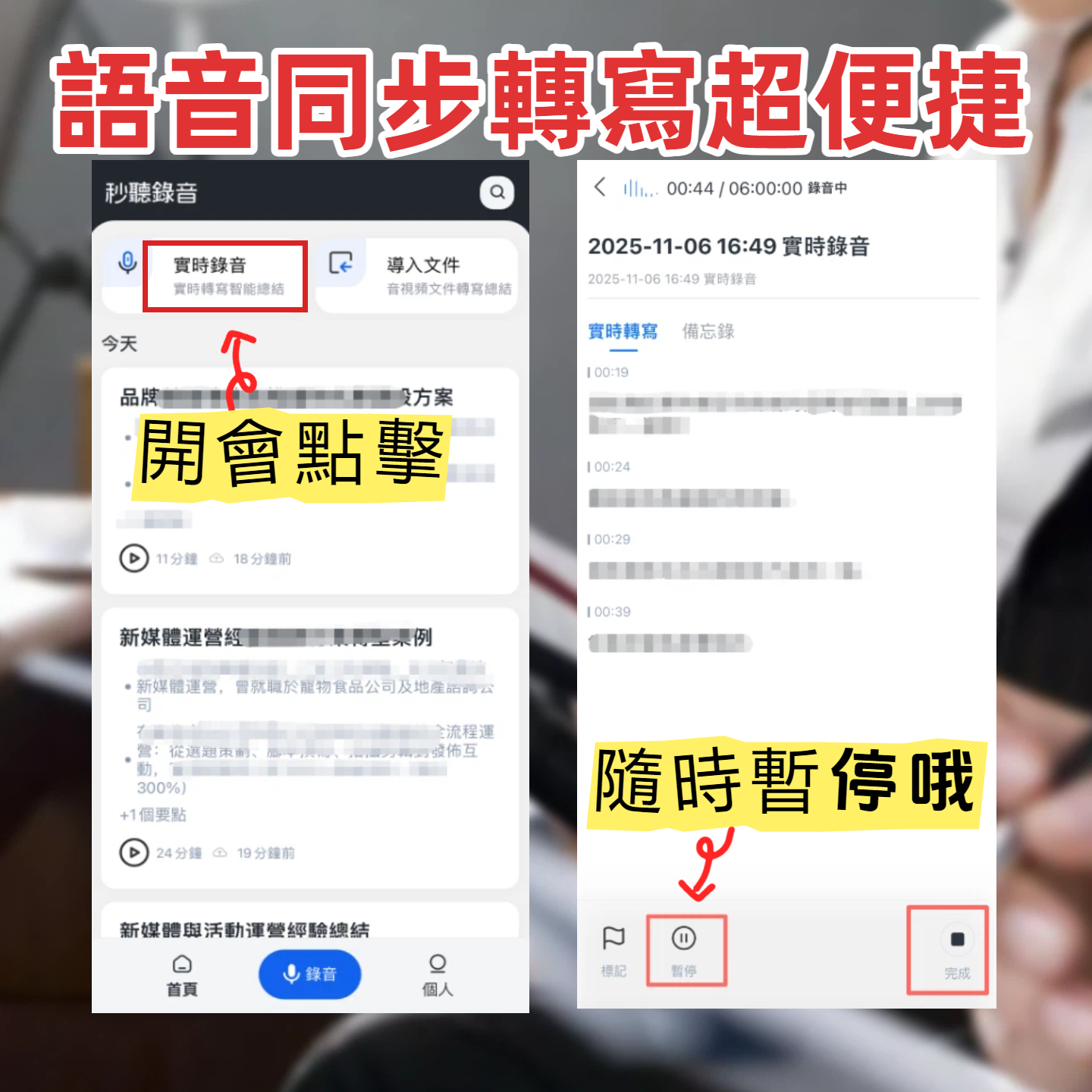
Step 1: Real-Time Transcription During Meetings or Classes
In an in-person meeting or class, open your phone or computer and click the "Real-Time Audio to Text" feature. The system transcribes speech into text instantly, with no waiting. You can monitor the conversation on screen, allowing you to focus on the discussion rather than frantic note-taking.
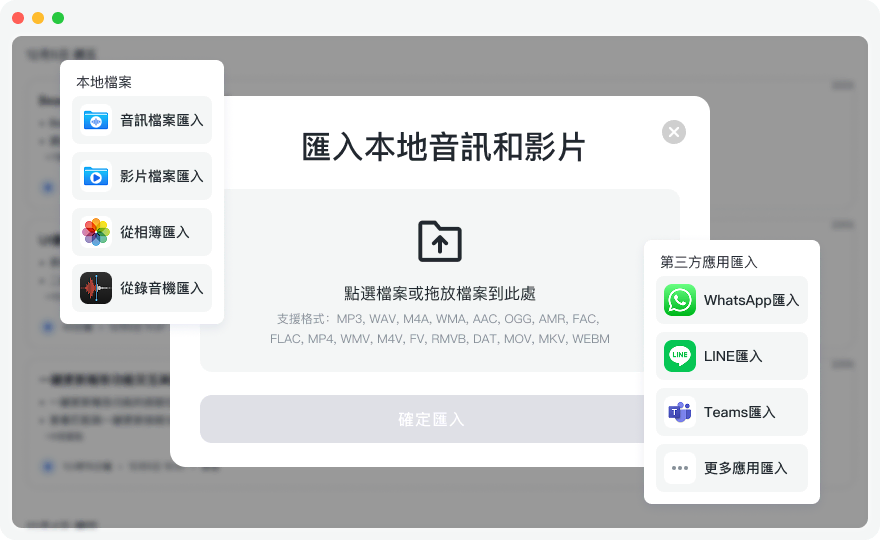
Step 2: Convert Audio Files After the Meeting
If you have audio files from other recorders or apps, use the "Audio File to Text" feature to upload the file. The system quickly generates a transcript with automatic speaker diarization and creates meeting minutes simultaneously, solving the pain point of costly re-listening.
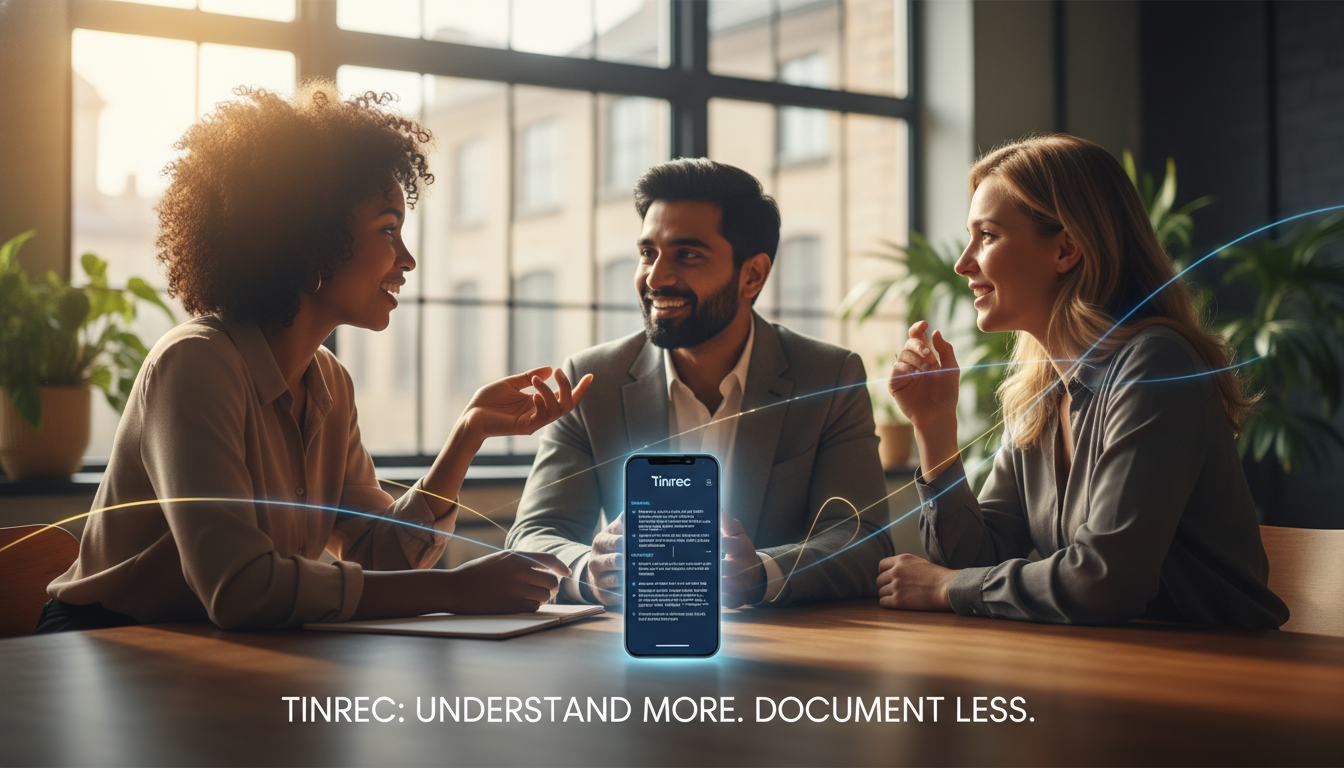
Step 3: Video and Podcast Link Parsing for Content Creators
If you're a marketer or self-learner needing to organize YouTube videos or podcast content, simply paste the URL into the "Podcast/Video to Text" feature. Without downloading large files, the system automatically grabs the audio track and generates a complete text summary.
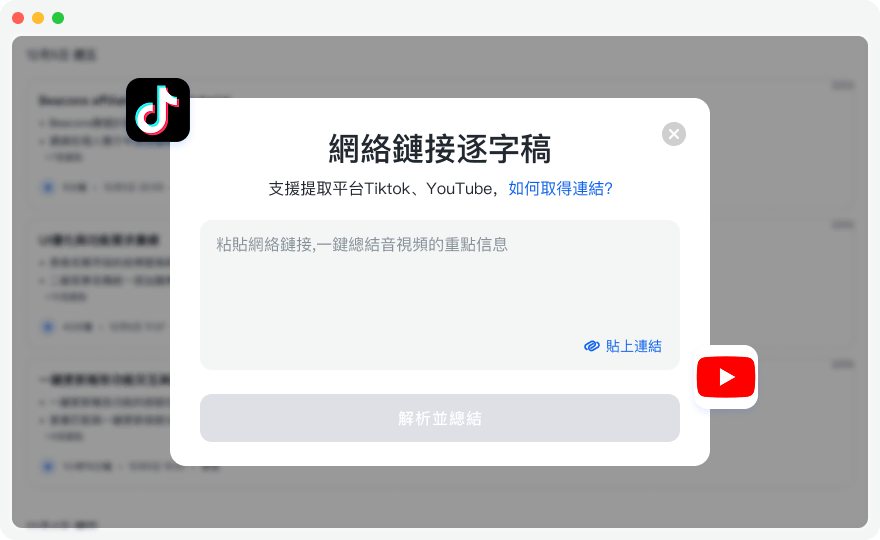
Step 4: AI Chat for Key Content Search
Traditional transcripts only allow Ctrl+F for specific keywords, but with the "AI Chat Query" feature, you can directly ask questions. For example: "What was the conclusion about the marketing budget from the meeting?" The AI will answer based on semantic understanding, just like asking an assistant who attended the entire meeting.
Frequently Asked Questions (FAQ)
Q1: Can the iPhone's built-in Voice Memos directly convert to text and summaries? The built-in recording feature on iPhone currently only provides basic storage and partial transcription, and lacks the ability to automatically generate decision summaries and action items. For business or study purposes, it's recommended to export the audio file and use a professional integrated application for AI analysis.
Q2: How do I automatically generate transcripts when using Microsoft Teams or Google Meet for remote meetings? If your company hasn't purchased an advanced enterprise plan, you may not have built-in AI summaries. A lightweight solution is to simultaneously open a web-based tool with real-time transcription (e.g., Tinrec) on your computer during the meeting, capturing audio via microphone to get key notes.
Q3: Do free speech-to-text tools have usage limits? Most tools offer free trial quotas, e.g., some provide 100 minutes per month. For light users (occasional recording of ideas or short meetings), this is sufficient. For heavy projects, consider upgrading to paid plans (e.g., 600 or 1200 minutes per month).
Q4: How accurate are models for meetings mixing Mandarin, English, Taiwanese, and Hakka? Traditional general models often produce garbled text. However, new technologies have greatly improved; for example, enterprise-level myVoca is specifically tuned for local mixed languages, achieving high accuracy. Integrated tools with multi-language support also significantly reduce understanding and organization costs.
Q5: Transcripts often run thousands of words—how can I quickly find key points? Tools that only provide transcripts cannot solve this problem. When choosing a tool, ensure it has AI summary generation or conversational query features to turn time-based content into scannable, actionable text, letting AI summarize key points and to-do lists.
Q6: Can I convert self-study online courses or foreign videos into text? Yes, many advanced applications support direct input of YouTube or podcast URLs. The tool will parse the content in the cloud and output time-stamped transcripts and notes, ideal for students and content creators.
Turn every recording into actionable outcomes
Get 60 free transcription minutes when you sign in. No credit card required.
Related Reading
You might also like

5 Best AI Meeting Note Tools Tested in 2026: Which One Turns Recordings into Usable Meeting Minutes?
We tested 5 AI meeting note tools, comparing speech-to-text, AI summaries, team collaboration, and pricing to help you find the best fit for your workflow, with sample meeting minutes included.

2026 Hands-On Comparison of 2 AI Meeting Note Tools: Tinrec vs Granola – Which Is Better for Chinese Meetings?
Struggling with meeting notes? This comparison of Tinrec and Granola, two bot-free AI meeting tools, tests them across five key areas: recording methods, file import, Chinese language support, post-meeting workflow, and team management, to help you pick the best solution for Chinese meetings and team collaboration.

2026 Free AI Meeting Minutes Platforms Compared: 5 Tools Reviewed
A 2026 comparison of free AI meeting minutes platforms, hands-on testing 5 tools including Tinrec, analyzing free quotas, Cantonese transcription, AI Q&A, and team features to help you save time and avoid overtime.

6 Best AI Meeting Recorder Apps of 2026: Hands-On Comparison for U.S. Professionals
This hands-on comparison reviews Tinrec, Notta, Otter.ai, Fireflies.ai, Granola, and TurboScribe, covering transcription, summarization, pricing, and team features to help you choose the right AI meeting assistant.

2026 Free AI Meeting Minutes Solutions: 4 Tools Compared
A 2026 roundup of free AI meeting minutes plans, comparing Tinrec, Notta, Otter, and Granola. We help you choose the right tool based on bot-free recording, Chinese language support, post-processing, and team collaboration.
Tinrec vs Notta 2026: 5-Dimension Comparison - Which Is Better for Chinese Meeting Notes?
Spending two hours in a meeting and another two organizing the notes? This article compares Tinrec and Notta across 5 dimensions to help you decide which online AI meeting notes app suits Chinese users best, with tips to avoid common pitfalls and buying advice.

2026 Free AI Meeting Minutes Solutions: 3 Tools Compared
Tired of spending two hours on meeting notes? This hands-on review from a mid-level manager's perspective covers the free plans of Tinrec, Otter.ai, and Notta, helping you decide which fits your meeting habits best.
5 Best AI Meeting Minutes Platforms in 2026: A Hands-On Comparison for Chinese Meetings and Team Collaboration
Tired of manually replaying and transcribing meeting recordings? This article compares 5 AI meeting minutes platforms—from Tinrec to Notta, Otter, Fireflies, and Granola—covering free plans, core features, and ideal use cases to help you find the most time-saving meeting tool.

2026 Review of 5 Online AI Meeting Minute Tools: How Tinrec Turns Meetings into Searchable Assets
Tired of spending hours on meeting notes? This hands-on review, featuring Tinrec's instant recording, compares 5 common online meeting minute solutions, covering bot-free recording, AI summaries, action items, and team spaces to help you pick the right tool.