
Turn recordings into transcripts and summaries in minutes
Upload audio or video for multilingual transcription, AI notes, and action items
Have You Ever Counted How Much Time You Spend Organizing After Recording?
Many people think the key to a recording app is "recording clearly," but the real time cost often comes after the recording. Have you ever counted: a 60-minute interview or meeting takes 1 hour to record, and then 2 or 3 hours to replay, pause, and manually transcribe—recording is only a small part of the work, but organizing eats up most of your time.
That's why when choosing a recording app, you can't just look at "whether it can record." The built-in Voice Memos on iPhone can handle basic recording, but if you need transcription, key point organization, and collaborative sharing, you should look at more comprehensive AI meeting notes tools.
This article focuses on Tinrec as the main test subject, showing you the complete workflow of a recording app from "recording" to "organizing."
What Can a Recording App Do for You?
For the average iPhone user, the core value of a recording app isn't the recording itself, but the subsequent organization and use. Here are the 4 most common scenarios.
Scenario 1: Meeting Notes Ready in 5 Minutes After the Meeting
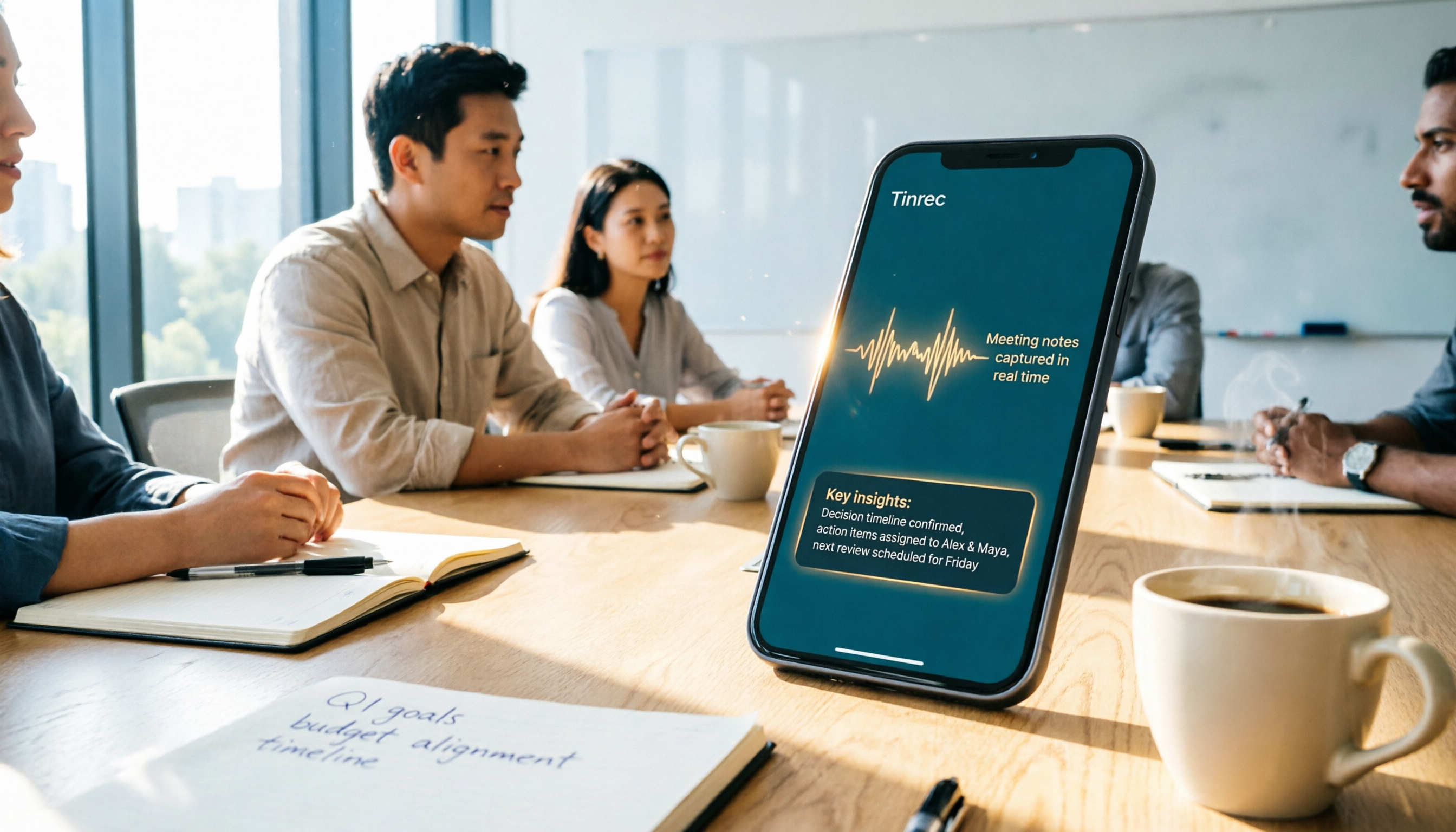
Previously, after a two-hour meeting, you might spend another hour organizing the meeting notes. Now with AI meeting notes features—using Tinrec as an example—by the time the meeting ends, the AI has already generated summaries, conclusions, and action items. Who is responsible for what and what the deadlines are is clear at a glance. You no longer need to replay the entire recording to find key points.
Scenario 2: No More Manual Transcription for Interviews
If you conduct user interviews, expert interviews, or research, the most painful part is transcribing. Tinrec can convert speech to text in real time, generating the transcript as you record. By the end of the interview, most of the transcript is already done. You only need to quickly proofread, not listen from start to finish.
Scenario 3: Classroom Recordings Become Searchable Notes
When attending classes or lectures, recordings often sit in your phone and are never opened again. Tinrec converts recordings to text and supports AI Q&A—you can ask, "What were the key exam points the teacher mentioned?" It answers based on the recording content, turning classroom recordings into truly reviewable material.
Scenario 4: Team Meeting Materials No Longer Scattered Across Personal Phones
If you're a project lead or manager, team members each record and save their own files, and meeting materials never come together. Tinrec's team space can centrally store meeting recordings, transcripts, summaries, and action items. New members can also view historical meeting materials without having to ask for files one by one.
What Are the Core Capabilities of a Recording App?
Real-Time Transcription: Text Appears as You Record, Not After
Many recording apps only start transcribing after the recording is finished. Tinrec's real-time transcription displays text simultaneously during recording. During meetings or interviews, you can watch the text to ensure no key points are missed, without waiting until the recording ends to check.
AI Summaries and Chapters: Long Meetings Automatically Broken Down into Key Points
It's not about condensing the transcript into a single paragraph, but structuring it—meeting topics, discussion conclusions, action items, and responsible persons are listed separately. Tinrec also breaks long meetings into chapters, making it easy to jump to the section you want to review.
AI Q&A: Ask Directly, No Need to Replay the Recording
After transcription, you can ask Tinrec questions directly—"Who mentioned the budget in the meeting?" "What were the client's main concerns?"—and it answers based on the content understanding. This is much faster than manually searching for keywords in the transcript.
Action Item Extraction: Automatically Organize Tasks from Discussions
The worst thing about meetings is "lots of talk, but no one remembers what to do." Tinrec extracts action items from the meeting content, organizing who is responsible and when it's due into a list for easy follow-up.
Multi-Format Export: Bring Results into Your Workflow
Organized transcripts, summaries, and action items can be exported in document formats and directly sent to tools like Notion, Google Docs, OneNote, and Dropbox, without copy-pasting.
Stop organizing recordings by hand
Upload audio or video and automatically get a transcript, summary, and action items
Practical Use Cases
Meeting Notes: From "Having a Recording" to "Having Conclusions"
When using your iPhone in a meeting, open Tinrec to record, and real-time transcription displays simultaneously. After the meeting, AI summaries and action item lists are already generated. You can directly export the action items to your team without separately organizing meeting minutes.
For online meetings, Tinrec's desktop version can directly capture system audio, handling meetings on Zoom, Google Meet, Microsoft Teams, and more, without needing to invite a meeting bot.
Interviews and Research: Transcripts and Key Points in One Go
When conducting user interviews, use Tinrec to record and transcribe simultaneously. After the interview, the transcript is ready. You can use AI Q&A to quickly identify key needs mentioned by interviewees and organize them into research notes. Compared to manual listening and typing, you save at least half the time.
Classes and Lectures: Recordings Become Searchable Learning Materials
After recording a class, Tinrec converts the content to text and automatically segments it. When reviewing, you don't have to listen from start to finish; just search for keywords or ask the AI for key points to quickly find the section you want to review.
Team Collaboration: Centralized Management of Meeting Materials
If you're a team manager, Tinrec's team version can centralize all members' meeting recordings, transcripts, summaries, and action items in one team space. Members can view historical data, and managers can allocate seats, view usage, and access audit logs. Team data won't disappear if a member leaves.
5 Things to Consider When Choosing a Recording App
1. Is Transcription Built-In or an Add-On?
While iPhone's built-in Voice Memos is free, its transcription capabilities are limited, and its organization features are basic. Some recording apps require an additional fee to unlock transcription. Tinrec's transcription, summarization, and AI Q&A are core features, and the free version offers basic quotas to try without paying upfront.
2. Can It Help You Organize After Recording?
Transcription is just the first step—the key is whether it can help you organize afterward. Tinrec doesn't just provide transcripts; it automatically generates summaries, chapters, and action items, and supports AI Q&A, turning recording content into truly usable material.
3. Does It Support Chinese and Mixed Chinese-English?
If you often record Chinese meetings, classes, or interviews, pay attention to language support. Tinrec performs stably with Chinese and mixed Chinese-English content, and also supports real-time translation and bilingual viewing, making it suitable for users who need cross-language organization.
4. Single User or Team Collaboration?
If you only record occasionally for personal use, the built-in app or free version is sufficient. But if you need to share meeting materials with a team, manage members and permissions, consider a team version. Tinrec's team version provides a dedicated space, seat management, and usage analytics, suitable for departments or project teams.
5. Is the Free Plan Enough?
Don't just look at the word "free"; see what the free quota allows you to do. Tinrec's free version offers basic quotas to experience recording, import, summarization, and transcription. Try it first before deciding to upgrade. If you have a short-term high-volume recording need, consider a weekly card; for long-term stable use, choose Pro or an annual plan.
Frequently Asked Questions
Is iPhone's Built-in Voice Memos Sufficient?
If you only record occasionally and don't need transcription or key point organization, Voice Memos is sufficient—it's free and simple to use. But if you need transcription, automatic summaries, action item extraction, or team sharing, consider a more feature-complete tool like Tinrec.
What's the Difference Between Tinrec and Regular Recording Apps?
Regular recording apps mainly handle recording. Tinrec goes further by converting recordings to text, organizing summaries, chapters, key points, and action items, and supporting AI Q&A, translation, export, and team collaboration. It handles the work after recording as well.
Can Tinrec Record Online Meetings?
Yes. Tinrec's desktop version directly captures system audio, handling online meetings on Zoom, Google Meet, Microsoft Teams, Webex, and more, without needing to invite a meeting bot. You need to actively open Tinrec to start recording.
What Features Can I Try in the Free Version?
Tinrec's free version offers basic quotas to experience core features like real-time recording, audio/video import, transcription, summarization, and AI Q&A. Try it out first, then decide whether to upgrade based on your usage frequency.
What Should I Note About Privacy and Authorization for Recording?
When using any recording tool, you should comply with local laws and obtain consent from participants when necessary. Tinrec users should also confirm relevant authorization before recording to avoid disputes.
Conclusion
The value of a recording app is no longer just "recording clearly." For iPhone users, what truly saves time is the automatic transcription, summarization, action item extraction, and team collaboration after recording.
If you have meetings, interviews, or classes to record every week, we strongly recommend trying Tinrec. The free version lets you experience core features and see what it's like to have AI organize your recordings—no more manual transcription or replaying entire recordings to find key points.
References
Turn every recording into actionable outcomes
Get 60 free transcription minutes when you sign in. No credit card required.
Related Reading
You might also like

How to Choose a Voice Recorder in 2026: A 5-Step Guide from PTT Reviews to AI Meeting Transcription
PTT recommendations for voice recorders often focus solely on audio quality, overlooking the time spent on playback and transcription. This article compiles real discussions from PTT users, guiding you through 5 steps to decide between a physical voice recorder and an AI recording tool, comparing use cases for Sony, Mrobo, JNN, and Tinrec.

Otter vs Notta 2026: Which Transcription Tool Actually Saves You OT Hours?
Otter and Notta are among the most discussed transcription tools on Reddit, but for Hong Kong users, the real concerns are Cantonese accuracy, Zoom meeting notes, and AI summarization. This article compares the pros and cons of both tools in real meeting scenarios and introduces a better alternative for Chinese-language meetings and team collaboration.

2026 Free AI Voice Recorder Plans: 3 Options Compared
AI voice recorders have become popular tools for meetings, interviews, and classes. This article highlights 3 noteworthy AI voice recorders and recording solutions, including Tinrec, which supports meeting recording without bots, PLAUD, and Penpower AI Voice Recorder. We compare free allowances, core features, and ideal use cases to help you quickly determine which one fits your needs.

Transkriptor vs Notta 2026 Buying Guide: Hands-On Test and Recommendations for Two Transcription Tools
Transkriptor and Notta are both popular AI transcription tools, but they suit different use cases. This article compares language support, custom vocabulary, real-time transcription, pricing plans, and team collaboration to help you decide which one better fits your meeting notes and transcript needs.

5 Best Voice Recorder Apps for Android in 2026: From Quick Notes to Team Collaboration
With so many voice recorder apps available, how do Android users choose? This article redefines the true value of recording tools across four dimensions—audio quality, post-recording organization, cross-device sync, and team collaboration—and compares five popular options.

Yating Transcriber Limits Tested in 2026: Free Credits, Hours, and Usage Thresholds Explained
How much free credit does Yating Transcriber offer? Is it normal for upload progress to stall at 99%? This article outlines the main limitations of Yating Transcriber, including free tier, paid hours, single-session length, and multi-device usage, and highlights scenarios where alternative AI meeting note tools might be worth considering.
3 Best Recording Apps with Transcription in 2026: Free vs. AI-Powered—Which Is Worth It?
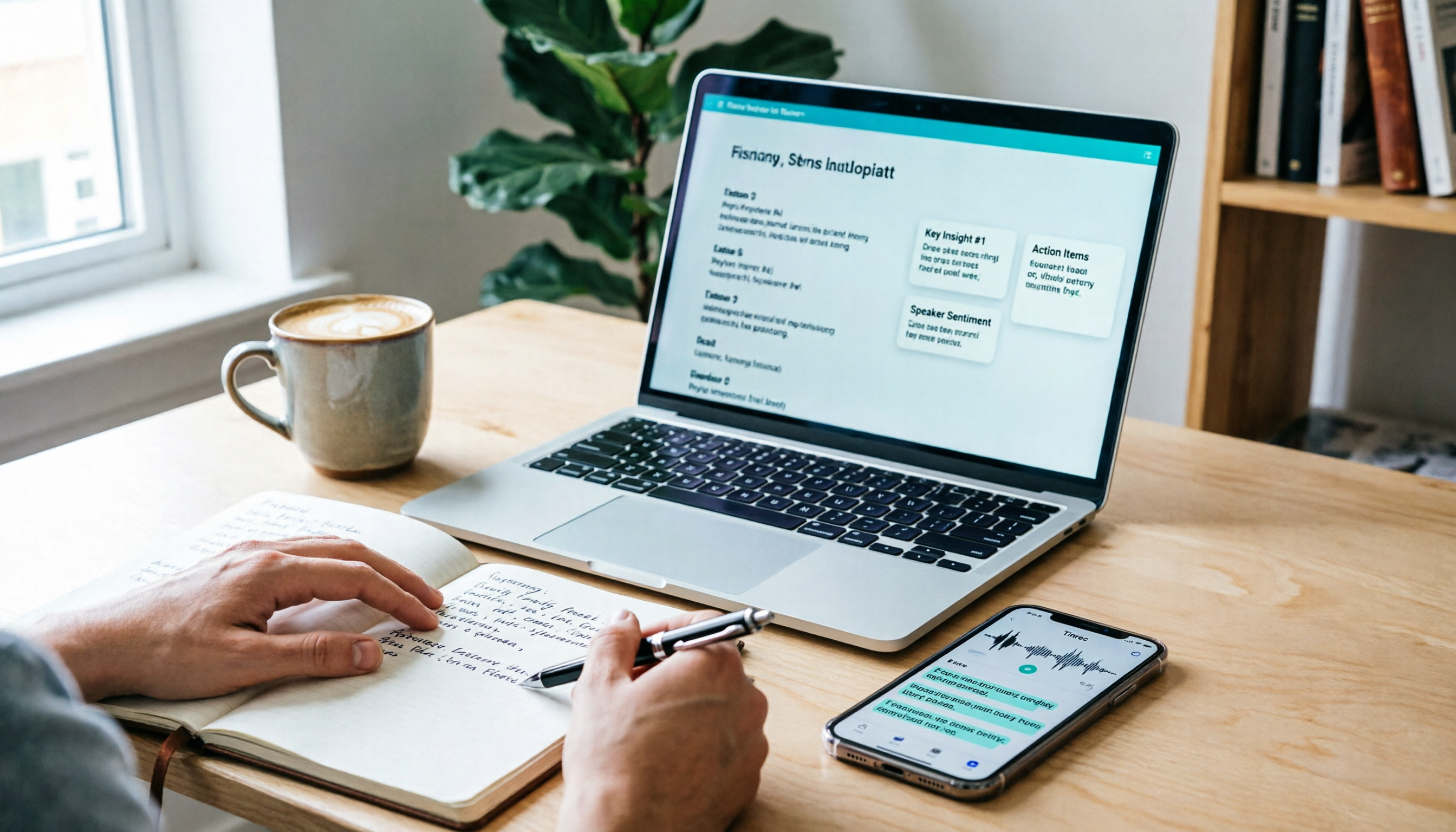
With so many recording apps that transcribe audio to text, how do you choose? This article compares Tinrec, Yating Transcription, and iPhone Voice Memos based on the real needs of office workers, students, and freelancers, covering transcription, AI summarization, free tiers, and cross-platform support to help you quickly decide which is best for meeting notes and interview transcripts.

2026 Voice-to-Text Tool Comparison: TurboScribe or Notta—Which One Is Right for You?
TurboScribe and Notta are both AI voice-to-text tools, but they serve very different purposes. One focuses on batch transcription and translation, while the other specializes in real-time meeting notes. This article breaks down the differences and helps you choose the right tool for your needs without making a costly mistake.

Best Voice Recorders of 2026: 5 Tested, Top Pick for Chinese Meeting Notes
Struggling to choose a voice recorder? This article compares SONY, Victor, Ergonomic Technology, INJA, and Tinrec based on use cases, audio quality, battery life, and AI features to help you find the best option for meeting minutes, lectures, and interviews.