
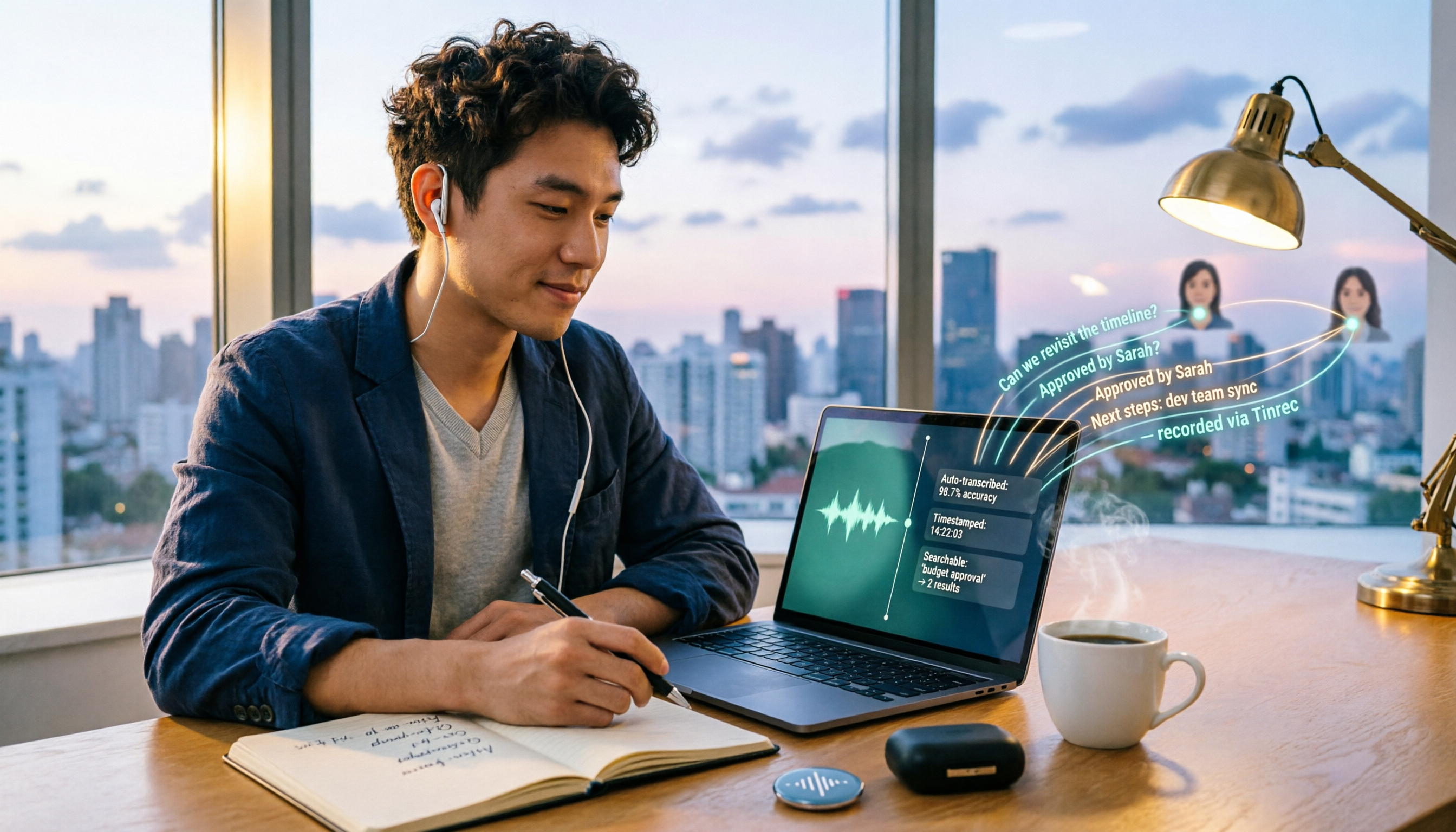
Turn recordings into transcripts and summaries in minutes
Upload audio or video for multilingual transcription, AI notes, and action items
How to Record Computer Screen Audio in 2026: 3 Methods + Automatic Meeting Transcription
"How do I record my computer screen?" Whenever I get asked this, I usually ask a question back: Do you want to capture the screen, or what's being said on the screen?
These two needs call for completely different tools.
If you just want to record gameplay, step-by-step operations, or presentation animations, the built-in features on Windows and Mac are enough. No installation, no cost.
But if you're recording an online meeting, an interview, or a class, and afterward you need to turn it into a transcript, meeting notes, and action items—you'll find that getting just a video file is where the trouble begins.
Below are screen recording methods that still work in 2026, and for situations where you need to use the recording right away, I'll share the option that saves me the most effort.
Before Recording, Decide: Do You Need the Screen or the Content?
Scenario 1: Online meeting. After a one-hour meeting, you've recorded the screen, but to write meeting minutes, you still have to listen to the whole thing again—double the work.
Scenario 2: Tutorial or walkthrough. You need to record the entire desktop workflow and capture microphone narration simultaneously, with higher demands on video quality and audio sources.
Scenario 3: Reporting a problem. When an engineer or support agent asks you to describe "the process of the screen crashing," instead of typing a long paragraph, just record a video clip—they'll understand immediately.
These three needs all look like "screen recording," but the first one really needs the text and conclusions from the video, not the video itself. This is the most common mistake when choosing a tool.
4 Key Points to Understand Before Choosing a Screen Recording Tool
1. Can it record system audio? Many people only realize after recording that there's no sound because many tools default to microphone only. To capture the other party's voice in an online meeting, the key is whether the tool can capture "internal computer playback audio."
2. Does it require extra installation, or does it put a bot into the meeting? Built-in tools require no installation but have limitations; meeting bots join as a participant, adding an unfamiliar account to the meeting room; another approach is to use a desktop app to capture system audio directly without disturbing other participants. Tinrec's desktop version takes this bot-free route.
3. What do you get after recording? Getting just an MP4 versus getting a transcript, summary, and to-do list are completely different workloads. If the purpose of recording is "to search and organize later," the latter truly saves time.
4. Free quotas and recording limits. Built-in tools are usually free but have time or scenario limits; paid tools offer larger quotas, but you need to read the plan details carefully. This will be explained item by item below.
Tinrec — My Choice When You Need "Ready-to-Use After Recording"
Tinrec is an AI meeting notes and collaboration tool for individuals and teams, available on iOS, Android, web, and desktop.
Let me clarify its positioning: it's not a universal screen recorder for gameplay. It excels at turning content-rich recordings—meetings, interviews, classes—into searchable, organizable, reusable data.
How it records online meetings. Tinrec's desktop version captures system audio directly, handling Zoom, Google Meet, Microsoft Teams, Webex, and other online meetings without inviting an extra meeting bot. For participants, no unfamiliar account appears in the meeting room.
It starts organizing while recording. It generates a transcript in real time, and by the end of the meeting, AI has already produced a summary, chapters, key points, and action items. Who's responsible for what and what's next—no need to listen again.
You can keep asking questions after recording. This is where it differs most from ordinary transcription tools. After recording, you can directly ask about the meeting content, such as "Who mentioned the budget in the last meeting?" It answers based on semantics, not just a list of keyword search results.
Stop organizing recordings by hand
Upload audio or video and automatically get a transcript, summary, and action items
Export and collaboration. Transcripts, summaries, and action items can be exported to common formats and taken to Notion, Google Docs, OneNote, Dropbox, and other tools for further processing. The team version centralizes this data in a team space, where members can view, search, and reuse past meetings, and data doesn't leave with individuals when team members change.
Honestly, I think its most practical aspect is bridging the gap between "recording" and "organizing." Most people get stuck not on recording, but on the pile of content afterward that no one wants to touch.
Limitations to note. If you're recording desktop tutorials or gameplay where "the screen itself is the point," Tinrec isn't designed for that—built-in or dedicated screen recording tools are more suitable. Also, transcription and summary quality depends on the recording environment; air conditioning noise, multiple people talking over each other, and technical jargon can all degrade results. For important content, it's best to verify against the recording.
Who it's for. If you frequently have online meetings, interviews, or classes and want usable text data right after recording, Tinrec will save you much more time than a simple screen recorder.
Besides Tinrec, These Screen Recording Methods Are Also Worth Knowing
Windows Game Bar (Win + G). Built into Windows 10/11, press Win + Alt + R to start recording, saved in the Captures folder, completely free. Note that it's actually part of the Xbox Game Bar, and recording can only lock onto a single application window. Switching or trying to operate the desktop will stop the recording, and you can't pause. Suitable for quick gameplay or single-window recording, but you won't get transcripts or summaries—something Tinrec can do that it can't.
Mac built-in screenshot toolbar and QuickTime Player. On Mac, press Command + Shift + 5 to bring up the recording tool, where you can select the area and specify the microphone; you can also use QuickTime Player's "File > New Screen Recording." No installation, quick to learn, but to stop recording you need to click the stop button in the menu bar or press Command + Control + Esc. It gives you a video file, and you'll have to organize it yourself—no AI summaries or Q&A like Tinrec.
FonePaw Screen Recorder. Supports both Windows and Mac, allows custom recording areas, unlimited recording time, simultaneous screen and audio capture, and can record mouse and keyboard actions. Suitable for those who need long desktop operation recordings. It solves the "recording" problem; if you need transcripts, action items, and team sharing for meeting content, that's exactly what Tinrec fills in.
Pitfall Guide: 4 Most Common Mistakes in Computer Screen Recording
Pitfall 1: Discovering no sound after recording. Many tools default to microphone only, and computer playback audio won't be captured. Before recording, confirm the audio source settings, especially for meeting recordings.
Pitfall 2: Assuming built-in tools can record everything. Windows Game Bar can only record a single application, not the entire desktop workflow. For cross-software operations, you'll need other tools.
Pitfall 3: Ignoring legal and consent issues. Before recording meetings or conversations with others, be aware of local laws and obtain consent when necessary.
Pitfall 4: Treating the video file as the end goal. If the recorded file just sits there unorganized, it's as good as not recorded. This is especially true for meeting content—tools that automatically generate summaries and action items and allow later search and Q&A are much more valuable.
Summary: Which One Should You Use?
Let me break it down by scenario:
- Recording gameplay or a single window → Windows Game Bar, no installation and free.
- Mac recording a specific area → Command + Shift + 5 or QuickTime Player.
- Recording full desktop tutorials or long sessions → tools like FonePaw Screen Recorder.
- Recording online meetings, interviews, or classes and wanting transcripts, summaries, and action items → Tinrec, desktop bot-free recording, AI organization after the meeting.
- Teams wanting to turn every meeting into searchable data → Tinrec Team Version, with a team space to centrally manage meeting records, members, seats, and usage. Team first trial is 7 days, 1 free seat, 300 minutes of shared team import quota; paid plans are USD 29.80/seat/month (monthly) or USD 199/seat/year (annual, about USD 16.58/month), each paid seat provides 2,000 minutes of shared team import quota per month. Actual prices and benefits are subject to the official purchase page.
If your purpose for recording is "to organize and use later," I suggest trying Tinrec's free version for one meeting first to see if the transcript quality and organization meet your needs, then decide whether to upgrade—no need to pay upfront.
References
- Computer Screen Recording Methods Sharing - Mobile01
- How to Record Computer Screen? Windows/Mac Built-in Screen Recording Tools Tutorial!
- How to Record Screen on Mac - Apple Support (Taiwan)
- 2025 Applicable - Beginner Tutorial: How to Screen Record? (Phone / Computer / Windows / Mac / iOS / Android)
- How to Use a Computer for Screen Recording? Introduction to Computer Screen Recording Tools
Turn every recording into actionable outcomes
Get 60 free transcription minutes when you sign in. No credit card required.
Related Reading
You might also like

5 Screen Recording Solutions Tested and Compared in 2026: The Easiest Way to Capture System Audio
Recording your screen but getting no sound is a common pain point. This article starts with the principles of system audio capture, compares 5 practical screen recording solutions, and shares the method I found easiest after hands-on testing.

3 Memo Recording Methods Compared in 2026: Can iPhone Built-in, Notta, or Tinrec Save You Cleanup Time?
How do you record audio in iPhone Notes? This article covers three built-in recording methods and compares iPhone built-in Notes, Notta, Otter.ai, and Tinrec. From post-recording organization and cross-platform export to AI meeting minutes, find the most time-saving memo recording workflow.
CapCut Desktop Recording 2026: Voiceover Steps & 4 Transcription Tools Compared
Can CapCut desktop record audio? Yes. This guide walks you through the complete voiceover recording steps in CapCut desktop, then answers the real question most people get stuck on: how to turn recordings into usable transcripts and meeting notes. It covers 4 key selection points and compares Tinrec, CapCut, Notta, and Otter.ai, with common pitfalls and scenario-based recommendations.
4 iPhone Voice Memos Organization Tools Compared: Where Are Recordings Stored? Tinrec Saves the Most Time
iPhone Voice Memos are stored locally by default, or in iCloud if sync is enabled. This article shows you where to find files and tests 4 organization tools. Tinrec stands out for Chinese transcription and AI Q&A, ideal for turning recordings into transcripts and to-dos.
2026 Laptop Recording Guide: Built-in Features Tested + Tinrec Smart Organization
How do you record audio on a laptop? This article covers built-in recording methods on Windows and Mac, tests how Tinrec turns recordings into transcripts, summaries, and to-dos, and compares Tinrec with Notta for meeting notes to help you find the best laptop recording solution.

5 Recording Tools Tested and Compared in 2026: Where's the Recording Feature? Whose AI Summarization Saves the Most Time?
Where is the recording feature? iPhone's Voice Memos is hidden in the Utilities folder, Android devices have their own built-in recorders, and online meeting recording permissions are tied to the host. This article clarifies the recording entry points for three scenarios and tests 5 recording tools, covering transcription, AI summaries, to-dos, and team knowledge retention, helping you avoid common pitfalls and find the one that truly saves time.

2026年4款电脑录屏工具实测对比:内置够用吗?还是得靠AI整理
电脑其实都有内置录屏功能,Windows 10 以上按 Win + G 就能调出 Xbox Game Bar,Mac 也有内置屏幕录制。但真正的问题是录完之后怎么办——本文比较内置工具、剪辑型录屏软件与 AI 会议记录工具 Tinrec,带你判断哪一种才符合你的实际需求。
Tinrec vs Yating Transcription 2026: 5-Dimension Comparison for Chinese Meeting Transcription
People searching for 'which AI can generate transcripts' are often stuck not on converting speech to text, but on the time-consuming post-meeting organization. This article compares Tinrec and Yating Transcription across five dimensions: post-meeting organization, online meeting recording, cross-language translation, pricing flexibility, and team collaboration. It includes third-party test highlights and buying advice to help you decide which tool to use.

What Is Speech-to-Text in 2026: How It Works + AI Meeting Notes
What is Speech-to-Text (STT)? This plain-language guide explains how voice-to-text works, the difference between ASR and TTS, and the key factors for choosing a tool in 2026. It compares Tinrec with Otter, Notta, and Granola to help you decide which one fits your needs.