
Turn recordings into transcripts and summaries in minutes
Upload audio or video for multilingual transcription, AI notes, and action items
Facing online courses, remote meetings, or YouTube videos that can run one to two hours, extracting key points often takes a lot of time. Many people frequently encounter pain points like "forget after listening" or "finding key points feels like looking for a needle in a haystack." To solve this problem, more and more professionals and students are turning to AI tools to boost efficiency.
This article will review popular AI tools in 2026 and provide a complete guide including comparison dimensions, feature comparison tables, practical step-by-step instructions, and a FAQ section.
Quick Navigation Conclusions:
- For processing extra-long texts or complex research documents: Prioritize Claude or NotebookLM.
- For multimodal understanding (directly analyzing images, text, audio, and video): Consider Gemini.
- For a workflow that seamlessly converts "video/audio" into "text, meeting minutes, and action items": Check out tools like Tinrec that focus on audio/video processing.
Which Video Summary AI Tool to Use? Core Q&A
"Which tool should I use to find key points in videos?" The answer depends on your video source format and final goal. According to a 2025 online sentiment survey, general-purpose large language models like ChatGPT and Gemini already have strong summarization capabilities, but they are usually better at handling "pure text." If you only have video files or URLs, you need a tool that can first accurately transcribe speech to text and then perform semantic analysis.
If you only need to distill key points from existing transcripts, a general-purpose AI can handle it. But if you want to drop a video link or upload a meeting recording and directly get speaker-separated transcripts, decision summaries, and action items, then a tool with a complete "recording/video → understanding → action" workflow (like Tinrec) would be a more fitting solution for real-world scenarios.
Comparison and Hands-on Testing of Mainstream Video Summary AI Tools
According to a 2026 survey by DailyView, the AI market is fiercely competitive. Below we select several representative tools with video/audio processing or summarization potential for comparison:
1. ChatGPT
As a highly discussed AI tool, ChatGPT excels in logical integration and summary generation. When processing video summaries, users typically need to first obtain the transcript via other plugins and then feed it to ChatGPT for organization. It suits users who need highly customized prompts to generate specific format reports.
2. Gemini
Google's Gemini is a multimodal large language model whose biggest advantage is directly understanding multiple information forms including images, video, and audio. For everyday knowledge Q&A or general summaries, it provides intuitive and efficient support.
3. Claude
Known as a tool for handling extra-long texts, Claude is particularly suitable for reading and summarizing large documents or long speech transcripts. Its safety design and precise context understanding make it less prone to hallucinations when processing massive amounts of information.
4. NotebookLM
Google's note-taking powerhouse designed for research and writing. If you have transcripts, PDFs, and related documents from multiple videos, NotebookLM can aggregate these different sources and automatically summarize key points, making it ideal for building complex knowledge frameworks.
5. Tinrec (Second Listening Recording)
Unlike purely conversational AIs, Tinrec focuses on converting "time-based content" into "actionable text." It supports directly parsing online video links or uploading local audio/video files. While generating transcripts, it automatically produces meeting minutes and to-do lists, solving the problems of low information density and high replay cost in traditional transcripts.
Stop organizing recordings by hand
Upload audio or video and automatically get a transcript, summary, and action items
Core Feature Comparison Table
| Comparison Dimension | ChatGPT | Gemini | Claude | NotebookLM | Tinrec |
|---|---|---|---|---|---|
| Supported Languages | Multilingual | Multilingual | Multilingual | Multilingual | Supports automatic recognition of 10 languages including Chinese, English, Japanese, Korean |
| Online Video Link Parsing | Requires plugins/third-party | Supported (especially YouTube) | Not directly supported | Not directly supported | Supported (e.g., YouTube, podcasts) |
| Local Audio/Video Upload | Supports some formats | Supported | Not supported (documents only) | Supports specific audio formats | Supports import of various audio/video formats |
| AI Summaries & Action Items | Requires manual instructions | Requires manual instructions | Requires manual instructions | Excels at information synthesis | Automatically generates summaries, conclusions, and to-do items |
| AI Semantic Query | Supports conversational query | Supports conversational query | Supports conversational query | Supports source-based Q&A | Supports conversational query based on recording/video content |
Features & Comparison FAQ: How to Choose the Right Tool?
What video formats are supported? Can I directly paste a YouTube link?
Most general-purpose AIs (like earlier text models) cannot directly read URLs. Currently, Gemini integrates well with YouTube content. Meanwhile, professional transcription tools usually offer a dedicated "video link parsing" feature—just paste the URL and the system automatically extracts the audio track for transcription and summarization.
What is the difference between Tinrec and general AI chatbots in video summarization?
General AI chatbots (like ChatGPT or Claude) mostly rely on users to input pre-processed text. The difference with tools like Tinrec is that they provide an all-in-one workflow: from speech recognition and speaker diarization of the original video/audio to automatically extracting decision summaries and action items, eliminating the tedious steps of copying and pasting between multiple software.
Hands-on Tutorial FAQ: How to Turn Videos into Concise Key Points Step by Step?
To quickly turn lengthy videos into practical notes or meeting minutes, refer to the following practical steps based on a complete workflow:

Step 1: Process Online Videos (e.g., YouTube or Podcasts)
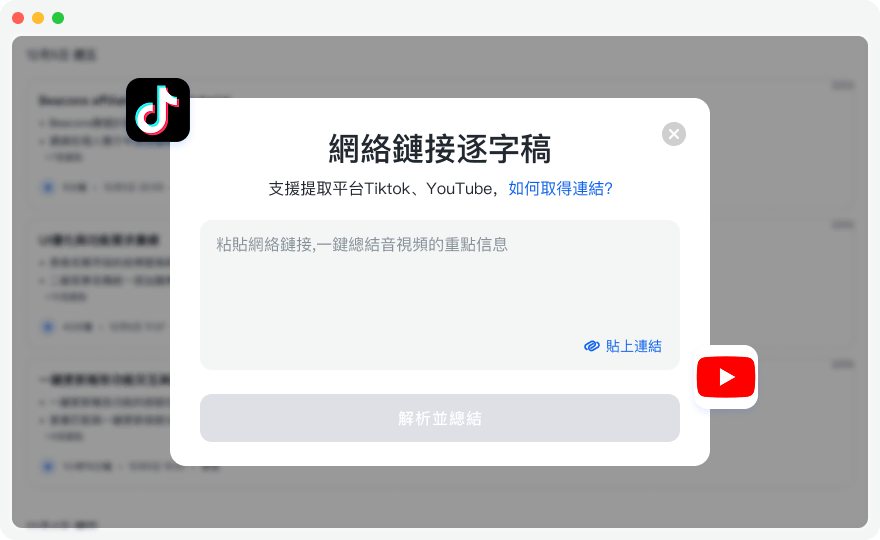
If the source is an online video, no need to spend time downloading. Using a tool with URL parsing capability, paste the link directly into the "Podcast/Online Video to Text" entry. The system automatically extracts the audio and starts converting it into a transcript. This is highly efficient for organizing online courses or self-media content.
Step 2: Import Local Audio or Video Files
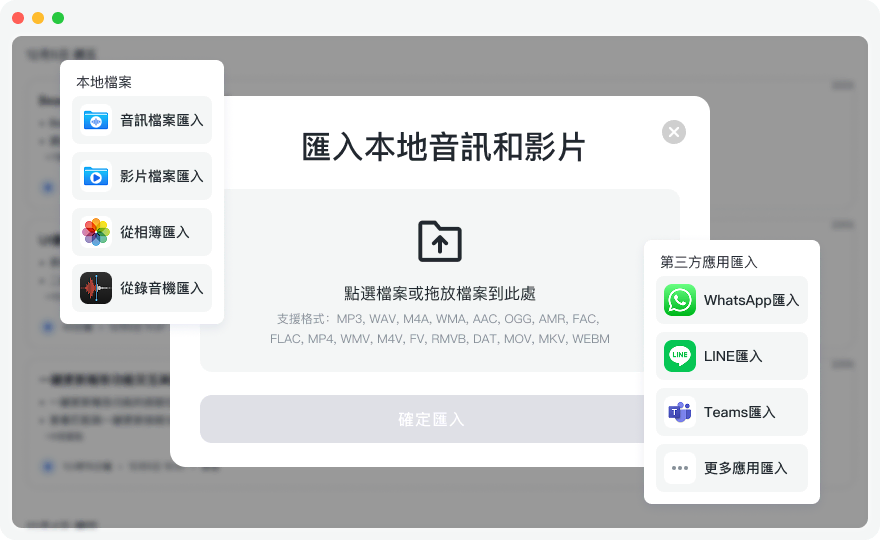
For self-recorded physical meetings or interview videos, use the "Audio File to Text" feature to upload local files. During conversion, the tool not only produces a full text document but also automatically differentiates speakers, making it easy to clarify who said what later.
Step 3: Real-time Recording Conversion for Physical Scenarios
If you are attending an ongoing lecture or meeting, rather than post-processing, you can directly enable the "Real-time Recording to Text" feature. The tool generates text synchronously as you record, allowing you to keep up with the discussion without waiting, and even mark key points in real time.
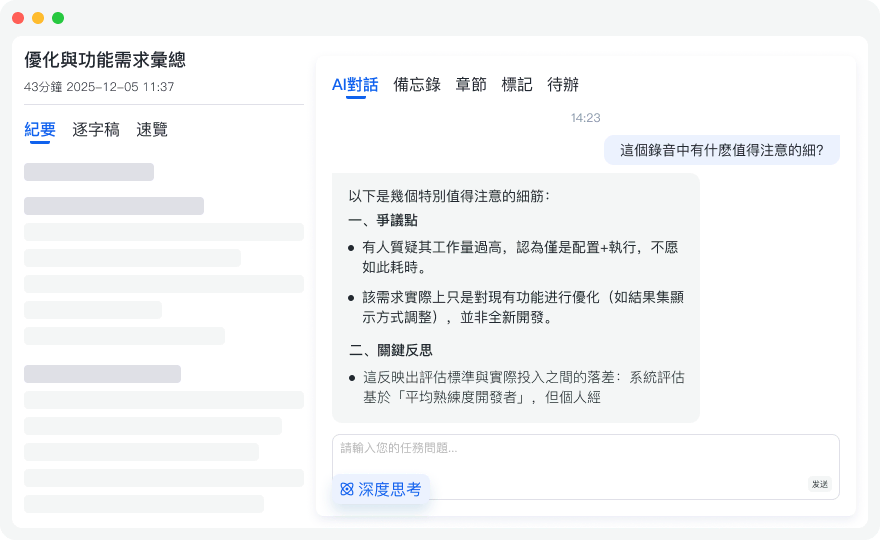
Step 4: Use AI Dialogue to Search for Details
Traditional transcripts only allow Ctrl+F keyword searches. With the built-in "AI Dialogue Query" feature, you can directly ask questions about the generated record (e.g., "What was the total marketing budget for next week mentioned in the meeting?"). The AI provides accurate answers based on the video content, just like asking an assistant who attended the entire session.
Scenarios & Business FAQ: Free Credits, Pricing, and Use Cases
Do video summary AI tools offer free credits?
Pricing models vary among tools. For example, general-purpose AIs usually have free basic models available but with usage limits. For audio/video processing tools, they often provide a free basic recording duration (e.g., 100 minutes per month). For high-frequency business needs, upgrading to Basic or Pro plans can grant higher duration limits.
When processing long meetings (Teams/Meet) or online courses over an hour, will the AI miss key points?
For lengthy content, the core challenge is the AI's context window memory. Models like Claude perform well in this regard. Specialized meeting summary tools often employ chunk processing and structured output techniques to ensure the final "decision highlights" and "to-do lists" are complete, avoiding information loss due to length.
Can these summary tools be conveniently used on mobile phones (e.g., iPhone/Android)?
Most modern AI services support multiple platforms. Whether via a web interface or dedicated apps on iOS or Android, data synchronization is achievable. Especially for field interviews or impromptu meetings, real-time recording and quick summarization on mobile devices are particularly important.
For foreign language videos (e.g., full English speech without subtitles), can the AI directly recognize and generate a Chinese summary?
Tools with multilingual support can automatically detect the language in the video (e.g., English, Japanese, Korean). A powerful AI engine not only accurately transcribes the original transcript but also combines translation capabilities to directly output a summary in the user's preferred language (e.g., Traditional Chinese), significantly reducing the cost of cross-language understanding and organization.
Turn every recording into actionable outcomes
Get 60 free transcription minutes when you sign in. No credit card required.
Related Reading
You might also like

Tinrec vs Otter.ai in 2026: A 5-Dimension Comparison for Chinese Meeting Notes
We tested Tinrec and Otter.ai across 5 key dimensions—Chinese transcription, bot-free recording, AI Q&A, team collaboration, and more—and provided meeting note examples and a pitfall guide to help you choose the right tool.

2026 Hands-On Comparison of 2 Smart Meeting Recorders: For Chinese Meetings and Team Collaboration, Tinrec Is the More Practical Choice
We tested Tinrec and Otter.ai hands-on, comparing them across five key dimensions: bot-free recording, Chinese language experience, file import, post-meeting workflow, and team governance—to help Taiwanese office workers find the best AI meeting notes tool.

2026 Hands-On Comparison of 4 AI Meeting Recorders: Which One Turns Meetings into Actionable Data?
We tested Tinrec, Otter, Notta, and Granola—four AI meeting note tools—covering bot-free recording, Chinese language experience, AI Q&A, and team spaces to help you find a real time-saver.

2026 Review: 5 Smart Meeting Note Tools Compared – Tinrec (Miao Ting Lu Yin) Saves the Most Time with Bot-Free Recording and AI Q&A
Hong Kong professionals tested 5 AI meeting note tools. Tinrec (Miao Ting Lu Yin) stands out with bot-free recording, AI Q&A, and team spaces, helping you save post-meeting time. Find out which one suits you best.

2026 Smart Meeting Recorder Tools Compared: Tinrec vs Plaud Note – Which Is Better for Office Workers?
This article compares Tinrec and Plaud Note across five dimensions: hardware requirements, online meeting recording, file import, AI summaries, and team collaboration, to help you decide which is more suitable for the average office worker.

2026 Smart Meeting Notes Comparison: Why Tinrec Is the Best Choice for Hong Kong Workers?
Hong Kong workers attend meetings daily, then have to work overtime to organize meeting notes? We tested 4 smart meeting note tools and ended up keeping Tinrec. It supports Cantonese, doesn't require adding a bot to record online meetings, and has team spaces, truly helping you leave work on time.

2026 Tinrec Smart Meeting Minutes: Bot-Free Recording + AI Auto Summary & To-Dos
How to choose a smart meeting minutes app in 2026? This article focuses on Tinrec, teaching you how to record online meetings without bots, auto-generate summaries and to-dos, and compares Otter, Notta, Granola, etc., to help you quickly find the right meeting notes solution.

2026 Smart Meeting Minutes Tools Compared: Tinrec's 3 Key Features + Team Collaboration Tested
Spending two hours in a meeting and another two organizing the notes? This article starts with common pitfalls, helps you understand what to look for in smart meeting minutes tools, tests Tinrec's bot-free recording, AI Q&A, and team spaces, and compares Otter and PLAUD to help you avoid selection traps.
Tinrec Meeting Recorder 2026 Tutorial: Record Meetings Without Bots + AI Q&A to Find Key Points
Spending two hours in a meeting and another two hours writing up notes? This article tests Tinrec's meeting recorder, showing you how to record online meetings without bots and use AI Q&A to quickly find key points. We also compare Granola, PLAUD Note, and Notta to help you choose the right tool.