
Turn recordings into transcripts and summaries in minutes
Upload audio or video for multilingual transcription, AI notes, and action items
Why Do You Need a Video Subtitle Extraction Tool?
Before you start looking for tools, you need to answer one key question: Are the subtitles you want to extract "soft subtitles" or "hard subtitles"? Soft subtitles are separate subtitle tracks that can be toggled on and off in a player, and when extracted, they become an srt file. Hard subtitles are text burned directly into the video frame — you can't turn them off, and you can only extract them through frame-by-frame OCR recognition. Choose the wrong approach, and you'll waste an entire night bouncing between tools.
This semester I'm working on my graduation project, and I have a batch of interview recordings and online course videos to process. I tried 6 different methods. Below they're ordered by "the order I ultimately kept using" — the first one is what I use most now.
Option 1 | Tinrec — No Matter Where Subtitles Are Burned, Generate Usable Text Directly from Video Audio
One-sentence positioning: Turn your videos and recordings into searchable, queryable, and further processable text data — not just a transcript.
Key Highlights
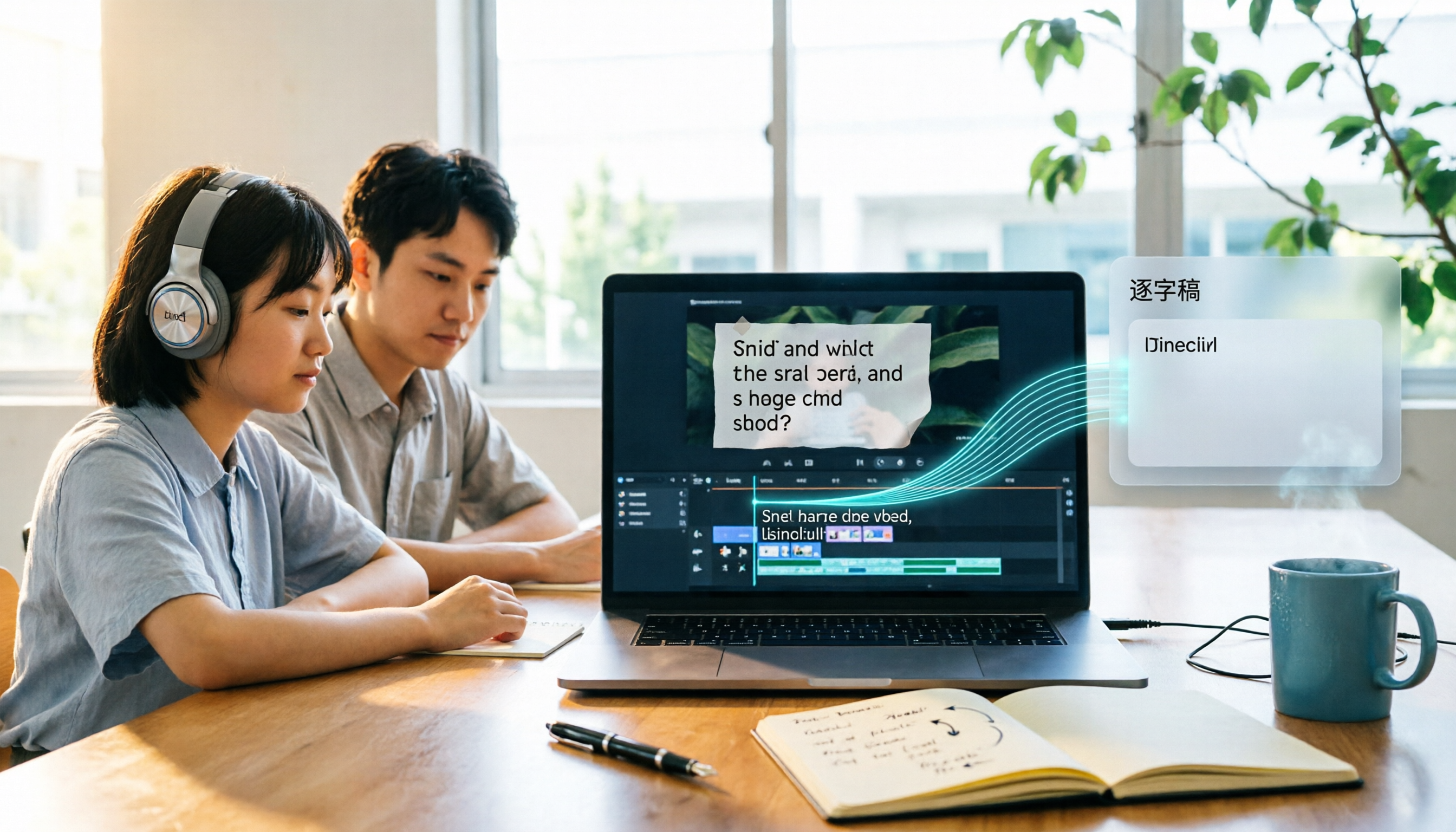
- Audio/Video File Transcription: Upload existing interview videos, course recordings, and historical audio to organize them directly into transcripts. This is especially convenient for videos that only have on-screen subtitles and no subtitle track — you don't need frame-by-frame OCR; instead, you re-transcribe the audio into text.
- AI Q&A: This is the biggest difference from ordinary transcription tools. I can directly ask "What were the three pain points the interviewee mentioned?" without having to rewatch a 40-minute video from the beginning.
- Summaries, Chapters, and To-Dos: Long videos are automatically broken into chapters with key points and to-dos, so you can grab sections directly when writing your project report later.
- Multi-Format Export: You can take results to Notion, Google Docs, OneNote, or Dropbox for further editing — very practical for group note-taking.
- Desktop Bot-Free Recording + Real-Time Translation: During remote interviews, you can record and transcribe simultaneously. Cross-language course videos can also be viewed in the original language, translation, or bilingual format.
Free and Paid Plans: The free version has a basic quota to try recording, importing, summaries, and transcription. For short-term intensive use, there's a weekly pass. For steady use, there are Pro monthly and annual plans. If a group project needs to share data, the team version offers a 7-day trial for first-time eligible users, 1 free seat, and 300 minutes of shared team import quota. Team monthly is USD 29.80 per paid seat per month; annual is USD 199 per paid seat per year, which works out to about USD 16.58 per month.
Who It's For: People whose videos don't have a usable subtitle track, or who want summaries and query features in addition to text. Note that it takes the "re-transcribe from audio" approach. If you need frame-by-frame comparison of on-screen text, that's the domain of OCR tools.
Option 2 | FFmpeg — Free, Fastest, But Requires Command Line
One-sentence positioning: The most powerful multimedia processing tool; extracting soft subtitles is almost instant.
Key Highlights:
- Directly accesses subtitle tracks without affecting original video quality. Supports common formats like MP4, MKV, MOV, and AVI.
- One command saves it as a standalone srt file:
ffmpeg -i input.mp4 -map 0:s:0 output.srt.
Free/Paid: Completely free. Who It's For: People whose videos already have subtitle tracks and who don't mind using the terminal. On macOS, it runs right in Terminal — speed is its biggest advantage.
Option 3 | Subtitle Edit — Graphical Interface, Beginner-Friendly
One-sentence positioning: When you need to both extract and edit subtitles, it's easier to pick up than pure command-line tools.
Key Highlights:
- Can work with Tesseract OCR to scan the screen and convert hard subtitles into editable formats like SRT.
- Has subtitle extraction and format conversion features without writing commands yourself.
Free/Paid: Free. Who It's For: Beginners who need to edit subtitles while exporting them. If you only occasionally convert a video, its graphical interface will save more mental effort than FFmpeg.
Stop organizing recordings by hand
Upload audio or video and automatically get a transcript, summary, and action items
Option 4 | Video-subtitle-extractor (vse) — Local OCR for Hard Subtitles
One-sentence positioning: An open-source tool that extracts hard subtitles from videos into srt external subtitle files.
Key Highlights:
- Based on a deep learning framework, including subtitle region detection and subtitle content extraction. No third-party API required — everything runs locally.
- Supports recognition of 87 languages including Simplified Chinese, Traditional Chinese, English, Japanese, and Korean, and provides Windows CPU/GPU executable versions.
Free/Paid: Free. Who It's For: People dealing with hard subtitles who want offline processing and don't mind spending time running recognition. One reminder: don't include Chinese characters or spaces in the file paths for videos and programs, or unknown errors may occur.
Option 5 | VLC Media Player (VLSub Extension) — Handle It Right in Your Player
One-sentence positioning: The player you already have on your computer — add an extension and you can grab subtitles.
Key Highlights:
- Use the VLSub extension to get soft subtitles without opening another website to download them.
- Video files need to be named correctly for VLC to find matching subtitles. You can also uncheck automatic subtitle file detection in preferences.
Free/Paid: Free. Who It's For: People who just want to quickly check whether a video has a subtitle track or occasionally grab a subtitle file.
Option 6 | DownSub — Pure Online, the Savior for Public Video Subtitles
One-sentence positioning: No installation needed — paste a URL and grab subtitles.
Key Highlights:
- Works in a browser and supports public videos on platforms like YouTube.
- Can retrieve manually uploaded subtitles or platform auto-generated subtitles.
Free/Paid: Free. Who It's For: Students with zero budget who only need to process public online videos. The downside is that it only handles "subtitles already on the platform" — your own recorded files won't work.
With So Many Options, How Should You Choose?
- Video has no subtitle track, or you want summaries and query features in addition to text → Tinrec (an all-in-one workflow with transcription, summaries, AI Q&A, and export).
- You're dealing with your own recorded files, course recordings, or interview videos → Tinrec (audio/video file import is designed for exactly this scenario).
- You need bilingual comparison for mixed Chinese-English or multilingual content → Tinrec (supports multilingual meeting transcription, real-time translation, and bilingual viewing).
- After transcribing, you also need to take notes and share data with classmates → Tinrec Team Version (team space, member and seat management; data belongs to the team and won't be taken away when members leave).
- Video already has a subtitle track, and you just want to extract it for free without fearing command line → FFmpeg.
- Subtitles are burned into the screen, and you want free, offline processing → Video-subtitle-extractor or Subtitle Edit.
- You just want to view subtitles for a public YouTube video → DownSub, no installation needed.
4 Things to Know Before Using a Video Subtitle Extraction Tool
- Confirm the subtitle type before choosing a tool. Extracting soft subtitles takes seconds; hard subtitles must go through OCR, which is more troublesome and time-consuming. Getting this judgment right saves half your time.
- Free doesn't mean zero cost. Free OCR tools don't cost money, but they cost your computer's time and performance. Paid tools cost money but save time. Take Tinrec as an example: the free version has a basic quota you can try first. Once you're sure you have weekly needs, consider upgrading — that's more cost-effective than buying an annual plan and using it fewer than three times.
- Recognition accuracy is affected by source quality. Blurry visuals, unusual fonts, noisy audio, or overlapping speakers will all reduce results. A more reliable approach: after generating a transcript with a tool like Tinrec, use timestamps to replay and verify important sections — don't copy the whole thing blindly.
- Pay attention to naming and permissions. Some tools are sensitive to file paths (no Chinese characters or spaces), and VLC also needs correct naming to match subtitles. Also, follow local laws when recording and transcribing, and get consent when necessary.
Conclusion
There's no "one tool to rule them all" for subtitle extraction: if the video has a subtitle track, use FFmpeg to extract it; if subtitles are burned into the screen, use an OCR tool to scan them; and when you don't even have subtitles — only audio — re-transcribing directly from audio is actually faster. For student projects that need "text, summaries, and query capability," Tinrec is currently the only option I've kept using. Try the free version on one project first — you'll quickly feel whether it's enough.
(Note: Free quotas and prices for each tool may change. Please refer to official pages for actual terms.)
References
- How to Extract/Save Subtitles from Video: Soft Subtitles and Hard Subtitles
- Video-subtitle-extractor Hard Subtitle Extractor 2.2.0 CPU Version for Windows - Softking Software King - Software Information | Professional Software Download Platform
- 4 Methods to Extract Subtitles from Video: Soft Encoding/Hard Encoding
- [Ultimate Guide] How to Easily Extract Subtitles from Video
- How to Use a Subtitle Extractor: 4 Useful Solutions
Turn every recording into actionable outcomes
Get 60 free transcription minutes when you sign in. No credit card required.
Related Reading
You might also like

6 Best Audio-to-Text Tools in 2026: Chinese Transcription, Meeting Notes, and Pricing Compared
We tested 6 audio-to-text tools in 2026, from Tinrec to free online transcription services. Compare Chinese recognition, post-meeting organization, pricing, and ideal users to decide which one to try first.

2026 Top 5 Work Summary Video Tools Compared: Which Saves the Most Time on Recording-to-Script?
When creating an annual work summary video, the bottleneck is usually not editing but the scattered material from dozens of meetings. This article reviews 6 tools that convert meetings and interviews into transcripts, summaries, and scripts, comparing Chinese meeting experience, AI follow-up questions, export capabilities, and free tier limits, with clear recommendations for different budgets and scenarios.

2026 Tinrec Video Summarization Guide: Transcribe Videos and Generate AI Summaries & To-Dos
Videos keep piling up, but you're stuck because tools only support content with subtitles and can only process one at a time? Starting from the real need for 'bulk video summarization,' this article reviews how Tinrec handles input sources, output depth, Chinese language experience, quota calculation, and team data retention. It includes practical use cases, key considerations for purchase, and FAQs to help you decide if it's suitable for your batch of videos.

2026 Complete Guide to Meeting Notes Software: A Practical Workflow from Transcript to Action Items
Most people make the wrong first choice when picking meeting notes software. This guide starts with common pitfalls, covers 5 key buying factors, a hands-on walkthrough of Tinrec's full workflow, brief reviews of 3 alternatives, and the 4 most common mistakes—so you can find the one that truly saves you time.

2026 Comparison of 4 Online Video Summarization Tools: Which Handles Chinese Videos and Meeting Replays Best?
Which online video summarization tool should you use? This article uses three real-world scenarios—Chinese online courses, meeting replays, and team sharing—to compare Tinrec, Notta, TurboScribe, and Granola on supported sources, post-summary processing, free quotas, and team management. It also highlights four common pitfalls when choosing a tool, helping you find a workflow that truly saves time from watching videos.

5 Best EPUB to PDF Converters in 2026: Free Online Tools Compared
Need to convert an EPUB ebook to PDF but not sure which tool to use? We tested 5 online EPUB to PDF converters—Smallpdf, CleverPDF, PDF Candy, FreePDFConvert, and Visual Paradigm Online—so you can compare how they work, their free limits, and who each one is best for.

How to Transcribe Audio to Text in 2026: A Complete 5-Step Guide
A mid-level manager who runs 15 meetings a week shares the three biggest pitfalls of audio-to-text transcription and compares Tinrec vs Otter.ai across five dimensions: Chinese recognition, online meeting recording methods, post-meeting output, audio file storage, and team governance. Includes a 5-step workflow from recording to meeting minutes and selection advice.

6 Video Link Extraction Tools Tested and Compared in 2026: Which One Requires No Install and Lets You Share Directly?
How do you choose a video link extraction tool? This article reviews 6 online tools, comparing their positioning, free plans, and ideal users—from turning videos into shareable URLs and downloading video backups to converting video content into searchable text—so you can pick the right tool for your needs.

2026 Complete Guide to Video Content Summarization: A Practical Tutorial to Turn Long Videos into Usable Notes
Starting from common student mistakes in video note-taking, this guide explains what video content summarization can do for you and its core capabilities. Using Tinrec as an example, it demonstrates four practical scenarios: courses, projects, interviews, and content creation. Finally, it lists 6 key considerations for choosing a tool and answers FAQs to help you decide if the free quota is enough and whether to upgrade.