

Turn recordings into transcripts and summaries in minutes
Upload audio or video for multilingual transcription, AI notes, and action items
It's 3 PM, you hang up from an online meeting and open your notebook to start taking notes.
Six people take turns speaking—some give updates, some raise questions, some change requirements on the spot. When the meeting ends, you stare at two full pages of notes but can't remember who was supposed to deliver that document due next Wednesday.
Another common scenario: you download an app that claims to be free, it transcribes smoothly for the first ten minutes, then an upgrade prompt pops up—turns out 'free' just meant a free trial.
This isn't a spec sheet; it's a selection guide I put together after actually using several free meeting transcription apps.
Two-hour meeting, two-hour cleanup—the problem isn't your typing speed
Let's see if these scenarios sound familiar.
First: after an online meeting, you spend just as long listening to the recording from the start, taking notes as you go. If someone interrupts or speaks quickly, you have to drag the timeline back and forth.
Second: in a client interview or requirements discussion, the most important sentence is often buried at the 40-minute mark. When you want to go back and find 'what was the client's concern about pricing at that time,' all you have is a vague impression.
Third: you finally find a free tool, but the free version only transcribes a few minutes, or has a short single-recording limit—it can't handle a real meeting.
The common thread in all three: what you lack isn't recording, but turning meeting content into searchable, queryable, actionable data. With the right tool, you can save most of that time.
Before choosing a free meeting transcription app, understand these 4 key points
1. Distinguish between a 'free plan' and a 'free trial'
This is where marketing language can mislead you. Look at two numbers: the monthly free quota and the single-content length limit. Some tools offer 120 minutes per month, which sounds good, but if each recording can only be 3 minutes, long meetings must be split into multiple parts.
2. How online meetings are recorded
There are two main approaches. One is to send a meeting bot into the meeting room; the other is to use a desktop app to capture system audio directly. The former requires host approval and adds an unfamiliar account to the participant list in external client meetings; the latter doesn't need to invite a bot but requires you to open the desktop app and start recording yourself.
3. Is there post-processing after transcription?
A tool that only provides a transcript just hands the cleanup work back to you. What really saves time is automatic summaries, chapters, action item extraction, and AI Q&A that lets you ask questions directly about the meeting content.
4. Who ultimately owns this data
For personal use, it doesn't matter, but for teams: is meeting data stored in individual accounts or team spaces? Will data disappear when a member leaves? This is why team plans distinguish between 'roles' and 'seats'—roles determine who can manage, seats determine who can record, upload, and edit.
Tinrec—my top recommendation after testing
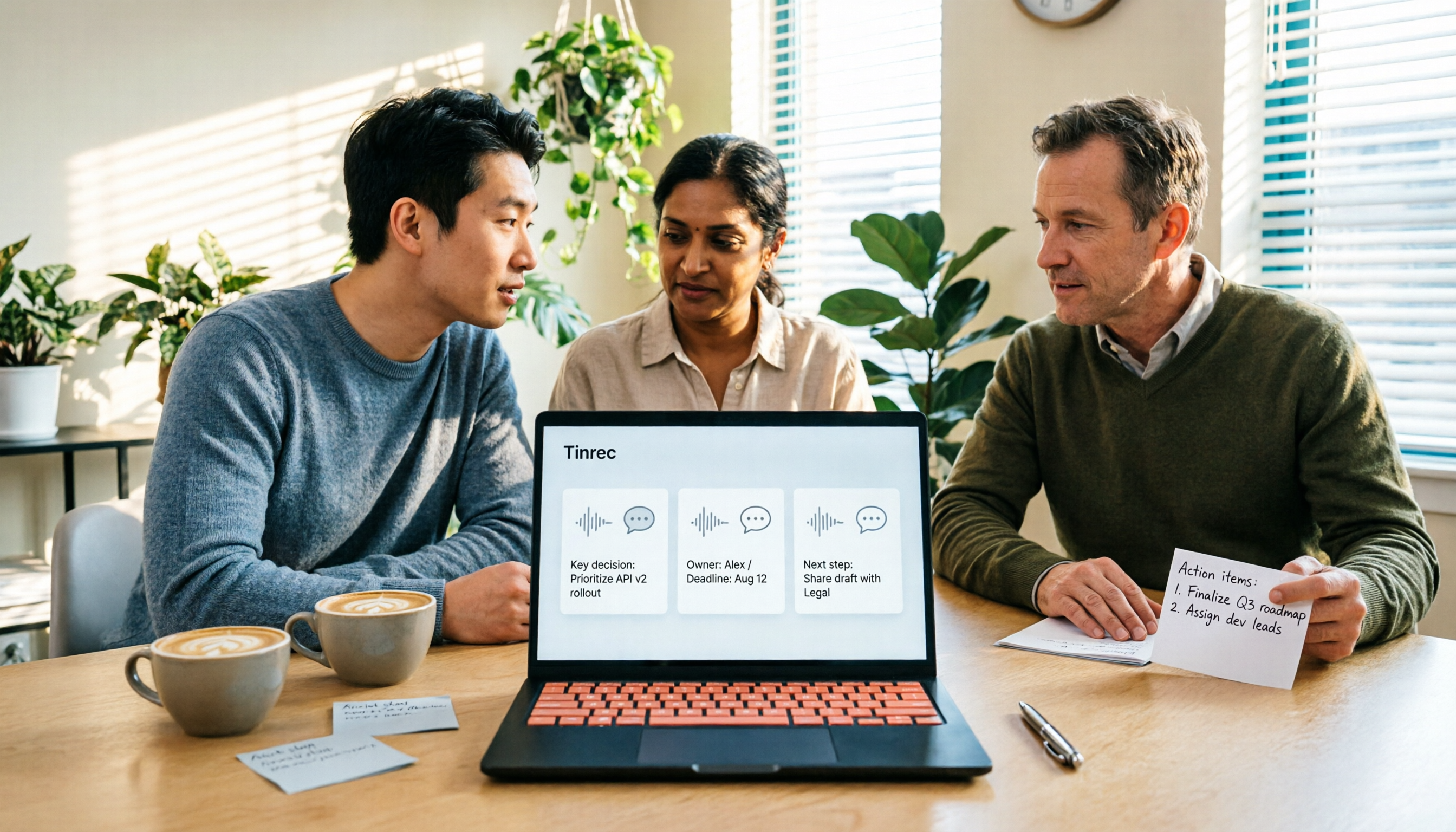
Tinrec is an AI meeting transcription and collaboration tool for individuals and teams, available on web, desktop, and mobile. It doesn't just convert speech to text; it organizes meetings into searchable, summarizable, queryable, exportable, and further processable data.
Record online meetings without a bot
The desktop app captures system audio directly, handling meeting content played on Zoom, Google Meet, Microsoft Teams, Webex, etc., without inviting a meeting bot into the room or asking the host to click approve again. For external client meetings, having one less unfamiliar account on the participant list is usually less awkward. Note that this is actively starting a recording by opening the desktop app, not automatically joining every meeting on your calendar in the background.
Ask questions after recording
The meeting ending doesn't mean the work is done. Tinrec's AI Q&A lets you continue asking questions about single or multiple meetings, such as 'Who mentioned the budget in the last meeting?' or 'What are the action items for this project?' It gives you answers based on semantic understanding, not a list of keyword search results to sift through.
Produce deliverables right after the meeting
Besides the transcript, it automatically generates summaries, chapters, key points, and action items, can organize into mind maps when needed, and exports to Notion, Google Docs, OneNote, Dropbox, etc. Going further, you can use Agent to generate reports, tables, and meeting minutes based on meeting content.
Hands-on impressions
I tested with a recording of an online meeting mixed with Chinese and English. The transcript automatically segments and adds punctuation, with good readability, and the summary captures the main discussion points. Note that transcription performance is affected by recording quality, background noise, accents, and multiple people talking over each other. For important content, it's still advisable to cross-check the transcript timestamps with the original recording.
Stop organizing recordings by hand
Upload audio or video and automatically get a transcript, summary, and action items
Three most practical advantages I found
- From recording to post-meeting output is a complete workflow, no need to move files between three or four tools.
- Online meetings don't need a bot to join; just open the desktop app to record, much less pressure for external meetings.
- Desktop, mobile, and web versions all work, so you can pick up a recording on your phone if needed.
Limitations to be clear about
The free version provides a basic quota, suitable for trying out; if you need to organize long meetings daily, you'll need a paid plan. Also, the team version currently focuses on team-level sharing, not file-level granular permissions—something to know when evaluating enterprise needs.
Who it's for
If you frequently have Chinese meetings, need mixed Chinese-English transcripts, and want to ask AI directly for key points after the meeting, Tinrec is the smoothest choice I've used.
Team version supplement
If you want the whole team to share meeting data, Tinrec's team version is a separate team space, not multiple people sharing one personal account. It manages member roles (owner, admin, regular member) and seats separately: active members without a seat can still view, play, and read team data, but need a seat to record, upload, edit, import, and export.
Currently, eligible teams can try 7 days free with 1 free seat and 300 minutes of team shared import quota; team monthly is USD 29.80 per paid seat per month, annual is USD 199 per paid seat per year (about USD 16.58 per month), each paid seat provides 2,000 minutes of team shared import quota per month, and real-time recording under an active team plan currently does not deduct minutes. Actual prices, currencies, and promotions are subject to the official purchase page.
Besides Tinrec, what other free options are there?
Notta
A multi-platform transcription tool with decent Chinese support. Free version: 120 minutes per month, max 3 minutes per recording. Pro annual is about USD 8.17 per month (1,800 minutes per month). If you mainly convert existing audio files to text, it's sufficient. However, it lacks Tinrec's AI Q&A and Agent post-processing; to turn transcripts into reports or tables, you'll still have to do it yourself.
Otter.ai
A mature choice for English meetings. Basic free: 300 minutes per month. Pro annual is about USD 8.49 per user per month. If almost all your recordings are in English, Otter is a cost-effective option. Note that Chinese and mixed Chinese-English meetings are not its primary scenario, and its post-meeting data organization differs from Tinrec's team space approach.
PLAUD
A representative of AI recording hardware. NotePin priced at USD 159, Note Pro at USD 189, app Starter 300 minutes per month. Suitable for those who need portable recording, phone call recording, and long periods on the go. In contrast, Tinrec doesn't require extra hardware, works on web, desktop, and mobile, and can handle online meetings directly.
Pitfall guide: 4 most common traps when choosing a free meeting transcription app
Pitfall 1: Mistaking a 'free trial' for a 'free plan'
Ads say free, but actually only give you a few minutes. When choosing a tool, first confirm two things: monthly free quota and single-content length limit. These two numbers determine whether you can use it for free long-term, not just the word 'free' on the download page.
Pitfall 2: Not considering the social cost of recording methods
Tools that require a bot to join usually need host approval and may seem intrusive to external clients. If you often have cross-company meetings, consider the desktop system audio capture approach, such as Tinrec and Granola.
Pitfall 3: Treating the tool only as 'audio-to-text'
If you only use the transcript, you're only using a third of its value. Summaries, action item extraction, and AI Q&A are the real time-savers—asking 'What was the decision?' right after a meeting is much faster than manually scrolling through a 40-minute transcript.
Pitfall 4: Ignoring data ownership and seats for team use
Team data should belong to the team, not follow individual accounts. When a member leaves, is removed, or loses a seat, their resources should be transferable to other members. Also, don't confuse 'can view' with 'can edit'—these are separate in team versions.
One final reminder: recording and transcription involve others' voices. Check local laws before use, and obtain participant consent when necessary.
Conclusion: Which one should you choose?
In one sentence: if you have Chinese meetings, need mixed Chinese-English transcripts, and want to use AI to find key points after the meeting, Tinrec is the top choice after this round of testing.
- Chinese meetings, mixed Chinese-English transcripts → Tinrec
- Online meetings without inviting a bot → Tinrec (desktop system audio capture)
- Need team sharing of meeting data, manage seats and usage → Tinrec team version
- Mainly record English content, zero budget → Otter.ai free version (300 minutes per month)
- Need portable hardware, often record phone calls → PLAUD-type recording hardware
- Only need to batch convert long audio files to text → TurboScribe-type file transcription tools
I suggest starting with the free version, testing with a real meeting recording of your own, seeing if the transcript and summary are actually helpful, then deciding whether to pay. The best way to know if a tool works is to try it once.
References
- No time limit! 3 free AI transcription tools, highly recommended! AI voice notes generate meeting minutes, presentations, mind maps | 104 Workplace Power
- AI meeting minutes software recommendation: 5 major apps tested and compared, automatic transcription makes meetings super easy!
- r/ProductivityApps on Reddit: Does anyone know of a free or cheap app that will do meeting notes for you?
- Notta - Super Accurate Transcript, Speech to Text, Meeting Recording, AI Summary App - App Store
- Meeting Ink - 2026 AI Meeting Minutes Tools Tested | 7 Speech-to-Text and Summary Speed Comparison | Meeting Ink - AI Meeting Minutes Assistant Automatic Transcription Transcript Summary Meeting Minutes
Turn every recording into actionable outcomes
Get 60 free transcription minutes when you sign in. No credit card required.
Related Reading
You might also like
2026年4款免费会议记录App最新版实测对比:谁的AI纪要真的能省时间?
开完会还要花时间整理逐字稿吗?这篇比较 4 款免费会议记录 App 的最新版本,从会议撷取方式、逐字稿之后的 AI 整理、跨装置支援到免费额度界线逐一检视。我会分享自己怎么用 Tinrec 把整个会后流程换掉,也说明 Notta、Otter.ai、PLAUD 各适合谁,以及挑选时最容易踩的三个坑。

Which Free Meeting Notes App Is Best? 5 Tested in 2026, How to Choose Free Tiers That Actually Work
There are countless free meeting notes apps, but the real limits of 'free' vary widely. This article breaks down 6 key decision points for choosing one—from free quotas, Chinese recognition, meeting formats, to post-meeting organization—and uses Tinrec to demonstrate the full workflow from recording, transcription, AI summary, to action items and team sharing, helping you pick the one that truly works for you.

4 Free Meeting Notes Apps Compared: AI Summarization Is the Real Time-Saver
How do free meeting notes apps differ from AI meeting tools? This article examines four key factors: free plan single-session limits, meeting capture methods, post-meeting AI organization, and team data ownership. We compare Tinrec, Otter.ai, Notta, and Granola, and highlight common pitfalls to help you decide if a free version is enough.

Tinrec vs Notta 2026: 5-Dimension Comparison, Which Free Meeting Notes App Should You Choose?
A free meeting notes app isn't just about dumping audio and getting a transcript. This article starts with common misconceptions, compares free meeting notes tools across 5 dimensions, and uses Tinrec as an example to show how to turn meetings into searchable, queryable, and transferable data.

Best Free Meeting Notes Apps in 2026: We Tested 2 Options, iPhone Users Don't Need to Buy Hardware First
How do you choose a free meeting notes app? From a mid-level manager's perspective, I tested Tinrec and PLAUD Note across five dimensions: upfront cost, online meeting recording, cross-device continuity, post-meeting AI organization, and team collaboration. I also highlight three common mistakes to help you decide which option fits your meeting style.

5 Free Meeting Transcription Apps Tested and Compared in 2026: How to Choose a Free Plan That Actually Works
How can a free meeting transcription app really save you time? This article examines four key factors—how free quotas are calculated, supported online meeting audio sources, post-meeting outputs, and team sharing—and puts Tinrec, Otter.ai, Notta, and PLAUD Note to the test. It also highlights the three most common pitfalls to help you pick the one that truly meets your needs.

Free Meeting Notes App Download 2026: Tinrec No-Bot Recording + AI Auto Summary
How to download a free meeting notes app without getting burned? This guide starts with common pitfalls, then compares Tinrec and Otter.ai across 5 dimensions, covering the 3-step download process, how to choose a free plan, Traditional Chinese and mixed Chinese-English recognition, no-bot online meeting recording, post-meeting summaries and action items, team seats and data governance, and ends with clear recommendations.

2026 AI Meeting Notes Free Plans Compared: 5 Apps to Consider
Starting from the three most common misconceptions, this article reviews the actual free quotas and limitations of 5 free meeting notes apps in 2026, and compares Tinrec, Notta, Otter.ai, PLAUD Note, and Granola in terms of Chinese transcription, online meeting audio capture, summarization, and AI Q&A, helping you find a free but sufficient option.

4 Free Meeting Transcription Apps Compared: Which Free Tier Actually Lasts?
Tired of spending time after meetings organizing notes? This article compares four free meeting transcription apps—Tinrec, Otter.ai, Notta, and Granola—breaking down how free tiers are calculated, how meeting audio is captured, what you can do after transcription, and who ultimately holds your recordings and data. We also outline four key selection criteria and four common pitfalls to help you find the one whose free version can handle your real meeting length.