
Turn recordings into transcripts and summaries in minutes
Upload audio or video for multilingual transcription, AI notes, and action items
When dealing with meeting recordings, interview transcripts, or confidential corporate data, the worst scenarios are rampant Chinese recognition errors, API costs that skyrocket with usage, or potential data leaks from cloud platforms. Especially now that major tech companies are releasing powerful AI models, should you invest resources in deploying open-source models on-premise or simply adopt ready-made software services?
This article will walk you through the latest speech-to-text solutions in 2026, covering recent popular open-source models to ready-to-use SaaS products, providing clear 5 evaluation dimensions, a tool comparison table, and a hands-on guide.
Quick Navigation: If you are a development team with computing resources and highly value data sovereignty, the recently released Cohere model or the classic Whisper are top choices for on-premise deployment; if you need to produce meeting summaries and cross-language translations immediately without dealing with any code, you should prioritize evaluating Tinrec, an AI product with a complete "recording to action items" workflow.
1. User Segmentation & Selection Criteria: Should You Choose Open-Source Models or Application Tools?
When searching for "speech-to-text models," different groups face entirely different pain points. Clarifying your own needs is the first step.
1.1 User Segmentation: What Type Are You?
- Developers & IT Architects: Need underlying open-source models, focusing on API call limits, on-premise deployment feasibility, privacy compliance, and development flexibility.
- Enterprise Managers & Project Managers: Need cross-platform application tools, focusing on team collaboration, not missing meeting details, and automatically generating actionable tasks.
- Students & Self-Learners: Need a lightweight solution that can quickly process class recordings, summarize key points, and has a certain free allowance.
- Content Creators & Media: Need high-precision transcript generation tools to quickly convert interview recordings or videos into article material.
1.2 5 Core Dimensions for Choosing a Solution
- Accuracy & Language Support: Does it support Chinese, multilingual automatic recognition, and understanding of professional terminology?
- Data Privacy & Deployment Cost: Must data be uploaded to the vendor’s servers? If on-premise deployment, how high is the hardware threshold?
- Real-time & Post-processing: Beyond transcripts, can it generate summaries and extract decisions (action items) in real-time?
- AI Query Capability: Can it perform semantic search and conversational Q&A on long recordings, rather than traditional keyword search?
- Total Cost of Ownership: Includes API billing, hardware setup costs, or the value for money of software subscriptions.
2. 2026 Mainstream Speech-to-Text Models & AI Applications: A Side-by-Side Review
2.1 Cohere Open-Source Speech Model: A New Star Focused on Privacy & On-Premise Deployment
Recently, Cohere released a lightweight open-source speech-to-text model that directly challenges cloud-dependent services. The model has 2 billion parameters and supports 14 major business languages. Its biggest advantage is deployment flexibility—developers do not need expensive enterprise-grade GPU clusters; it can run on consumer-grade GPUs or mid-range cloud instances. For businesses handling sensitive information, this provides excellent data sovereignty protection.
2.2 OpenAI Whisper: The Benchmark for Open-Source Speech Recognition
Whisper, with its powerful multilingual recognition capability, has become a popular choice among developer communities. Its accuracy is extremely high, but as model size increases, so do computing resource requirements (e.g., GPU VRAM), making it suitable for technical teams with some infrastructure capability and a need for high customization.
2.3 Google Cloud Speech-to-Text: Enterprise-Grade Cloud API
Google offers a stable and mature speech recognition API supporting a vast number of languages, ideal for development scenarios requiring seamless integration into existing enterprise systems. However, full reliance on cloud APIs means businesses must consider the security implications of data transmission and the potential cost escalation with increased usage.
2.4 Tinrec: Ready-to-Use Recording & Meeting Workflow
Unlike tools that only provide underlying models or simple transcripts, Tinrec positions itself as a complete AI recording assistant. It supports automatic recognition of 10 languages, not only converting recordings to text in real-time but focusing on the subsequent use of information—automatically generating meeting minutes and action items. Users don't need to know any code, and it supports multi-platform sync (Web, iOS, Android), making it suitable for modern workplace and education scenarios that value efficiency.
2.5 Built-in Captions in Major Meeting Software (e.g., Teams / Meet)
Most communication software already has built-in speech-to-text features. The advantage is that they are completely free and require no additional tools. The downside is that recognition quality varies, and after the meeting ends, it is often difficult to export structured summaries and action items directly, usually requiring third-party tools for secondary processing.
Stop organizing recordings by hand
Upload audio or video and automatically get a transcript, summary, and action items
3. Speech-to-Text Solutions "Core Comparison Table" & Decision Tree
Tool Comparison Table
| Dimension | Cohere Open-Source | OpenAI Whisper | Google Cloud API | Tinrec | Built-in Meeting Captions |
|---|---|---|---|---|---|
| Target Users | Developers / Enterprise IT | Developers / Researchers | Enterprise Dev Teams | Professionals / Students / Creators | General meeting attendees |
| Language Support | 14 business languages | Nearly 100 languages | Most global languages | 10 languages (auto-detect) | Varies by software |
| Real-time & Post-processing | Requires custom integration | Text output only | Text output only | Built-in summary & action items | Captions/basic recording only |
| AI Query Capability | None | None | None | AI conversational query | None |
| Privacy & Deployment | On-premise, data never leaves | On-premise or API | Cloud API processing | Cloud SaaS architecture | Cloud processing |
| Price / Cost | Free open-source (hardware cost) | Free open-source (hardware cost) | Pay-per-minute usage | Free tier: 100 mins/month | Included in software subscription |
Decision Tree: Which Solution Fits You?
- If you need to handle highly confidential data and have an engineering team → Choose Cohere or Whisper for on-premise deployment, ensuring data sovereignty.
- If you need to seamlessly integrate speech recognition into a large enterprise system → Choose Google Cloud Speech API for maximum stability.
- If you don't want to write code, need cross-device recording, and want instant meeting summaries and to-do lists → Choose Tinrec to quickly set up a workflow.
4. Hands-On Tutorial: How to Quickly Build a "Record → Understand → Act" Workflow
For most non-technical users, adopting a ready-made AI assistant is the fastest way to boost productivity. Below we use Tinrec as an example to demonstrate practical steps for 4 common scenarios, helping you turn time-based content into actionable textual data.
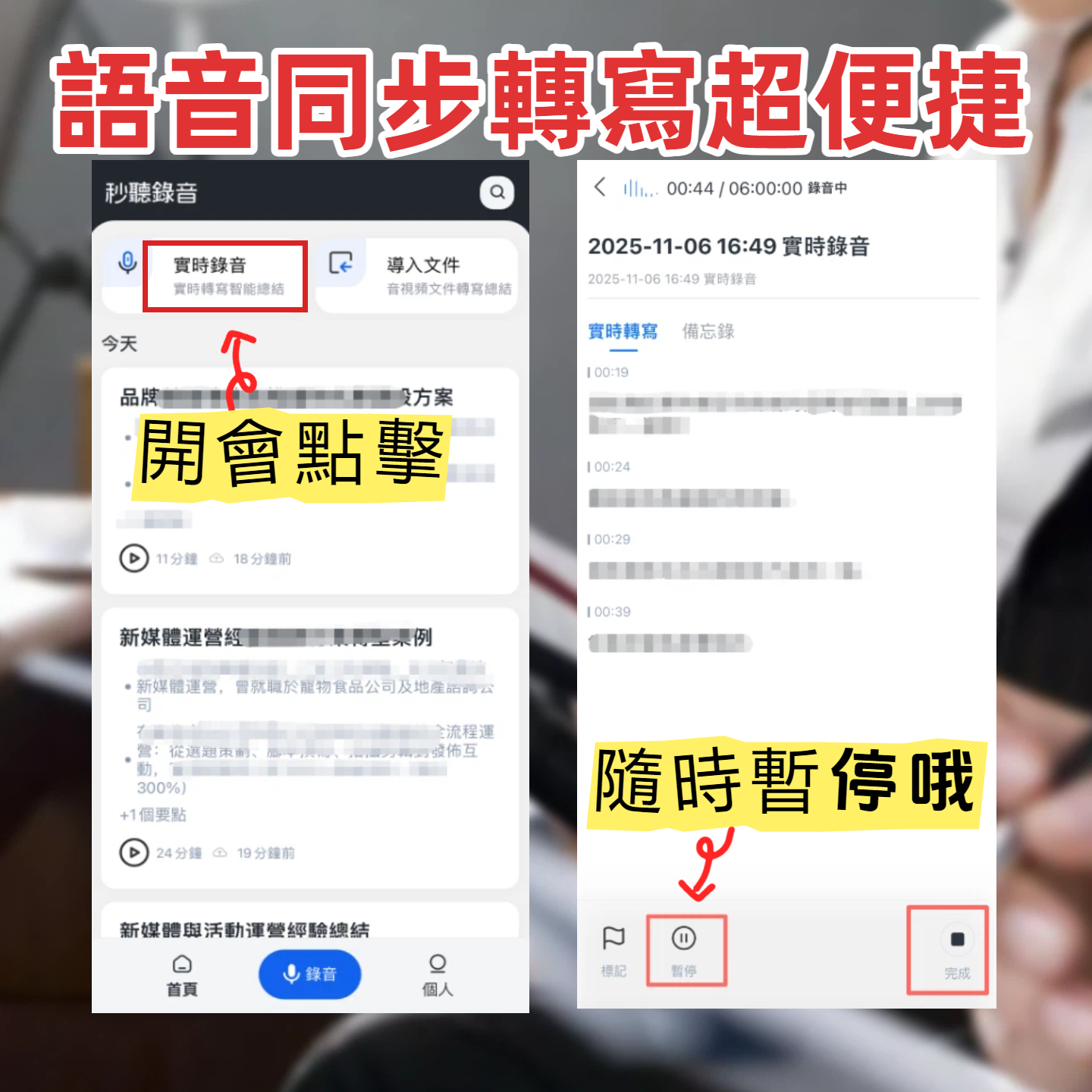
Step 1: Real-Time Transcription for In-Person Meetings & Classes
When conducting face-to-face interviews or attending physical meetings, seeing text in real-time can greatly reduce anxiety.
- Open the Tinrec real-time transcription feature.
- Click to start recording; the system will instantly convert speech to text while recording—no waiting required.
- After the meeting ends, click stop, and the system will automatically perform speaker diarization and key point summarization.
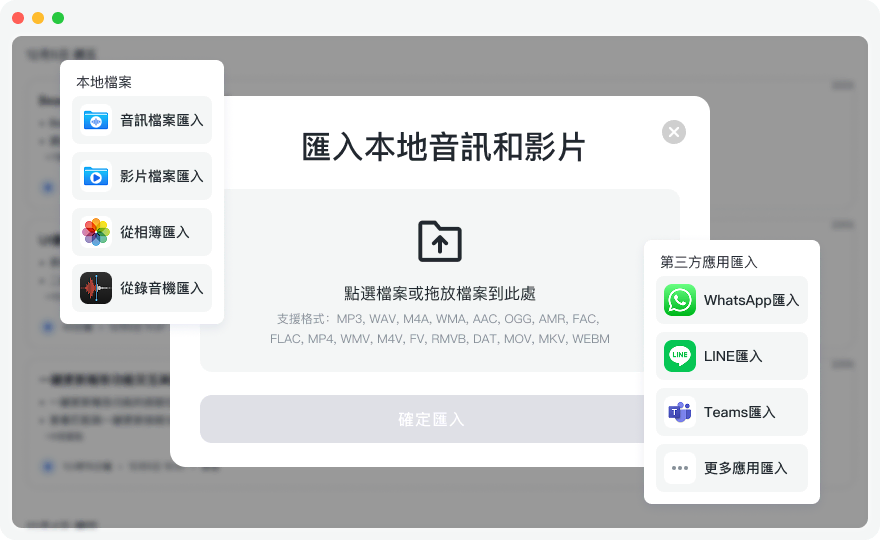
Step 2: Process Existing Audio Files
If you have previously recorded interview audio or meeting files, you can quickly convert them as well.
- Go to the Tinrec audio-to-text interface.
- Drag and drop supported audio format files to upload.
- The system will rapidly complete transcription and automatically generate a transcript with context and an AI summary.
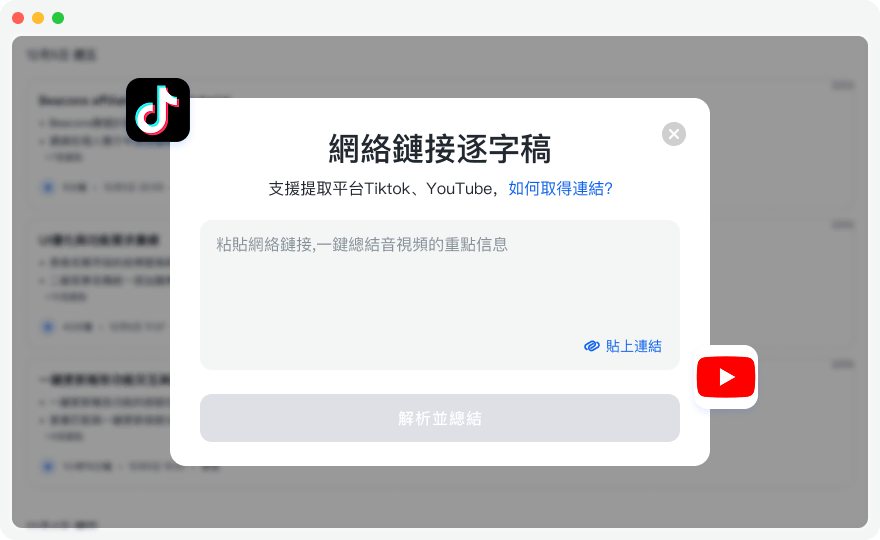
Step 3: Efficiently Absorb Knowledge from Online Videos & Podcasts
For self-learners and content creators, it's often necessary to extract key points from YouTube or podcasts.
- Copy the URL of the online video or podcast you want to process.
- Go to the Tinrec podcast/video-to-text section.
- Paste the link, and the system will automatically parse and convert the content into text, helping you quickly browse the video outline without having to listen for an hour.
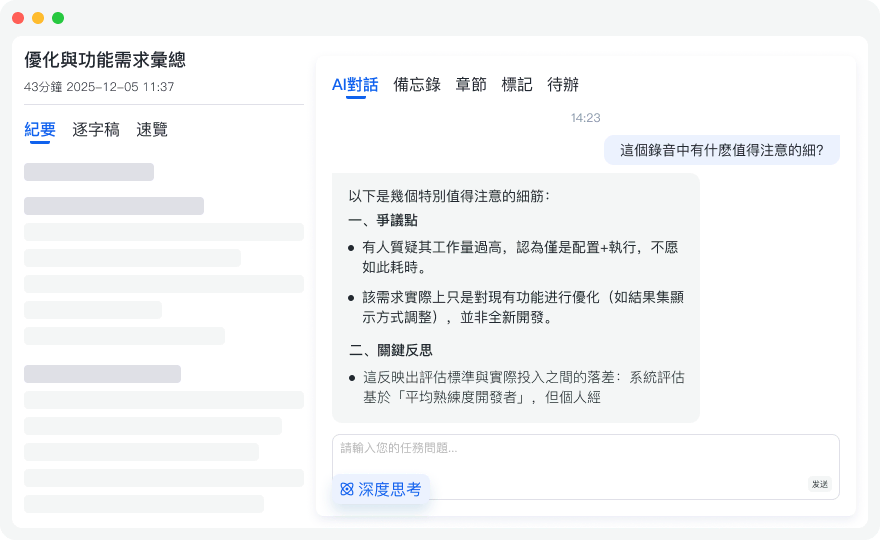
Step 4: Deep Extraction with AI Conversational Query
Traditional transcripts only allow Ctrl+F keyword search, which falls short when you forget the exact words. AI query changes this experience.
- In the completed transcript document, open the AI conversational query feature.
- Ask directly in natural language, e.g., "In the recording, what instructions did the boss give regarding the marketing budget for next quarter?"
- The system will engage in intelligent conversation based on the recording content, quickly providing answers and action suggestions, as if you were asking an assistant who took full notes throughout the meeting.
5. Frequently Asked Questions About Speech-to-Text Models
Q1: Do I need a very powerful computer to deploy open-source models locally (e.g., Cohere or Whisper)? Traditional large models often require enterprise-grade GPUs, but recent developments (such as Cohere's 2-billion-parameter model) have significantly lowered the barrier. Developers can run them smoothly using consumer-grade GPUs, modern gaming computers, or mid-range cloud instances.
Q2: How well do speech-to-text tools support Chinese, especially Taiwanese accents or Chinese-English code-switching? Current mainstream models have made great strides in Chinese support. For example, many SaaS platforms (including Tinrec) support multilingual automatic recognition and handle the common code-switching environment in Taiwanese workplaces quite well, reducing the need for manual corrections.
Q3: If I usually use an iPhone for recording, is there a recommended workflow for transcription? iPhone's built-in voice memos are limited by system functionality and cannot directly generate AI summaries. I recommend using a cross-platform service (e.g., Tinrec supports both iOS and Web). Record on your phone, then use cloud computing to transcribe and extract key points in real-time, saving the hassle of manually exporting audio files.
Q4: Teams and Google Meet already have captions, why do I need third-party tools? Built-in features usually only provide captions during the meeting. Once the meeting ends, tracing context or organizing action items is very time-consuming. The value of third-party tools is to further convert "text" into "meeting minutes" and "decision action items."
Q5: How much free allowance do these tools offer? Open-source models are free but require your own hardware compute power. SaaS tools typically adopt subscription models. For example, Tinrec offers a free tier of 100 minutes per month, suitable for light users; for heavy transcription needs, paid plans (starting at $4.9/month) provide more generous quotas.
Q6: Is it safe to upload confidential meeting recordings to the cloud? This depends on corporate policy and the tool's privacy policy. If the company absolutely prohibits data from leaving the internal network, on-premise deployment of open-source models is the only solution. If the company accepts cloud services, choose a SaaS platform with robust security encryption and a privacy statement that user data will not be used for unauthorized purposes.
Turn every recording into actionable outcomes
Get 60 free transcription minutes when you sign in. No credit card required.
Related Reading
You might also like
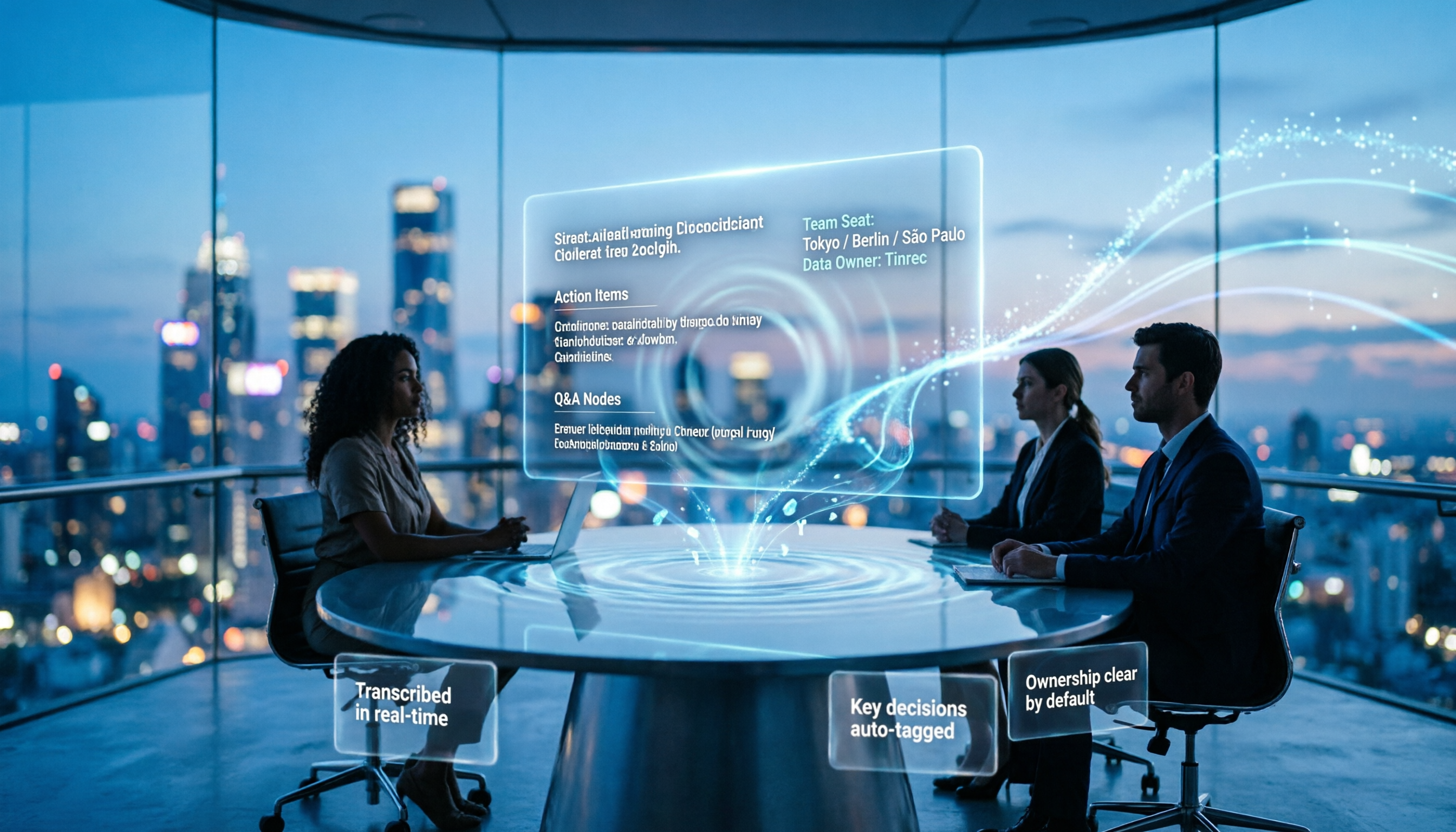
4 AI Meeting Note Tools Tested in 2026: Which One Saves the Most Time on Auto-Organizing Transcripts?
The pain of meeting notes isn't slow typing—it's time-consuming organization. This article addresses common misconceptions, tests 4 AI meeting note tools, breaks down key buying factors, Tinrec's bot-free recording and AI Q&A workflow, team plan seats and data ownership, plus a pitfalls guide and selection advice.
2026 Teams Meeting Transcription Comparison: 4 Methods Tested — Is Avoiding a Meeting Bot Really Easier?
Teams built-in transcription requires both the organizer and each user to enable the policy, and live captions are not saved—so many people only discover after the meeting that there is no transcript at all. This article reviews four ways to transcribe Teams meeting recordings, from Teams built-in, Otter.ai, and Notta to Tinrec, comparing bot-free desktop recording, AI Q&A, action item extraction, and team seat management, with a pitfalls guide and scenario-based recommendations.

4 Video-to-Transcript Tools Tested and Compared in 2026: 3 Pitfalls to Understand Before Importing Video
Importing a video to generate a transcript looks simple, but the real bottlenecks are usually format support, time codes, and how usage limits are calculated. This article starts with common misconceptions, outlines 4 key points for choosing a tool, then shares a hands-on test of Tinrec from video import to AI summaries, action items, and team knowledge retention, and compares TurboScribe, Notta, and Granola for use cases and pitfalls to avoid.

How to Transcribe Classroom Recordings in 2026: A Complete 5-Step Guide
When it comes to transcribing classroom recordings, most people only ask which tool is the most accurate. But what really determines whether you'll be overwhelmed all semester is the audio source, the classroom language, and the total number of hours. This article uses university and graduate school classroom scenarios to compare Tinrec and Otter.ai across 5 dimensions, and provides a 5-step process you can follow directly, along with purchasing advice.

How to Transcribe Zoom Meeting Recordings in 2026: No-Bot Recording + Automatic Meeting Minutes
Done with a Zoom meeting but still need to organize the transcript and minutes yourself? This guide covers the complete process for transcribing Zoom meeting recordings, including no-bot recording, real-time transcription, AI summaries and action items, AI Q&A, and 5 key points to consider when choosing a tool. It also demonstrates the workflow using Tinrec.

2026 AI Meeting Recorder Comparison: 4 Tools Tested for Chinese Meetings
Two-hour meetings followed by two hours of note organization is a daily reality for most office workers. This hands-on test of 4 AI recording and note-taking tools covers bot-free recording, Chinese transcription, AI Q&A, team knowledge retention, pricing, and limitations to help you decide which one is worth keeping.

5 Speaker Summary Tools Tested for 2026: Why Tinrec Is Less Work for Chinese Meetings
Starting from the question 'What exactly do you need a tool to do for you?', this hands-on comparison of common speaker summary tools explains how Tinrec performs in Chinese meeting transcription, bot-free online meeting recording, AI summaries and action items, AI chat queries, multi-format export, and team spaces. It also covers five key points to consider when choosing a tool and answers common questions.

2026 AI Meeting Notes: Automatic Speaker Identification + AI Q&A Summaries
Why do you still have to manually organize meeting transcripts even when speakers are automatically labeled? This article starts with common misconceptions about automatic speaker identification, breaks down 4 key dimensions for choosing a meeting notes tool, tests Tinrec's bot-free online meeting recording, AI summaries and Q&A, team spaces, and other features, compares it with Otter.ai, PLAUD Note, and Notta, and includes a pitfalls guide and buying advice.
4 Best AI Meeting Note Takers in 2026: Which One Actually Captures Action Items?
The hardest part of a meeting isn't recording it—it's turning two hours of discussion into an action list with names and deadlines. This article compares Tinrec, Otter.ai, Notta, and Granola across four key criteria: action item accuracy, AI Q&A, post-meeting workflow, and team data ownership. We explain who each tool is best for and highlight key buying considerations to help you choose the right tool and stop wasting time on manual transcripts.