

Turn recordings into transcripts and summaries in minutes
Upload audio or video for multilingual transcription, AI notes, and action items
How to Record Google Meet in 2026: 5-Step Tutorial and a No-Bot Solution
Have you ever been in a Google Meet meeting, searched everywhere, and just couldn't find the "Record" button? Most people's first reaction is to think they missed it, but the more common reason is that recording isn't enabled for their plan.
Google Meet native recording isn't available on every account—free personal accounts don't have it. Even if your company has Workspace, the recorded video still sits in Google Drive, and you still have to manually create transcripts, summaries, and action items.
This article uses 5 steps to show you how to record Google Meet without a bot using Tinrec desktop, and automatically organize it into searchable, queryable meeting materials afterward.
Tinrec is an AI meeting notes and collaboration tool that supports real-time audio-to-text transcription, bot-free online meeting recording, audio/video file transcription, real-time translation, and can generate summaries, chapters, action items, and mind maps.
What Can Google Meet Native Recording Do for You?
Google Meet built-in recording is suitable for users who already have an eligible plan and just want to save the meeting video. According to Google's official documentation, native recording requires an eligible Google Workspace or Google One plan (e.g., Business Standard or higher, Enterprise editions, or Google One 2TB or higher); free personal accounts cannot use it.
The host or co-host can start recording, the recording is saved to the meeting host's Google Drive, and participants receive notifications when recording starts and ends.
Note that native recording produces a video file—it does not automatically become a transcript, summary, or action item list. If you have to manually rewatch and organize after recording, you're spending extra time.
That's why many people turn to tools that handle both "recording + post-meeting organization." Tinrec plays the latter role in this workflow: it captures the meeting audio and organizes the content into usable materials.
What Are the Core Capabilities for Google Meet Recording?
Recording Google Meet with Tinrec isn't just about "capturing it"—it's about whether you can use it directly after recording. Here are 5 capabilities you'll actually use:
- Bot-free recording: Tinrec desktop directly captures your computer's system audio, so you don't need to invite a meeting bot to join Google Meet. Just have your meeting normally on your computer and start recording with Tinrec—no extra bot appears in the participant list.
- Real-time transcription and translation: Transcribe while recording, so you can see the transcript during the meeting. Supports Chinese, mixed Chinese-English, and multilingual content; switch between original, translated, or bilingual view for cross-language communication.
- AI summaries and chapters: After the meeting, Tinrec automatically generates summaries, chapters, and key points, so you don't have to watch long meetings from start to finish.
- Action item extraction and AI Q&A: Organize action items from discussions; you can also ask questions directly about the meeting content, such as "What did the participant say the deadline is next week?" or "What budget range did the client mention?"
- Export and team collaboration: Transcripts and summaries can be exported to Notion, Google Docs, OneNote, Dropbox, and other tools for continued use. The team version also stores meeting materials centrally in a team space, where admins can manage members, roles, seats, usage, and audit logs.
Practical Scenario: 5 Steps to Record Google Meet with Tinrec and Organize the Meeting
Step 1: First confirm your Google Meet native recording eligibility. If you have a free personal account, instead of looking for the button, switch to a desktop recording solution; if your company has Workspace recording permissions, also confirm host or co-host status, because not every participant can press record.
Step 2: Install Tinrec desktop and start recording after Google Meet begins. Tinrec captures computer system audio and doesn't require a bot to join. We recommend using headphones or checking your microphone and system audio settings to avoid recording ambient noise.
Stop organizing recordings by hand
Upload audio or video and automatically get a transcript, summary, and action items
Step 3: View the real-time transcript during the meeting. If the meeting includes foreign language content, enable real-time translation and use original, translated, or bilingual mode to confirm key points. Capturing text while the meeting is happening means you won't need to re-listen to the whole session afterward.
Step 4: Wrap up with AI summaries, chapters, and action items after the meeting. Tinrec organizes the meeting into summaries, chapters, and action items; when you need to follow up on details, use AI Q&A to ask about the meeting content directly—no manual searching through the video timeline.
Step 5: Export or save to team space. For personal use, export transcripts and summaries to your favorite tools; for team use, save meeting materials in the team space so members can share and view them, making future searches or handoffs easier.
5 Things to Consider When Choosing a Google Meet Recording Tool
- Plan eligibility and recording permissions: Google Meet native recording has plan requirements, and free accounts don't have it. Tinrec desktop doesn't require Google Workspace recording permissions—as long as meeting audio plays from your computer, you can record, which is friendlier for budget-conscious users.
- Whether a bot joins the meeting: Some meeting recording tools join as a bot, which may affect the meeting experience or require host approval. Tinrec uses system audio capture, so no extra participant appears—suitable for situations sensitive to meeting privacy and workflow.
- Post-meeting organization capabilities: Getting only a video file isn't enough—the key to saving time is whether it can transcribe, generate summaries, and extract action items. Tinrec puts transcription, summaries, chapters, action items, and AI Q&A in one workflow.
- Chinese and multilingual support: Users in Taiwan often encounter meetings with mixed Chinese and English. Tinrec supports Chinese, Traditional Chinese, and multilingual content, and offers real-time translation and team hotwords, which help with technical term recognition. Actual performance is affected by recording quality, accents, noise, and overlapping speakers—we recommend testing with actual meeting clips.
- Team management and data ownership: If a team shares meeting notes, consider whether data belongs to individuals or the team. Tinrec team version provides independent team spaces, member roles, seat management, usage analytics, audit logs, and an audio recycle bin; when a member leaves or loses a seat, team resources can be handed over to other active members, so data doesn't leave with the individual.
Frequently Asked Questions
Q1: Can I record Google Meet with a free account? A: Google Meet native recording requires an eligible Google Workspace or Google One plan; free personal accounts cannot use it. If you're on the free version, you can use Tinrec desktop to capture computer system audio for recording—no need for Google Meet's record button.
Q2: Do I need to invite a bot to record Google Meet with Tinrec? A: No. Tinrec desktop directly captures the meeting audio playing on your computer and does not join as a bot—no extra account appears in the participant list.
Q3: Does Tinrec automatically generate transcripts and summaries after recording? A: Yes. Tinrec supports real-time transcription and can generate summaries, chapters, and action items after the meeting, and you can use AI Q&A to follow up on details around the meeting content. For important information, we recommend cross-checking with transcript timestamps and recording playback.
Q4: Where can I export the recorded meeting materials? A: Transcripts and summaries can be exported to Notion, Google Docs, OneNote, Dropbox, and other common tools. Team version meeting materials are stored centrally in the team space for easy sharing and viewing by members.
Q5: What's the difference between Tinrec team and personal versions? A: Personal version data is managed by the individual account; the team version provides an independent team space where meeting data belongs to the team, plus capabilities such as members, roles, seats, sharing permissions, usage analytics, audit logs, and recycle bin. The team version's first eligible trial is 7 days, 1 free seat, and 300 minutes of team shared import quota; team monthly billing is USD 29.80/paid seat/month, annual billing is USD 199/paid seat/year (approximately USD 16.58/month), and each paid seat provides 2,000 minutes of team shared import quota per month. Real-time recording is currently not deducted by minutes under active team plans and seats. Actual prices and benefits are subject to the official purchase page.
Conclusion
Google Meet native recording has eligibility requirements, and the recorded video isn't the same as a ready-to-use meeting record. If what you want is "record it and then be able to search, summarize, and follow up on action items," Tinrec desktop's bot-free recording plus AI organization is more convenient than simple screen recording.
Individuals can start with the free version to experience the basic quota; if your team needs to share meeting materials, manage seats, and view usage, then consider the team version. Finally, remember to inform participants before recording and comply with local laws and company policies.
References
Turn every recording into actionable outcomes
Get 60 free transcription minutes when you sign in. No credit card required.
Related Reading
You might also like

Google Meet Recording in 2026: 3 Methods Compared — Why Tinrec Is Better for Post-Meeting Organization
How does Google Meet work? The free version supports up to 100 participants and 60-minute meetings, but transcription and Gemini notes are only available on select plans. This article breaks down Google Meet's operating logic and practical limitations, and compares Tinrec's differences in bot-free recording, post-meeting organization, cross-platform unification, and team knowledge retention.

2026 Comparison of 3 Google Meet Meeting Notes Tools: Which One Saves You Post-Meeting Cleanup Time?
Starting from actual Google Meet use cases, this compares three meeting note approaches: Google Meet built-in recording, Otter.ai, and Tinrec. It explains differences in bot-free recording, transcripts, summaries and action items, and team data retention, helping you decide which fits your work style.
2026 Complete Guide to Google Meet Links: 6 Ways to Create and Post-Meeting Organization
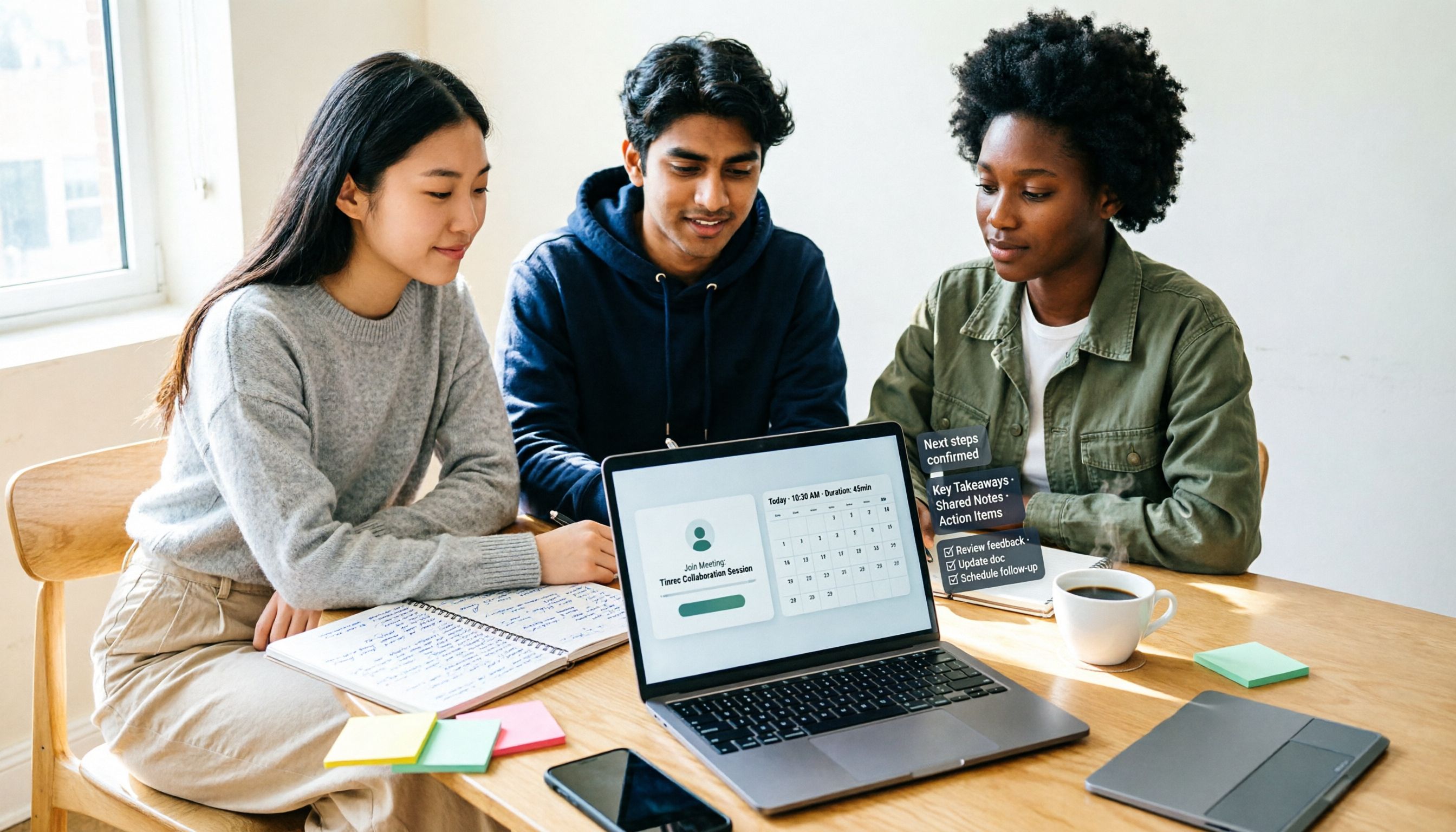
Starting from a real campus group project scenario, this guide thoroughly covers 6 methods to create Google Meet links, including desktop, mobile, Calendar, and Gmail entry points, and explains the difference between instant meeting links and scheduled meeting links. At the end, it explains how to use Tinrec after a meeting to turn transcripts, summaries, and action items into deliverable materials.

Google Meet Screen Sharing in 2026: Tab vs. Window vs. Entire Screen Compared
Sharing your screen in Google Meet may seem like a one-click task, but the three modes—tab, window, and entire screen—differ completely in audio, privacy risks, and ideal use cases. This side-by-side comparison breaks down the steps, sound settings, mobile differences, and common pitfalls for each sharing method, plus practical tips on how to capture and turn meeting content into searchable team knowledge after sharing.

Google Meet Recording in 2026: 3 Methods Tested and Compared — Which One Actually Preserves Your Meeting Record?
Google Meet's native recording isn't hard to find because the button is hidden — it's gated by three barriers: plan eligibility, admin controls, and file ownership. This article starts from where readers get stuck most often, explains the full prerequisites for built-in recording, and compares three alternative approaches — Tinrec, Otter.ai, and Granola — to help you decide which method fits which scenario.

3 Google Meet Note-Taking Tools Tested for 2026: Which Saves the Most Time in Video-Off Meetings?
You can join, see, hear, and speak in Google Meet without turning on your camera, but the real challenge is remembering what happened afterward. This article first covers 4 key settings before turning off video (join requirements, hiding tiles without video, profile picture, post-meeting notes), then tests and compares Tinrec, Otter.ai, Granola, and Notta in video-off Google Meet meetings, with 4 pitfalls to avoid and scenario-based recommendations.

Google Meet Time Limit in 2026: Free Extension Tips & Meeting Notes Workflow
Google Meet's free version isn't always limited to 60 minutes. This guide breaks down the real rules behind the time limit, three ways to extend meetings, and four common pitfalls. It also tests a bot-free recording and post-meeting organization workflow to help you decide whether to upgrade, restart the link, or switch to a different note-taking method.

How to Start a Google Meet Without a Host in 2026: 5-Step Guide
Can you start or join a Google Meet without the host present? This guide breaks down two common misconceptions, explains that join permissions are determined by the meeting creation settings—not by the host's presence—and compares Google Meet's built-in capabilities with Tinrec's bot-free meeting notes workflow across 5 dimensions. Includes 5 practical steps plus team plan seats, usage, and audit details.

6 Google Meet Note-Taking Tools Tested for 2026: Can You Get Transcripts Without a Meeting Bot?
After a Google Meet call, transcripts, action items, and decisions often go unorganized. This article reviews 6 note-taking tools that work directly with Google Meet, including Google Meet's built-in Gemini, Tinrec, Otter.ai, Fireflies.ai, Notta, and Granola, and lists free quotas and paid pricing honestly to help you decide which one best fits your workflow.