
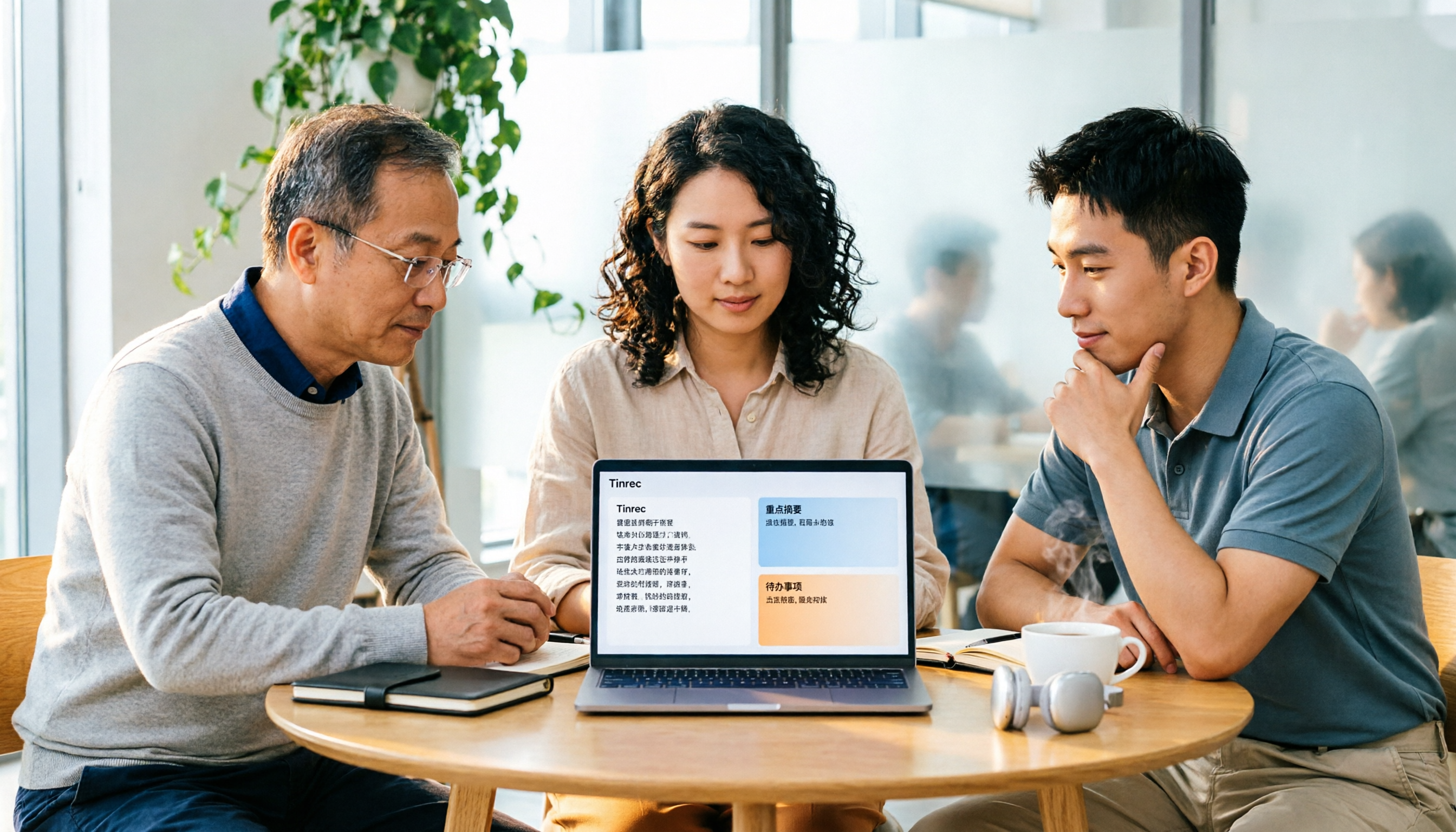
Turn recordings into transcripts and summaries in minutes
Upload audio or video for multilingual transcription, AI notes, and action items
2026 Audio-to-Text Tools Compared: ChatGPT Has Limits, Tinrec Better for Meeting Notes?
The meeting ended, but the transcript hasn't started—you don't need another recording file
Friday afternoon, you just finished a 90-minute client meeting. The recording sits quietly on your phone, and you just want to quickly toss it to ChatGPT to summarize the key points.
But after uploading, you discover: the file exceeds 25MB, and it doesn't directly give you a transcript with speaker labels.
More commonly, meeting recordings have Chinese, English, product names, and people's names mixed together. The transcribed text not only needs to be accurate but also quickly turn into summaries, action items, and searchable team data.
If you've encountered these situations, this article is for you.
Can ChatGPT transcribe audio? Understand these 4 key limitations first
Bottom line: ChatGPT can handle speech-to-text on some plans and devices, but it's not a universal "upload audio and get a one-click transcript" tool.
Currently, there are three common methods: ChatGPT Record on macOS desktop, Whisper API, and real-time voice dictation on mobile or web. Each method has different conditions and limitations.
Limitation 1: File size and length. ChatGPT's common 25MB limit is easily underestimated. A 60-minute, 128kbps MP3 meeting is about 57.6MB—more than double the limit—so you usually have to split it before uploading. Tinrec supports audio and video file transcription, saving you the manual file-splitting step for long meetings.
Limitation 2: Plan and device. The standard chat interface doesn't support direct one-click audio upload transcription; macOS desktop Record requires Plus, Pro, or Enterprise plans, and Whisper API requires obtaining your own key. Mobile mostly only offers real-time voice mode. Tinrec offers web, desktop, and mobile apps, and the desktop version can directly capture system audio to record online meetings.
Limitation 3: Output format and post-processing. ChatGPT's transcription may be a large block of unformatted plain text; you still have to prompt it for Traditional Chinese output and manually organize summaries and action items. Tinrec puts transcripts, AI summaries, chapters, action items, and Q&A into a single workflow.
Limitation 4: Multi-speaker and team collaboration. One of ChatGPT's biggest blind spots is that it cannot directly produce multi-speaker transcripts with speaker labels. A four-person, 90-minute client meeting often requires extra steps to map each segment to the right person. Tinrec focuses on post-meeting summaries, action items, and team sharing; if you need transcripts, we still recommend manual proofreading.
Simply put, if you only occasionally use real-time voice dictation, ChatGPT's free plan is worth a try; but if you have meeting recordings to organize every week, you need a tool that turns "transcription" into "actionable data."
Tinrec—our top choice after testing
Tinrec is an AI meeting notes and collaboration tool for individuals and teams, available on web, desktop, and mobile. Its positioning isn't just recording-to-text; it turns meetings into searchable, collaborative, actionable team data.
No bot needed for online meetings. Open Tinrec desktop, and it directly captures computer system audio, handling Zoom, Google Meet, Microsoft Teams, Webex, and other online meetings without an extra bot joining. For those who frequently have client meetings, this eliminates the awkward "please wait while I invite the recording bot" step.
Historical audio files become usable transcripts. If you already have MP3, M4A, WAV, or other recording files, you can upload them directly for transcription. After transcription, you not only get a transcript but also automatically generated summaries, chapters, and action items. The owners, deadlines, and decisions mentioned in the meeting can be organized into a follow-up checklist.
Ask follow-up questions after the meeting. Tinrec supports AI Q&A around meeting content. You can directly ask: "What were the client's main concerns?" or "What was the conclusion on the budget?" No need to Ctrl+F through thousands of words of transcript. It can also export results to Notion, Google Docs, OneNote, Dropbox, etc., or further generate reports, tables, and meeting minutes.
We tested with a mixed Chinese-English meeting recording, and the transcript, summary, and action items were all completed in the same interface; actual results will still be affected by recording quality, background noise, accents, and technical terms—we recommend verifying names and product names afterward. Tinrec also offers team hotwords to maintain commonly used team terminology, helping with recognition of specialized vocabulary.
Stop organizing recordings by hand
Upload audio or video and automatically get a transcript, summary, and action items
Advantage 1: Chinese and mixed Chinese-English meeting experience. For users in Taiwan, mixing Chinese and English in meetings is the norm. Tinrec can handle Chinese, Traditional Chinese, and multilingual meeting scenarios, and supports real-time translation and bilingual viewing.
Advantage 2: Complete post-transcription workflow. Many tools only give you a transcript; Tinrec also gives you summaries, chapters, action items, Q&A, and export. For those who need to write meeting minutes, track projects, or follow up with clients, it saves post-meeting organization time.
Advantage 3: Team data can accumulate. The team version provides an independent team space where meeting data belongs to the team, with management capabilities for members, roles, seats, usage analytics, audit logs, and audio recycle bin. The team version currently offers a 7-day trial, 1 free seat, and 300 minutes of shared import quota; monthly billing is USD 29.80 per paid seat per month, annual billing is USD 199 per paid seat per year, and each paid seat provides 2,000 minutes of shared import quota per month.
Limitations should also be clear. The free version is suitable for light usage; if you have many meetings every week, you still need to evaluate paid plans. Also, Tinrec does not promise a fixed accuracy rate; when recording quality is poor, multiple people talk over each other, or there are too many technical terms, transcription results still require manual proofreading.
If you frequently need to organize Chinese meetings, want to get summaries and action items directly after meetings, or want to accumulate meeting data for team use, Tinrec is a highly suitable option to try first.
Besides Tinrec, what other options are there?
ChatGPT: If your need is only occasional real-time voice dictation, ChatGPT's free plan works; but pre-recorded audio files cannot be uploaded for one-click transcription in the standard chat interface—you need macOS Record or Whisper API depending on your plan, and there's a 25MB limit. Its transcription is usually a block of plain text that doesn't automatically generate action items and a team database. Tinrec puts transcripts, summaries, action items, and team space into a single workflow.
Granola: A bot-free meeting notes tool, suitable for those who like to take notes during meetings. But Granola doesn't support uploading pre-recorded audio files and doesn't save meeting audio; if you have historical recordings to organize, it can't help. Tinrec supports audio and video file transcription and retains audio files, and can also answer follow-up questions about meeting content.
TurboScribe: A cost-effective file transcription tool focused on long files, batch uploads, and subtitle translation, suitable for processing large amounts of recording files at once. However, it's more of a file transcription tool, not a real-time meeting notes workflow; Tinrec excels at bot-free recording of online meetings, post-meeting summaries, action items, and team collaboration.
Pitfall Guide: The 4 most common mistakes when choosing an audio-to-text tool
Pitfall 1: Only looking at "can it transcribe," ignoring "can the output be used." ChatGPT can transcribe, but with plan, device, and file size conditions. The output may be a large block of plain text that you still have to manually organize. When choosing a tool, first ask yourself: Do I want a transcript, or meeting minutes I can send directly to my boss?
Pitfall 2: Ignoring the 25MB and length limits. A 60-minute MP3 can exceed 25MB. If you have to split files every time, it's a big time sink in the long run. Prioritize tools that can handle long meetings or at least have a smooth process.
Pitfall 3: Ignoring multi-speaker labels. For meetings with four or more people, transcripts without speaker labels are hard to read. ChatGPT still requires extra steps to map speech to people; if your meetings often involve multi-person discussions, pay special attention to this.
Pitfall 4: Keeping team data in personal accounts. If meeting recordings and transcripts only exist on personal devices, they can easily be lost when members leave or hand over. Team version tools should let data belong to the team and manage members, seats, and usage.
Conclusion: Which one should you choose?
In one sentence: ChatGPT can transcribe audio, but with conditions; if you want data you can use directly after meetings, Tinrec is more suitable.
- Need Chinese meetings, mixed Chinese-English transcription, and post-meeting summaries → Tinrec
- Want bot-free recording of Zoom, Meet, Teams online meetings → Tinrec desktop version
- Have historical audio to transcribe and want to ask follow-up questions → Tinrec
- Team needs to share meeting data, manage seats and usage → Tinrec team version
- Only occasional real-time voice dictation, no pre-recorded files → ChatGPT free plan is worth a try
We recommend starting with Tinrec's free version and trying it with a real meeting recording you have. If the summaries, action items, and Q&A fit your workflow, then consider upgrading—no need to pay from the start.
References
- Audio to Text: Did You Choose the Right Tool? | Jun's Salon
- Is ChatGPT Speech-to-Text Feasible? 3 Methods and Real Limitations (2026)
- Recording to Text Often Fails? Toss the Audio File to ChatGPT and Get Transcripts and Action Items in One Go | Manager Today
- Latest 2026: Solutions for ChatGPT Unable to Transcribe Speech and 3 Recommended Tools | AI Transcription Service—Mr. Transcription
- Can ChatGPT Transcribe Audio? 2026 Recording-to-Text Tool Review and Selection Guide - Tinrec Blog
Turn every recording into actionable outcomes
Get 60 free transcription minutes when you sign in. No credit card required.
Related Reading
You might also like

4 Best Transcription Tools in 2026: Yating, Tinrec Features & Free Tier Comparison
What is Yating Transcription? This article first explains its features, free quota, and pricing, then compares it with Tinrec, Otter.ai, and Notta. From recognition scenarios to post-meeting organization and team data ownership, it helps you decide which tool suits your meetings and workflow.

Tinrec vs Notta 2026: 5-Dimension Comparison — Which Audio-to-Text Tool Is Worth It for Students?
From university lectures and group discussions to final exam review, we tested and compared audio-to-text tools like Tinrec and Notta, covering five key buying factors: free quota, Chinese recognition, post-meeting summaries, AI Q&A, and team collaboration, to help students choose a truly usable transcription tool.

2026 Comparison of 5 Audio Transcription Tools: Free to Paid at a Glance
Starting from real decision points, this comparison covers Tinrec, Notta, Otter.ai, Granola, and TurboScribe's audio transcription capabilities, including live recording, file import, AI summaries and Q&A, team collaboration, and pricing plans—helping you choose the right tool instead of downloading another one.

AI Meeting Notes in 2026: Gemini Upload vs. Google Meet Built-in vs. Tinrec — Which One Is Enough?
Can Gemini take meeting notes? Yes, but it only handles transcription. This article breaks down the three most common mistakes when using Gemini for meeting notes, explains the version and language limitations of Google Meet's "Take notes for me," and demonstrates Tinrec's complete workflow — from bot-free recording and AI summaries to action item extraction and team knowledge retention — plus five key buying criteria and an FAQ.

5 Free Audio-to-Transcript Tools Tested: Which Free Tier Actually Works? (2026)
Turning audio into transcripts is less about whether it can be done and more about whether the free tier can handle a full file without constant re-listening and correction. This guide compares the free plans, workflows, and limitations of Tinrec, MyEdit, Google AI Studio, ChatGPT, and Canva, with a comparison table and recommendations. Information verified as of August 2026.

2026 AI Meeting Assistant Comparison: Summoning Is Easy, but Can It Write the Minutes?
Ever tried to call on AI mid-meeting only to waste time finding the entry point? This article first explains how to summon Google Gemini on desktop, Chrome, and mobile, then puts four meeting assistants—Tinrec, Otter.ai, Granola, and Notta—to the test, covering bot-free recording, transcript organization, AI Q&A, free tiers, and team seats.

4 Free Transcription Tools for 2026: Free Tiers and Meeting Notes Use Cases Compared
Can Gemini do transcription? Yes, and it works with a free account, but there are limits on file size, usage count, and post-meeting organization. Based on the real needs of a mid-level manager with 15 meetings per week, this article compares the free conditions, use cases, and limitations of Gemini, NotebookLM, TurboScribe, and Tinrec, and summarizes the 3 most common pitfalls when choosing a tool, helping you produce usable transcripts on a zero budget.

How Many Words Per Minute Is a Normal Speaking Rate in 2026? 5 Real-World Tests and Transcript Word Count Conversions
How many words per minute is a normal speaking rate? Chinese meetings and everyday conversations typically fall between 150-220 words per minute, while English is about 130-150 words. This article breaks down the differences using 5 real-world scenarios, explains why a single standard answer will make you miscalculate transcript length, and covers word count conversions for one-hour meetings, key points for choosing audio-to-text tools, and practical usage of Tinrec.

2026 Comparison of 4 Transcription Tools: Yating Only Exports Text, Audio Files Must Be Kept by Yourself
Yating Transcribe exports text files, not the original audio—this is the real reason many people can't find the 'export audio' button. Starting from this decision point, this article explains Yating's export process and formats, and compares Tinrec, Notta, and Otter.ai in terms of audio retention, post-meeting organization, and team collaboration to help you decide which one to use.