
Turn recordings into transcripts and summaries in minutes
Upload audio or video for multilingual transcription, AI notes, and action items
With the rapid development of artificial intelligence, Automatic Speech Recognition (ASR) has evolved from a simple dictation tool into an intelligent assistant that can understand semantics and summarize key points. Especially in Traditional Chinese application scenarios, facing regional accent differences, homophones, and the common code-switching between Chinese and English in the workplace, the new generation of AI models demonstrates remarkable adaptability. This article will give you an in-depth look at the current state of Chinese speech recognition and share how to apply it to daily work and content creation.
1. Technical Breakthroughs and Challenges of Chinese Speech Recognition
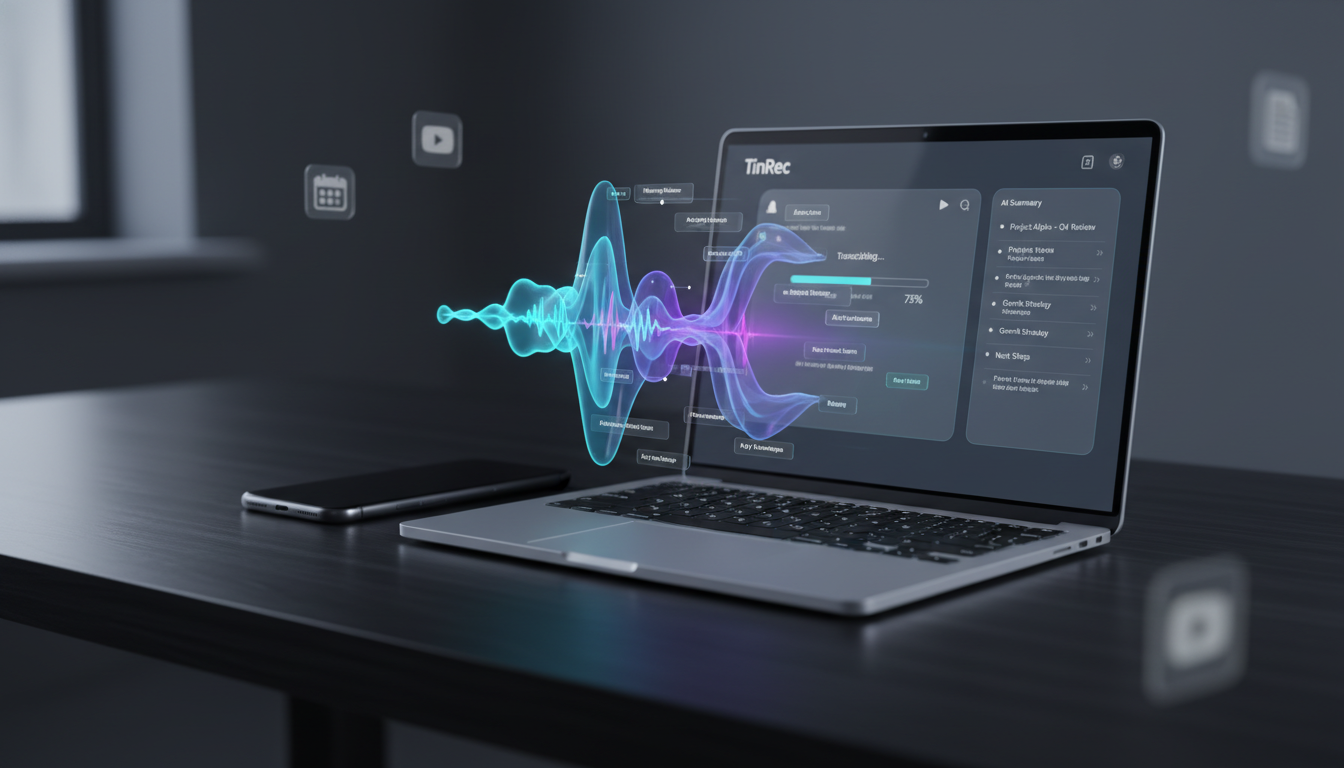
Compared to English, Chinese speech recognition faces unique challenges. First, there is the problem of homophones. A large number of homonyms in Chinese need to be judged based on context. Second, diverse accents, from standard Mandarin to Mandarin with Taiwanese or Hong Kong accents, test the generalization ability of algorithms.
In recent years, deep learning models based on the Transformer architecture (such as OpenAI's Whisper model and its variants) have significantly improved the recognition rate of "Chinese-English mixed" speech. Now, AI can not only accurately capture mixed sentences like "The project deadline is next Wednesday" but also automatically distinguish different speakers through speaker diarization technology, laying a solid foundation for automated meeting notes.
2. Workplace Applications: From Simple Transcription to AI Meeting Summaries
In the modern workplace, meeting minutes are often the most time-consuming and error-prone环节. Traditional voice recorders can save audio, but transcribing later is a nightmare. The new generation of speech recognition applications not only convert speech into verbatim transcripts but more importantly, they "understand."
AI meeting summaries have become key to improving team efficiency. Through natural language processing (NLP) technology, the system can automatically extract key decisions, action items, and assigned persons from a one-hour recording. This means you no longer need to replay the entire recording; just one minute reading the AI-generated summary gives you the meeting highlights.
Stop organizing recordings by hand
Upload audio or video and automatically get a transcript, summary, and action items
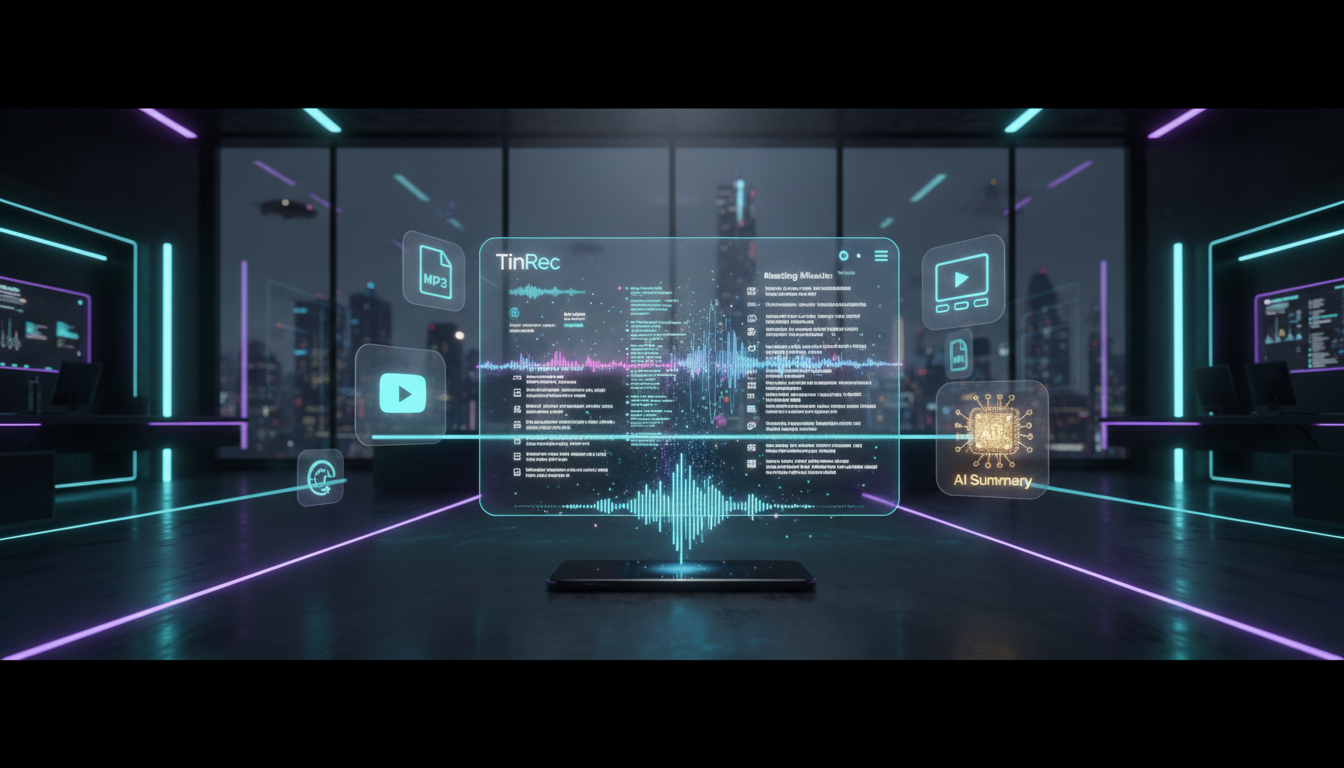
3. Solving Specific Pain Points: Call Recording and File Transcription
Besides face-to-face meetings, many business communications happen over phone or online calls. For scenarios like journalist interviews, business negotiations, or legal consultations, the demand for call recording to text is high. However, due to mobile system privacy policies, obtaining high-quality call recordings and converting them into editable text is not easy.
Among available solutions, TinRec is a tool worth noting, focusing on solving these specific audio processing pain points. Unlike general input methods that only provide real-time dictation, TinRec is designed to handle complete audio files and call recordings. Whether it's an interview recorded on a phone or an MP3 file on a computer, users can import it into the system for high-precision transcription.
Especially for MP3 to text needs, TinRec's advantage lies in its integration of advanced AI models that intelligently segment and format the recording content, directly generating AI meeting summaries. For researchers or journalists who need to organize large amounts of interview data, this is a significant time-saving tool. Its core functionality is tightly focused on "efficiency," freeing users from tedious transcription work.
4. A Boon for Content Creators: YouTube Subtitles and Video Post-Production

For YouTubers and video creators, adding subtitles is often the most tedious part of post-production. However, subtitles are crucial for SEO and improving viewer retention. The maturity of Chinese speech recognition technology has made YouTube subtitle generation easier than ever.
Modern tools can automatically generate SRT subtitle files with timestamps. Creators simply upload audio or video files, and the AI quickly produces a first draft of subtitles. At this point, the accuracy of the tool directly determines the time needed for proofreading. For example, TinRec, in addition to meeting summary features, also supports exporting transcriptions as subtitle formats, making it not only a business tool but also a workflow accelerator for content creators. Importing AI-generated subtitles directly into editing software or YouTube's backend can reduce the hours spent on subtitling to just tens of minutes.
5. Future Trends: Privacy and More Natural Interaction
Looking ahead, Chinese speech recognition technology will move toward lower latency, higher privacy protection, and more natural multimodal interaction. With the improvement of edge computing capabilities, more recognition processing can be done directly on the device, further ensuring data security.
In terms of tool selection, one-stop services that seamlessly integrate "recording," "transcription," "summarization," and "format output" will become mainstream. Whether for precise AI meeting minutes or rapid content production, choosing a tool like TinRec with comprehensive features and accurate recognition will be key to staying competitive in this information-explosion era.
Mastering speech recognition technology is not just about typing fewer words; it's about investing precious time in more creative thinking and decision-making.
Turn every recording into actionable outcomes
Get 60 free transcription minutes when you sign in. No credit card required.
Related Reading
You might also like

4 AI Transcription Tools Tested for 2026: Which One Saves the Most Post-Meeting Time?
A mid-level manager's hands-on review of AI transcription tools: converting speech to text is just the first step. The real key is whether it can automatically generate summaries, action items, and build a team knowledge base. This article shares 5 criteria for choosing an AI transcription tool based on real meeting scenarios, and how Tinrec solves post-meeting follow-up pain points with bot-free recording, AI Q&A, and team spaces.
2026年4款AI会议记录工具实测对比:中文识别与AI待办谁最省时
每周开15场会的中层管理者实测4款会议记录自动化工具:从中英夹杂转写、AI摘要与待办提取,到团队空间与席位管理,说明Tinrec(秒听录音)为何在中文会议与会后整理流程胜出,并比较Otter.ai、Granola、Notta各自适合谁、限制在哪里。

Tinrec vs Granola 2026: 5-Dimension Comparison for Turning Recordings into Actionable To-Dos
Many people think that handing a recording to AI and asking for a summary will automatically produce a to-do list, but what they get is text that can't be tracked. This article focuses on 'turning recordings into trackable to-dos' and compares Tinrec and Granola across 5 dimensions: Chinese to-do recognition, recording sources, to-do output format, AI follow-up questions, and team data retention. It includes practical steps and FAQs to help you decide which workflow to use.

2026 AI Meeting Summary Tools Compared: 4 Options from Free to Paid
Compare 4 AI meeting summary tools in 2026, covering free and paid plans, Chinese transcription, bot-free recording, and team collaboration. Tinrec is the top recommendation, with Otter.ai, Notta, and Granola also reviewed for their strengths and limitations, helping professionals find the right meeting summary tool.

Tinrec vs Otter.ai in 2026: A 5-Dimension Comparison for Chinese Meeting Notes
How do you choose meeting note software in 2026? This article compares Tinrec and Otter.ai across 5 practical dimensions, outlines how Notta and Granola differ, and includes common pitfalls and tips to help you find the right AI meeting notes tool for Chinese meetings and team collaboration.

4 AI Meeting Note Tools Tested for 2026: Which Saves the Most Time for Chinese Meetings?
Still spending two hours writing meeting notes after the meeting? This article compares four AI meeting note tools, breaking down Chinese and mixed Chinese-English recognition, meeting recording methods, post-meeting summaries and action items, cross-platform export, and team member management. It also lists four key pitfalls to avoid when choosing a tool, helping you find a solution that truly saves time.

2026 Guide: Convert Audio to Transcripts — Stop Typing Manually & Auto-Generate Meeting Minutes with AI
Don't want to type transcripts by hand? This guide covers two scenarios—live meetings and pre-recorded files—and outlines 4 key buying factors. We tested Tinrec's bot-free meeting recording, AI summaries, and Q&A workflow, compared Notta, Granola, and PLAUD, and included the most common pitfalls to avoid.

4 AI Recording Tools Tested for 2026: Which Saves the Most Time on Chinese Meeting Notes?
Recorded a meeting but never have time to organize it? This hands-on comparison looks at four common approaches—built-in phone features, free online tools, AI recording hardware, and dedicated AI meeting note tools—and tests Tinrec on Chinese meeting transcription, summaries, and action items. Includes 6 buying considerations and FAQs.

2026 Medical Meeting Transcription Tools Compared: Which AI Saves You the Most Time with Chinese Transcripts and Summaries?
For professionals juggling over a dozen meetings a week and still stuck with post-meeting notes, which tool should you use? This article dives into practical decision points, covering 5 key factors for choosing a medical meeting transcription tool. We tested Tinrec's bot-free recording, AI summaries, action item extraction, and AI Q&A, and briefly review alternatives like Notta, Otter.ai, and PLAUD. We also provide a guide to avoid common pitfalls and final recommendations.