

Turn recordings into transcripts and summaries in minutes
Upload audio or video for multilingual transcription, AI notes, and action items
4 AI Meeting Note Tools Tested for 2026: Which Saves the Most Time for Chinese Meetings?
It's 3 PM on a Wednesday, and a two-hour project meeting just ended. You return to your desk, open the recording on your phone, and prepare to start writing meeting notes—only to realize you can't remember who said what, so you have to listen from the beginning. By the time you finish, it's dark outside, and you have another meeting tomorrow.
Even more frustrating: the meeting covered a lot, but all that's left is a document no one will look at again. Who's responsible, when it's due, what was decided last time—all scattered in the conversation.
If you've been in this situation, this article is for you.
Still Spending Two Hours Writing Notes After a Meeting? The Real Problems Are These Three Things
Most people think the problem with meeting notes is "typing too slowly," but the actual bottlenecks are usually three.
First, the meeting moves too fast. The host speaks quickly, topics jump around, and as you listen and take notes, you only capture fragmented keywords.
Second, a transcript is not the same as meeting notes. Even if you convert the entire meeting recording to text, that transcript is usually long and messy. Who said what, which part is the conclusion—you still have to organize it yourself.
Third, notes don't turn into action. The finished file gets thrown into a shared folder, and no one goes back to check action items. What really should remain is "who will do what, and by when," not every single word.
In other words, what you need is not faster typing, but a process that filters meeting content into actionable signals.
Before Choosing an AI Meeting Note Tool, Understand These 5 Key Points
There are many tools on the market, but what works for others may not work for you. Here are five aspects I always look at when choosing a tool.
1. Chinese and mixed Chinese-English recognition performance. Meetings in Taiwan are rarely pure Chinese; they usually mix, like "give me this proposal by next Wednesday." When choosing a tool, I first throw in a recording of my own company's meeting to see if proper nouns and mixed sentences are correctly separated.
2. How the meeting is recorded. There are three common methods: a bot joins the meeting as a participant, desktop software directly records the computer's audio, or a recording hardware device is used. The first is the most convenient, but some companies don't like an unfamiliar account in the meeting room; the latter two don't disturb other participants.
3. What can be done after the transcript. A tool that only provides a transcript is like returning the organizing work to you unchanged. Whether it can automatically generate summaries, chapters, action items, and even let you ask questions directly about the meeting content is the key to saving time.
4. Can it connect back to your existing workflow? After writing notes, you should be able to export to Notion, Google Docs, OneNote, or your team's knowledge base, so you don't create another silo.
5. Free quota and team management. For personal use, check if the free quota is enough; if a department will use it together, look for member management, seat allocation, usage statistics, and audit logs.
Once you think through these five points, you'll find the choices are actually limited.
Tinrec—Our Top Recommendation After Testing
Tinrec is an AI meeting note and collaboration tool for individuals and teams. It not only converts audio to text but also organizes meetings into searchable, summarizable, queryable, and exportable data, making it especially friendly for Taiwan's mixed Chinese-English meeting scenarios.
First, its most unique feature: no meeting bot required. The Tinrec desktop app directly captures the computer's system audio, so for online meetings on Zoom, Google Meet, Microsoft Teams, Webex, you don't need to invite any extra bot into the meeting room. Just open the desktop app to record and generate a live transcript. Note that this does not mean it will automatically join all meetings on your calendar; you still need to start recording yourself.
The second practical part is real-time translation and bilingual transcripts. During international meetings, you can see the original text, translation, or bilingual view while recording. With the team hotwords feature, you can pre-load company-specific product names and project abbreviations into the dictionary to reduce the chance of mishearing technical terms.
Third, and what I think sets it apart most from ordinary transcription tools: post-meeting workflow. After the meeting, Tinrec automatically generates summaries, chapters, key points, and action items, plus a mind map to quickly scan the meeting structure. Even more useful is AI Q&A—you can directly ask it "how was the budget allocated in the last meeting?" It understands content semantically, rather than telling you to go back and Ctrl+F for keywords. When you need to deliver, it can generate reports, tables, and documents, and export to Notion, Google Docs, OneNote, Dropbox, etc., for further editing.
Stop organizing recordings by hand
Upload audio or video and automatically get a transcript, summary, and action items
For team use, Tinrec for Teams centralizes recordings, transcripts, summaries, and action items in one team space. Team resources belong to the team; when a member leaves, is removed, or loses their seat, the data is transferred to other active members and does not disappear with the individual account. Admins can set owners, admins, and regular members, allocate or revoke seats, view usage trends, member rankings, and details, and query and export audit logs. Deleted audio goes to the team recycle bin, currently retained for 30 days, and can be recovered before permanent deletion.
Pricing: Team plan is USD 29.80 per paid seat per month, or USD 199 per paid seat per year (about USD 16.58 per month). Eligible teams can try 7 days free with 1 free seat and 300 minutes of shared team import quota; paid seats provide 2,000 minutes of shared team import quota per month. Live recording currently does not deduct minutes; file and web link imports consume shared team quota. Individual users have a free version, weekly pass, Pro monthly, and Pro annual, depending on usage frequency.
Limitations to be honest about: First, Tinrec does not publicly promise a fixed accuracy rate; actual performance depends on recording quality, noise, accents, overlapping speech, and technical terms—a common situation for all speech-to-text tools. Second, team permissions are "team-level sharing"; all active members can read team data, and roles and seats control who can record, upload, and edit—not file-level granular permissions. Third, seats and members are two different things; members without a seat can view and listen but cannot upload or edit.
Who it's for: If your meetings are mainly in Chinese or mixed Chinese-English, you don't want a bot joining meetings, you want to ask AI directly for key points after recording, and you need to turn meeting data into team assets, Tinrec is one of the most suitable choices currently.
Besides Tinrec, What Other Options Are There?
Otter.ai: A mature choice for English business meetings. Free version has 300 minutes per month; Pro annual is about USD 8.49 per user per month, including 1,200 minutes per month. If your meetings are almost entirely in English, it's a cost-effective solution. However, Chinese-focused meeting minutes, mixed Chinese-English organization, and team hotword management are not its main scenarios; Tinrec is more aligned with the needs of Taiwanese teams for Chinese meetings, team hotwords, and post-meeting Agent output.
Notta: The competitor with the highest overlap with Tinrec. Free version has 120 minutes per month, max 3 minutes per session; Pro annual is about USD 8.17 per month (1,800 minutes), Business annual is about USD 16.67 per seat per month. Its multilingual transcription is good, but if you want desktop bot-free recording of online meetings plus AI Q&A and Agent post-processing around meeting content, Tinrec's workflow is more complete.
PLAUD Note/NotePin: Representatives of AI recording hardware. NotePin is USD 159, Note Pro USD 189; subscription plans: Pro USD 99.99 per year (1,200 minutes per month), Unlimited USD 239.99 per year. Its advantage is portability and ability to record phone calls, but you need to carry an extra device and pay for hardware. Tinrec requires no hardware; it works on phone, desktop, and web, and can handle online meetings and existing recordings together.
Pitfall Guide: The 4 Most Common Mistakes When Choosing an AI Meeting Note Tool
Pitfall 1: Only looking at the official claimed accuracy rate. Many tools claim "98% accuracy," but that's usually measured in a quiet environment with standard accents. Real meeting rooms have air conditioning noise, keyboard sounds, and people talking over each other, so performance will be lower. Test with your own meeting recordings, not just advertising numbers.
Pitfall 2: Thinking a transcript equals meeting notes. A transcript is just a draft. AI can still make mistakes with proper nouns, accents, and tone, and using it directly for external communication is risky. Important conclusions should be verified against the transcript timestamps and recording playback.
Pitfall 3: Ignoring how the meeting is recorded. If a tool requires a bot to join the meeting, it will be a problem with external clients or strict security requirements. Desktop system audio recording without extra hardware is usually the least disruptive approach.
Pitfall 4: Buying a tool but not connecting the results back to your workflow. Using a transcription tool only as "audio to text" means you're only using one-third of its value. Export action items to task management tools and put summaries into your team knowledge base, so meeting notes actually drive things forward.
One final reminder: recording and transcription involve personal data. Before use, confirm compliance with local regulations and obtain participant consent when necessary.
Conclusion: Which One Should You Choose?
In one sentence: if you want "usable notes right after the meeting" rather than "organizing them yourself after the meeting," then tools with post-meeting organization and AI Q&A will save the most time.
- Chinese or mixed Chinese-English meetings, no meeting bot → Tinrec (desktop captures system audio, supports real-time translation and bilingual)
- Want to ask AI directly for conclusions and action items after recording → Tinrec (AI Q&A plus action items, chapters, mind map)
- Need to organize phone, computer, and existing recordings together → Tinrec (phone, desktop, web multi-platform, supports file import)
- Department needs to share meeting data, manage members and usage → Tinrec Team (team space, roles and seats, usage analytics, audit logs)
- Meetings almost entirely in English, limited budget → Otter.ai (this is its best scenario, and the only exception recommendation in this article)
Tinrec has a free version to try first; if it meets your needs, consider a weekly pass or Pro—no need to pay for a whole year at once. Try it with one real meeting, and you'll know if it can save you those two hours.
References
- How to use AI for meeting minutes? How to organize meeting transcripts? | AI speech-to-transcript tutorial | 104 Career Power
- Top AI meeting note tools for 2026, time-saving must-haves for meetings!
- Meeting Ink - AI meeting note assistant automatically transcribes and summarizes meeting minutes
- Organizing meeting minutes is painful? 5 NotebookLM AI note transformation tricks, accurate translation even with mixed Chinese-English and technical terms | BusinessNext
- AI meeting note organization tips! 6 steps to use Gemini Notebook and prompt templates, speech-to-text, mixed Chinese-English no problem | 104 Career Power
Turn every recording into actionable outcomes
Get 60 free transcription minutes when you sign in. No credit card required.
Related Reading
You might also like

2026 Guide: Convert Audio to Transcripts — Stop Typing Manually & Auto-Generate Meeting Minutes with AI
Don't want to type transcripts by hand? This guide covers two scenarios—live meetings and pre-recorded files—and outlines 4 key buying factors. We tested Tinrec's bot-free meeting recording, AI summaries, and Q&A workflow, compared Notta, Granola, and PLAUD, and included the most common pitfalls to avoid.

4 AI Recording Tools Tested for 2026: Which Saves the Most Time on Chinese Meeting Notes?
Recorded a meeting but never have time to organize it? This hands-on comparison looks at four common approaches—built-in phone features, free online tools, AI recording hardware, and dedicated AI meeting note tools—and tests Tinrec on Chinese meeting transcription, summaries, and action items. Includes 6 buying considerations and FAQs.

2026 Medical Meeting Transcription Tools Compared: Which AI Saves You the Most Time with Chinese Transcripts and Summaries?
For professionals juggling over a dozen meetings a week and still stuck with post-meeting notes, which tool should you use? This article dives into practical decision points, covering 5 key factors for choosing a medical meeting transcription tool. We tested Tinrec's bot-free recording, AI summaries, action item extraction, and AI Q&A, and briefly review alternatives like Notta, Otter.ai, and PLAUD. We also provide a guide to avoid common pitfalls and final recommendations.
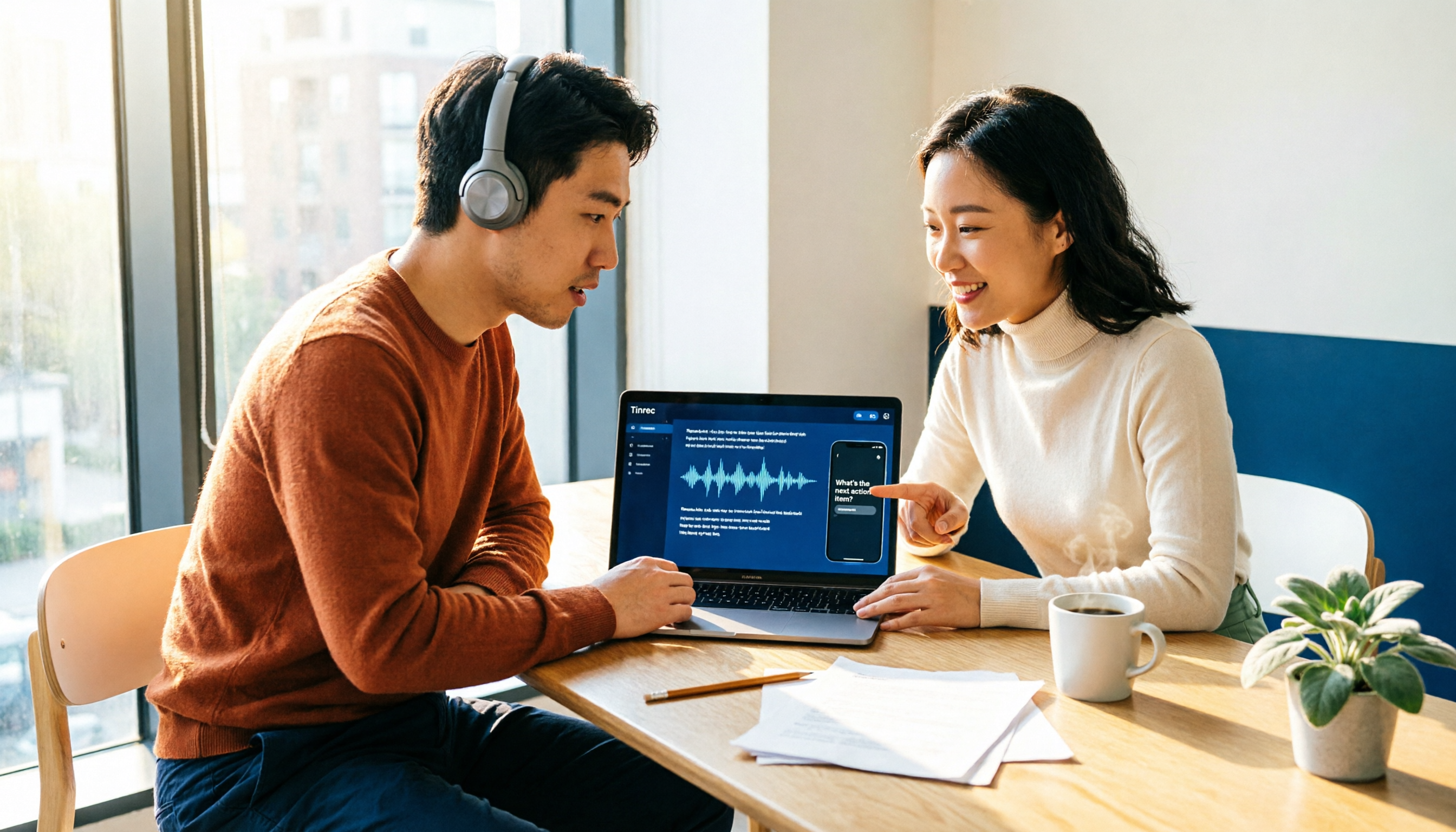
How to Choose an Automatic Transcription Tool in 2026: 5 Steps to Compare Yating Transcription and Tinrec
How do you choose an automatic transcription tool? Starting from the actual checklist I use when picking tools, I compare Yating Transcription and Tinrec across five dimensions, covering online meeting recording methods, post-meeting organization depth, AI Q&A, cross-platform team collaboration, and quota pricing, to help you determine which one better fits your workflow.

4 Best Audio-to-Text Apps in 2026: Which One Actually Saves You Post-Meeting Time?
A mid-level manager who attends 15 meetings a week shares hands-on experience. From online meeting recording methods and transcription performance for Chinese and mixed Chinese-English to post-meeting summaries and action item organization, this breaks down the differences among four types of audio-to-text apps and explains how Tinrec uses bot-free recording, AI summaries, action item extraction, and team spaces to turn meetings into searchable, collaborative, actionable data.
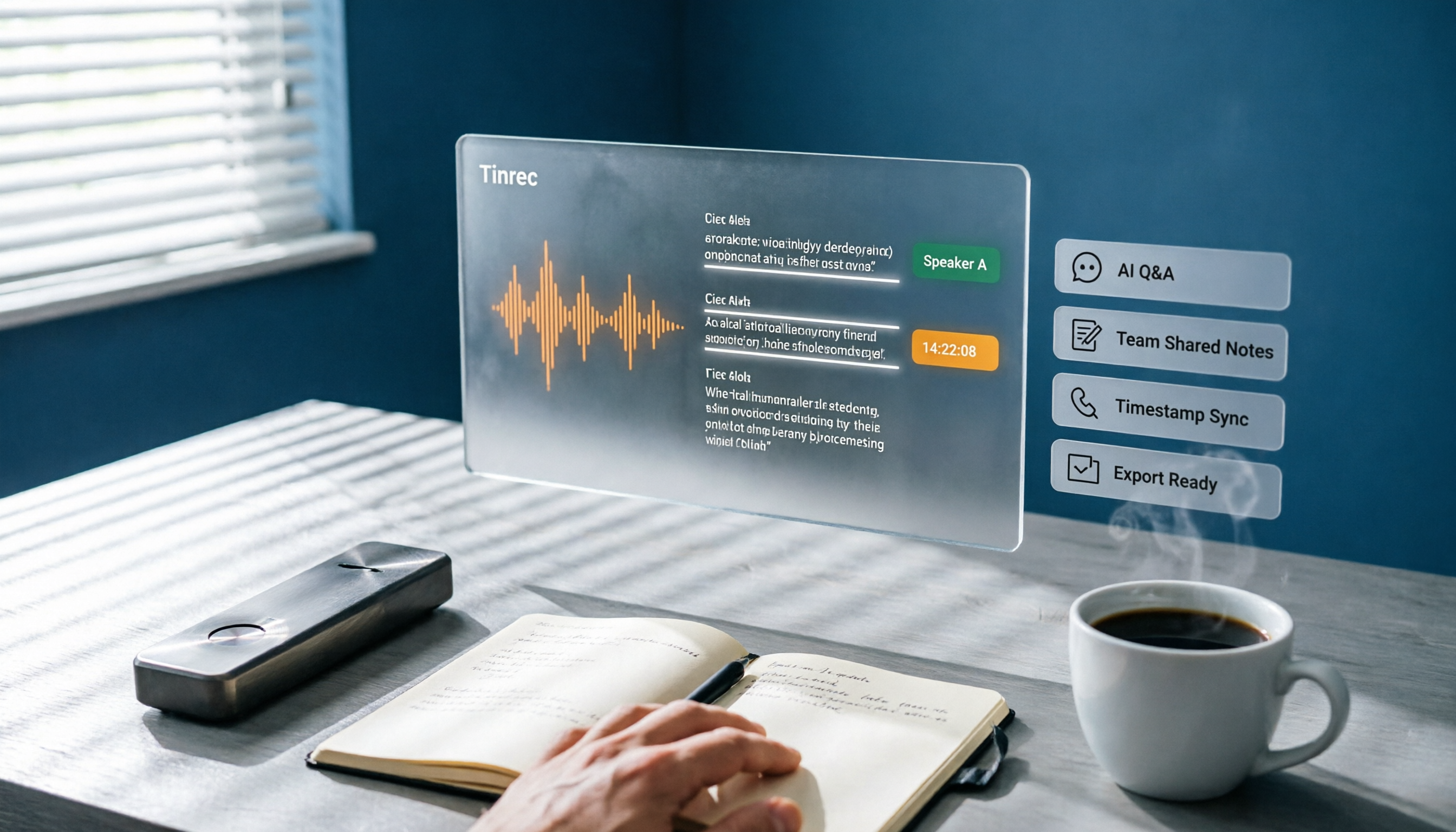
4 Interview Transcription Tools Compared in 2026: From Recording to Citable Text
After an interview, organizing the transcript often feels more exhausting than the interview itself. This article starts from 'recording to citable text' and compares 4 interview transcription tools, covering speaker labeling, AI Q&A, audio retention, and team sharing, plus common pitfalls and selection advice.

Tinrec vs Notta 2026: 5-Dimension Comparison for Chinese Meeting Transcription Tools
Starting from the decision focus of 'Do you want transcription, or usable meeting data?', this article compares Tinrec and Notta across 5 dimensions, covering selection criteria, a full breakdown of Tinrec, other options, and pitfalls to avoid, helping Chinese meeting users make a quick choice.

5 Transcription Tools Tested and Compared in 2026: Transcription Takes Too Long—Which One Actually Saves Time?
Transcription takes too long, and the problem is often not typing speed but the "listen, type, re-read" workflow. This article tests 5 transcription and AI meeting note tools, covering how to judge accuracy, post-meeting organization, audio retention and export, free quotas, and team seat licensing. It provides criteria you can follow directly and analyzes Tinrec's actual performance in bot-free recording, AI Q&A, and team knowledge retention.

2026 Comparison of 3 Audio-to-Transcript Tools: Which Offers the Best Free Tier and AI Q&A?
Just finished a meeting and realized no one took notes? Replaying the recording to type a transcript can eat up an entire afternoon. This article compares 3 audio-to-transcript tools, breaking down Chinese and mixed Chinese-English recognition, online meeting recording methods, AI summaries and Q&A, cross-platform use, and quota pricing. We also highlight 4 common pitfalls to help you choose a solution that truly saves time.