

Turn recordings into transcripts and summaries in minutes
Upload audio or video for multilingual transcription, AI notes, and action items
4 Best Audio-to-Text Apps in 2026: Which One Actually Saves You Post-Meeting Time?
When choosing an audio-to-text app, most people first look at "how many languages does it support" and "what's the accuracy rate." But after testing a round myself, I found the real questions to ask first are these three:
- Are your meetings online or in person?
- Do you just need a transcript, or do you want summaries and action items organized for you too?
- Will you use this data alone, or does your team need to search it together?
Once you answer these three questions, you'll probably know which type of tool to look at.
I'm a mid-level manager leading a team of 10, with about 15 meetings a week—weekly meetings, project progress meetings, one-on-ones, cross-department coordination. What used to bother me most wasn't the meetings themselves, but afterward: three decisions, seven action items, and I'd still be organizing meeting notes at 8 p.m.
During this time, I tried all four mainstream types of tools on the market. The first I used was an AI assistant focused on English business meetings. It was mature, but our meetings often mix Chinese and English, and its recording method was to have a meeting bot join the meeting—having an unfamiliar account in an external client meeting made me uncomfortable. Later I switched to a service focused on cost-effective file transcription. It was great for long audio files, but it essentially only gave you a transcript; summaries and action items were still up to you. In between, I also tried using my phone's built-in speech-to-text. It was enough during the meeting, but completely useless for post-meeting organization. In the end, what stayed was Tinrec, and I'll explain why later.
What Can an Audio-to-Text App Do for You?
Scenario 1: Get meeting notes within five minutes after the meeting Previously, after a two-hour meeting, you might spend another hour organizing. Now, with Tinrec as an example, the transcript runs while the meeting is happening, and after the meeting AI directly generates a summary, chapters, and action items—who's responsible for what, when it's due, all clearly listed.
Scenario 2: When reporting to your boss, you can find last time's conclusion "Who proposed that budget last time? What was the conclusion?" These questions are the worst when you flip through notes for three minutes and still can't find it. Tinrec's AI Q&A lets you directly ask: "Which meeting mentioned the budget adjustment?" It will answer based on the meeting content, without you having to search cell by cell.
Scenario 3: Tasks assigned to subordinates no longer get "forgotten after verbal instructions" Verbal instructions have no record. Two days later when you ask, the other person says they forgot, and you have no evidence. Record a segment with Tinrec, and action items are automatically extracted, with responsibility and deadlines on record.
Scenario 4: After cross-department coordination, follow-up has evidence What takes the most time in cross-department work is never the communication itself, but the confirmation and follow-up after communication. Keep the transcript, and who promised what in the meeting can be checked back anytime.
What Are the Core Capabilities of an Audio-to-Text App?
Real-time transcription: Transcribe while recording, not process after recording. Tinrec supports real-time audio-to-text, so in offline meetings and interviews you can see the text on the spot. If you notice a missed point, you can ask right away, instead of discovering a missing section after the meeting.
Bot-free online meeting recording: This is something I especially care about. Tinrec's desktop version directly captures computer system audio, used for Zoom, Google Meet, Microsoft Teams, Webex, and other online meetings, without inviting a meeting bot as a participant. For external meetings, whether the participant list is clean is actually part of professional image.
AI summaries and chapters: It's not condensing the transcript into one paragraph, but structured organization—meeting topic, discussion highlights, conclusions, and action items listed separately. Long meetings are split into chapters, so you can jump directly to the section you care about.
Action item extraction: Pull action items out of the discussion. This is the feature I use most, because it directly corresponds to the progress I need to track each week.
AI Q&A: After transcription is complete, you can continue asking questions. Historical meetings are no longer static files, but a body of data you can query.
Real-time translation and multi-format export: For cross-language meetings, you can view the original, translation, or bilingual content; the organized results can be exported to Notion, Google Docs, OneNote, Dropbox, and other existing workflows, and Agent post-processing can generate reports, tables, and documents.
Team space: If meeting data is used by more than just you, Tinrec's team version provides an independent team space. Meeting data belongs to the team, new members can view historical data, and when members change, data doesn't leave with the individual.
Stop organizing recordings by hand
Upload audio or video and automatically get a transcript, summary, and action items
Practical Use Cases
Weekly meetings and project progress meetings This is the most standard use. Turn on Tinrec desktop version to record during the meeting, and summaries and action items are generated directly afterward. My habit is to spend two minutes before the meeting ends to go over the action item owners and deadlines, so I don't have to re-listen to the recording the next day.
Cross-department coordination and decision meetings The value of these meetings is the "basis for decisions." Record with Tinrec, save the transcript and summary in the team space, and later when asked "why was this decided back then," you can find it by searching keywords.
Customer interviews and requirement discussions Customer needs, concerns, and commitments are scattered throughout an hour-long conversation. After transcribing with Tinrec, the AI summary organizes the key points, and you can export it as a document for the team, much more complete than handwritten notes alone.
One-on-one meetings The biggest fear in managing people is misremembering. Record key points during the meeting, organize them into action items afterward—who needs to improve what skill, what to follow up on next time—all on record, so it doesn't become "I remember you said last time..."
Courses and online lectures To organize a two-hour online course, Tinrec can handle audio and video files, and can also import some public web content, converting it into transcripts, summaries, and key points, so you can review by reading text directly.
5 Things to Note When Choosing an Audio-to-Text Tool
1. Can it be used after transcription A transcript is just raw material. What you need to ask is: can it then help you organize into summaries, chapters, action items? With Tinrec as an example, after transcription you can continue with summaries, action item extraction, AI Q&A, and even generate reports and tables—the time savings are here, not in the transcription itself.
2. Performance with Chinese and mixed Chinese-English Our meetings often mix Chinese with English technical terms. Tinrec covers Chinese, Traditional Chinese, and multilingual meeting scenarios, and supports team hotwords, so you can add company-specific terminology to improve recognition of professional vocabulary. Actual results are affected by recording quality, noise, accents, multiple people speaking at once, and technical terms. For important content, it's recommended to check back against the recording.
3. How to record online meetings Having a meeting bot join has its own perception and permission issues. Tinrec takes a bot-free approach: the desktop version captures system audio, and you decide when to start recording and which meeting to record, rather than all meetings being automatically recorded.
4. Data ownership and team collaboration If data is shared by the team, check whether it has a team space, member and seat management, usage analytics, and audit logs. Tinrec's team version separates "roles" and "seats": roles determine who can manage the team and settings, seats determine who can record, upload, edit, import, and export; members without seats can still view, play, and read team data.
5. Quotas and pricing The free version provides basic quota, suitable for occasionally organizing a recording and experiencing the process first; short-term intensive use (e.g., project sprints, interview weeks) can consider a weekly card; for regular weekly use, Pro monthly or annual is more reasonable. The team version is currently USD 29.80 per paid seat per month, or USD 199 per paid seat per year, equivalent to about USD 16.58 per month. Each paid seat provides 2,000 minutes of team shared import quota per month; under an active team plan and seats, real-time recording is currently not deducted by minutes. Actual prices, currencies, and promotions are subject to the official purchase page.
FAQ
Q: What accuracy can an audio-to-text app achieve? It's not advisable to trust any fixed number. Actual performance depends on recording quality, noise, accents, overlapping speakers, and technical terms. A reasonable expectation is: it saves you 80% of the mechanical typing work, but important numbers, names, and conclusions still need to be checked against the recording.
Q: Does Tinrec require installing a meeting bot? No. Tinrec's desktop version directly captures computer system audio to record Zoom, Google Meet, Microsoft Teams, Webex, and other online meetings, without an extra bot account appearing in the participant list.
Q: Is the free version enough? The free version provides basic quota, suitable for occasionally organizing a recording and experiencing the full process first. If, like me, you have a dozen meetings a week and need to produce notes almost every day, then go straight to Pro or the team version, so you won't get stuck on quota.
Q: What's the difference between the team version and sharing one account among multiple people? The team version is an independent team space. Meeting data belongs to the team, and you can manage members, roles, seats, usage, and audits. When a member leaves, is removed, or loses a seat, resources are handed over to other active members, not taken away by the individual.
Q: Are there legal issues with recording? Regulations vary by location. Before recording and transcribing, you should comply with local laws and obtain participant consent when needed.
Conclusion
Back to the three questions at the beginning: online or offline, just a transcript or post-meeting organization, personal use or team sharing. Once you think these three things through, you'll know which type of tool to look at, instead of being led by "how many languages it supports."
In my own situation—a dozen meetings a week, reporting upward and tracking downward—what stayed in the end was Tinrec. The reason isn't complicated: it doesn't need a bot in the meeting, it's good enough for Chinese meetings, summaries and action items are generated directly afterward, and meeting data can settle in the team space, becoming an asset that can be searched and queried. There are many transcription tools, but the one that saves me the most post-meeting time is this type.
References
- No time limit! 3 free AI transcript tools, highly recommended! AI voice notes generate meeting records, presentations, mind maps | 104 Workplace Power
- SoundType AI ultra-accurate transcripts, speech to text, AI dictation - Google Play app
- Real-time speech-to-text app recommendations 1. iPhone/iPad "Notes" app supports real-time text conversion, free, supports Chinese and English
- Tested 4 best "speech to text" online tools, free instant audio file to transcript
- Must-see in 2026! 4 AI audio-to-text tool recommendations: meeting notes, podcast transcript神器 review - Mobile01
Turn every recording into actionable outcomes
Get 60 free transcription minutes when you sign in. No credit card required.
Related Reading
You might also like
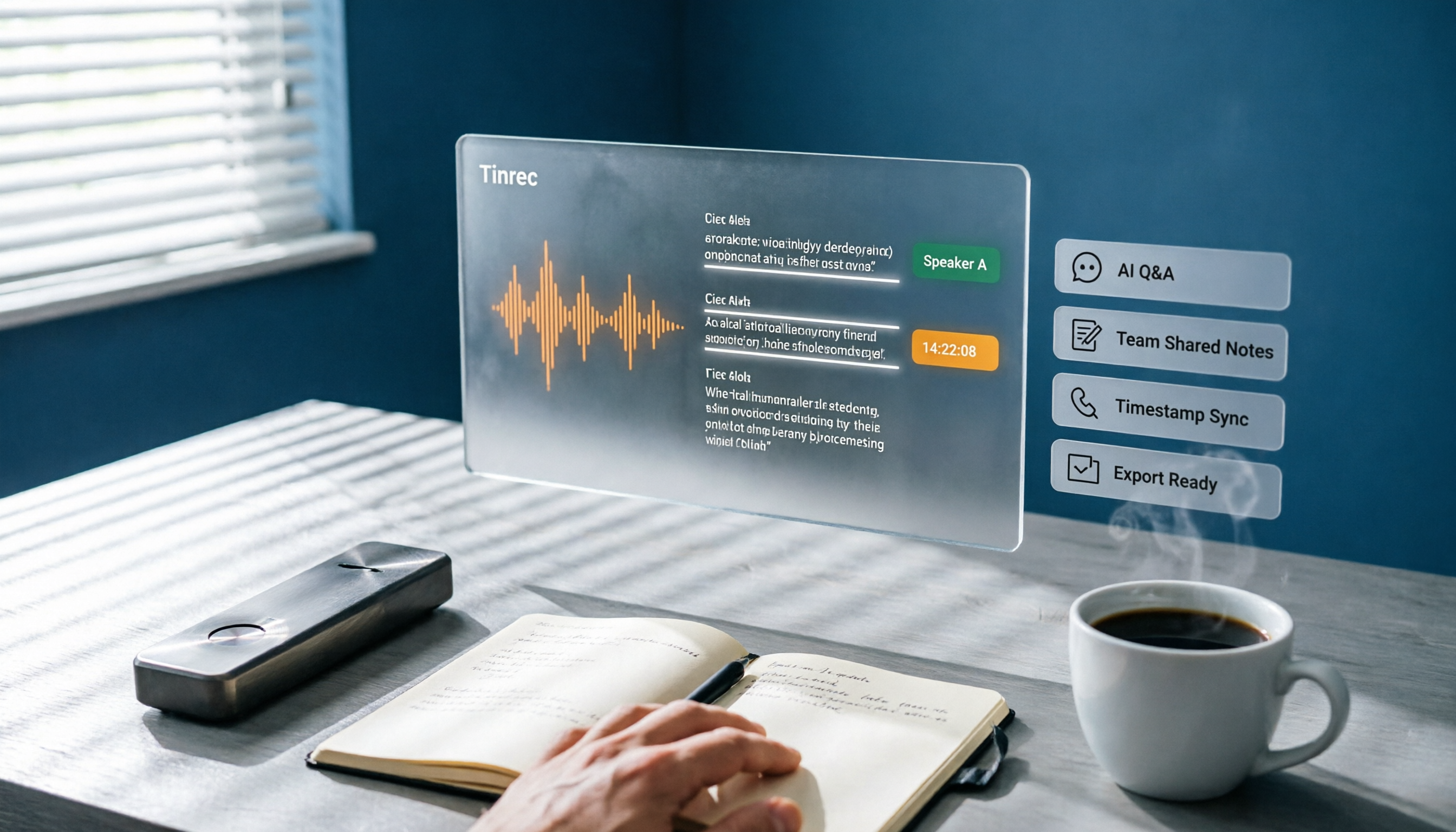
4 Interview Transcription Tools Compared in 2026: From Recording to Citable Text
After an interview, organizing the transcript often feels more exhausting than the interview itself. This article starts from 'recording to citable text' and compares 4 interview transcription tools, covering speaker labeling, AI Q&A, audio retention, and team sharing, plus common pitfalls and selection advice.

Tinrec vs Notta 2026: 5-Dimension Comparison for Chinese Meeting Transcription Tools
Starting from the decision focus of 'Do you want transcription, or usable meeting data?', this article compares Tinrec and Notta across 5 dimensions, covering selection criteria, a full breakdown of Tinrec, other options, and pitfalls to avoid, helping Chinese meeting users make a quick choice.

5 Transcription Tools Tested and Compared in 2026: Transcription Takes Too Long—Which One Actually Saves Time?
Transcription takes too long, and the problem is often not typing speed but the "listen, type, re-read" workflow. This article tests 5 transcription and AI meeting note tools, covering how to judge accuracy, post-meeting organization, audio retention and export, free quotas, and team seat licensing. It provides criteria you can follow directly and analyzes Tinrec's actual performance in bot-free recording, AI Q&A, and team knowledge retention.

2026 Comparison of 3 Audio-to-Transcript Tools: Which Offers the Best Free Tier and AI Q&A?
Just finished a meeting and realized no one took notes? Replaying the recording to type a transcript can eat up an entire afternoon. This article compares 3 audio-to-transcript tools, breaking down Chinese and mixed Chinese-English recognition, online meeting recording methods, AI summaries and Q&A, cross-platform use, and quota pricing. We also highlight 4 common pitfalls to help you choose a solution that truly saves time.
Tinrec vs Notta 2026: 5-Dimension Comparison — Which Writes Meeting Minutes Faster?
Struggling to finish meeting minutes? The problem is usually the process, not your writing. This article compares Tinrec and Notta across 5 dimensions: audio capture method, Chinese and mixed Chinese-English recognition, recording retention, post-meeting outputs, and team sharing. It explains how to use tools to get transcripts, summaries, and action items done in one go, with a pitfalls guide and selection advice.

3 Legal Meeting Transcription Methods Tested in 2026: How Tinrec Helps You Avoid Common Pitfalls
Transcribing legal meeting recordings isn't as simple as dropping audio into a tool. This article explores common pitfalls and explains how Tinrec turns pre-trial meetings, client interviews, and internal discussions into searchable, queryable, and actionable transcripts and meeting materials. It also covers 5 key factors to consider when choosing a transcription tool.

4 Customer Interview Transcription Tools Tested in 2026: Which One Actually Saves You Cleanup Time?
Tired of spending hours on customer interview transcripts? We tested 4 tools, covering selection criteria, an in-depth look at Tinrec, and pitfalls to avoid, to help you find a transcription solution that truly saves you cleanup time.

2026 M4A to Text: 5 Tools Tested + AI Summaries and Action Items in One Go
M4A is the most common audio recording format, but converting it to text is just the first step. This article starts with common pitfalls, breaks down 5 key factors for choosing an M4A-to-text tool, tests how Tinrec turns an M4A file into a transcript, summary, action items, and queryable meeting data, and briefly reviews TurboScribe, Notta, and Granola for their use cases and things to watch out for.
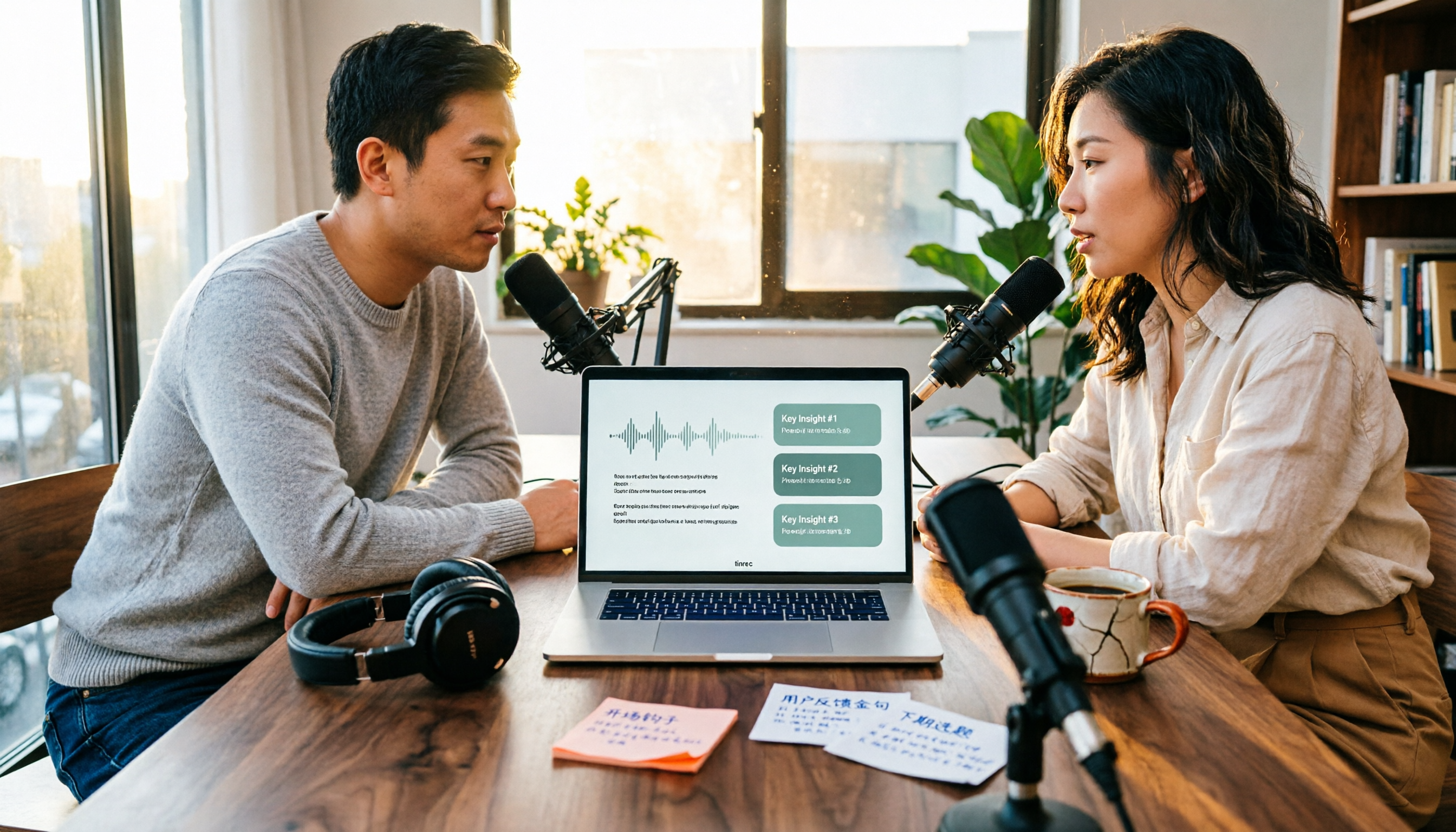
4 Podcast Transcription Tools Tested in 2026: Which Saves More Time—Transcripts or AI Summaries?
The same podcast audio file yields completely different results when run through four tools. This hands-on test compares Tinrec, Apple Podcasts' built-in transcripts, Notta, and TurboScribe, covering transcript readability, AI summaries and Q&A, export formats, and team collaboration. We also highlight common pitfalls around free quotas and per-file limits to help you find the most time-saving podcast transcription workflow.