

Turn recordings into transcripts and summaries in minutes
Upload audio or video for multilingual transcription, AI notes, and action items
4 Podcast Transcription Tools Tested in 2026: Which Saves More Time—Transcripts or AI Summaries?
Why Can't You Ever Finish Editing Your Podcast Transcripts?
Most people think the pain point of podcast transcription is "inaccurate recognition," but what really holds you back is usually the step after recognition.
Built-in transcripts let you "see the content," but they won't help you turn it into episode summaries, notes, or articles. If you want to paste the transcript into a blog, you have to copy it section by section. Not to mention episodes with mixed Chinese and English, Cantonese interviews, or two people talking over each other—the text comes out scattered, and aligning it back to the timeline is more tiring than listening again.
In other words, what you're missing isn't a text file, but a workflow that goes from "audio in" to "usable data out." This article uses the same episode audio to test how four tools differ.
5 Key Points to Understand Before Choosing a Podcast Transcription Tool
1. Can the transcript be used directly afterward? Transcribing text is just the first step. Whether it can automatically provide summaries, chapters, to-dos, or even let you ask questions about the content determines whether you spend 10 minutes or 1 hour wrapping up.
2. Is the input source broad enough? Your show might be a live recording, a file recorded on your phone, or a video file. How many types of materials the tool can handle determines whether you need to switch tools for different sources.
3. Mixed Chinese-English and speaker identification. Taiwanese shows often mix Chinese and English in one sentence, and Cantonese interviews are increasingly common. Whether the transcript can segment and label who is speaking directly affects readability.
4. Export and subsequent use. Transcripts need to be able to go into blogs, subtitle files, Notion, or reports to have secondary value. Tools that only allow online reading and no export are essentially locking your content inside.
5. Quotas and team ownership. For free plans, look at the "per-file limit," not just the monthly total. If your show is a team effort, audio files and transcripts should belong to the team, not follow an individual's account.
Tinrec (秒聽錄音) — Our Top Pick After Testing
Tinrec (秒聽錄音) is an AI meeting notes and collaboration tool for individuals and teams, available on mobile, desktop, and web. It supports Chinese, Traditional Chinese, and multilingual content, and offers real-time translation and bilingual view.
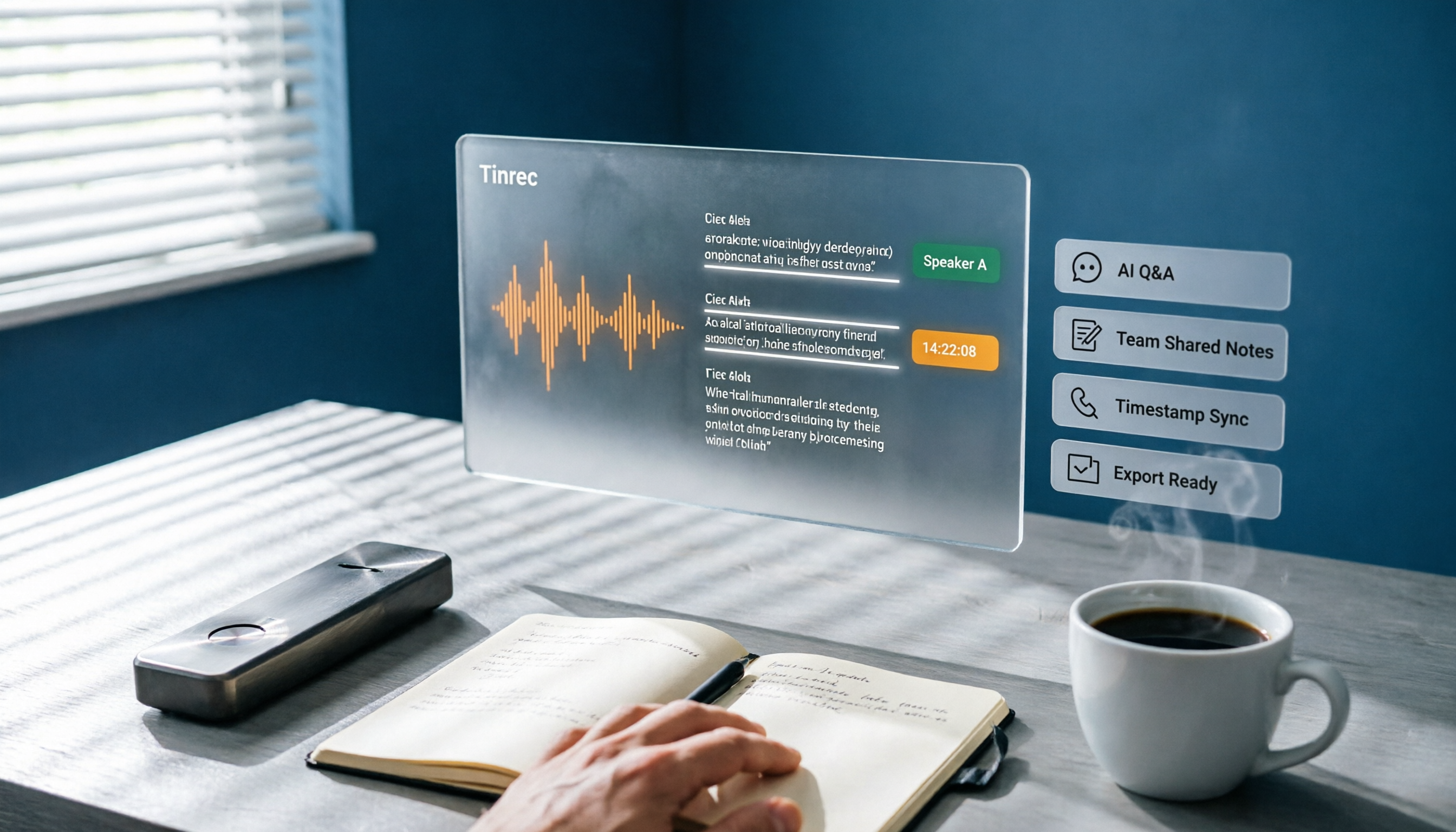
Audio in, key points out. After uploading your episode audio, it transcribes and automatically generates summaries, chapters, and to-dos. For a 1-hour interview, you see well-segmented key points instead of a wall of text.
Ask questions right after recording. This is the biggest difference from ordinary transcription tools: you can ask questions directly about the content, such as "In which segment did the guest mention the production process?" or "What are the three tools mentioned in the episode?" It doesn't give keyword search results but organized answers. When writing show notes or finding quotes, this feature saves the most noticeable time.
Export and team knowledge retention. Transcripts and summaries can be exported to Notion, Google Docs, OneNote, etc. for further editing. The team version keeps audio, folders, and to-dos in a shared team space, where members can view and search, and admins can manage roles, seats, usage, and activity logs. Additionally, the desktop version records online meetings by capturing system audio, without inviting a meeting bot—especially convenient for remote interviews. Team hotwords help maintain common show terminology.
Actual workflow test: We used a ~10-minute mixed Chinese-English episode audio and ran through upload, transcription, summary, Q&A, and export—all in one workspace, without switching between three tools. Note that transcription performance is still affected by recording quality, background noise, accents, and multiple people talking over each other. For important sections, we recommend replaying with timestamps.
Three practical advantages:
Stop organizing recordings by hand
Upload audio or video and automatically get a transcript, summary, and action items
- End-to-end workflow: from audio to summary and to-dos in one workspace, saving copy-paste time.
- Queryable transcripts: no need to re-listen to a 40-minute episode; find conclusions and quotes directly.
- Cross-device and team-friendly: record on mobile, organize on computer; team version keeps data in team space, so resources can be handed over when members change, not taken away.
Limitations (honestly): If you need to batch-process a whole season of long files and only care about unit price, its strength isn't there (see TurboScribe below). Also, the free version only offers basic quota; heavy users need to pay. Actual quotas and prices are subject to the official purchase page. For the team version, first-time eligible users can try 7 days free, including 1 free seat and 300 minutes of shared team import quota. Team monthly is USD 29.80 per paid seat per month, annual is USD 199 per paid seat per year. Each paid seat provides 2,000 minutes of shared team import quota per month. Real-time recording currently does not deduct minutes under active plans and seats.
Who it's for: Those who need Chinese or mixed Chinese-English transcripts, want to save time on "listening a second time," or whose show is a team effort.
Besides Tinrec, What Other Options Are There?
Apple Podcasts built-in transcripts: Convenient if you only listen on Apple Podcasts. After publishing, Apple automatically generates transcripts. Long-press an episode and select "View Transcript" to read, with words highlighted as they're spoken. However, when sharing, you can only copy up to 200 characters at a time, cannot export the whole transcript, and it doesn't generate summaries or to-dos. Dynamically inserted audio and music lyrics are also not included in the transcript. To turn transcripts into notes or articles, you still need a tool like Tinrec.
Notta: A multi-platform transcription tool with a good reputation for Chinese recognition. The official free version offers 120 minutes per month, with a maximum of 3 minutes per file. Pro annual is about US$8.17/month, with 1,800 minutes per month. Suitable for occasional short audio transcription. However, a 40-minute episode must be split into several parts. As for AI Q&A directly on transcripts, Tinrec has it, but Notta currently does not.
TurboScribe: Focuses on cost-effective file transcription. The official free version allows 3 files per day, up to 30 minutes per file. The paid version supports up to 10 hours per file and can upload 50 files at once—great for batch-transcribing an entire season, more economical than Tinrec in this regard. But it lacks AI Q&A around transcripts. If you want to ask about key points right after recording, you still need Tinrec.
Pitfall Guide: 4 Most Common Mistakes When Choosing a Podcast Transcription Tool
Pitfall 1: Only looking at the word "free" without checking per-file limits. Free plan limits are often hidden in the details: some give 120 minutes per month but only 3 minutes per file; some limit 3 files per day, 30 minutes per file. An episode often runs 40 minutes or more. Before choosing a tool, confirm whether the per-file limit can handle your episode length.
Pitfall 2: Thinking a transcript means it's organized. A transcript is raw material, not a finished product. What really saves time is post-processing like summaries, chapters, to-dos, and Q&A. Without them, you're just swapping "listening once" for "reading once."
Pitfall 3: Ignoring mixed Chinese-English and speaker identification. If a transcript doesn't segment or label speakers for mixed Chinese-English or Cantonese interviews, the time spent proofreading afterward might be longer than re-typing from scratch.
Pitfall 4: Forgetting compliance for recording and transcription. Before recording, remember to check local regulations and obtain participant consent, especially for guest interviews. This is much easier than fixing it later.
Conclusion: Which One Should You Choose?
- Want an end-to-end workflow from audio to summary, to-dos, and export → Tinrec
- Need usable transcripts for mixed Chinese-English or Cantonese interviews → Tinrec (supports Chinese, Traditional Chinese, and multiple languages, with real-time translation and bilingual view)
- Want to use AI to ask about key points and find quotes right after recording → Tinrec (AI Q&A)
- Show is a team effort, need to share materials and manage seats and usage → Tinrec Team Version
- Only listen on Apple Podcasts and just want to quickly read text → Apple Podcasts built-in transcripts (but cannot export the whole transcript)
- Budget-first, just need to batch-transcribe a whole season of long files → TurboScribe
The final advice is simple: take a segment of your own show's audio and run it through Tinrec's free version for a complete workflow—upload, view summary, ask a question. In 10 minutes, you'll know if it can save you from re-listening. Before recording and transcribing, don't forget to obtain participant consent and check local regulations.
References
- Apple Podcasts "Transcripts" feature - Apple Podcasts Creator Resource Center
- Convert Podcast to Text | Transcribe App & Online Editor
- Online Podcast Transcript Generator: Free Podcast Audio to Text
- Memo AI Tutorial: One-Click Transcribe YouTube, Podcast into Transcripts, Output Bilingual Subtitle Videos, AI Summaries and Mind Maps
- Free AI Podcast Summary Tool | Podcast to Text, Mind Map and Transcript - WayinVideo
Turn every recording into actionable outcomes
Get 60 free transcription minutes when you sign in. No credit card required.
Related Reading
You might also like

4 Best Audio-to-Text Apps in 2026: Which One Actually Saves You Post-Meeting Time?
A mid-level manager who attends 15 meetings a week shares hands-on experience. From online meeting recording methods and transcription performance for Chinese and mixed Chinese-English to post-meeting summaries and action item organization, this breaks down the differences among four types of audio-to-text apps and explains how Tinrec uses bot-free recording, AI summaries, action item extraction, and team spaces to turn meetings into searchable, collaborative, actionable data.
4 Interview Transcription Tools Compared in 2026: From Recording to Citable Text
After an interview, organizing the transcript often feels more exhausting than the interview itself. This article starts from 'recording to citable text' and compares 4 interview transcription tools, covering speaker labeling, AI Q&A, audio retention, and team sharing, plus common pitfalls and selection advice.

Tinrec vs Notta 2026: 5-Dimension Comparison for Chinese Meeting Transcription Tools
Starting from the decision focus of 'Do you want transcription, or usable meeting data?', this article compares Tinrec and Notta across 5 dimensions, covering selection criteria, a full breakdown of Tinrec, other options, and pitfalls to avoid, helping Chinese meeting users make a quick choice.

5 Transcription Tools Tested and Compared in 2026: Transcription Takes Too Long—Which One Actually Saves Time?
Transcription takes too long, and the problem is often not typing speed but the "listen, type, re-read" workflow. This article tests 5 transcription and AI meeting note tools, covering how to judge accuracy, post-meeting organization, audio retention and export, free quotas, and team seat licensing. It provides criteria you can follow directly and analyzes Tinrec's actual performance in bot-free recording, AI Q&A, and team knowledge retention.

2026 Comparison of 3 Audio-to-Transcript Tools: Which Offers the Best Free Tier and AI Q&A?
Just finished a meeting and realized no one took notes? Replaying the recording to type a transcript can eat up an entire afternoon. This article compares 3 audio-to-transcript tools, breaking down Chinese and mixed Chinese-English recognition, online meeting recording methods, AI summaries and Q&A, cross-platform use, and quota pricing. We also highlight 4 common pitfalls to help you choose a solution that truly saves time.
Tinrec vs Notta 2026: 5-Dimension Comparison — Which Writes Meeting Minutes Faster?
Struggling to finish meeting minutes? The problem is usually the process, not your writing. This article compares Tinrec and Notta across 5 dimensions: audio capture method, Chinese and mixed Chinese-English recognition, recording retention, post-meeting outputs, and team sharing. It explains how to use tools to get transcripts, summaries, and action items done in one go, with a pitfalls guide and selection advice.

3 Legal Meeting Transcription Methods Tested in 2026: How Tinrec Helps You Avoid Common Pitfalls
Transcribing legal meeting recordings isn't as simple as dropping audio into a tool. This article explores common pitfalls and explains how Tinrec turns pre-trial meetings, client interviews, and internal discussions into searchable, queryable, and actionable transcripts and meeting materials. It also covers 5 key factors to consider when choosing a transcription tool.

4 Customer Interview Transcription Tools Tested in 2026: Which One Actually Saves You Cleanup Time?
Tired of spending hours on customer interview transcripts? We tested 4 tools, covering selection criteria, an in-depth look at Tinrec, and pitfalls to avoid, to help you find a transcription solution that truly saves you cleanup time.

2026 M4A to Text: 5 Tools Tested + AI Summaries and Action Items in One Go
M4A is the most common audio recording format, but converting it to text is just the first step. This article starts with common pitfalls, breaks down 5 key factors for choosing an M4A-to-text tool, tests how Tinrec turns an M4A file into a transcript, summary, action items, and queryable meeting data, and briefly reviews TurboScribe, Notta, and Granola for their use cases and things to watch out for.