

Turn recordings into transcripts and summaries in minutes
Upload audio or video for multilingual transcription, AI notes, and action items
4 AI Recording Tools Tested for 2026: Which Saves the Most Time on Chinese Meeting Notes?
Do you have a few recordings sitting on your phone that you never finished listening to? You hit record during a meeting, thinking "I'll organize it later," but that "later" never came.
When you finally do get around to it, the choices become another headache: should you use your phone's built-in transcription, upload the file to a free online tool, buy an AI voice recorder, or use a dedicated AI meeting notes tool?
This article starts with the decisions you need to make. Figure out which scenario fits you first, then compare tools—that's far more useful than just looking at spec sheets. I'll use Tinrec as the main test subject, since it's been my go-to tool for organizing meeting and interview recordings lately.
What Can AI Recording Organization Do for You?
Most people imagine "AI recording organization" as: throw in a recording, get a transcript. But the real time-saver is what comes after—once it's text, does something pick out the key points for you?
Scenario 1: The meeting ends, and your notes are already done
I used to spend an extra hour after a two-hour meeting recalling and typing. Now with Tinrec's desktop app, the transcript generates in real time during the meeting, and by the time it's over, AI has already organized the summary, chapters, and action items. Who's responsible for what and when it's due—just check the list.
Scenario 2: A three-hour lecture recording, and you only want the highlights
Tinrec can upload audio or video files to transcribe, then generate summaries and chapters. You don't have to listen from start to finish—just jump to the sections you're interested in.
Scenario 3: You need to quote from an interview
The transcript is fully searchable, and you can use AI Q&A to dig into details. For example, ask "What did the interviewee say about pricing?" and it will find the relevant passage, saving you from rewinding over and over.
Scenario 4: Turn old recordings into a searchable database
Recordings pile up, and you forget what you even recorded. Tinrec's team space organizes meetings by topic, so new members can look back at past discussions.
What Are the Core Capabilities of AI Recording Organization?
Real-time recording to text
It's not just transcribing after the fact—it's text as you record. Tinrec supports real-time transcription in Chinese and multiple languages, so you can follow along during the meeting to make sure nothing important is missed.
Bot-free online meeting recording
This is what impressed me most about Tinrec. Its desktop app captures your computer's system audio directly, so for Zoom, Google Meet, Microsoft Teams, Webex, and other meetings, you don't need to invite a meeting bot. Note: this doesn't mean it automatically joins all meetings on your calendar—you still need to open Tinrec and start recording yourself.
AI summaries, chapters, and action items
After transcription, Tinrec organizes the content into a structured summary and breaks it into chapters by topic. Action items are also pulled from the discussion, so you don't have to highlight them one by one.
AI Q&A
This is the feature I find most useful. After transcription, you can ask Tinrec directly: "What was the budget for this meeting?" "What concerns did the client mention?" It answers based on semantic understanding, not just keyword matching.
Multi-format export and post-meeting output
Organized content can be exported to Notion, Google Docs, OneNote, Dropbox, and other tools for further work. Tinrec can also use Agent post-processing to generate reports, tables, and documents—great for anyone who needs to submit meeting minutes.
Team space
Meeting data belongs to the team, not to individual accounts. This makes a big difference for teams where "when someone leaves, the data scatters."
Four Common Approaches: My Hands-On Comparison
Bottom line first: none is always best. It depends on how often you use it, whether you need to handle online meetings, and whether you need team collaboration.
Approach 1: Built-in phone recording + manually paste into AI
Record, open the file, use the system's transcription feature to get text, then copy it into an AI chat tool to organize an outline. The upside is it's nearly free. The downside is you have to manually move the transcript, recognition quality is inconsistent for long meetings, and the transcript itself isn't easy to search.
Approach 2: Free online speech-to-text tools
Upload the audio file to a web tool, get text, then organize it yourself. These tools usually have file length or daily usage limits—fine for occasional one-off recordings, but not suitable as a daily meeting workflow.
Approach 3: AI recording hardware
The advantage of a standalone recording device is portability and long battery life—good for in-person interviews or situations where you need to capture audio on the fly. The trade-off is carrying an extra device, an extra hardware expense, and online meetings still have to be handled back on the software side.
Stop organizing recordings by hand
Upload audio or video and automatically get a transcript, summary, and action items
Approach 4: AI meeting notes tools (Tinrec as an example)
What sets this category apart is "after transcription." Tinrec brings real-time recording, online meetings, and file uploads into one place, then directly generates summaries, chapters, and action items—plus Q&A, export, and team space. If your meetings happen regularly every week, this approach saves the most noticeable time.
Real-World Use Cases
Meetings and project discussions
Weekly meetings, review sessions, and cross-department communication generate a lot of dialogue. With Tinrec, decision rationale and action items are preserved together, so checking last meeting's conclusions before the next one is quick.
Classes and lectures
Use the mobile app for real-time recording in physical classes, and the desktop app for online classes. Tinrec's chapter feature breaks long content into sections, so you don't have to re-listen to the whole thing when reviewing.
Interviews and research
Transcripts are searchable and annotatable, and AI Q&A quickly finds specific viewpoints from interviewees. Note: it's still a good idea to cross-check the organized content against the original, since AI does some polishing.
Content creation
Turn interview or meeting recordings into transcripts, then use Agent to generate article drafts or tables—one recording can produce multiple types of material.
6 Things to Consider When Choosing an AI Recording Organization Tool
1. Chinese and mixed Chinese-English recognition performance
Don't just look at marketing claims—test it with your own meeting recordings, especially segments with mixed Chinese and English. Tinrec covers Chinese, Traditional Chinese, and multilingual scenarios, and supports team hotwords so you can add company-specific terminology. Actual results will still be affected by recording quality, accents, background noise, and overlapping speakers.
2. How does it record online meetings?
Check whether the tool sends a bot to join the meeting or captures system audio. Tinrec uses the latter—no extra participant in the meeting, but you need to start the recording yourself.
3. What can it do after transcription?
A transcript is just the starting point. Make sure the tool can generate summaries, chapters, and action items, and whether you can ask questions about the content. Tinrec's completeness in this area is what I've found smoothest so far.
4. Are recordings retained?
Some tools keep only text, not audio. If you need to verify tone or add details later, whether recordings are retained matters. Tinrec keeps audio files, and the team version has an audio recycle bin—accidentally deleted files can be restored within the retention period.
5. How are team permissions designed?
If it's for team use, understand the difference between "roles" and "seats." Roles determine who can manage members and settings; seats determine whether a member can record, upload, edit, and export. In Tinrec's team version, members without a seat can still view, play, and read team data, but cannot perform actions like editing and exporting.
6. Pricing and quotas
Look at usage frequency, not just unit price. Tinrec's personal plan includes a free version, weekly pass, Pro monthly, and Pro annual. For occasional use, start with the free version. The team version is USD 29.80 per paid seat per month, or USD 199 per paid seat per year (about USD 16.58 per month), with each paid seat providing 2,000 minutes of shared team import quota per month. Eligible teams can try 7 days with 1 free seat and 300 minutes of shared import quota. Actual prices and promotions are subject to the official purchase page.
Frequently Asked Questions
Q1: How is AI recording organization different from built-in phone speech-to-text?
Built-in phone transcription is mostly for convenient input—it outputs continuous text with no summary, chapters, or action items. AI recording organization tools like Tinrec add a layer of structured organization after transcription, turning meetings into directly usable data.
Q2: Is the free version enough?
If you only occasionally organize a recording or two, the free version's basic quota is a good way to test the waters. But if you have meetings every week or need to upload long audio files, consider a paid plan for more stable quotas.
Q3: Do online meetings need a bot to join?
Not necessarily. Tinrec's desktop app captures system audio, so no extra meeting participant appears. The catch is you need to actively open Tinrec and start recording—it's not currently a mode that automatically joins all calendar meetings.
Q4: How accurate is it for Chinese?
Tinrec supports Chinese and multilingual transcription, and team hotwords let you maintain professional terminology. But accuracy depends on the recording environment, and I wouldn't recommend judging by a fixed percentage. For important content, cross-check with transcript timestamps and audio playback.
Q5: What's the difference between the team version and personal version?
Personal version data is managed by the individual account; the team version is a separate team space where meeting data belongs to the team, with additional features like member invitations, role and seat management, usage analytics, audit logs, and an audio recycle bin. When a member leaves or is removed, their team resources need to be handed over to other members—data doesn't leave with the individual.
Q6: Are there privacy or legal issues with recording organization?
This depends on your local regulations and the nature of the meeting. In practice, it's best to inform participants and get consent before recording and transcribing. For enterprise use, also confirm that team space member and seat settings comply with internal policies.
Summary
The real cost of organizing recordings was never the recording itself—it's the hour after. What AI tools save is that time spent manually transcribing and recalling meeting content.
If you record a lot and often handle Chinese meetings, Tinrec is currently the most complete workflow I've found—from real-time transcription and bot-free online meeting recording to summaries, action items, Q&A, export, and team space, all in one workflow. Start with the free version, try it on a real meeting, then decide whether to go further.
References
- How to transcribe mobile meeting recordings? Use Plaud + AI to record and organize in one go
- AI organizes my recordings: 2026 iPhone and cross-platform transcription tool test, a complete guide from transcript to action items - Tinrec Blog
- Get meeting notes done! How to do AI speech-to-transcript? Gemini Notebook, Gemini, EchoScript operation analysis | 104 Workplace
- No time limit! 3 free AI transcript tools, highly recommended! AI voice notes generate meeting records, presentations, mind maps | 104 Workplace
- The most recommended AI meeting notes tool of 2026, a must-have for time-saving and effortless meetings!
Turn every recording into actionable outcomes
Get 60 free transcription minutes when you sign in. No credit card required.
Related Reading
You might also like

4 AI Meeting Note Tools Tested for 2026: Which Saves the Most Time for Chinese Meetings?
Still spending two hours writing meeting notes after the meeting? This article compares four AI meeting note tools, breaking down Chinese and mixed Chinese-English recognition, meeting recording methods, post-meeting summaries and action items, cross-platform export, and team member management. It also lists four key pitfalls to avoid when choosing a tool, helping you find a solution that truly saves time.

2026 Guide: Convert Audio to Transcripts — Stop Typing Manually & Auto-Generate Meeting Minutes with AI
Don't want to type transcripts by hand? This guide covers two scenarios—live meetings and pre-recorded files—and outlines 4 key buying factors. We tested Tinrec's bot-free meeting recording, AI summaries, and Q&A workflow, compared Notta, Granola, and PLAUD, and included the most common pitfalls to avoid.

2026 Medical Meeting Transcription Tools Compared: Which AI Saves You the Most Time with Chinese Transcripts and Summaries?
For professionals juggling over a dozen meetings a week and still stuck with post-meeting notes, which tool should you use? This article dives into practical decision points, covering 5 key factors for choosing a medical meeting transcription tool. We tested Tinrec's bot-free recording, AI summaries, action item extraction, and AI Q&A, and briefly review alternatives like Notta, Otter.ai, and PLAUD. We also provide a guide to avoid common pitfalls and final recommendations.
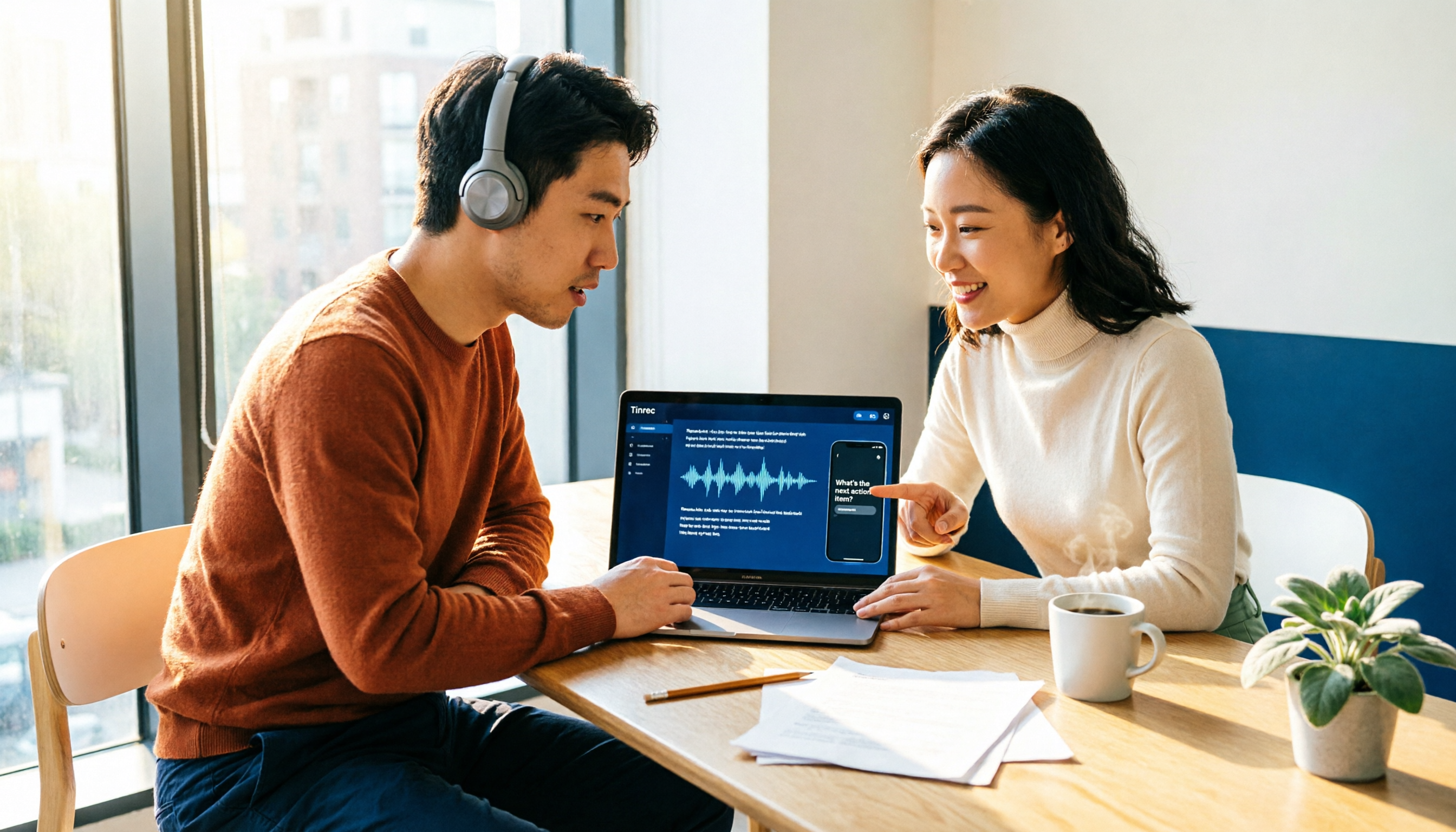
How to Choose an Automatic Transcription Tool in 2026: 5 Steps to Compare Yating Transcription and Tinrec
How do you choose an automatic transcription tool? Starting from the actual checklist I use when picking tools, I compare Yating Transcription and Tinrec across five dimensions, covering online meeting recording methods, post-meeting organization depth, AI Q&A, cross-platform team collaboration, and quota pricing, to help you determine which one better fits your workflow.

4 Best Audio-to-Text Apps in 2026: Which One Actually Saves You Post-Meeting Time?
A mid-level manager who attends 15 meetings a week shares hands-on experience. From online meeting recording methods and transcription performance for Chinese and mixed Chinese-English to post-meeting summaries and action item organization, this breaks down the differences among four types of audio-to-text apps and explains how Tinrec uses bot-free recording, AI summaries, action item extraction, and team spaces to turn meetings into searchable, collaborative, actionable data.
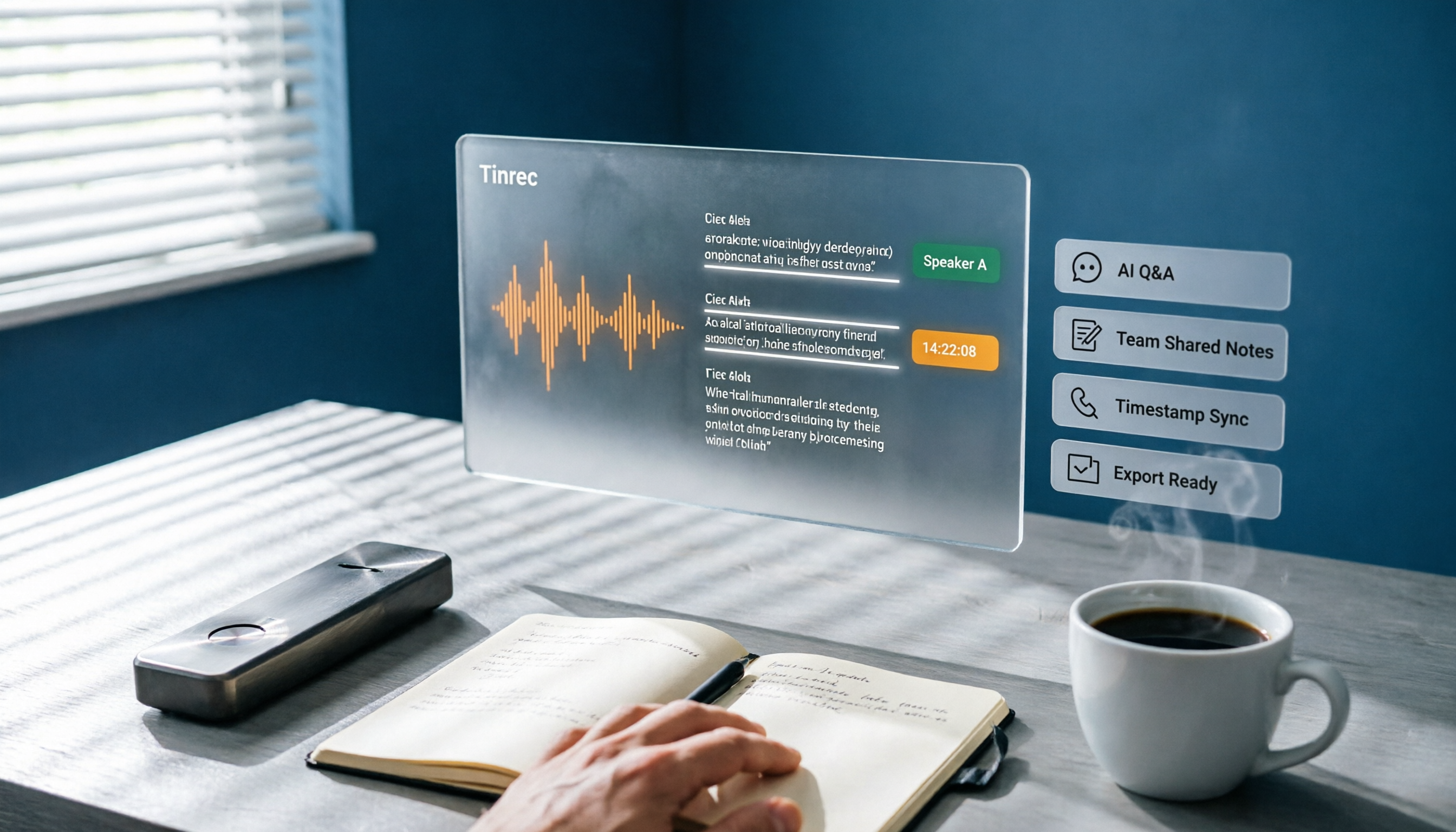
4 Interview Transcription Tools Compared in 2026: From Recording to Citable Text
After an interview, organizing the transcript often feels more exhausting than the interview itself. This article starts from 'recording to citable text' and compares 4 interview transcription tools, covering speaker labeling, AI Q&A, audio retention, and team sharing, plus common pitfalls and selection advice.

Tinrec vs Notta 2026: 5-Dimension Comparison for Chinese Meeting Transcription Tools
Starting from the decision focus of 'Do you want transcription, or usable meeting data?', this article compares Tinrec and Notta across 5 dimensions, covering selection criteria, a full breakdown of Tinrec, other options, and pitfalls to avoid, helping Chinese meeting users make a quick choice.

5 Transcription Tools Tested and Compared in 2026: Transcription Takes Too Long—Which One Actually Saves Time?
Transcription takes too long, and the problem is often not typing speed but the "listen, type, re-read" workflow. This article tests 5 transcription and AI meeting note tools, covering how to judge accuracy, post-meeting organization, audio retention and export, free quotas, and team seat licensing. It provides criteria you can follow directly and analyzes Tinrec's actual performance in bot-free recording, AI Q&A, and team knowledge retention.

2026 Comparison of 3 Audio-to-Transcript Tools: Which Offers the Best Free Tier and AI Q&A?
Just finished a meeting and realized no one took notes? Replaying the recording to type a transcript can eat up an entire afternoon. This article compares 3 audio-to-transcript tools, breaking down Chinese and mixed Chinese-English recognition, online meeting recording methods, AI summaries and Q&A, cross-platform use, and quota pricing. We also highlight 4 common pitfalls to help you choose a solution that truly saves time.