
Turn recordings into transcripts and summaries in minutes
Upload audio or video for multilingual transcription, AI notes, and action items
Facing a one-hour interview recording or meeting notes, have you ever struggled with converting Cantonese colloquial speech into written language? Or felt helpless with heavy English-Chinese code-mixing in videos?
Don't worry—AI speech recognition technology is quite mature in 2026. This article assesses 6 popular tools from three dimensions: 'accuracy,' 'functionality,' and 'decision efficiency,' covering Subanana (specializing in Cantonese subtitles), Adobe Premiere Pro, and Tinrec (focused on meeting understanding).
Quick Decision Guide:
- If you're a YouTuber needing subtitles and value colloquial-to-written conversion: Go with Subanana.
- If you need to organize meeting notes, extract action items, and query via AI chat: Try Tinrec.
- If you want a completely free tool and don't mind installing software: Try pyTranscriber.
1. Two Core Challenges of Cantonese Audio to Text
Before choosing a tool, it's crucial to understand why Cantonese audio-to-text is especially difficult—these are the key metrics for evaluation:
- Separation of colloquial and written language: Cantonese recordings are typically colloquial (e.g., "hai mai" meaning "yes or no"), but formal documents or subtitles often require written language (e.g., "shifou" meaning "whether"). Most general-purpose AI only outputs verbatim, leading to massive post-editing work.
- Code-mixing: Hong Kong workplaces and daily conversations frequently include English words like 'Presentation,' 'Deadline,' 'App.' If the tool can't automatically switch language models, the output will be terrible.
2. In-Depth Review of 6 Mainstream AI Audio-to-Text Tools
We've compared the most Cantonese-supportive tools on the market, including Hong Kong–based Subanana, professional editing software Adobe Premiere Pro, and Tinrec with its AI comprehension focus.
Tool Comparison Overview
| Dimension | Subanana | Tinrec | Adobe Premiere Pro | pyTranscriber | Taption | ArcTime |
|---|---|---|---|---|---|---|
| Core Focus | Cantonese subtitle specialist | Meeting notes & knowledge management | Professional video post-production | Open-source free transcription | Online subtitle tool | Cross-platform subtitle software |
| Cantonese Accuracy | Extremely high (~97.5%) | High (supports multilingual recognition) | Average (~80-89%) | Average (Google API) | Low (~70-85%) | Moderate |
| Colloquial → Written | Supported (exclusive) | Requires AI summary assistance | Not supported | Not supported | Not supported | Not supported |
| Code-mixing Handling | Excellent | Excellent | Average | Weak | Nearly none | Average |
| AI Summary/Action Items | No | Auto-generated | No | No | No | No |
| Installation Required | Web app (no install) | App/Web/PC (multi-platform) | Requires installation (high-end PC) | Requires installation | Web app | Requires installation |
| Pricing | Free / paid upgrades | Free tier / subscription | Subscription (expensive) | Completely free | First 15 min free | Credit-based |
Stop organizing recordings by hand
Upload audio or video and automatically get a transcript, summary, and action items
Key Tool Highlights
1. Subanana: Top Choice for Subtitle Creators
In tests, Subanana achieves up to 97.5% accuracy in code-mixing scenarios and is one of the few tools that directly convert Cantonese colloquial speech into written language. For video subtitle creators, it saves massive post-editing time.
2. Tinrec (秒聽錄音): Efficiency Booster for Meetings & Learning
If your need goes beyond 'transcription' to 'key points extraction,' Tinrec offers a different approach. It supports Cantonese audio-to-text but emphasizes a complete workflow: Record → Understand → Act. Unlike traditional tools that only provide verbatim transcripts, Tinrec auto-generates meeting minutes, summaries, and action items, perfect for workplace meetings or class notes.
3. Adobe Premiere Pro: Built-in Convenience for Editors
While its Cantonese recognition accuracy (~89.4%) lags behind specialized tools and it's sensitive to background noise, for editors already using the Adobe ecosystem, the built-in convenience is unmatched.
3. Why You Should Care About Tinrec: Beyond Verbatim Transcripts
During testing, we found that simple 'audio-to-text' often solves only half the problem—you get a wall of text and still need to re-read it.
Tinrec differentiates itself by tackling 'information overload':
- Real-time transcription: See text as you record, with iOS, Android, and Web sync across devices.
- AI smart summaries: For long Cantonese meetings, Tinrec automatically filters rambling and extracts core conclusions.
- AI chat query: Something traditional subtitle software can't do. You can ask the AI, "What was the decision on the marketing budget in this meeting?" and it answers based on the recording—highly useful for searching hours of audio.
- Multi-format support: Import audio files or paste online video links (e.g., YouTube, podcasts) for processing.
4. Practical Tutorial: How to Efficiently Convert Audio to Text
Below are step-by-step instructions for different scenarios.

Scenario A: Real-time Recording in Meetings (Using Tinrec)
Suitable for: class notes, in-person meetings, interviews.
- Open Tinrec's real-time transcription feature or mobile app.
- Select recording language (supports Cantonese/Chinese/English, etc.).
- Tap start recording; the system will transcribe speech into text in real time.
- After recording, tap 'AI Analysis' to automatically identify speakers and generate 'meeting minutes' and 'action items.'
Scenario B: Processing Existing Audio/Video Files
Suitable for: sorting past interview recordings, podcast material.
- Prepare your audio file (mp3/m4a/wav) or video link.
- For subtitles: Log into Subanana or Taption, upload the file, wait for AI recognition, and download the SRT subtitle file.
- For key point extraction: Use Tinrec's audio file transcription or podcast/web video transcription feature.
- Upload the file or paste the link.
- Wait for cloud processing (typically a few minutes for 1 hour of audio).
- Use AI chat query to quickly ask about details, e.g., 'What were the three solutions mentioned by the speaker?'
5. Frequently Asked Questions (FAQ)
Q1: Which tool is most accurate for Hong Kong Cantonese accents? According to Subanana's test data, Subanana achieves the highest accuracy with Hong Kong accents and code-mixing. Tinrec performs reliably in multilingual recognition and semantic understanding, suitable for users who need follow-up content organization.
Q2: Can iPhone or Android phones directly transcribe audio to text? Yes. Tinrec supports both iOS and Android platforms, with data synced to the web version. You can record on your phone and later edit or export on your computer.
Q3: Are there completely free Cantonese audio-to-text tools? Yes. pyTranscriber is open-source and free (requires installation); Subanana and Tinrec offer free trial credits (Tinrec provides 100 minutes per month for free), suitable for light users.
Q4: Can I export transcripts to Word or PDF? Most tools, including Subanana and Tinrec, support exporting transcripts to TXT, Word, or PDF for further editing.
Q5: Is AI still accurate in noisy environments? Background noise is a major challenge for AI. Tests show Subanana handles noise better (~93.4% accuracy), while Premiere Pro and pyTranscriber are more affected (dropping below 75%). For best results, record close to the microphone or use a directional mic.
Q6: Can I use these tools for YouTube subtitles? Yes. If your main goal is to output SRT subtitle files and burn them into videos, Subanana or ArcTime are purpose-built. If you want to turn video content into articles or notes, Tinrec's video-to-text feature is more suitable.
Turn every recording into actionable outcomes
Get 60 free transcription minutes when you sign in. No credit card required.
Related Reading
You might also like

2026 Real-Time Recording Tools Compared: Which Can Transcribe While Recording?
How do you choose a real-time recording tool? This article tests and compares Tinrec, free online voice recorders, Bandicam, and Granola in real meeting scenarios, explaining why what happens after recording is key, plus 4 buying tips, pitfalls to avoid, and scenario-based recommendations.
5 Meeting Recording Apps Compared in 2026: From Transcripts to Team Collaboration
Meeting recording apps aren't just about audio quality—they're about what happens after the meeting. This guide breaks down five common tool approaches, covering live transcription, AI summaries, action item extraction, AI Q&A, team spaces, and seat management. Using Tinrec as an example, we walk through bot-free online meeting recording, Chinese transcription, summaries, and exports, and compare the free, Pro, and Team plans to help you decide which solution fits your meeting needs.

What Is Instant Messaging in 2026? 5 Steps to Understand the Definition and Choose Tools
What does instant messaging (IM) mean? This article starts with the definition, history, and message storage methods to help you understand the essence of synchronous communication, 4 key points for choosing tools, and compares meeting and communication organization tools like Tinrec, Otter.ai, Notta, and Granola. Finally, a pitfall guide helps you choose the right tool.

Can You Share a Recording with Others in 2026? 5 Key Legal Points and How Tinrec Helps You Organize
Whether you can share a recording with others depends on your role, purpose, and content. This article summarizes key legal points on invasion of privacy and personal data protection, and explains how to use Tinrec to turn recordings into transcripts or summaries so you only share necessary information, reducing privacy and legal risks.

5 Best AI Meeting Notes Apps of 2026: Which Free Version Is Actually Enough?
There are countless AI meeting note takers, but buying one doesn't guarantee better notes. This article starts with the most common mistakes and inefficient habits, outlines 4 key factors for choosing a meeting transcription tool, tests Tinrec's bot-free recording, AI Q&A, and team workspace, and compares Otter.ai, Notta, and TurboScribe on positioning and pricing to help you find a solution that truly saves time.

4 Recording AI Tools Tested in 2026: Which Saves the Most Time on Chinese Meeting Minutes?
Before choosing a recording AI, first confirm where your meetings take place. This article tests 4 common recording AI tools, breaking them down from four angles: audio capture method, post-transcription output, recording file retention, and team sharing. It also summarizes pitfalls to help you determine which one truly saves time on meeting notes.

How to Use an AI Recording Assistant in 2026: A Complete 5-Step Guide
A complete 2026 guide to AI recording assistants: starting from common misconceptions about manual transcription, this guide explains what an AI recording assistant can do for you, a 5-step workflow, real-world use cases, and 5 key purchasing considerations. It uses Tinrec as an example to demonstrate real-time transcription, bot-free online meeting recording, AI summaries and action item extraction, AI Q&A, and team workspace governance, with FAQs and team pricing details at the end.
4 Real-Time Voice Tools Tested for 2026: Which Saves the Most Time for Meeting Notes and Transcripts?
What is real-time voice? This article first clarifies the difference between Apple Live Speech and Live Voicemail, then tests 4 tools, comparing meeting notes, transcripts, AI Q&A, and team collaboration to help you find the most time-saving solution.
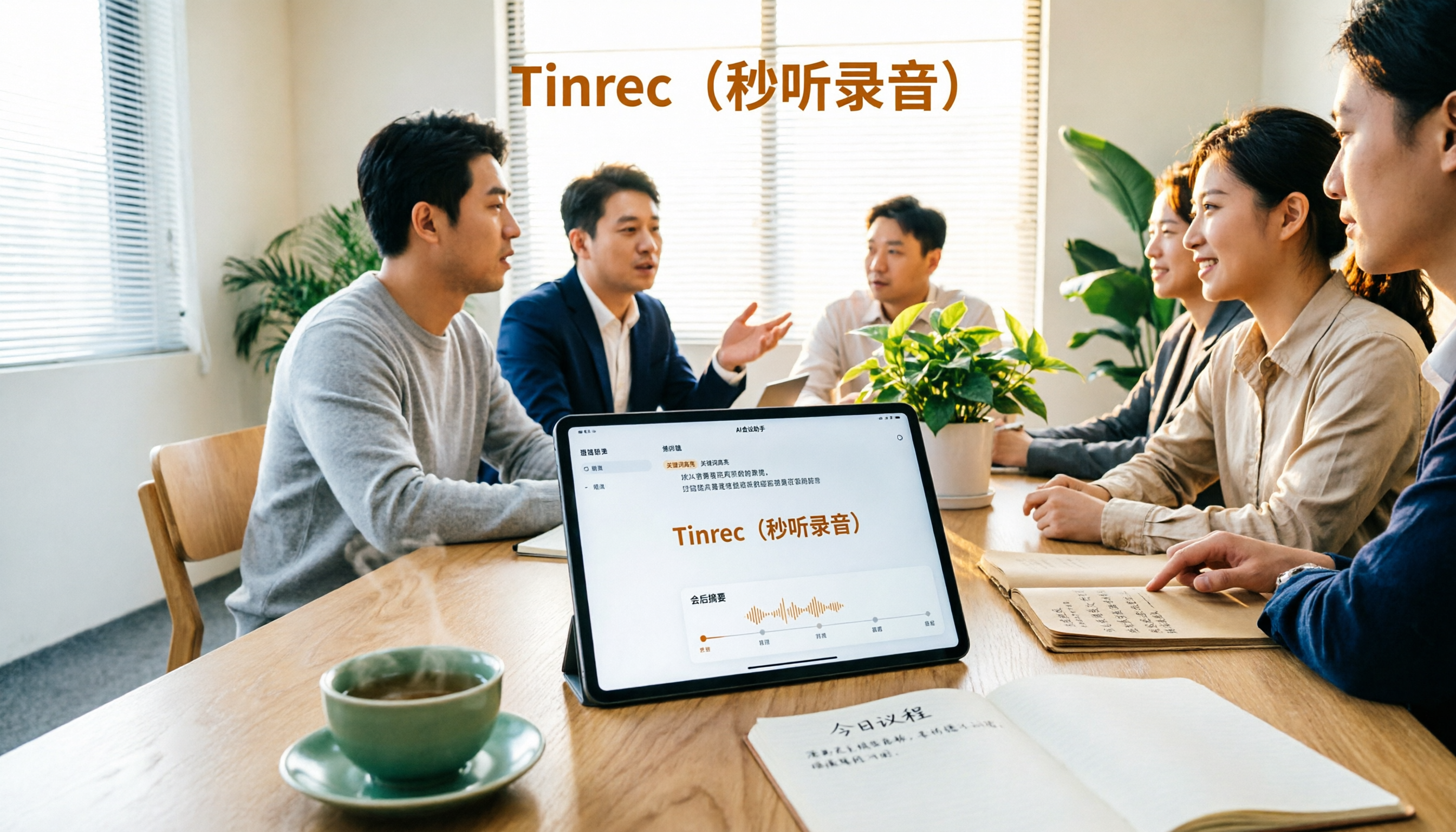
4 AI Recording Tools Tested for 2026: Which One Saves the Most Time on Chinese Meeting Notes?
Still have meeting recordings nobody re-listens to? We tested 4 AI recording tools, comparing Chinese transcription, meeting capture methods, post-meeting summaries, AI Q&A, and team data ownership. Find out why Tinrec is the smoothest for Chinese meetings and team collaboration, plus when to choose PLAUD, Otter.ai, or Notta, and key pitfalls to avoid.