

Turn recordings into transcripts and summaries in minutes
Upload audio or video for multilingual transcription, AI notes, and action items
5 Meeting Recording Apps Compared in 2026: From Transcripts to Team Collaboration
How do you choose a meeting recording app? I usually start with three questions: Are you recording online meetings, in-person conversations, or both? Do you just need a transcript afterward, or do you want someone to organize who does what and by when? Do team members need to review past meetings together?
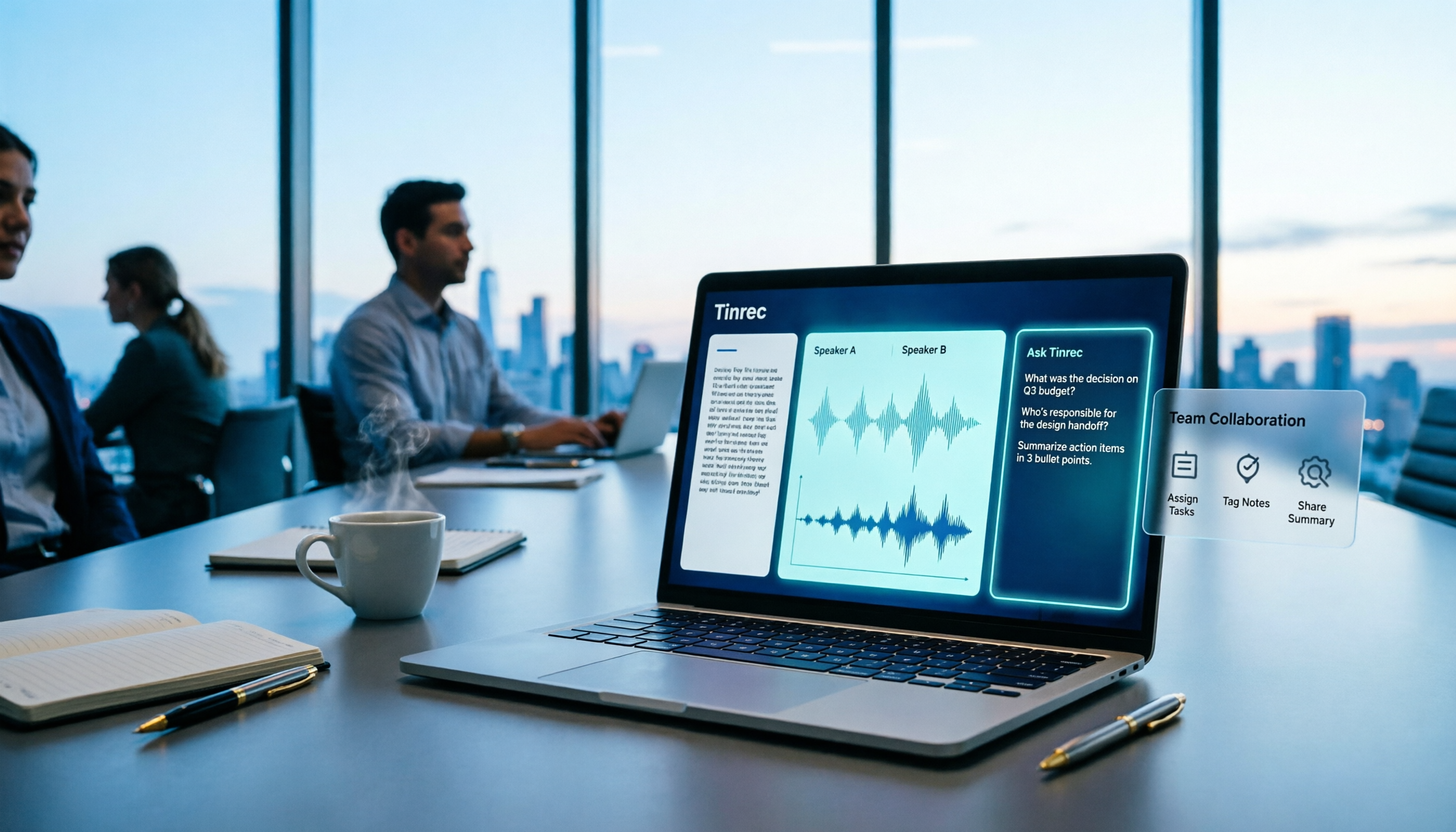
These three questions will directly determine whether you should look at free tools, transcription tools, or an AI meeting notes tool like Tinrec that turns meetings into team knowledge. I typically categorize common meeting recording apps into five approaches: pure recording, transcription, AI summarization, meeting bots, and team collaboration. This article compares them along these five lines.
What Can a Meeting Recording App Do for You?
Scenario 1: Get a summary 5 minutes after an online meeting ends Previously, after a one-hour Zoom or Google Meet, you might spend another 30 minutes replaying the recording and organizing key points. With Tinrec, for example, the desktop version can capture your computer's system audio directly without adding a meeting bot to the room; after the meeting, the transcript, summary, chapters, and action items are generated together.
Scenario 2: In-person interviews—record and view the transcript simultaneously Interviews or in-person meetings are hard to type during, and you worry about missing key points. Tinrec supports live recording to text, so you can record while confirming what the other person said in text, and afterward use AI Q&A for any unclear sections.
Scenario 3: Team weekly meetings—keep action items Many meetings don't lack conclusions; it's that conclusions aren't tracked. Tinrec can extract action items from discussions and place meeting data into a team space; when new members join, they can also view past meeting records and action items.
What Are the Core Capabilities of a Meeting Recording App?
Live transcription: Text appears as you record, not after. With Tinrec, live transcription displays content synchronously, so you can quickly confirm if any keywords were missed during the meeting.
AI summary and chapters: Not just condensing the entire transcript into one sentence, but organizing meeting topics, discussion conclusions, and action items separately. Tinrec generates summaries, chapters, and key points, so you can quickly skim long meetings.
Action item extraction: The biggest fear in meeting notes is just writing "handle after meeting." Tinrec organizes action items from the conversation, making owners and tasks more visible.
AI Q&A: After transcription, you can directly ask about the meeting content. For example, "Which budget version did the client mention?" or "Who needs to submit a report before the next meeting?" Tinrec answers based on meeting semantics, so you don't have to replay the entire recording.
Bot-free online meeting recording: Some tools require a meeting bot to join the room, but Tinrec's desktop version captures device system audio. The current user must actively initiate recording; it does not automatically join all calendar meetings. This is more natural for teams that don't want an extra participant in the meeting.
Real-time translation and bilingual view: For cross-language meetings, you can view the original text, translation, or bilingual content. Tinrec supports real-time translation, which helps with mixed Chinese-English or international meetings.
Multi-format export and post-meeting processing: Transcripts and summaries can be exported to common formats and third-party tools such as Notion, Google Docs, OneNote, and Dropbox. Tinrec can also use Agent post-processing to generate reports, tables, and documents.
Practical Use Cases
Remote and online meetings: Tinrec's desktop version can handle audio from Zoom, Google Meet, Microsoft Teams, Webex, and more without a bot joining. After the meeting, it directly generates transcripts, summaries, and action items—ideal for teams with weekly meetings.
In-person meetings and interviews: Use your phone or desktop version for live recording and transcription. Tinrec's transcripts are searchable and reviewable, and interview materials can continue to be used for AI Q&A and summaries.
Courses and study notes: After recording a class, Tinrec can organize chapters and key points, breaking a two-hour course into easy-to-review segments. When cross-language learning is needed, you can also enable translation assistance.
Stop organizing recordings by hand
Upload audio or video and automatically get a transcript, summary, and action items
Customer communication and sales records: Customer interviews, requirement discussions, and proposal explanations can be captured with Tinrec transcripts and summaries. After the meeting, export action items and customer requirements to your workflow to reduce information gaps.
Team knowledge retention: Tinrec's Team plan provides an independent team space where meeting data belongs to the team. Members can view, play, and read team data even without a seat; only with a seat can they record, upload, edit, and import/export.
5 Things to Consider When Choosing a Meeting Recording App
How to record online meetings: First confirm whether the tool uses "meeting bot joining" or "desktop system audio capture." Tinrec's desktop version doesn't need an extra bot to join the meeting, but the user must actively initiate recording—it doesn't automatically join all meetings.
Can it organize after the meeting: Tools that only provide transcripts still require you to read them yourself. In addition to transcripts, Tinrec offers summaries, chapters, action items, AI Q&A, and Agent post-processing, turning meetings into data you can continue working with.
Chinese and multilingual performance: Chinese meetings, mixed Chinese-English, and multilingual meetings have different needs. Tinrec covers Chinese, Traditional Chinese, and multilingual scenarios, and supports real-time translation and team hotwords; actual results are affected by recording quality, accents, noise, and overlapping speech, so don't rely solely on promotional numbers.
Team governance capabilities: If meeting data is to be used by multiple people, check for team spaces, roles, seats, usage analytics, and audit logs. Tinrec's Team plan distinguishes roles and seats: roles determine management permissions, seats determine whether one can record, upload, edit, and import/export. Active members without a seat can still view team data.
Pricing and quotas: The free plan is suitable for light use, a weekly card for short-term high frequency, and a Pro monthly or annual plan for steady use. Tinrec's Team plan offers a 7-day trial for first-time eligible users, 1 free seat, and 300 minutes of shared team import quota; team monthly is USD 29.80 per paid seat per month, annual is USD 199 per paid seat per year (about USD 16.58 per month), and paid seats provide 2,000 minutes of shared team import quota per month. Real-time recording under an active team plan and active seat is currently not deducted by the minute. Prices and promotions are subject to the official purchase page.
Frequently Asked Questions
Q1: How is Tinrec different from a regular recording app? A regular recording app mainly captures audio. Tinrec goes further by converting recordings into transcripts, organizing summaries, chapters, key points, and action items, and also supports AI Q&A, translation, export, and team spaces.
Q2: Does Tinrec need a meeting bot to join online meetings? No. Tinrec's desktop version directly captures computer system audio and doesn't need an extra bot as a participant. The user needs to actively open Tinrec to start recording; it should not be understood as automatically joining all calendar meetings.
Q3: Is the free plan enough? Tinrec's free plan provides a basic quota, suitable for occasional recording organization and trying out the transcription and summary workflow. If you have steady weekly meetings, consider a Pro monthly or annual plan; for short-term intensive meetings, a weekly card may work.
Q4: What's the difference between the Team plan and the Personal plan? Personal plan data is managed under an individual account. The Team plan is an independent team space where meeting data belongs to the team, and adds capabilities such as members, roles, seats, shared benefits, usage analytics, audit logs, and an audio recycle bin.
Q5: Can team members without a seat view meeting data? Yes. Active members without a seat can view, play, and read team data; however, resource-consuming operations like recording, uploading, editing, and import/export require a seat.
Q6: Can deleted meeting recordings be recovered? Tinrec's Team plan provides an audio recycle bin. After audio enters the recycle bin, it can be restored before permanent cleanup begins; the current retention period is 30 days. Action items are not within the scope of the current team recycle bin.
Conclusion
The difference between meeting recording apps isn't just audio quality—it's whether they can help you organize, follow up, export, and collaborate after the meeting. If you only need occasional recording, a free tool might suffice; but if you have weekly meetings, instead of spending time replaying and manually organizing, let Tinrec turn your meetings into searchable, collaborative, and actionable data. You can start with the free plan to experience the basic quota and see if AI transcription and summaries fit your meeting rhythm.
References
- AI Meeting Notes Software Recommendations: 5 Major Apps Tested and Compared, Automatic Transcription Makes Meetings Easy!
- Meeting Ink - Transcript AI Meeting Summary Speech to Text - Google Play App
- Notta - Ultra-Accurate Transcript, Speech to Text, Meeting Recording, AI Summary Notes App - App Store
- Gemini Meeting Notes APP: The Strongest Plaud AI Alternative | AI Recording to Text
- Recorder - Google Play App
Turn every recording into actionable outcomes
Get 60 free transcription minutes when you sign in. No credit card required.
Related Reading
You might also like

What Is Real-Time Transcription in 2026: Definition, 4 Key Factors, and Tool Comparison
What is real-time transcription and how does it differ from transcribing recordings? This article explains the definition and how it works in plain language, outlines 4 key factors to consider, and compares Google Live Transcribe, Yating, Notta, and Tinrec in Chinese meetings, post-meeting organization, and team collaboration, with scenario-based recommendations.

4 Meeting Transcription Tools Tested: Which AI Saves the Most Time on Chinese Transcripts and Summaries?
After a meeting, do you spend another two hours organizing the audio recording? This article compares four meeting transcription tools—Tinrec, Notta, Otter.ai, and Granola—on Chinese transcription, AI summaries and action items, bot-free recording, team collaboration, and pricing to help you find the most time-saving solution.

3 iPhone Audio-to-Text Apps Tested in 2026: How Long Can You Record and Which Saves the Most Time After Meetings?
How long can an iPhone actually record? This article first breaks down the storage, battery, and file interruption risks of the built-in Voice Memos app, then compares 3 audio-to-text tools from a student's perspective—covering free quotas, single-recording limits, post-meeting organization, and AI Q&A capabilities—to help you decide whether the built-in recorder is enough or if you need an AI recording assistant that delivers key points right after recording.
Google Live Transcribe vs Tinrec in 2026: 5-Dimension Comparison — Which Is Better for Meeting Notes?
Google Live Transcribe & Sound Notifications is an Android accessibility tool known for being free, providing real-time transcripts, and sending environmental sound alerts. Tinrec focuses on meeting notes and team collaboration. This article compares them across 5 dimensions—transcription and organization, online meeting recording, AI Q&A, audio file import, and team management—to help you decide which one to use for meeting notes.

3 iPhone Call Recording Solutions Compared: iOS 18 Built-in vs Tinrec in 2026
iPhone call recording finally has a built-in solution with iOS 18, but regional restrictions, legal issues, and post-call organization are the real pain points. This article compares 3 solutions: iOS 18 built-in call recording, Tinrec, and PLAUD Note with Otter.ai, helping you understand how to record calls and quickly turn them into transcripts, summaries, and action items.

2026 Real-Time Recording Tools Compared: Which Can Transcribe While Recording?
How do you choose a real-time recording tool? This article tests and compares Tinrec, free online voice recorders, Bandicam, and Granola in real meeting scenarios, explaining why what happens after recording is key, plus 4 buying tips, pitfalls to avoid, and scenario-based recommendations.

What Is Instant Messaging in 2026? 5 Steps to Understand the Definition and Choose Tools
What does instant messaging (IM) mean? This article starts with the definition, history, and message storage methods to help you understand the essence of synchronous communication, 4 key points for choosing tools, and compares meeting and communication organization tools like Tinrec, Otter.ai, Notta, and Granola. Finally, a pitfall guide helps you choose the right tool.

Can You Share a Recording with Others in 2026? 5 Key Legal Points and How Tinrec Helps You Organize
Whether you can share a recording with others depends on your role, purpose, and content. This article summarizes key legal points on invasion of privacy and personal data protection, and explains how to use Tinrec to turn recordings into transcripts or summaries so you only share necessary information, reducing privacy and legal risks.

5 Best AI Meeting Notes Apps of 2026: Which Free Version Is Actually Enough?
There are countless AI meeting note takers, but buying one doesn't guarantee better notes. This article starts with the most common mistakes and inefficient habits, outlines 4 key factors for choosing a meeting transcription tool, tests Tinrec's bot-free recording, AI Q&A, and team workspace, and compares Otter.ai, Notta, and TurboScribe on positioning and pricing to help you find a solution that truly saves time.