

Turn recordings into transcripts and summaries in minutes
Upload audio or video for multilingual transcription, AI notes, and action items
3 iPhone Call Recording Solutions Compared: iOS 18 Built-in vs Tinrec in 2026
Why iPhone Call Recording Is Always a Headache — You Need Usable Records, Not Just Audio
Many people think iPhones can't record calls, or that installing a third-party app lets you record secretly. In fact, iOS 18 now has built-in call recording, but it's not available in some regions, and you must let the other party know before recording.
Another common misconception is that recording is enough. If call recordings aren't turned into transcripts, summaries, and action items, finding key information afterward is still painful. Especially for business negotiations, client consultations, or online courses, a two-hour recording might only contain three minutes of key points.
This article helps you avoid these pitfalls by comparing the 3 most common iPhone call recording and post-call organization solutions.
4 Key Points to Understand Before Choosing an iPhone Call Recording Solution
1. Is your call a traditional phone call or an online meeting? Traditional carrier calls and online meetings like Zoom, Google Meet, and Microsoft Teams require completely different recording methods. iOS 18's built-in call recording is for traditional phone calls; online meetings need desktop tools or the meeting software's own recording feature.
2. Regional and language support iOS 18 call recording is currently unavailable in some countries and regions, including the EU, Russia, Saudi Arabia, and Turkey. Even where available, transcripts and summaries require Apple Intelligence, and Chinese transcription may not arrive until iOS 18.4 or later.
3. Legal and consent issues In Taiwan, recording without the other party's consent may violate laws against invasion of privacy and communication security. iOS 18's built-in recording automatically plays a "This call will be recorded" audio prompt that both parties hear. While this prevents secret recording, it also protects you.
4. How do you organize after recording? This is the most easily overlooked point. A plain audio file is hard to search, hard to share, and even harder to turn into action items. Instead of just looking for a tool that can record, look for a solution that can record and organize.
Tinrec — Our Top Pick After Testing
Tinrec is an AI meeting notes and collaboration tool for individuals and teams. It supports iOS, Android, and web, and its core positioning isn't a "voice recorder" but a way to turn meetings and calls into searchable, summarizable, queryable, and exportable data.
The most important point first: Tinrec's desktop version can directly capture computer system audio to handle online meetings on Zoom, Google Meet, Microsoft Teams, Webex, and more, without inviting a meeting bot. This is very convenient for remote workers — no more scrambling to add a bot to the meeting; just open Tinrec desktop and generate transcripts while you meet.
If the call is a traditional phone call, iOS 18 built-in recording can capture it, but afterward you can upload the audio file to Tinrec. Tinrec automatically transcribes it and generates AI summaries, chapters, key points, and action items. In our test with a 5-minute Chinese meeting recording, transcript generation was fast, and the summary captured the main discussion points. Note that actual accuracy depends on recording quality, background noise, accents, and overlapping speakers; for important content, it's best to cross-check with the original.
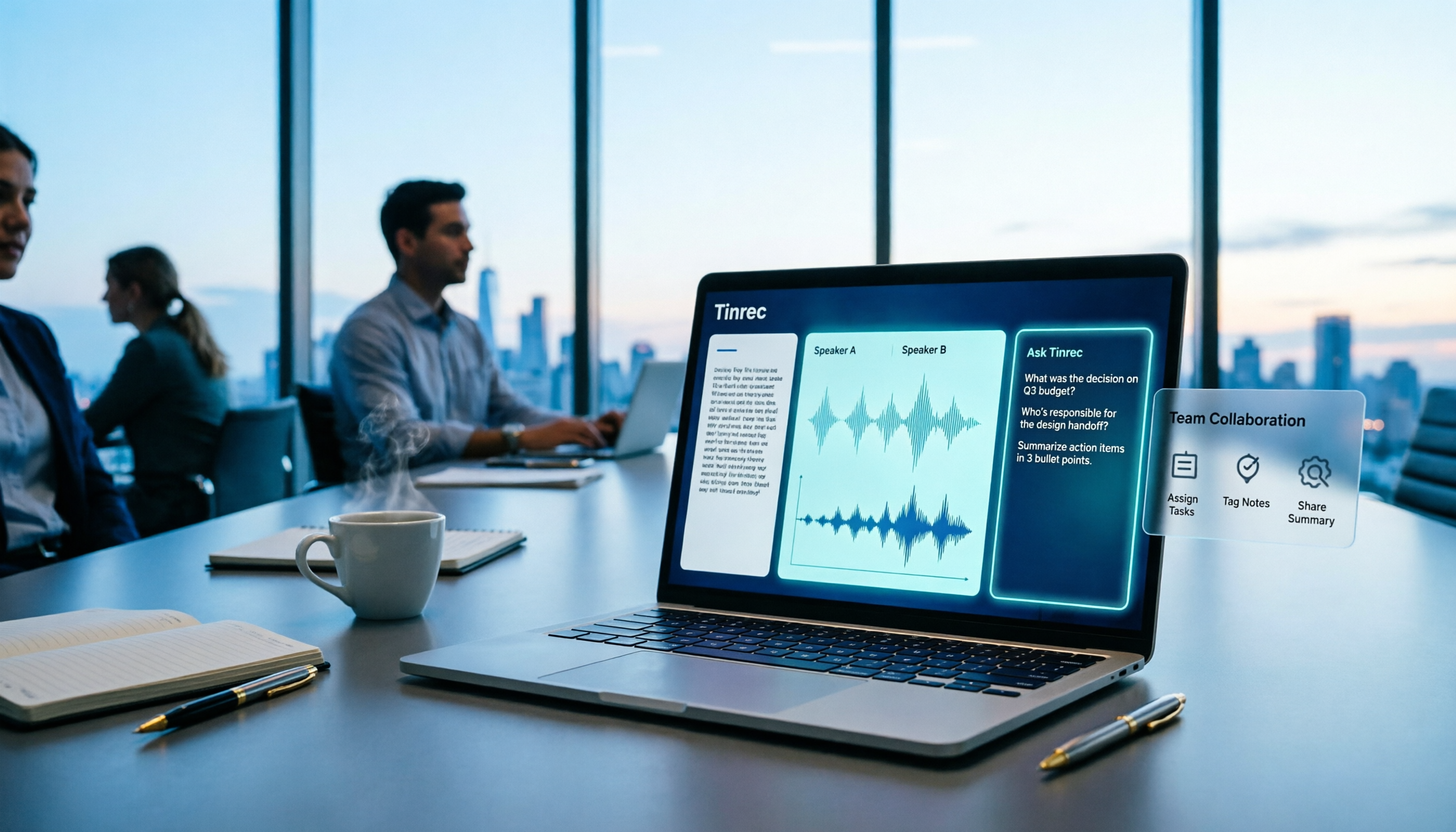
The feature that made me think "this is what post-call organization should be" is AI Q&A. After recording, you can directly ask it: "What budget constraints did the client mention in this call?" or "Who was responsible for following up on the quote in the last meeting?" It doesn't just give you keyword search results; it answers directly based on semantic understanding. This is rare among tools at the same price point.
In addition, Tinrec can export results to Notion, Google Docs, OneNote, Dropbox, and other tools, and can continue generating reports, tables, and meeting minutes. For team use, the team version provides an independent team space where meeting data belongs to the team, with members, roles, seats, usage analytics, and audit logs. Members without a seat can still view and play team data; only with a seat can they record, upload, and edit. This is very practical for departments that need to accumulate meeting assets.
Stop organizing recordings by hand
Upload audio or video and automatically get a transcript, summary, and action items
Pricing: The personal version has a free tier for basic usage, plus weekly, Pro monthly, and Pro annual plans. The team version is currently USD 29.80 per paid seat per month, or USD 199 per paid seat per year, with each paid seat providing 2,000 minutes of team shared import quota per month; live recording doesn't deduct minutes under an active team plan. Actual prices are subject to the official purchase page.
Simply put, if you want the experience of "record a call and not have to organize it manually afterward," Tinrec is our most recommended choice after testing.
Besides Tinrec, What Other Call Recording Options Are There?
iOS 18 Built-in Call Recording This is the most direct traditional phone recording solution for iPhone users. In supported regions, tap the record button in the top-left corner during a call; after a 3-second countdown, both parties hear a prompt, and the recording is saved to the "Call Recordings" folder in the Notes app, with transcripts and summaries available. Limitations: regional and language support is still rolling out, and there's no AI Q&A or team sharing. If you only need to record an occasional call and your region is supported, the built-in feature is enough. But if you need cross-platform organization or team collaboration, Tinrec is more suitable.
PLAUD Note / NotePin PLAUD represents AI recording hardware; users buy a standalone device, suitable for portable recording and phone calls. Current US official pricing shows NotePin at USD 159, Note Pro at USD 189, with membership plans: Starter at 300 minutes per month, Pro at USD 99.99 per year. The advantage of hardware is battery life and physical buttons, but the downside is carrying an extra device, and handling online meeting system audio isn't as direct as Tinrec desktop. Tinrec requires no extra hardware to record online meetings on your computer without a bot, and offers team spaces and AI Q&A.
Otter.ai Otter.ai is one of the top choices for English meetings. The free version offers 300 minutes per month; Pro annual billing is about USD 8.49 per user per month. It supports meeting transcription, AI Chat, and team management. However, its Chinese and Cantonese experience isn't as good as Tinrec, and Tinrec can record desktop meeting audio without a bot and store data in team spaces. If you mainly record English content, Otter.ai is a reasonable choice; but if you need Chinese meeting notes and post-meeting AI queries, Tinrec is a better fit.
Pitfall Guide: 3 Most Common iPhone Call Recording Mistakes
Pitfall 1: Thinking an app can record secretly. iOS strictly limits app access to the microphone during calls for privacy protection. There's no app on the market that "perfectly natively" supports two-way call recording without complex setup. Instead of looking for secret recording methods, legally use iOS 18 built-in recording or switch to an online meeting platform for recording.
Pitfall 2: Only looking at "can it record," ignoring "can it be used." An audio file isn't the end goal. Without transcripts, summaries, and action items, finding a single sentence afterward means listening from start to finish. Include "post-call organization" in your selection criteria, such as Tinrec's AI summaries, action item extraction, and AI Q&A.
Pitfall 3: Ignoring regional restrictions and legal risks. iOS 18 call recording is unavailable in some regions, and you must let the other party know before recording. In Taiwan, secret recording without consent may be illegal. Instead of worrying afterward, choose a compliant approach from the start and get consent when needed.
Conclusion: Which One Should You Choose?
- Traditional phone calls, and your region supports iOS 18 built-in recording → Use iPhone built-in call recording directly, then upload the audio to Tinrec for transcripts and summaries.
- Online meetings (Zoom, Meet, Teams, Webex) → Use Tinrec desktop to record without a bot and generate transcripts while you meet.
- Need Chinese transcripts, AI Q&A, team sharing → Tinrec, the most recommended post-call organization solution in this article.
- Zero budget, only recording English meetings → Otter.ai free version, 300 minutes per month.
- Need portable recording hardware → PLAUD Note or NotePin, but you'll need to carry an extra device.
We suggest trying Tinrec's free version first, using a meeting or call recording of your own to experience transcripts, summaries, and AI Q&A. If it meets your needs, consider upgrading — no need to pay from the start.
References
- How to Record iPhone Calls While on the Phone? 2026 iOS Recording-to-Text Guide and Tool Review - Tinrec Blog
- Upgrade to iOS 18 for iPhone Call Recording: Step-by-Step Guide, Finally Record While on the Phone! - Dream & Hunter
- Record and Transcribe Calls on iPhone - Apple Support (Taiwan)
- How to Use iPhone Call Recording? iOS Built-in Recording and AI Transcription Tips - Mr. Mad
- How to Record iPhone Calls? 5 iPhone Call Recording Methods Revealed!
Turn every recording into actionable outcomes
Get 60 free transcription minutes when you sign in. No credit card required.
Related Reading
You might also like

What Is Real-Time Transcription in 2026: Definition, 4 Key Factors, and Tool Comparison
What is real-time transcription and how does it differ from transcribing recordings? This article explains the definition and how it works in plain language, outlines 4 key factors to consider, and compares Google Live Transcribe, Yating, Notta, and Tinrec in Chinese meetings, post-meeting organization, and team collaboration, with scenario-based recommendations.

4 Meeting Transcription Tools Tested: Which AI Saves the Most Time on Chinese Transcripts and Summaries?
After a meeting, do you spend another two hours organizing the audio recording? This article compares four meeting transcription tools—Tinrec, Notta, Otter.ai, and Granola—on Chinese transcription, AI summaries and action items, bot-free recording, team collaboration, and pricing to help you find the most time-saving solution.

3 iPhone Audio-to-Text Apps Tested in 2026: How Long Can You Record and Which Saves the Most Time After Meetings?
How long can an iPhone actually record? This article first breaks down the storage, battery, and file interruption risks of the built-in Voice Memos app, then compares 3 audio-to-text tools from a student's perspective—covering free quotas, single-recording limits, post-meeting organization, and AI Q&A capabilities—to help you decide whether the built-in recorder is enough or if you need an AI recording assistant that delivers key points right after recording.
Google Live Transcribe vs Tinrec in 2026: 5-Dimension Comparison — Which Is Better for Meeting Notes?
Google Live Transcribe & Sound Notifications is an Android accessibility tool known for being free, providing real-time transcripts, and sending environmental sound alerts. Tinrec focuses on meeting notes and team collaboration. This article compares them across 5 dimensions—transcription and organization, online meeting recording, AI Q&A, audio file import, and team management—to help you decide which one to use for meeting notes.

2026 Real-Time Recording Tools Compared: Which Can Transcribe While Recording?
How do you choose a real-time recording tool? This article tests and compares Tinrec, free online voice recorders, Bandicam, and Granola in real meeting scenarios, explaining why what happens after recording is key, plus 4 buying tips, pitfalls to avoid, and scenario-based recommendations.

5 Meeting Recording Apps Compared in 2026: From Transcripts to Team Collaboration
Meeting recording apps aren't just about audio quality—they're about what happens after the meeting. This guide breaks down five common tool approaches, covering live transcription, AI summaries, action item extraction, AI Q&A, team spaces, and seat management. Using Tinrec as an example, we walk through bot-free online meeting recording, Chinese transcription, summaries, and exports, and compare the free, Pro, and Team plans to help you decide which solution fits your meeting needs.

What Is Instant Messaging in 2026? 5 Steps to Understand the Definition and Choose Tools
What does instant messaging (IM) mean? This article starts with the definition, history, and message storage methods to help you understand the essence of synchronous communication, 4 key points for choosing tools, and compares meeting and communication organization tools like Tinrec, Otter.ai, Notta, and Granola. Finally, a pitfall guide helps you choose the right tool.

Can You Share a Recording with Others in 2026? 5 Key Legal Points and How Tinrec Helps You Organize
Whether you can share a recording with others depends on your role, purpose, and content. This article summarizes key legal points on invasion of privacy and personal data protection, and explains how to use Tinrec to turn recordings into transcripts or summaries so you only share necessary information, reducing privacy and legal risks.

5 Best AI Meeting Notes Apps of 2026: Which Free Version Is Actually Enough?
There are countless AI meeting note takers, but buying one doesn't guarantee better notes. This article starts with the most common mistakes and inefficient habits, outlines 4 key factors for choosing a meeting transcription tool, tests Tinrec's bot-free recording, AI Q&A, and team workspace, and compares Otter.ai, Notta, and TurboScribe on positioning and pricing to help you find a solution that truly saves time.