
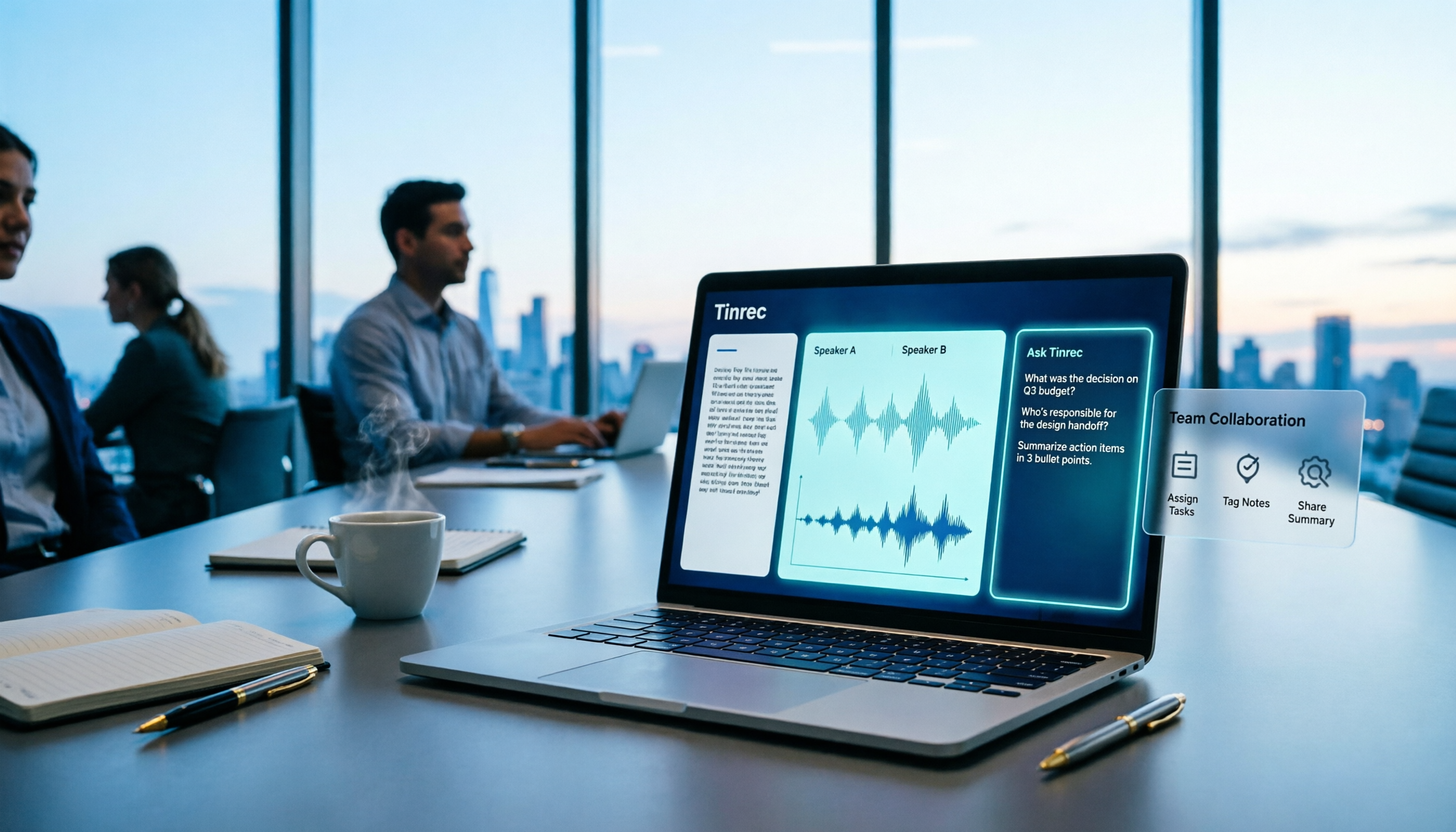
Turn recordings into transcripts and summaries in minutes
Upload audio or video for multilingual transcription, AI notes, and action items
Google Live Transcribe vs Tinrec in 2026: 5-Dimension Comparison — Which Is Better for Meeting Notes?
After a meeting, your boss says, "I need the meeting notes before you leave today," and you stare at that 40-minute recording on your phone, thinking you'll have to listen to it all over again. At times like this, you probably think of the free "Live Transcribe & Sound Notifications" on Android, or you may have heard of Tinrec. Both names are related to "turning sound into text," but one is an accessibility tool and the other is a meeting workflow tool, so their purposes are very different.
First, let's clarify what "Live Transcribe & Sound Notifications" is: it's an Android app designed by Google for deaf and hard-of-hearing users. "Live Transcribe" converts speech received by the phone into text in real time. Sources indicate it supports over 120 languages and dialects, allows custom words, and includes automatic punctuation, keyword highlighting, and search. "Sound Notifications" sends an alert when specific environmental sounds occur (such as a smoke alarm, doorbell, or baby crying). On most devices, you can enable it from Settings → Accessibility; some models like Pixel even have it pre-installed.
Below, we compare the two in the same "meeting notes" scenario across 5 dimensions.
Google Live Transcribe & Sound Notifications vs Tinrec | Quick Overview
Google Live Transcribe & Sound Notifications is an accessibility aid on Android phones, centered on real-time speech-to-text and environmental sound alerts. Tinrec is an AI meeting notes and collaboration tool for individuals and teams, focusing on post-transcription organization, follow-up questions, and data retention.
| Item | Google Live Transcribe & Sound Notifications | Tinrec |
|---|---|---|
| Positioning | Android accessibility tool (real-time transcript + sound notifications) | AI meeting notes and team collaboration tool |
| Platform | Android phones | Web, desktop, mobile |
| Core difference | Real-time captions, sound detection, on-device offline processing | Transcript + summary + chapters + action items + AI Q&A + team space |
| Cost | Free | Free and paid plans; team plan USD 29.80 per paid seat per month |
The 5 dimensions compared below are: transcription and organization, online meeting recording, AI Q&A and post-processing, audio file import and data retention, and team collaboration and management.
Dimension 1 | Chinese Meeting Transcription and Post-Meeting Organization
Google Live Transcribe focuses on "seeing text in real time": you can see the transcript on screen as you speak, and it offers keyword highlighting and search. For one-on-one conversations or close-range audio, user feedback in the sources considers accuracy to be good. However, it outputs only the transcript itself—no summaries, chapters, or to-do lists.
Tinrec also provides Chinese meeting transcripts and handles mixed Chinese-English content, and after transcription it automatically generates AI summaries, chapters, key points, and action items, and can even produce mind maps. After a meeting, you don't need to re-listen to the whole thing—just look at the structured results.
This dimension: For those who need "post-meeting organization," Tinrec clearly wins; if you only need a transcript, Google's free version is enough.
Dimension 2 | Online Meeting Recording Methods
Google Live Transcribe is a mobile app, and its audio source is the phone's microphone. To record online meetings on Zoom, Google Meet, or Microsoft Teams, you basically have to point your phone at the speaker or use your phone to pick up audio during the meeting, and ambient noise and echo will affect the results.
Tinrec's desktop version directly captures the computer's system audio. When handling meeting audio played on these platforms, you don't need to invite a meeting bot to join as a participant—you just start recording yourself.
This dimension: For those who frequently have online meetings, Tinrec's recording method is more convenient and wins.
Stop organizing recordings by hand
Upload audio or video and automatically get a transcript, summary, and action items
Dimension 3 | AI Q&A and Post-Meeting Processing
Google Live Transcribe is positioned for assisted communication and environmental awareness, and the source materials do not describe features for asking follow-up questions or reprocessing meeting content.
Tinrec supports AI Q&A across single or multiple meetings, and can use Agent post-processing to generate reports, tables, and documents, then export results to tools like Notion, Google Docs, OneNote, and Dropbox for further use.
This dimension: For those who want to "do more with meeting content," Tinrec wins.
Dimension 4 | Audio File Import and Data Retention
Google Live Transcribe mainly focuses on real-time audio capture, and the source materials do not mention importing existing audio or video files; its use cases lean toward live conversations and surrounding sounds.
Tinrec can upload existing audio and video files to organize past meetings, interviews, and old recordings; the audio files themselves are retained, and the team plan also has an audio recycle bin so accidentally deleted files can be restored before permanent cleanup begins.
This dimension: For those with a pile of old recordings to organize, Tinrec wins.
Dimension 5 | Team Collaboration and Management
Google Live Transcribe & Sound Notifications is a personalized accessibility tool and has no concept of team spaces, seats, or usage management.
Tinrec's team plan provides independent team spaces: you can create and switch between multiple teams, invite members via link, set owners/admins/regular members, and assign or revoke seats. Team resources belong to the team; even members without a seat can view, play, and read materials, but they need a seat to record, upload, edit, import, and export. Admins can also view usage trends, member rankings and details, manage team hotwords, and query and export audit logs.
As for cost, the team plan is currently USD 29.80 per paid seat per month, or USD 199 per paid seat per year. Eligible teams can try it for 7 days with 1 free seat and 300 minutes of shared team import quota. Paid seats provide 2,000 minutes of shared team import quota per month. Real-time recording under an active team plan and active seats is currently not deducted by the minute.
This dimension: For departments or project teams that want to turn meetings into team assets, Tinrec wins.
What Unique Advantages Does Each Have?
On Tinrec's side: First, the desktop version records without a bot, so you don't need an extra account stuck in the meeting list. Second, the post-meeting workflow is complete—summaries, chapters, action items, Q&A, and multi-format export all in one. Third, team spaces keep transcripts and action items in one place, so data stays with the team even when members change. Fourth, it supports real-time translation and bilingual viewing for Chinese and multilingual meeting scenarios, and team hotwords can handle specialized terminology.
Google also has two hard-to-replace advantages: First, it's completely free, and most Android phones can enable it in settings; some models like Pixel even have it pre-installed. Second, sound notifications and real-time transcription in over 120 languages, with processing done on-device and offline capability. Sources indicate data is not sent back to Google servers, which provides real help for daily communication and home safety for hard-of-hearing users.
Conclusion: Which Should You Choose?
- You need Chinese meeting notes, plus summaries, chapters, and action items → Tinrec (Google only gives transcripts)
- You want to record Zoom, Meet, or Teams without adding a meeting bot → Tinrec (desktop version captures system audio)
- You want to ask questions directly about meeting content and generate reports or tables → Tinrec (Google doesn't have this workflow)
- You need to organize old recordings, or need team sharing, seats, and usage management → Tinrec (team plan offers team spaces, auditing, and recycle bin)
- You just want to turn conversations into text for free on an Android phone, or need sound alerts for doorbells, smoke alarms, etc. → Google Live Transcribe & Sound Notifications is more than enough
In one sentence: Google Live Transcribe & Sound Notifications is a free, real-time accessibility assistant; Tinrec is a workflow tool that turns meetings into searchable, queryable, deliverable data. For office workers and teams that need to produce meeting notes, Tinrec is a more complete choice, and you can start with the free version to test it on your own recordings.
Final reminder: Recording and transcription involve other people's conversations. Please comply with local laws before use, and obtain participants' consent when necessary.
References
- Live Transcribe & Sound Notifications - Google Play App
- Talk to the phone and record it as text: "Google Live Transcribe"
- Google Live Transcribe: A Comprehensive Information Sharing
- Sound Notifications: Get notified when important sounds occur in your surroundings - Android Accessibility Help
- Google lets phones help users notice specific sounds in daily life - mashdigi - Tech, New Products, Fun, Trends
Turn every recording into actionable outcomes
Get 60 free transcription minutes when you sign in. No credit card required.
Related Reading
You might also like

What Is Real-Time Transcription in 2026: Definition, 4 Key Factors, and Tool Comparison
What is real-time transcription and how does it differ from transcribing recordings? This article explains the definition and how it works in plain language, outlines 4 key factors to consider, and compares Google Live Transcribe, Yating, Notta, and Tinrec in Chinese meetings, post-meeting organization, and team collaboration, with scenario-based recommendations.

4 Meeting Transcription Tools Tested: Which AI Saves the Most Time on Chinese Transcripts and Summaries?
After a meeting, do you spend another two hours organizing the audio recording? This article compares four meeting transcription tools—Tinrec, Notta, Otter.ai, and Granola—on Chinese transcription, AI summaries and action items, bot-free recording, team collaboration, and pricing to help you find the most time-saving solution.

3 iPhone Audio-to-Text Apps Tested in 2026: How Long Can You Record and Which Saves the Most Time After Meetings?
How long can an iPhone actually record? This article first breaks down the storage, battery, and file interruption risks of the built-in Voice Memos app, then compares 3 audio-to-text tools from a student's perspective—covering free quotas, single-recording limits, post-meeting organization, and AI Q&A capabilities—to help you decide whether the built-in recorder is enough or if you need an AI recording assistant that delivers key points right after recording.

3 iPhone Call Recording Solutions Compared: iOS 18 Built-in vs Tinrec in 2026
iPhone call recording finally has a built-in solution with iOS 18, but regional restrictions, legal issues, and post-call organization are the real pain points. This article compares 3 solutions: iOS 18 built-in call recording, Tinrec, and PLAUD Note with Otter.ai, helping you understand how to record calls and quickly turn them into transcripts, summaries, and action items.

2026 Real-Time Recording Tools Compared: Which Can Transcribe While Recording?
How do you choose a real-time recording tool? This article tests and compares Tinrec, free online voice recorders, Bandicam, and Granola in real meeting scenarios, explaining why what happens after recording is key, plus 4 buying tips, pitfalls to avoid, and scenario-based recommendations.

5 Meeting Recording Apps Compared in 2026: From Transcripts to Team Collaboration
Meeting recording apps aren't just about audio quality—they're about what happens after the meeting. This guide breaks down five common tool approaches, covering live transcription, AI summaries, action item extraction, AI Q&A, team spaces, and seat management. Using Tinrec as an example, we walk through bot-free online meeting recording, Chinese transcription, summaries, and exports, and compare the free, Pro, and Team plans to help you decide which solution fits your meeting needs.

What Is Instant Messaging in 2026? 5 Steps to Understand the Definition and Choose Tools
What does instant messaging (IM) mean? This article starts with the definition, history, and message storage methods to help you understand the essence of synchronous communication, 4 key points for choosing tools, and compares meeting and communication organization tools like Tinrec, Otter.ai, Notta, and Granola. Finally, a pitfall guide helps you choose the right tool.

Can You Share a Recording with Others in 2026? 5 Key Legal Points and How Tinrec Helps You Organize
Whether you can share a recording with others depends on your role, purpose, and content. This article summarizes key legal points on invasion of privacy and personal data protection, and explains how to use Tinrec to turn recordings into transcripts or summaries so you only share necessary information, reducing privacy and legal risks.

5 Best AI Meeting Notes Apps of 2026: Which Free Version Is Actually Enough?
There are countless AI meeting note takers, but buying one doesn't guarantee better notes. This article starts with the most common mistakes and inefficient habits, outlines 4 key factors for choosing a meeting transcription tool, tests Tinrec's bot-free recording, AI Q&A, and team workspace, and compares Otter.ai, Notta, and TurboScribe on positioning and pricing to help you find a solution that truly saves time.