

Turn recordings into transcripts and summaries in minutes
Upload audio or video for multilingual transcription, AI notes, and action items
You just finished a client call, and the other party made some promises during the conversation. You want to share the recording with a colleague for reference, but you're worried it might be illegal. Or maybe you just want to drop the meeting recording into a group chat so everyone can listen for themselves. Let's start with the conclusion: whether you can share a recording with others isn't simply a yes-or-no question. It depends on your purpose, the recipient, and the content. This article organizes the key legal points and explains how to use Tinrec to turn recordings into safer forms of sharing.
Can You Share a Recording with Others? Understand 3 Key Legal Points First
Most people think, "If I was part of the conversation, recording it is fine." But when you share it with others, the legal assessment changes. According to sources like Legis-Pedia and Zhe Lu Law Firm, the following three key points determine whether your recording can be shared.
1. Are You a Party to the Conversation?
If you are a participant in the conversation and record your own dialogue with the other party, in principle you don't need the other party's consent, because the Communication Security and Surveillance Act mainly punishes surveillance of others' communications. However, note that this doesn't mean you can freely share the recording.
2. What Is the Purpose of the Recording?
If your purpose is to threaten the other party, humiliate or retaliate against them, or leak private content to a third party, even if you are a party to the conversation, it may constitute an unlawful purpose. Hong An Law Firm reminds you to clarify your motive before recording, otherwise you might end up facing criminal liability instead of protecting yourself.
3. To Whom and What Content Are You Sharing?
Sharing a recording with unrelated people may involve the offense of invasion of privacy under Articles 315-1 and 315-2 of the Criminal Code. If the content includes the other party's name, photo, or other identifiable personal data, it may also violate the Personal Data Protection Act. Zhe Lu Law Firm points out that without an exemption under Article 20 of the Personal Data Protection Act, you may face criminal liability. RealTalk also recommends using recordings only as evidence and avoiding sharing them with unrelated personnel.
Simply put: the recording itself may be legal, but distribution is another risk. If you need to let others know the content of a call, a better approach is to first convert the recording into a transcript or summary and share only the necessary information.
Sharing the Raw Recording Directly vs. Organizing with Tinrec First
Sharing the raw recording directly is convenient but risky. You might accidentally let a third party hear unrelated conversations or the other party's private information, or even break the law. Organizing with Tinrec first allows you to extract only the key points, reducing privacy concerns.
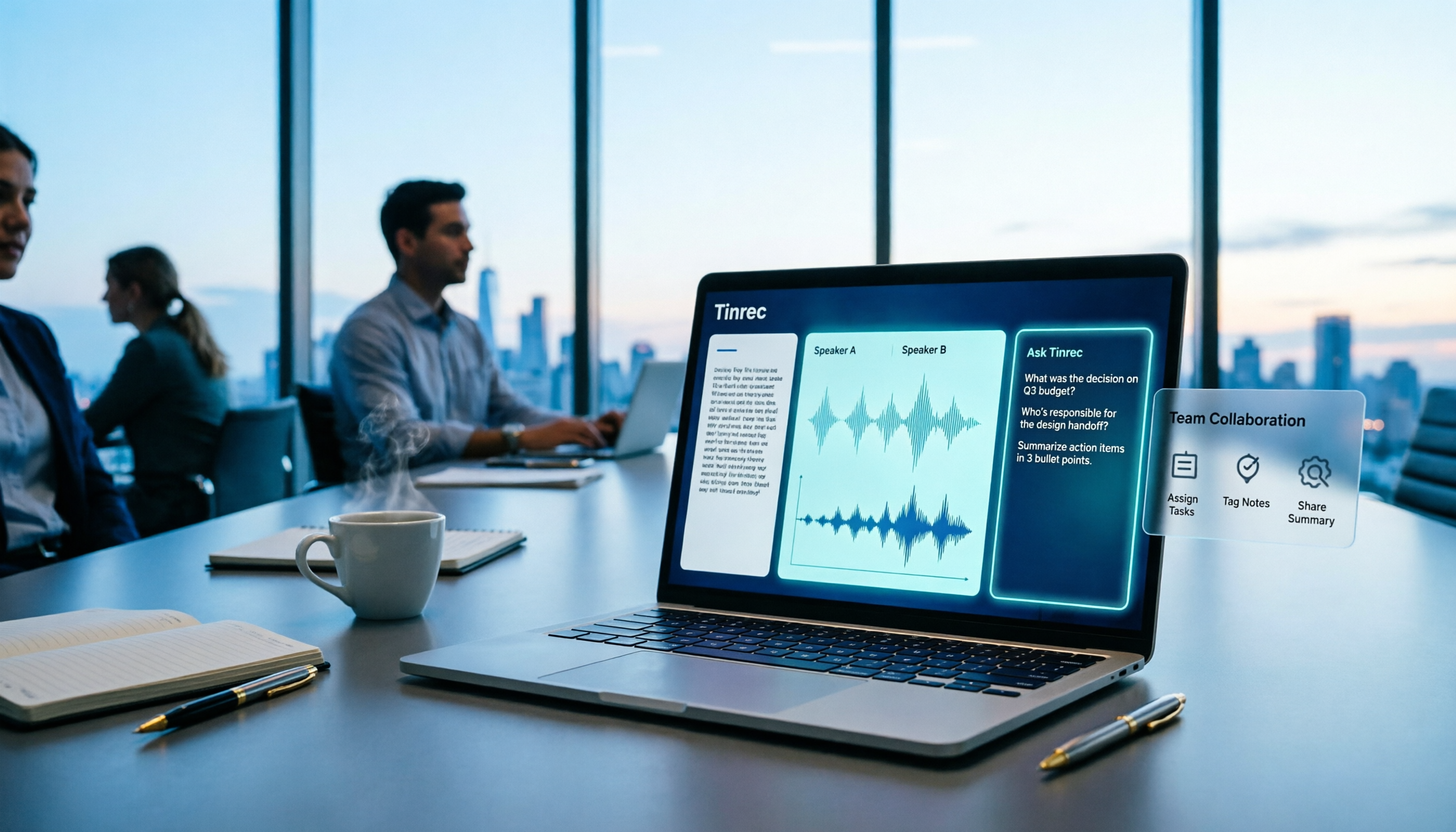
Tinrec is an AI meeting notes and collaboration tool that can transcribe recordings into text in real time and automatically generate summaries, chapters, and action items. You don't need to send the entire recording; just share transcript segments or meeting minutes so colleagues can quickly grasp the key points.
This approach has two benefits: first, it prevents the raw recording from being forwarded arbitrarily; second, text is easier to search and cite than audio. For situations where you need to preserve evidence, you can keep the original recording yourself and provide it to a lawyer or court when necessary.
Overview of Tinrec's Core Features
Below are Tinrec's main features related to recording organization. Each feature helps you handle recording content more safely.
Real-Time Recording to Text
Open Tinrec, and text appears as you record. During meetings, you can follow along with the text to make sure you don't miss key points, and the transcript is ready as soon as the meeting ends. This way, you don't need to send recording files back and forth.
Bot-Free Online Meeting Recording
Tinrec's desktop version directly captures computer system audio and handles online meetings on Zoom, Google Meet, Microsoft Teams, Webex, and more without needing a meeting bot to join. For remote teams, this is a very natural way to take notes.
AI Summaries and Chapters
After recording, Tinrec automatically generates summaries, chapters, and key points. You can read the summary directly to quickly grasp meeting conclusions instead of listening to the entire recording from the beginning.
Action Item Extraction and AI Q&A
Tinrec can extract action items from discussions, and you can also ask questions about the meeting content, such as "What is the client's budget cap?" or "Who is responsible for the next step?" It will provide answers based on semantic understanding.
Stop organizing recordings by hand
Upload audio or video and automatically get a transcript, summary, and action items
Multi-Format Export and Team Spaces
Tinrec supports exporting results to Notion, Google Docs, OneNote, Dropbox, and other tools. The team version also provides team spaces where meeting data belongs to the team and members can share and view, but a seat is required to edit or upload.
Practical Use Cases
Sharing Key Points After a Client Meeting
You recorded a client meeting but don't want to send the entire recording to your team. Use Tinrec to generate a summary and action items, then share only these minutes in the team space. Everyone can quickly get up to speed, and client privacy is protected.
Organizing Transcripts for Interview Research
Research interview recordings are usually long. You can upload them to Tinrec, convert them to transcripts, search for keywords, and cite the segments you need. When sharing with your advisor, provide only the organized text, not the raw recording.
Internal Weekly Meeting Notes
Record your weekly meetings with Tinrec and automatically generate summaries. After the meeting, post the summary and action items to the group. When you need to review, pull up the transcript from the team space instead of re-listening to the recording.
Personal Self-Protection and Evidence Preservation
If you encounter a dispute and need to record for self-protection, save the original recording first, then use Tinrec to convert it to text for easier timeline organization later. When providing it to a lawyer, handle it according to their instructions.
Points to Consider When Choosing a Recording Organization Tool
If you're looking for a recording organization tool, besides price, consider the following aspects.
Language Support and Chinese Recognition
Chinese meetings often mix in English proper nouns. Whether the tool supports mixed Chinese-English and multilingual transcription affects the usability of the transcript. Tinrec covers Chinese, Traditional Chinese, and multilingual meeting scenarios, and supports real-time translation and team hotwords.
Cross-Platform and Input Sources
Your meetings may happen on a computer, phone, or in a physical meeting room. Tinrec supports real-time recording, online meetings, audio files, and mobile recording, covering multiple input sources.
AI Post-Processing Capabilities
A transcript alone isn't enough. The ability to automatically summarize, extract action items, and support Q&A is key to saving time. Tinrec focuses more on these post-processing features.
Export and Workflow Integration
Generated content needs to be brought into your existing workflow. Tinrec supports multi-format export and export to tools like Notion and Google Docs.
Team Collaboration and Permission Management
If used by a team, confirm the distinction between members, roles, and seats. Tinrec's team version provides team spaces, seat allocation, usage analytics, and audit logs. Members without a seat can still view data but cannot edit or upload.
Frequently Asked Questions
Can I share a recording with others?
If you are a party to the conversation and the purpose of the recording is legitimate, the recording itself is usually not illegal. However, sharing the recording with unrelated third parties may involve invasion of privacy or personal data protection laws. It's best to share only with those who need to know, or share an organized summary instead.
Is it illegal to send a recording to a group chat?
If group members are unrelated to the call content and the recording contains the other party's privacy or personal data, it may be illegal. RealTalk reminds that sharing a recording of a coworker complaining in the break room, even just for fun, may be against the law.
After organizing a recording with Tinrec, can I share it freely?
Still no. You're sharing text, but if the text contains personal data or private information, you must still comply with personal data protection laws. The tool only helps reduce the risk of directly distributing recordings; it is not a legal immunity guarantee.
Is Tinrec's free version enough?
The free version provides a basic quota to experience recording, importing, summarizing, and transcription. If you occasionally organize a recording, you can try the free version first. If you have a large number of meetings in a short period, consider a weekly pass or Pro.
What's the difference between the team version and the personal version?
Personal version data is managed under an individual account. The team version provides an independent team space where meeting data belongs to the team, plus members, roles, seats, sharing rights, usage analytics, and audit logs. The team's first trial includes 7 days, 1 free seat, and 300 minutes of shared import quota.
Conclusion: You Can Share Recordings, But Share the Right Things
Back to the original question: can you share a recording with others? Legally, there's no simple "yes" or "no." The key lies in your role, purpose, and method of sharing. If you are a party to the conversation and recorded for self-protection, it's usually fine. But arbitrarily distributing the recording may cross the line.
Instead of sending the raw recording directly, use Tinrec to organize the content into transcripts, summaries, or action items, and share only the necessary information. This way, your team can quickly grasp the key points while reducing privacy leaks and legal risks. If you have such needs, try Tinrec's free version and test it with your own recordings.
References
- Do ordinary people need the other party's consent to record their face-to-face conversation or phone call? What kind of recording is not considered an unlawful purpose? | Legis-Pedia
- Privacy and Evidence Preservation: A Guide to Legal Use of Recordings and Screenshots - Zhe Lu Law Firm
- Do you must have others' consent to record? 3 minutes to understand the evidence and legality of recordings - Hong An Law Firm - Taipei corporate, commercial, criminal, labor, civil, intellectual property legal consultation advisor, Taipei Zhongshan District law firm recommendation - Taipei law firm recommendation | Criminal | Civil | Family | Intellectual Property
- 5+ practical life knowledge about secret recordings! Workplace recording and mobile recording illegal and legal situations organized
- Secret recording as evidence... be careful not to sue and get sued! Discussing whether secret recordings violate the law - Law 010
Turn every recording into actionable outcomes
Get 60 free transcription minutes when you sign in. No credit card required.
Related Reading
You might also like

What Is Real-Time Transcription in 2026: Definition, 4 Key Factors, and Tool Comparison
What is real-time transcription and how does it differ from transcribing recordings? This article explains the definition and how it works in plain language, outlines 4 key factors to consider, and compares Google Live Transcribe, Yating, Notta, and Tinrec in Chinese meetings, post-meeting organization, and team collaboration, with scenario-based recommendations.

4 Meeting Transcription Tools Tested: Which AI Saves the Most Time on Chinese Transcripts and Summaries?
After a meeting, do you spend another two hours organizing the audio recording? This article compares four meeting transcription tools—Tinrec, Notta, Otter.ai, and Granola—on Chinese transcription, AI summaries and action items, bot-free recording, team collaboration, and pricing to help you find the most time-saving solution.

3 iPhone Audio-to-Text Apps Tested in 2026: How Long Can You Record and Which Saves the Most Time After Meetings?
How long can an iPhone actually record? This article first breaks down the storage, battery, and file interruption risks of the built-in Voice Memos app, then compares 3 audio-to-text tools from a student's perspective—covering free quotas, single-recording limits, post-meeting organization, and AI Q&A capabilities—to help you decide whether the built-in recorder is enough or if you need an AI recording assistant that delivers key points right after recording.
Google Live Transcribe vs Tinrec in 2026: 5-Dimension Comparison — Which Is Better for Meeting Notes?
Google Live Transcribe & Sound Notifications is an Android accessibility tool known for being free, providing real-time transcripts, and sending environmental sound alerts. Tinrec focuses on meeting notes and team collaboration. This article compares them across 5 dimensions—transcription and organization, online meeting recording, AI Q&A, audio file import, and team management—to help you decide which one to use for meeting notes.

3 iPhone Call Recording Solutions Compared: iOS 18 Built-in vs Tinrec in 2026
iPhone call recording finally has a built-in solution with iOS 18, but regional restrictions, legal issues, and post-call organization are the real pain points. This article compares 3 solutions: iOS 18 built-in call recording, Tinrec, and PLAUD Note with Otter.ai, helping you understand how to record calls and quickly turn them into transcripts, summaries, and action items.

2026 Real-Time Recording Tools Compared: Which Can Transcribe While Recording?
How do you choose a real-time recording tool? This article tests and compares Tinrec, free online voice recorders, Bandicam, and Granola in real meeting scenarios, explaining why what happens after recording is key, plus 4 buying tips, pitfalls to avoid, and scenario-based recommendations.

5 Meeting Recording Apps Compared in 2026: From Transcripts to Team Collaboration
Meeting recording apps aren't just about audio quality—they're about what happens after the meeting. This guide breaks down five common tool approaches, covering live transcription, AI summaries, action item extraction, AI Q&A, team spaces, and seat management. Using Tinrec as an example, we walk through bot-free online meeting recording, Chinese transcription, summaries, and exports, and compare the free, Pro, and Team plans to help you decide which solution fits your meeting needs.

What Is Instant Messaging in 2026? 5 Steps to Understand the Definition and Choose Tools
What does instant messaging (IM) mean? This article starts with the definition, history, and message storage methods to help you understand the essence of synchronous communication, 4 key points for choosing tools, and compares meeting and communication organization tools like Tinrec, Otter.ai, Notta, and Granola. Finally, a pitfall guide helps you choose the right tool.

5 Best AI Meeting Notes Apps of 2026: Which Free Version Is Actually Enough?
There are countless AI meeting note takers, but buying one doesn't guarantee better notes. This article starts with the most common mistakes and inefficient habits, outlines 4 key factors for choosing a meeting transcription tool, tests Tinrec's bot-free recording, AI Q&A, and team workspace, and compares Otter.ai, Notta, and TurboScribe on positioning and pricing to help you find a solution that truly saves time.